But we have a delicious class today.
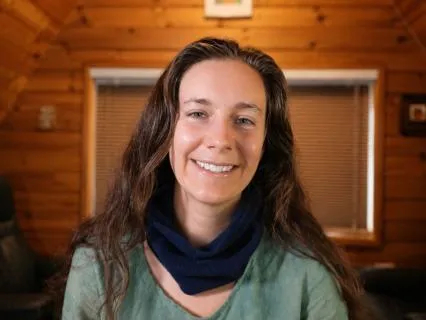
You might notice that today I'm wearing this big fuzzy thing,
Even though it's the middle of summer for me.
And I just find that having my voice warm is such a better way to start practice.
So I've done a steam this morning.
I've practiced with my water bottle bubbler.
And I've been wearing this and I can feel that there's heat around my throat.
So I've done some warming up even without having to use my voice very much.
And this is helpful because often I've heard that people say,
You know,
You don't want to warm up your voice first thing in the morning,
Right?
When you wake up,
Um,
It can feel like things are tight and,
And that's true.
And these are ways that we can warm up the voice.
So things are loose.
So even for example,
If you were to go for a run in the morning,
Let's say you wouldn't just like,
Put on your shorts and shirt and get out there and start going,
You would probably do some stretches.
And you'd probably want to start out at a slower pace and warm up.
So that's what these things are doing for me.
And so I highly recommend you try that out and see how that changes your voice,
How much stronger it might feel if you warm it up before you use it.
And then the other thing is,
As always,
Lip chap.
Keeping those lips moist is a great way to keep the hydration going for your body because dehydration is a big deal.
One of the most challenging things to face as a singer,
We need lots of delicious moisture in our mouths.
If you don't have it,
You can get those scratchy types of feelings.
And you can get a lot of this kind of buildup of phlegm.
And other types of like mouth sounds.
Mouth noises and when you have the lip chap on it just helps to keep everything moist.
So those are just some quick tips to keep your voice in a healthy place.
All right,
So we're going to talk about resonance and placement today.
And if you've learned about resonance and placement maybe you've learned you have a low or a middle or a high voice or and you're an alto or a soprano or a bass or tenor or whatever like all these different ways to talk about and categorize the voice.
That's all valid and important and I'm going to talk about something.
Else today.
I'm going to talk about how to feel where your voice is in your body and without having to label it just know by feeling where it is and where it might be going and how to play with your voice and have fun with this very.
.
.
Complicated to explain.
Feeling in your body.
I'll do this by just explaining quickly my voice.
So my voice has a lot of nasal resonance.
So we have this resonant chamber here,
This kind of triangle that vibrates.
And if you were to just go hum,
Hum,
You could probably feel the vibrations in your face.
And some people refer to this as the mask.
I like to have a lot of nasal resonance up here because it takes a lot of pressure and weight off of my vocal folds.
It allows me to speak for a long time with a lot of clarity.
There's a lot of brightness in my voice.
There are other singers.
I like to use Cher as an example.
If you've never heard Cher sing,
That's okay.
It's just that she sings way back here.
Elvis is another example.
There's all this throatiness.
There's this depth to the voice.
They're singing with a lot of resonance in their soft palate that's back way back here at the back of of the head And so.
.
.
There's nothing wrong with either of them.
They're both great.
It's up to you to find out what feels best for you and where you want to sit most of the time.
And just to know that you have the choice to go back between voices.
Sometimes I like to be back here.
Sometimes I like to be up here.
And my voice is a mixture and your voice is a mixture of all of it.
It's like every part of it is.
Is sounding as I speak,
It's just that some parts of it are.
.
.
Are stronger,
Depending on everything,
Your physiology,
You know,
How big your face is,
How big your throat is,
How tall of a person you are.
It all plays a role.
And so this is where we get to find our voice and what feels best for us.
And it's possible that you've lived your life using a voice that doesn't actually serve you best and that doesn't really feel that great for you.
You might be doing things like going into vocal fry and saying things like that,
Which again,
Inherently isn't wrong.
It's just doing things to your voice to make it work for you.
So we're going to go through these exercises now and I'll explain more.
And And maybe we'll start with that vocal fry because that seems to be something a lot of people do nowadays.
It's like the evolution of the female voice especially,
But I also hear it in male voices where there's a lot of vocal fry.
That's what it's called,
And it's actually a vocal technique you can use.
And what it is doing is it's basically using next to no air.
And your vocal folds,
Which I'll just like,
I always demonstrate vocal folds like that.
So there's,
There are a lot more complex than that,
But to show them with my fingers,
That's as it's,
You know,
They're opening to make sound and closing and kind of doing that and air is coming through them.
So when you're doing a lot of vocal fry,
Not a lot of air is coming through and you're actually at that,
That raspy creaky door,
Witchy sound is the,
Against one another.
So just try to do that with me.
Maybe it's easy for you.
Maybe it's already a part of your voice.
And just sink back without more pressure or weight or forcing,
You're really getting as little air and as little sound as necessary to feel this.
And what practicing that does is it helps you to feel what it's like for your vocal folds to open and close.
And we want them to open and close.
A lot of times,
If you're really breathy,
For example.
They're not really closing very well.
So your enunciation isn't very clear.
So just rah,
Rah,
Rah,
Rah.
Playing,
Making some sounds there for a little bit with me.
Rah,
Rah,
Rah,
Rah.
Less volume,
Less effort.
Just doing it a little bit.
Ra ra ra ra ra ra ra ra ra ra ra ra ra ra ra ra ra ra ra ra ra ra ra ra ra ra ra ra those vowels with me.
Ra,
Ra,
Ra,
Ra,
Wee,
Wee,
Wee,
Wee,
Ra,
Ra,
Ra,
Ra,
Ra,
Ra,
Ra,
Ra,
Ra,
Ra.
And just seeing how It is to basically not use air when you make sound.
And then just speak normally,
Just la la la,
Le le le,
Lo lo lo,
And see if you notice any difference.
For me,
I'm noticing a lot more.
Clarity,
Like even their clarity,
There's like,
It's like,
My vocal folds are fully bouncing off each other and they're making that connection that I want them to make.
So if you ever find that you're dropping into a lot of breathiness,
Again,
There's nothing wrong with breathiness,
But if you don't want it,
The way to counteract it is to get that.
Vocal fry going a little bit.
So that's a part of placement,
How your vocal folds are opening and closing.
Another way to explore that is to just do little tiny sounds like that where you're cutting off the sound almost immediately.
So try that with me,
Just going through the vowels.
Eh,
Eh,
Eh,
Ee,
Ee,
Ee,
Oh,
Oh,
Oh.
And so that's another way to just do it if the vocal fry feels a little edgy for you,
If it kind of hurts your throat.
And again,
We're just doing this with a little volume and little pressure.
We're never forcing anything.
There's not like tension that we're holding.
It's super relaxed in the voice.
And if you're finding it hard to get back into that relaxed place,
You just yawn.
Ah,
Sighing out.
Ah,
Just relaxing everything.
Home.
And then you might actually start yawning.
And that's okay too.
That's normal.
Signaling to your body that you're relaxing and that's good and also it really helps to stretch everything out.
Alright.
So.
.
.
This practice is called the hum uh ah and what it's doing is it's helping us to develop awareness of our our mask resonance with the hum so do that with me hum And maybe you feel a bit of tickling here around your lips.
You might even feel it in your teeth,
In your nose.
It might tickle.
You can maybe feel the vibration if you touch.
And then we move to ang,
U-n-g,
Ang.
And then the last sound is ah.
So we're going from this closed.
A frontal butt resonance hum into soft palate or um the resonance in the back of our mouth,
Our cathedral.
It's kind of like in the head.
You can feel it if you touch your ears.
It might be vibrating or back here at the back of your head.
So we've got our resonance all over and then we open up and we feel the resonance coming through with the sound and that resonance is so rich.
If you were to sing without any resonance,
It would end up sounding very dull and it would lose that magical quality of the human voice.
It's very difficult to sing without it,
But it is something that we like to cultivate as singers.
Bring more frequency into the sound and this is part of the healing quality of music as well when we got this vibration here and here we're like vibrating our brains with these frequencies so we don't have to listen to the frequencies we're just making them stay in the meditative experience of doing this with me.
Wow.
Bye.
And now,
Continuing on.
Just noticing how when I do it,
I'm smiling,
I have this lift in my palate,
It's raised.
How?
You And it's an easy smile.
I'm not forcing anything.
I have a relaxed face.
My lips are relaxed.
It's just that they're lifted slightly in this upper area.
Happy Samaritan!
And then the other pieces,
If you like.
If it's too long or you want to go longer with it,
This is also a great voice breath practice.
So you're learning how to Hold breath in the body and release it at the same time.
And maybe you're trying to lengthen your exhale as well.
And you can also play with different peaches.
Um.
.
.
So I went up in pitch there.
You can do a lower pitch.
Whatever feels good for you.
Maybe just give me a little sway in your body so you remember to stay soft and supple.
You can always return to the massaging behind the ears,
The occiput area,
Just getting that area.
A reminder that you don't have to hold tension.
And as we get to the ah there,
We're opening the mouth more wide and we're allowing that sound to really come out.
As long and as spiraling as it wants to.
And part of this is that we're exploring what it's like to feel that resonance without pushing,
Without extra effort.
So when you open to the ah sound,
It should feel easy.
And if you start to feel like,
Oh,
It doesn't feel easy,
It's feeling like I'm pushing,
Then just back off a little bit.
Do some.
.
.
Playing with your body.
Tell it it can relax.
Because part of this is just retraining the brain that we actually don't need to push,
We don't need to have that tension in order to make a sound.
And that's just so much we're doing here,
Learning a new thing.
If there's tension,
That's okay.
Letting it be okay,
Knowing that that's what you're working on.
Calming into less tension.
The goal and the destination needs to be playful and light so that that can happen.
It's not something you can force.
Money.
Money.
You Noticing where your posture is as you do this,
Keeping your chest broad,
Your shoulders relaxed,
Your breath coming into your side body,
Your back body,
Your low belly.
Um.
.
.
You Mom?
You you A few more here really enjoying it.
Hearing the sounds and just letting yourself sing.
You you that you can play on any level,
Any of the different pitches.
This is meant to be done with one single breath.
So,
Breathe in.
One breath.
And I still have more left in me.
And if that's not your case,
If you're finding that's too long,
Just do it shorter.
Whatever you have capacity for today.
Alright,
We'll bring that practice to a close.
And just sitting for a moment in the stillness,
Eyes closed if it feels good,
And just noticing how you're feeling.
Taking a breath and sighing it out.
Maybe just rubbing your hands on your thighs.
You are doing great.
You are learning.
You are coming home to yourself and your body.
This is great work.
You These ones go into how you can play with that kind of more share voice that I talked about,
The back voice.
The depth voice let's call it and then up here into this like bright nasally-ness and so if you're wanting to cultivate both of them or either of them just focusing on one of these practices more than the other.
So the first one we'll do is the.
.
.
So I've heard it be called like the kitten voice,
The witchy voice,
The creaky door.
So you can see how I'm like scrunching at my nose and I'm really trying to get all the sound to come right here.
And I'm just making like this M-E sound.
It's kind of an annoying sound,
But it's also funny.
And then you can open that up into like a nae nae nae nae nae nae nae nae nae nae nae nae nae nae nae nae nae nae nae nae nae nae nae nae nae nae nae nae nae nae nae nae nae nae nae nae nae nae nae nae nae nae nae nae nae nae nae nae nae nae nae nae nae nae nae nae nae nae nae nae nae nae nae nae nae nae nae nae nae nae nae nae nae nae nae nae nae nae nae nae nae nae nae nae nae nae nae nae nae nae nae nae nae nae nae nae nae nae nae nae nae nae nae nae nae nae nae increasing the volume of your voice without any added effort.
I'm just trying it a couple more times.
Me,
Me,
Me,
Me,
Me,
Me,
Me,
Me,
Me,
Me,
Me,
Me.
Really getting it up here.
Me,
Me,
Me,
Me,
Me,
Me,
Me,
Me,
Me,
Me.
And then you can do that with a scale as well.
Me,
Me,
Me weaving in you know if you want to start working on pitch accuracy and getting the right notes getting yourself a piano app or in my case I have a piano on my computer and so then I'm just playing notes along it so this is A-D-A So then you're not only practicing the resonance,
But you're practicing the resonance in different pitches.
And this is how you can get their resonance going at any,
If you're singing high or if you're singing low.
Wee wee wee and see if we can do it lower.
So that is the,
We'll call it the nene or the mimi,
The brightness resonance.
And now we'll move to the depth resonance.
Blah blah blah blah blah L-O-M.
WOM WOM WOM WOM WOM.
Do that with me.
WOM WOM WOM WOM WOM.
So you'll find to make that sound you really have to relax your tongue down and your soft palate lifts.
So there's this like WOM.
Huge spaciousness in your throat.
It actually kind of feels like a stretch in your ear area.
Mom,
Mom,
Mom,
Mom,
Mom So you can do it with scales but really just like doing it a couple times even like oh I don't know if you can hear that but for me it's like wow I have so much more depth in my voice just by doing that a few times.
WOM WOM WOM Wong,
Wong,
Wong So again,
You can do it with the pitches and experience it at different pitch and frequencies.
But you can also just,
Wom-wom-wom-wom-wom-wom-wom-wom,
Just do it around.
So those are two of my favorites.
They work so well,
And they're really fast.
So that's really great.
We have one more practice.
So lots to study after this session.
And this is called the waterfall technique.
I learned this from my teacher Sonia Draculich So this is kind of the last thing I do if I'm working on resonance as a warm-up,
So I'll show you first it goes So we're starting from a low pitch,
Going to a high pitch,
And back down to a low pitch in one breath.
We're starting on the oo.
And the ooh is good because when we're in the ooh state,
We're actually lengthening out the vocal folds.
So if you imagine these tissues kind of stretching out.
And as we get closer,
Higher,
Higher,
They get closer and finer and finer and finer.
And then as we open up into that,
Ah,
The vocal folds just relax and open.
AHHHHHHHHHHHHHHHHHHHHHHHHHHHHHHHHHHHHH So try that with me.
Just seeing what your voice feels like when you do this.
Nooooooooooooooooooooooooooooooooooooooooooooooooooooooooooooooooooooooooooooooooooooooooooooooooooooooooooooooooooooooooooooooooooooooooooooooooooooooooooooooooooooooooooooooooooooooooooooooooooooooooooooooooooooooooooooooooooooooooooooooooooooooooooooooooooooooooooooooooooooooooooooooooooooooooooooooooooooooooooooooooooooooooooooooooooooooooooooooooooooooooooooooooooooooooooooooooooooooo and so some things you might notice.
What's happening with your tongue.
Is it moving around or is it stuck kind of at the bottom of your mouth while you go up?
Your tongue is wild and free.
But we don't want it to be like.
.
.
Moving around in your mouth like that we want it to be more stuck to the bottom of our mouth and starting to really create like if your tongue is like this you want it to create this like basin for the sound to flow through.
I imagine in mine like a riverbed.
The bottom of my mouth is this riverbed,
And the deeper it goes,
The more water,
I.
E.
Breath,
Can flow through my riverbed and create this beautiful flowing sensation.
The other thing you might notice is on the way up or down,
Your voice breaks.
The way to think about it is like if,
If you,
If this is a waterfall and you're going up and down,
The water is catching on some of the rocks.
And it's not,
It's not fluid and smooth.
And we want that fluid,
Smooth sensation.
Same on the way down.
I can hear where it used to happen for me,
This break,
This place where the rock formations came out.
Disturb the flow of water.
And that's okay.
Some people actually have this as part of their vocal technique.
Like they like it.
It's,
It's their personal thing that they have.
And so it's not something necessarily we want to do away with.
It's just something that we want to be able to have control over when we use it and when we don't use it.
So it doesn't become a crutch.
So,
Um,
What I'd like you to imagine if that's happening for you is that,
Your bringing the sound forward.
The sound is coming.
In front of the rocks.
This takes a lot of interoception to get this and practice over time,
But just explore it for today and see what might happen if you try again.
Oh.
So something I noticed there for me is that my break was coming.
I find it will come back if I start thinking about it too much because this is also a physiology thing.
This is something our bodies have adapted to do that we don't need to do.
What happened for me is my jaw came kind of forward and down a bit more.
So it kind of moved.
Bye.
So that might also help you to think about,
And maybe even placing your hands here.
Down.
So I'm kind of just lightly pressing my fingers into the back of my jaw.
Very lightly,
Just it's almost like feather light.
And it's just inviting more space.
Here in my hyoid area for my larynx to move more freely.
Oooooooooooooooooooooooo Mm-hmm.
So that is really like the one exercise you could do if you only had one minute to practice and warm up,
Which I hope you always have more time.
But if you only had one minute,
That's the one that I would do because it helps you with your range.
Helps you determine if you've got some crackly,
Breaking in your voice,
Where to release the tension.
Maybe you need to do a bit of massaging.
And it plays with the vocal folds,
Letting them lengthen and widen,
So it gives them that stretch.
So that they can just warm up and perform better,
Just like if you were to stretch your hamstrings.
Or your quads.
Or whatever you might be working if you were doing a full body workout.
Alright,
So again,
Just taking a moment,
Maybe closing your eyes,
Rubbing your thighs,
Getting in your body.
That's a lot of mind work,
A lot of new techniques to use.
Practice and play with and now I'd like you to just let them go,
Maybe just tapping on your chest.
Thank you,
Body.
Trying some new things.
I'm glad to be learning these things,
Whatever might be true for you,
Just affirming that you're here and you're working hard.
Doing your best.
Showing up.
And then just taking a couple breaths.
You and your body.
All right,
So for our last five minutes or so,
We're gonna just flow into some singing.
So I'm gonna bring my Shruti box back and And what I'm going to do is I'm going to sing these different phrases.
And the prompt is to do call and response.
So I'll sing a phrase and then you sing a phrase back to me.
And I won't hear you,
Of course,
But it's like we're having a conversation.
And this is great.
Out-of-the-mind work for practicing singing and practicing tone so you can repeat the same thing back to me.
Mimicking me or you can say something else.
And you can use whatever sounds you want.
There are truly no rules.
And if you'd rather just sing the whole way through and then just kind of have me singing intermittently with you,
That's great too.
But I encourage you to just try out the call and response as well.
We'll be here for about five minutes or so.
La,
La,
La,
La,
La,
La,
La La la la,
La la la La la lai,
La la lai Lay,
Lay,
Lay,
Lay,
Lay,
Lay Okay,
I'm gonna bring in an intention.
Let's bring into our mind's eye this.
The sensation of walking.
Through the forest with one of your friends.
Maybe it's an animal friend or a human friend.
And you're just sweetly walking in the sun,
Dappling through the maples and the fir trees.
And you're just wanting to express to each other how grateful you are to be in each other's lives and how wonderful it is to be alive,
To have these forests to walk through.
Keeping the fresh air of the room.
Forest fill your lungs.
And that's what's the intention behind these sounds that we're making,
Just joy and gratitude,
Delight and pleasure.
La,
La,
La,
La,
La,
La,
La,
La,
La,
La I'm gonna lie,
Lie,
Lie,
Lie,
Lie La la la la,
La la la la,
La la Lie,
Lie,
Lie,
Lie,
Lie,
Lie,
Lie No,
No,
No,
No,
No La,
La,
La,
La La la la la,
La la la,
La la la Ay,
Ay,
Ay,
Ay,
Ay,
Ay,
Ay,
Ay,
Ay Ay,
Ay,
Ay,
Ay,
Ay,
Ay,
Ay,
Ay I,
I,
I,
I,
I,
I.
Why?
I,
I,
I All right,
Now just find your freedom.
Any singing will do.
You can do toning or humming or melodies.
You Oh bringing your creation to a close.
Sitting softly and quietly for a moment,
Just feeling with that.
Good for your body,
Your nervous system.
What a beautiful practice.
To be in resonance with life.
With our tissues,
Our bodies,
Our voices,
Our truth.
This is what we're here to do when we do voice work.
Sigh.
Thank you for joining today.