Namaste.
Today the practice is going to be chandranam.
Now Chandra means the moon.
So Namaskar means bowing to the essence of.
So Chandra Namaskar is bowing to the essence.
Of the moon So where the sun is kind of solarizing and powerful and activates Manipura chakra and courage and shine and energy and all of that,
That's so wonderful.
Chandra Namaskar is typically practiced on the full moon.
And the new moon.
And it's also practiced any time where you're feeling a little dip in energy and you want to have a little bit more of a lunar practice.
So that's kind of a lunar practices are lower to the earth and kind of a little more yin,
A little more mellow.
And so whenever you need a little bit of nourishment,
That's when you think of Chandra Namaskar.
We think of the moon as the qualities of Soma or nectar.
And it's very relaxing,
It's soothing,
It's mystical,
It's magical.
So that's what.
.
.
This practice of Chandra Namaskar is all about.
So put this one in your back pocket.
And let's do it together.
So coming to the top of your mat,
And you can bring your feet hips width apart.
Or comfortable distance apart.
Just take a moment to feel your navel back and your tailbone down,
Your core activated,
Your bondus activated,
Your pelvic floor drawing up,
Your navel drawing back so your tailbone gets nice and long.
And then bring your hands together.
And take a moment to just imagine the energy of the moon above you.
Just think of that beautiful,
Mystical,
Luminescent moon above you.
And just the awe and awe.
To that energy,
That quality of the moon.
And if you have a special intention,
That you would like to Invoke the list.
Chandra Namaskar.
Remembering Sankalpas when you take your right hand on top of your left.
And you state your intention there in the affirmative.
I am feeling nourished.
Balanced and balanced.
I am feeling healed and whole.
And full of peace.
Shalom and blessed.
Whatever your intention is,
Go ahead and set that down.
And then when you're ready,
You can bring your hands together.
And then slowly.
Bring your hands out in front of you and circle them around,
Out to the side.
And back and we'll just do that.
Three times with the sound of hope.
So palms face up like you're opening to this energy of the moon.
Oh.
And scooping all that energy.
From the back.
And drawing it back in.
Feeling your heart open with each O.
So your hands go back.
Letting go of anything from the past and just taking with you all that you want to bring forward.
Om.
And feeling that energy of the moon.
This time,
As your hands go back,
You're going to take your hands to either side.
Of your tailbone,
Supporting your lower back,
Just for a nice,
Easy back opening.
It's called standing in the Navatasana,
Imagining that shimmer of the moon filling your heart.
Energy of the moon.
And then as you exhale,
Pour your body down.
You can take your hands to the backs of your legs.
In Uttanasana.
You always.
.
.
Have a few moments in your Uttanasana.
I like to shake my head.
Releasing anything I know I need to carry.
And then from there,
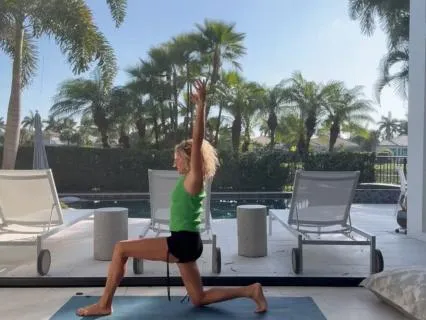
You'll step back with your right leg so that your left leg is in front.
And you're going to take your knee down.
So if you need to put something comfortable underneath,
Feel free.
And then as you inhale,
Bring your arms up.
Towards the sky in this high lunge.
You're going to feel it in your front gate,
Ribs are back,
Tailbone is long.
If you can keep all that together,
You can come a little lower.
And just open your arms wide.
As you exhale and come down.
Step in back.
Into Arauca.
Feel free to.
.
.
And you let your spine,
For that first round,
Pedal to your knees.
Pull your ribs back.
Activate your link.
And then from here,
Take your knees down.
And reach your hands forward.
We call this anahatasana,
Heart chakra asana.
Then pulse your heart down towards the earth.
You're going to inhale and coil in.
And then exhale,
Close your heart back down.
And one more like this,
As you pull in,
You're drawing your pelvic floor,
Your navel,
And your chin all towards each other,
All your bandhas,
And really gather that.
Energy at the base of your spine.
We call it kundalini shot.
Mmm.
Rest your heart downwards towards the earth,
But no tweaking in your heavy neck.
And then come forward into a Sphinx Asana as you lower your hips down carefully.
Lathen your heart through your shoulders.
And then exhale,
Coming to full pronunciate.
Just really one breath,
But it gives you this opportunity.
To remember your prayer,
Your intention.
Offer some thanks and gratitude.
For the moon it rises.
And sense and again.
Inhaling as you come up into a low cobra.
And then exhale as you take it back.
Into downward facing dog it's always important to really power up that dog after you do Cobra back then,
So you can bring that length and symmetry back to your spine.
Activate Mula Bandha here,
Udiyata Bandha,
Lengthen in your lower back,
In your core life.
And then with your right foot to the center line,
Inhale.
And slowly breathe up your left leg.
Keep your pelvis neutral.
And then as you exhale,
Take your left foot forward,
Your right knee is coming down.
Inhaling and reaching up feeling that energy and that devotion towards the moon above you you can open your arms almost like you're holding the moon as you drop your hips a little lower.
And then as you exhale,
Stepping forward with your right leg.
Fully inside.
Inhale as your hands come up through the fronts of your leg And you can set your foot so that they're hips width apart,
And then your hands are going to come back to your lower back.
And support your lower back so that your heart can open back up and receive that nectar.
And then we go into the next side of Chondra Namaskar.
We go right into it.
As you exhale,
Pour it back down.
Oh,
It's enough.
And this time you'll step back with your left leg Knee comes down.
Inhale as you take your arms.
Oh.
And exhale,
Open your eyes wide to embrace the energy of the moon.
All the way down to your back toes.
Exhale.
I don't know.
Inhale your knees come down reach your hands forward Keep your pelvic floor active and surrender your heart towards the earth just to your own degree.
Anahatasana.
Inhaling as you coil all the way forward.
Into a sphinx asana.
Pull your heart through.
Exhale,
You come into a full plank.
Hands are cupped over your head in the triangle position.
Remembering your intention.
And then inhaling as your hands come back to your side.
Press that.
Mmm.
Ah,
Don't look up.
Really use that energy.
To lengthen your spine.
Activate Urapanda.
Then on the next breath,
You'll step your right foot to the center line.
Breathe slowly,
Your left leg up.
Neutral pelvis.
And then as you exhale,
Take it forward,
Right,
And it comes down.
Inhale as you come up into that.
I love John Jane Yasun.
And stay high or drop in as you open your arms and hold the energy of the moon.
Receive it.
Receive all the nectar that you need,
All the nourishment,
All the love.
Then as you exhale,
Hands come down.
Step forward in uttanasana,
Hands to the tops of your hips.
This completes one Chandra Namaskar.
So from here,
As your hands come back up the fronts of your legs.
Step your foot out,
So your hips foot apart.
Inhaling,
Finishing with that standing.
Anahatasana.
And then draw everything in and out.
Really feel the energy from your pelvic floor and your navel.
Extending your tailbone long.
And take the arms back up.
And finish with Pana Mudra as you hold the energy of the moon.
Your hand.
Feeling that nectar pouring down.
Wherever you need a little sweetness,
A little healing,
A little love,
A little relaxation,
A little healing.
And then as you reach your hands back up.
And.
.
.
As you bring your hands.
Together.
And just taking a moment.
With your eyes closed.
To.
.
.
Feel the energy that you've created.
From Chandra.
Energy.
Of the world.
To remember the next time.
There's a phone or a new line.
You can do this practice.
Whenever you need.
A little extra nourishment.
Killing.
Nectar.
You can give it.
For yourself.
This is.
.
.
Power.
Of practice.
Is that you can be Your own.
Healer.
And you have everything that you need right here.
In this amazing.
.
.
Body.
Not enough.
So enjoy.
Namaste.