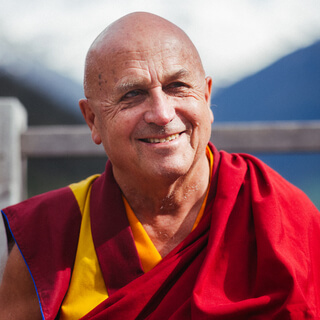
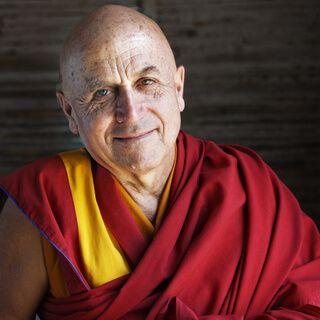
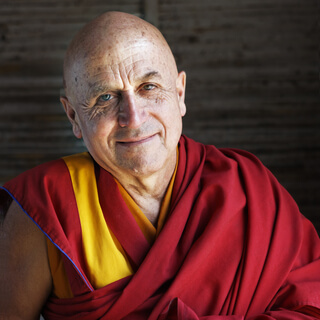
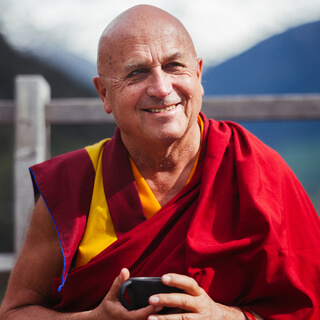
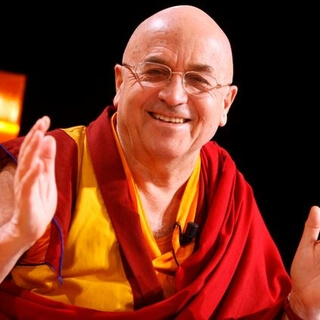
These are really two men that probably don't need an introduction,
But they deserve one.
And it would be a very long introduction to share.
The impact that you've both had.
On the lives of others.
Of people all over the world.
Richie has all the academic credentials,
So I'll share his formal professional title.
The William James Anvilis Research Professor of Psychology and Psychiatry.
He's the Director of the Wiseman Laboratory for Brain Imaging and Behavior.
And the founder of the Center for Healthy Minds at the University of Wisconsin.
In 2006,
Richie was named one of the most influential individuals by Time Magazine.
He's written hundreds of very important scientific papers and has written a wonderful book that's Widely used and saying used by we use it in our university class at UVA the emotional life of your brain I have another book coming out soon.
And Richie has been a longtime board member and a founder.
Founding board member of the Mind & Life Institute.
So it's really wonderful to have you here.
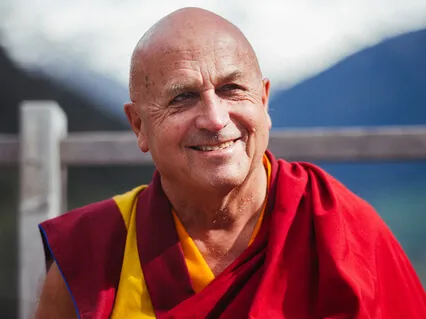
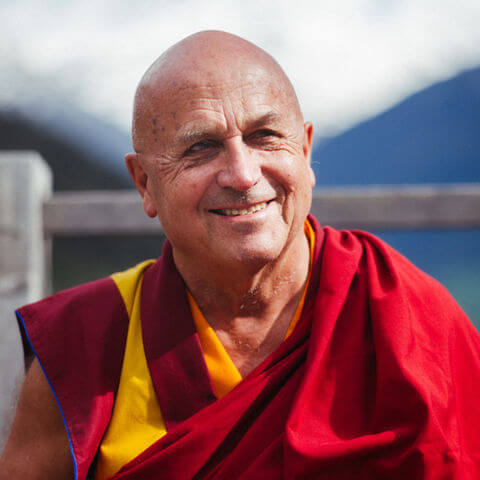
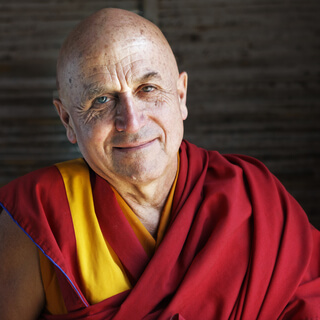
And Mathieu Ricard is,
Has.
A PhD.
In molecular genetics from the Pasteur Institute.
And for 45 years.
He's been a Buddhist monk.
He decided to forsake his scientific career and instead became a serious monk.
Practitioner of Tibetan Buddhism.
And has lived mainly in the Himalayas.
Mathieu has published many books,
Many,
Many books.
Just name a couple,
A few here.
The Monk and the Philosopher.
Happiness,
A guide to developing life's most important skill.
Last year,
The book Altruism,
The Power of Compassion to Change Yourself and the World.
And also the book,
Caring Economics.
Is that partly a mind and life related book?
And it's conversations and altruism,
Compassion between scientists,
Economics,
And the Dalai Lama.
And Ma Chu has a new book that has just come out.
It's called A Plea for the Animals.
And we are selling it here,
And he will be doing a book signing.
And in addition,
He is an amazing,
Amazing photographer.
And we are really fortunate that we have an art exhibit here at this conference,
And Matt Hsu's work is being featured there.
So we are in for a treat.
Richie and Matt Hsu are going to have a conversation,
And there'll be an opportunity to also receive questions from the audience.
So thank you very much.
Enjoy.
It's really a pleasure and an honor to be here this evening to begin this third international symposium.
And I'd like to begin with just a few reflections.
First,
It's been a very difficult week,
As many have alluded to.
And I felt So heartened coming here to San Diego to be among such close friends and colleagues and to give each other warm hugs.
And when I woke up on Wednesday morning,
I woke up with fire in my belly.
With the conviction that the work that we are all doing is ever more important.
So it's particularly poignant,
I think,
That we are together meeting this week.
I also want to Just.
.
.
Spend a few moments reflecting on Francisco Varela,
One of the co-founders of Mind & Life.
I first met Francisco considerably before Mind & Life was started.
I met him in a lab in New York in either 1980 or 1981,
And it was the lab of E.
Roy John,
A very famous neuroscientist who has I think sort of gone off into obscurity,
But was really a great man.
And Francisco and I were dabbling in his lab together,
Trying to figure out how we can measure the duration of a perceptual moment.
And.
.
.
That was my first introduction to Francisco,
And it was just through an extraordinary set of karmic circumstances that we then found ourselves together at the beginning of Mind and Life.
And in the early days,
He was my roommate in the Kashmir cottage,
A little guest house run by the brother of His Holiness the Dalai Lama in Dharamsala.
Sala,
India,
When we had mind and life meetings that could be accommodated in a very small guest house.
Those were very different days,
But they were really important days,
And Francisco's vision and his dedication to science and to practice were themes that continue to resonate and inspire the work that so many of us are doing these days.
And finally,
I just want to say what an extraordinary pleasure and honor it is to be working with Susan.
She has been an extraordinary leader,
And it is so fantastic to have Mind in Life now in a period of stable leadership,
Steady leadership,
And visionary leadership in a way that I think we can all rest confident for the future of this organization,
As when Mathieu and I went backstage and saw the extraordinary equipment back there,
Mathieu turned to me and said,
This organization is going to be around a lot longer than we are,
Which is very,
Very heartening.
So I'd like to begin our little dialogue by just sharing that Mathieu and I,
I think,
First met at a Mind and Life meeting in Dharamsala,
India that was held in the year 2000.
And it was the meeting on destructive emotions.
And that was a pivotal meeting for many,
Many reasons.
Francisco was at that meeting,
In addition,
Paul Ekman was at that meeting.
And His Holiness was extremely animated and challenged us at that meeting to really begin to take this work out into the world,
To begin to do more serious scientific research.
And I think it was at that meeting that the possibility of serious scientific research with very long-term practitioners such as Mathieu were considered.
I think that we were all inspired by His Holiness at that meeting to begin this great project which we are all living today.
So.
I'd like to begin at that moment and one of the things that Mathieu has shared is that when he left the world of science after he received his PhD in molecular genetics where he worked with Francois Jacob,
The Nobel laureate,
I think that Mathieu believed when he did an extended post-doc in the Himalayas that he was saying goodbye.
To science and I think it would have really been inconceivable for him to have imagined that he would be not only thrust back into the world of science,
But actually be a co-author on major scientific papers.
So,
Mathieu,
Let me turn it over to you to just share with us some of those early reflections and how the current situation is really so different than you envisioned it at that early time.
Well,
Yes,
Of course.
I didn't expect that.
For 25 years,
Basically,
I was out of everything,
Living in a very simple way,
Near my teacher,
Kangyur Rinpoche and Thich Nhat Hanh Rinpoche.
But science,
For me,
Has always been the rigorous pursuit of investigating reality.
So I didn't feel I was abandoning science,
But turning to a different field,
A different domain of science,
Which is the science of the mind,
Of getting rid of the causes of suffering,
So something like that.
And then the beginning of my trouble after 25 years where the monk and the philosopher out of the blue did this dialogue with my father,
Which propelled me again,
You know,
Sort of in the Western world and public eye.
So I joined Mind & Life.
I also knew Francisco before joining Mind & Life.
And then following the first book,
I did a book with an astrophysicist,
Trinh Hoang Tuan,
The quantum and the largest.
And I remember very well when his illness was in Paris,
And we were waiting with Francisco to meet him.
And Francisco told me,
No,
You are just wasting your time.
Talking with a physicist.
Not that our dialogue was not interesting,
But he said,
You know,
To go at all in any physics lab or the accelerator at the CERN in Geneva and propose some kind of experiment.
It's just intellectual idea.
Show the same interest in neuroscience or psychology,
Then we can do things together.
So then I was invited to the 2000 Minded Life.
As you say,
It was a turning point certainly for me.
And halfway through,
His owner says,
What can we contribute to society?
And this project came.
And so we were recruiting sort of guinea pigs.
And I very imprudently left my hand.
I didn't know what I was going into.
About 100,
000 fMRI machines and everything else flying guinea pig.
But,
You know,
The initial enthusiasm to bring together those two pursuits of investigating reality to now both ways,
You know,
For the third person perspective,
The first person perspective and serving His Holiness's vision,
That have always been a wonderful adventure.
I found a new sangha,
The sangha of scientists who are devoted to make a better world,
To investigating how we can train the mind and so forth.
It was an interesting return to science.
So we then began to actually conduct research and Mathieu was the very first long-term practitioner we had to visit our laboratory and he came to our lab in advance of a meeting that we had with His Holiness in 2001.
And that was a meeting that Francisco.
.
.
Was scheduled to attend and participate in.
It was a meeting in Madison,
Wisconsin.
And Mathieu came early to that meeting and we actually,
The night before,
The day before the meeting began,
He spent the day in the MRI scanner.
And then we arranged for a team of very dedicated graduate students and postdocs to work through the night.
And they furiously analyzed data from an N of 1.
That we were committed to sharing among ourselves and with His Holiness the next morning.
And so that was just a very crazy time when this all began.
And Francisco was quite ill at the time and at the very last minute he was not able to travel because of his illness and he sent instead someone who was his last student,
Antoine Lutz,
Who came to Madison for the first time.
And then,
Of course,
Antoine ended up staying for about a decade and was the principal scientist who conducted all of the work that we did with long-term practitioners.
And it was also at that meeting,
This was in 2001,
It was before Skype was available and we had a video link that we set up between Francisco in his bed and our meeting in Madison and it was during that meeting over this video link that His Holiness said goodbye for the last time to Francisco and he died very soon after that.
So it was a very poignant and momentous meeting.
So one of the topics that I wanted to explore with you this evening,
Mathieu,
Is one that really arises from a deep consideration of the roots of the contemplative traditions that you represent and the scientific work.
Today we see the proliferation of various forms of meditation in the West,
The term mindfulness is bandied about.
It's on the front cover of magazines.
In our center,
There are people who call it Mick Mindfulness at times.
And one of the things that I've heard you say on many occasions is that you prefer the phrase caring mindfulness as in contrast to the word mindfulness.
I wonder if you can share with us some insights from the contemplative traditions about the roots of mindfulness and about also how compassion and mindfulness may be connected and some advice that you can give us as scientists.
Well,
You know,
Next year will be actually 50 years that in 1967 I went first to Darjeeling to meet Kang Yo-jong Moshi.
And then for this half of a century,
It's so obvious that the whole Buddhist path is driven by altruism and compassion.
The whole point of achieving enlightenment is not just to be quiet somewhere in a little nirvana,
Some kind of nice island,
It's to gain the capacity true enlightenment to free being from suffering.
So altruism and compassion is the complete heart of the path.
So that was obvious in terms of teaching,
In terms of practice.
And then when I was fortunate to meet His Holiness in the early 80s and listen to him and be inspired by his presence and serve him on a few occasions,
Again and again,
Of course,
Compassion was the heart of this message for humanity,
For practitioners.
A time where I was about to go for a year retreat and occasion to meet His Holiness.
And I said,
Could you give me one piece of advice?
And he said,
In the beginning,
Meditate on compassion.
In the middle,
Meditate on compassion.
In the end,
Meditate on compassion.
So it was clear.
So then,
When I became more exposed to running around in this world and finding ourselves in strange places like the World Economic Forum or Davos and everything,
It became even more clear that on all fields,
Economy,
The environment,
Social justice,
Inequalities,
That altruism and compassion were the most powerful agent.
To deal with the challenges of this life,
Of our times.
And especially if you look at the environment,
Without altruism,
Why would you care for future generations?
So this is absolutely clear.
So in that sense,
Whether it's for our engagement in the world or personal practice,
Everything should be embedded within the sphere.
Of altruistic love and compassion.
So this applies to any practice.
I mean,
The motivation that you generate before starting anything.
So now,
More precisely,
Mindfulness.
You know,
Our dear friend John Kabat-Zinn began,
I don't know,
30 or 35 years ago.
Where did he begin?
In hospital setting with people who were suffering.
Not only the patient,
But often also the caregivers who are suffering of empathic distress,
Burnout,
Empathy fatigue.
There's no compassion fatigue,
By the way.
It's courageous compassion.
Anyway.
So.
Since he was dealing all the time with suffering people.
So his intervention of mindfulness-based stress reduction naturally brought about the compassionate attitude.
And it's an intervention that lasts eight weeks,
And there's a lot of components.
Now,
If you simply now,
As mindfulness has become the mindful revolution and everything,
If you just take the very,
Very technical,
Of course,
Very narrow definition of being in the present moment attentive to whatever comes in terms of thoughts,
Sensation,
Perception,
In a non-judgmental way.
Of course,
In the traditional Buddhist teaching,
There's also mindfulness in terms of recalling the teachings,
In terms of being not only mindful of what thoughts is in your mind,
But is it a wholesome or unwholesome thought?
And be mindful of the kind of antidote you could use if it's hatred.
So it's not quite entirely nonjudgmental,
But it is used with this technical definition.
So if you take it out of context,
Out of an intervention,
And now bring it in other fields of activity,
Say the corporate world,
As it's happening increasingly.
Well,
If you just have that.
You could imagine almost anything,
Because it becomes more like a tool that can be used both ways.
To be the advocate of the devil and give an extreme example,
Look at this sniper.
No,
He has to be very,
Very mindful.
He has to be in the present moment,
Because he has to be attentive of his target.
If he's distracted,
He has to come back.
He should not be swayed by emotion.
And he should be non-judgmental,
Because he has been told to kill anyone who comes in the field of his gun.
So you could have a mindful sniper.
You could have a mindful psychopath.
But certainly you can't have a caring sniper and a caring psychopath.
So by introducing that,
You just get rid of the other one.
And since everything should be embedded in compassion,
Action.
It's clear that that dimension should be without any ambiguity present from the start.
And by the way,
You can be mindful in that very narrow technical way without compassion,
But you cannot be compassionate without being mindful.
Because if you are fully engaged your mind in loving kindness and compassion,
Of course you have to be mindful.
So you get two for the price of one.
It's wonderful.
One of the areas of scientific research,
Which you reviewed some in your altruism book,
Which is,
I think,
So important for our field,
Is an increasing body of scientific literature that I would interpret as confirming this notion of innate basic goodness.
There are a variety of studies now,
As you know,
With infants,
Also some with other species,
With other species,
That suggest that there is this quality of innate basic goodness.
We come into the world with a preference for pro-social,
Cooperative,
Warm-hearted interaction.
Actions if given a choice.
And it's not to say that the negative components are not present,
But if we are given a choice,
We will choose the good.
And those findings,
I think,
Are so important because when we study the practices to cultivate compassion,
We are studying practices which are nourishing a basic quality which may already be present in the mind,
Where we can become familiar with those qualities and nurture them.
And in this sense,
I think that compassion can be likened in many ways to the way scientists view language.
We all come into the world with a biological propensity for language,
But we know that it requires a normal linguistic to nurture that capacity.
And there are case studies of children who are raised in the wild,
Feral children,
And they don't develop language normally.
And the same may be true of compassion,
That we come into the world with this innate propensity and the practices that we are studying are those that help to nurture that quality.
So is that reasonable from?
It's basic goodness.
It's not just like a dogma that you might have,
You know,
In one way,
In some tradition,
Original sin,
And Buddhism has original goodness,
And it's something different,
And you have to believe so and so forth.
It's actually based on a very profound insight on the fundamental nature of the mind.
And as you rightly said,
You know,
It's clear that there's this stronger propensity toward appreciating people who behave nicely to each other,
Even,
You know,
One year or three months old infant shows somehow this propensity.
Of course,
It's not to be naive.
We know that the other extreme can happen too.
We can become psychopaths,
Genocides happen.
This being said,
There's an increased,
I mean,
A stronger propensity to that.
And I would say also we could speak not only of basic goodness,
But the banality of goodness.
You know,
And I already spoke of banality of evil.
But the banality of goodness is if we think carefully,
Most of the time most of 7 billion beings behave decently with each other and it's so some,
The norm that we don't hardly notice it.
We don't notice the air that we breathe.
And nobody's surprised if today when you come out,
Nobody's going to say,
Wonderful,
You know,
There was no big fistfight in this assembly.
How great.
And if two people start fighting,
You say,
Well,
Those two guys were speaking about altruism and compassion,
And they start picking up a fight,
You'll be shocked.
Why?
Because it's a kind of aberration and a deviation,
And we forget what is the norm.
But why we could somehow speak from the Buddhist perspective about basic goodness?
It mostly has to do with investigation of the basic nature,
The fundamental nature of mind.
You know,
That basic awareness that underlies all emotion,
All thoughts,
All recollection,
Reasoning,
Perception,
Sensation,
There is kind of this primal faculty of knowing,
Of being aware,
That is unconditioned in a way.
In Buddhist terms,
We may call it the Buddha nature,
That is free from delusion,
Free from ignorance.
And why it is unconditioned?
Because it has to be to allow all the So there's a space that allows the clouds and the mountains.
So this basic awareness allows all the mental landscape to unfold.
It's like light.
Light is not modified.
If light's a heap of garbage or an angry face,
It doesn't change.
Light just reveals that.
So if meditators who somehow recognize that,
Suppose you can dwell in that fundamental awareness.
What will come next when it becomes start to take a shape of a thought or mental construct from that pure awareness is not going to be hatred.
It's not going to be jealousy or intense craving.
This is much later when things go wrong.
But the first manifestation is going to be something to relate in the world in a loving and compassionate way.
So that's why we could speak of the first manifestation of that awareness should be compassion and altruistic love.
It's sort of a natural understanding of that.
Thank you.
One of the challenges in scientific research on meditation and contemplative practices in the West is that we have a,
I think,
Very limited view of the landscape of these kinds of practices.
And I wonder,
Mathieu,
If you can share with us maybe an aspiration that you might have about domains where we can begin to investigate scientifically where there really is very little scientific research.
I'll prime the pump here a little bit and say a few things.
One of the important questions,
I think,
Related to an issue we were just discussing with caring compassion,
With caring mindfulness,
Is the question of how large a difference it might make for a practitioner to be educated with the view of altruism,
The importance of the ethical framework in which these practices are embedded,
In contrast to the techniques themselves,
That is,
The specific practices.
One of the,
Just to give a little data point here,
The very first randomized controlled trial that we did on mindfulness-based stress reduction,
Which was published in 2003,
Which actually turned out to be the very first randomized controlled trial of MBSR that had ever been done.
It was done in collaboration with Jon Kabat-Zinn.
John at that time felt so committed to the importance of this kind of research that he actually flew out to Madison for 10 consecutive weeks and he taught the class himself.
That was the intervention group.
And one of the things that we did in this study is we looked carefully at the relation between the number of minutes that people practiced and all the outcome measures that we obtained.
They were immune measures,
Measures of brain function,
All kinds of other measures.
And we looked systematically,
Very carefully,
And we really wanted to find something.
And it was a complete bust.
There was absolutely no relation between any outcome measure.
And the length of time that people reported practicing.
And we had people in that study who came to every class,
To each of the eight weeks,
But reported that they did zero amount of practice outside of class.
And so one interpretation of this is that John himself was teaching this,
And they all got the view.
They received this overall context.
And so their outcomes were influenced by that.
And it didn't really matter if they did the practice,
At least in these early stages.
So I wonder what your reflections are on that issue.
Well,
I'm not sure I would call that the view.
And I was actually going to ask you after that about some possibility of research about the view,
Analytical meditation of the self and all that.
But I would think more that while he was teaching,
And people must have gone to a free practicing sometime with him,
At least,
It set something in motion.
You get into that frame of mind of mindfulness and hopefully also compassion of caring mindfulness.
And even you stop,
You know,
There's something going on.
And I like this example of opening a bottle of perfume for 10 seconds and you close it.
But the perfume will linger for 10 minutes.
And so if you repeat that often enough,
The perfume will be there most of the time.
So it sets something in motion.
You know,
If you have 10 minutes of altruistic love and compassion,
You know,
The next hour,
Most likely you're not going to slap people on the face and tell terrible things.
But if you repeat that,
You know,
A few minutes,
A few times a day,
Then there will be a trickle that goes on.
So I think it's,
I would think it's more like not so much having a different view,
Although it can be an eye-opener to be,
To hear someone speaking about altruism,
Compassion,
Or mindfulness,
But the fact that when you have tasted some moment of practice,
Anytime you can refer very quickly to that perception or that experience just as if I've seen the seaside,
I close my eyes and immediately I can be there and feel what it is to be sitting by the sea.
Now to return to your question,
I think His Holiness the Dalai Lama often again reminds us about how could we investigate,
Which is not that obvious,
Because it's not so much about training the mind in a particular skill like attention or altruistic love.
In the investigating what the result of analytical meditation could be,
Sort of looking at the self that we conceive as a unitary,
Autonomous,
Permanent entity,
Deconstructing that as the Buddhist philosophy or investigation does,
Coming to a point that we realize that yes,
There is a self,
But it's a conceptual self and so forth,
And the consequences in our dealing,
Less reification of the divide between self and others,
And therefore,
Less attraction,
Repulsion,
And possibly less of the mental toxin,
All that.
So it seems more difficult to sort of bring an experimental protocol about that.
But that's something that is on this,
Has been sort of wishing again and again that we do serious research about that.
So do,
Since you heard that many times from him,
How do you think we could experimentalize that,
Bring it to an experimental setting?
Yeah,
I think it's really important.
And I think that there are strategies that we can use,
Both behavioral as well as neuroscientific.
And so there are some very robust phenomena that have been studied outside of the contemplative tradition that are relevant to this,
Relevant to self-identification.
So one,
For example,
Is the endowment effect,
Which has been studied by economists,
Behavioral economists.
And basically,
For those who don't know what the endowment effect is,
Essentially it's this.
If you come into an experimental situation and you're asked,
You're told that you're going to be getting a gift to acknowledge your participation in this study.
And you are asked to choose among several objects,
Like a mug or a pen,
Some small gift.
It turns out that once it becomes yours,
When it's my gift,
It's valued more than if it wasn't my gift.
So the very fact of it becoming so-called mine attaches some,
In this case,
Economic significance.
But it is a psychological significance.
So it's the mind added tax to the object,
Yes.
Yes,
Exactly.
Exactly.
So we can use strategies like that to,
I think,
Investigate the impact of analytic,
These kinds of analytic practices,
Particularly when they are focused on the self.
Well,
You've done this as a very beautiful example.
You gave the example of you're watching a beautiful shop with all Chinese pots.
Porcelain,
And expensive $1,
000 vase,
And the cat sort of makes the vase fall.
And you say,
Oh,
What a pity.
It's such a nice vase,
But no big deal.
You just brought that vase,
And your cat makes the vase break down,
And then it's the end of the world.
That's a good example.
And the other question I wanted to ask you,
For years now,
We have been engaging in this what we could call fundamental research.
What is the effect of mind training,
Short-term,
Long-term?
What is the signature in the brain of different types of mind training?
And obviously,
There's no such thing as meditation with a big M.
If you ask someone who is doing physical exercise,
He says,
I'm training.
You say,
What?
Is it rugby,
Or badminton,
Or chess?
It's quite different.
So we know that now,
Thanks to this wonderful research.
But as it's always challenges to what can we contribute to society?
So now you I think beginning to Bring that in the education with preschoolers or all kinds of walks of life working with veterans So that's acting really fulfilling its own SS aspiration And also that shows that we can go from the lab to the school and the lab to people who are in difficulty So I think that's a beautiful example.
If you could tell us a few where the coolest research is going.
Yeah I think that one of the buzzwords in the research community,
The life sciences research community,
Is translational research.
Wee.
At Mind and Life,
We can think of ourselves in part as doing a certain kind of translational research where we can take the insights from the basic research laboratory and study them in real-world context.
And so there's wonderful work that's being showcased here at this meeting in schools,
In education,
In workplace settings,
In healthcare settings.
And I think that This work is really,
Really important and I think we have a moral imperative.
To do this,
Because this is going to,
I think,
Enable the work to get out into major sectors of our culture,
And I think we need to extend the basic research in this way.
It's possible,
I believe,
To do studies that are equally rigorous that are conducted in these real-world settings.
And so I think that it's really very gratifying to see how much is being done now in these contexts.
It is not easy research to do.
It requires a lot of perseverance.
The real world contexts are a lot messier than the lab contexts.
And we critically need partners along with Mind and Life to fund this kind of research because it's also not going to be cheap.
But I think that this is the kind of work which ultimately will help us cross this important tipping point where we can envision a world.
In the not-too-distant future,
Where mental exercise of the kind that we study will be practiced in the same way that physical exercise is today,
And it will permeate the culture.
And so this kind of translational research,
I think,
Is what will be needed to help us cross that tipping point.
So maybe now,
We just have.
.
.
I just wanted to add a little word.
Please.
Of seemingly conclusion from my side is that we spoke of the mindful revolution.
And I think our dear friend today,
Jim Balla,
Who wrote this beautiful book,
Fearless Heart,
Also would agree that what we need now is the compassion revolution.
And considering the downfalling circumstances we find in the last few days,
We need to redouble our efforts.
So viva la revolucion del altruismo.
So we have a few minutes for questions,
If there are any questions or comments.
There are microphones,
I think,
Set up.
Over.
I'm not sure where.
There's a microphone right there.
So if anyone has a question,
We can spend a few minutes addressing them,
Please.
I hesitate to address you as Richie.
Please do.
Everyone calls me Richie.
You started to ask a question about how The Western view is limited in some way.
And there are areas that science has not been able to penetrate into or that have been difficult for science to address.
And the conversation then turned to the endowment effect,
Which is very interesting.
Was that what you had in mind?
Did you have something else in mind?
Yeah.
No,
I think there are multiple strands that are being put together,
And perhaps I wasn't as clear as I could be.
And you're,
I think,
Alluding in your question to another issue,
Which we really haven't talked about,
Which is whether What might be the limits in terms of what science can approach in the contemplative traditions?
Actually,
At one of the previous ISCS meetings,
I believe it was the first meeting in Denver,
Mathieu participated in a dialogue with Wolf Singer.
A very eminent neuroscientist,
And one of the wonderful comments that Wolf made at that time was,
If even half the things that you've told me are true,
We are in big trouble.
And what Wolfe was implying by that is that the phenomena that have been reported by people whose sanity is quite robust,
I would say,
Really raise huge questions for our scientific worldview.
And so here we We think of questions,
For example,
Concerning the relation between the mind and the brain,
Which we're not going to answer in the next five minutes.
But one of the things that I have tried to do,
Particularly in the last decade with students that I work with,
Is simply to practice humility and not knowing.
And rather than answering from a position of assumption and scientific hegemony to answer it honestly.
And the honest answer is we don't know.
And Francisco told me about this ultimate question of the nature of consciousness.
He said,
Let's keep our mind open.
There's still a long way to go before we come to some final understanding,
If that can be so.
Thank you.
Thank you.
Hello,
My question is a little,
Not a little,
It's a lot outside the academic world.
Interfaith minister and journalist,
And I see this like too complicated.
Why are you studying so long and so deeply something that has been so practical?
Like monks have been known all this for years.
Centuries.
Way not to do that translational thing to the real world faster.
Like,
You know,
Just people need to learn faster.
All this that you are just studying and studying and studying.
How can we just translate it faster and make it practical?
Thank you.
Well,
Maybe we both can address that.
The reason we do the basic science is not to confirm what we think we already know from the contemplative traditions.
As a scientist,
To me,
That does not feel like we're approaching it with honesty and with the true commitment to understanding the fundamental nature of reality.
There are things that we've learned in the basic science laboratory that have turned out to be very different than we thought they were going to be.
And there's still,
As we've been saying,
A lot that we don't know.
And so I think that we need to approach the basic research with an open mind and be prepared to discover things that we,
In fact,
Did not know.
And so there is still a need for basic research,
But I certainly honor and appreciate what you're saying and I think that we at the same time For those inclined to do this,
We need to bring this out into the world.
The world desperately needs this,
And we need to do the kind of translational research that we're talking about and influence major sectors of our culture,
Like education,
Like the workplace,
Healthcare.
Those are all sectors that are primed to,
I think,
Embrace this kind of work and the Translational research I think will greatly help.
So I would say we need both.
But in terms of education especially,
There are hundreds of wonderful alternative approach to education that came out of the inspiration of really dedicated teachers or mentors,
But many not being evaluated.
And so it's very hard then to say,
Oh,
This is the one that we should really safely and meaningfully bring in a larger sort of context.
So those two needs to go together,
Sound science,
And then be dedicated into translating it as soon as the science is solid enough.
Thank you very much for your discussion,
And it's a real pleasure to be here.
My question is the one of neuroenhancement.
So as neuroscience progresses,
We're finding new ways of stimulating the brain.
And I would argue that meditation,
One of these methods,
But now we also have neurofeedback,
Drugs,
Electric stimulation,
And maybe in the future optogenetics.
So in the same way that you propose meditation as a way to increase altruism and happiness,
I'm sure that people will propose to use drugs and these other methods do the same thing.
And I want to know your opinion on that.
Well,
As His Holiness the Dalai Lama said at one meeting,
If there's a pill or something I can do to my brain to really dramatically improve my compassion,
Please give it to me.
I think that it is a bit of scientific hubris to think that we're there.
At this point.
I think that we still,
There's so much that we still don't know.
I think doing research in these areas and investigating them is wonderful and something that we can encourage and explore.
But I think it's quite premature at this point to think that there's a molecule.
The notion that there's a single molecule for compassion I think flies in the face of everything we know about the brain.
Notion that there's a single location in the brain.
For altruism and compassion again flies in the face of everything we know about the brain and so I think it's going to be quite complicated and one of the things that I think is important for us to do with respect to the brain is periodically do humility inductions where we rub our noses in the extraordinary complexity and dissuade ourselves from the idea that we actually really even have a clue about what the fundamental operating principles are.
I don't think we're there yet.
Just a small thing about this kind of intervention.
You know,
For instance,
We know there are drug enhancing,
Performance enhancing in sports.
Those guys train 10 hours a day for years,
And on top of that,
They take something.
You can't expect that you just sit in your armchair and take something and you will win the New York Marathon.
So you might get euphoric for a few hours or something like that,
But it's not going to be the equivalent of training.
You might implant electrode and feel extraordinary bliss.
At the moment you take them out,
You just say,
Boo.
So and then feedback,
Again,
It seems to me so rudimentary.
And I've been through those things,
People putting two or three electrodes and say,
Meet on compassion,
And you will shine.
When you know the complexity just in the brain,
Forget about the different types of compassion and years and years of training.
Frankly,
Even if they tell me,
No,
Compassion is good,
It would not help me a damn.
It's better that after months and years,
If I feel I am a little bit more compassionate and kind,
I think that's the best feedback in the world.
Otherwise,
If you think my meditation is so great and everybody thinks it's just a pain,
This guy is just the same.
So I think the best feedback is your own flourishing,
What your teacher might tell you about your progress or your obstacles,
What other people might notice without you showing off about it.
So I think it seems hard to believe that you could replace a lifelong training like His Holiness,
Who for the last 60 years has been practicing four hours a day on understanding emptiness and compassion.
I mean,
The pill is still far away.
So,
We need to apologize to all of you in line.
Unfortunately,
Our time is up.
Mathieu and I will be around for the rest of the meeting,
And I'm sure that we'll both be happy to answer questions.
I wanted to end with just one quote,
A quote that many of you have probably heard from me before,
But it's something that bears repeating,
Particularly in this really strange and challenging times.
That we find ourselves in.
And it was written in 1921 by Albert Einstein,
Who was asked by a friend to give his friend some advice about some difficulties that he was encountering with his daughter.
And Einstein wrote,
A human being is part of a whole.
Called by us the universe,
A part limited in time and space.
He experiences himself his thoughts and feelings as something separated from the rest,
A kind of optical delusion of his consciousness.
This delusion is a kind of prison for us,
Restricting us to our personal desires and to affection for a few persons nearest us.
Our task must be to free ourselves from this prison by widening our circles of compassion.
To embrace all living creatures and the whole of nature in its beauty.
Thank you.