So.
.
.
Let me just say it's really wonderful to be back with all of you.
I had an opportunity to listen to all the talks that Dee and Brian and Lily offered.
Was deeply inspired by the wisdom of these beautiful teachers that are part of our Roding Fork community now.
And I was particularly moved by the theme of the inquiry,
What the heart of practice is for all of us.
And I loved hearing what it was for you.
That last talk that Dee recorded,
Thank you so much for doing that.
It was so wonderful to hear what the heart of practice is for all of you in this group.
The wisdom that's in this group is just,
It's remarkable.
And so what I thought today I would do is add my own reflection to this inquiry.
As was illustrated in all the sharing,
The heart of practice is truly a composite.
It's a composite of so many things.
And it's showing up,
As several of you had said,
You know,
Showing up is kind of one of the main parts of practice.
In that in that composite just showing up you know it's patience as was shared it's the ability to remember to say just this.
Or to remember to say yes and instead of the habitual yes but.
It's what Dee spoke of in many of her talks,
The inner discipline of alertness,
Of paying attention,
Of pausing.
Like in a poem.
You know,
The poem that she read about the peach,
To hold the fruit in our hands,
Adore it.
And then bite into the round jubilance of the peach.
That too.
Is the heart of practice.
And.
.
.
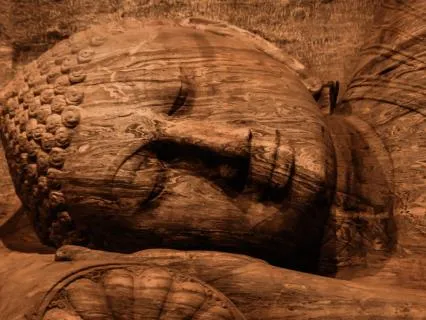
In the story of the Buddha's death,
Which I just shared in that poem by Mary Oliver.
It said that as he was dying,
He turned to those around him and he said something like,
Make of yourself a light.
Make of yourself a light.
Like a lamp in a dark room,
It doesn't matter.
How long the darkness has been there.
The moment the lamp is lit,
Things are revealed as they are.
So for me.
.
.
One large piece of this composite of practice.
Has been this illumination.
We are eliminating the dark places within ourselves.
We tell ourselves the truth,
And even if we cannot yet say it out loud.
Even if the truth is painful.
Even if it disrupts our entire self-image.
We tell ourselves the truth.
In the poly canon.
Greed.
Aversion and delusion are considered the roots of suffering.
And delusion.
Is presented as the third mental state.
But in my experience,
Delusion seems to be the water.
That Greed and aversion kind of swim in in this body and mind And the word,
The Pali word for delusion is mohawk.
That means delusion,
And it actually relates to the mental activity of ignorance.
Ignorance,
Not in the sense of like,
Not knowing something.
More like ignoring,
Ignoring.
You know,
It's been described as kind of like confusion and bewilderment.
Like not really understanding what's happening,
Being kind of confused.
And some teachers described.
Of this delusion as an obscuration.
Like you're wearing glasses that are really scratched up so that what you think you see may not be reality at all.
So I heard a teaching once from my friend and Dharma teacher,
Matthew Brensilver.
Who opened a talk one time on this topic of delusion.
By saying,
And I'm paraphrasing here,
I hope to share my wisdom,
But I can't help but share my delusion too.
Wisdom and delusion are so close.
Seeing and not seeing are so close.
They're entangled.
So,
This teaching.
.
.
Be a light unto myself.
Make of myself a light.
Shining awareness unto myself.
In the Polycanon,
It says.
.
.
Be an island unto yourself.
Be your own refuge with no other refuge.
Let the Dharma which is often translated as truth,
As nature,
Let the Dharma be your island.
The Dharma be your refuge,
With no other refuge.
So what the Buddha is essentially saying here is don't depend on other teachers.
Don't look outside of yourself for salvation or freedom.
Take refuge in direct experience.
See it clearly and practice.
Let the Dharma and mindful awareness be your guide.
So the heart of my practice is this.
These tools of clear seeing,
Of truth-telling.
And they are the four foundations of mindfulness.
Mindfulness is like a flashlight.
To enter the dark.
Directly,
Clearly knowing the body.
The feelings,
The mind states,
And the patterns that are operating.
When we see clearly what is happening.
In us.
So much more is possible.
Letting go is possible.
Freedom from identification is possible.
Aware of the constant flowing movement,
The change that's always happening.
And being a wave in that river of change instead of attempting to dam it.
That's possible.
All this is possible when we are a light unto ourselves.
What has been so helpful for me.
And turning on the flashlight.
Is this open awareness practice of asking,
Am I aware?
It's gotten to the point.
Where I just drop in the word aware.
And then,
Immediately,
I am.
And not just of what's happening in front of me,
But what's happening inside of me.
My breath.
The body.
In space.
The feelings in the moment.
Like,
Is it pleasant?
Is it unpleasant?
The mind state,
Like what's the mood,
Like right now.
What's the moon?
What's the pattern in the mind?
What am I believing?
You know,
All these lists.
That we teach from.
There's so many lists in the Buddhist canon.
These are just categories.
To help us illuminate what's not been seen.
For example,
The five hindrances.
You know,
Saying wanting.
And not wanting.
And laziness and restlessness and doubting.
Seeing how this operates in us,
Caring about it.
The five aggregates,
The six sensors,
The seven factors of awakening.
These are all areas that we shine light on.
Make of yourself.
A light.
And here are the categories in which you can see.
One of the characteristics of a wise person is that they are willing to recognize what is happening inwardly,
Even when it's not.
Good news!
Or does it feel so good?
So rather than turning away from discomfort,
The encouragement is to recognize.
The immense value.
Of seeing clearly.
Seeing things as they are.
Including what's difficult.
Because when we stop resisting truth,
We begin to discover The truth truly is.
What sets us free.
Truth is the ground.
From which transformation is possible.
So make of yourself a light.
We can do this in daily life today.
You know,
Imagine that you are later today stuck in traffic.
How is the body?
Are you gripping the steering wheel?
Is the feeling unpleasant?
Is the mind calm or irritated or impatient?
And the fourth foundation of mindfulness.
Mindfulness of the Dharmas.
This can be confusing for people.
But what it is,
Is are you seeing a version arising?
Are you seeing it?
Are you seeing the wanting for things to be different?
When you're stuck in traffic.
Are you recognizing?
The truth of suffering.
And that it's caused by wanting it to be otherwise.
Just shining light into this very body.
And what's happening in these four areas.
That have been suggested.
We can understand suffering and we can know freedom.
So next week,
We will dive a little deeper into these four areas.
But today I just wanted to contribute to the discussion on the heart of practice.
For me,
These four areas we shine light on.
They.
.
.
They're like the arteries of the heart.
They make all the other benefits possible.
So.
Again,
I'm very happy to be with you all.
I welcome your reflection and your thoughts on.
What I've just shared.
Thank you.