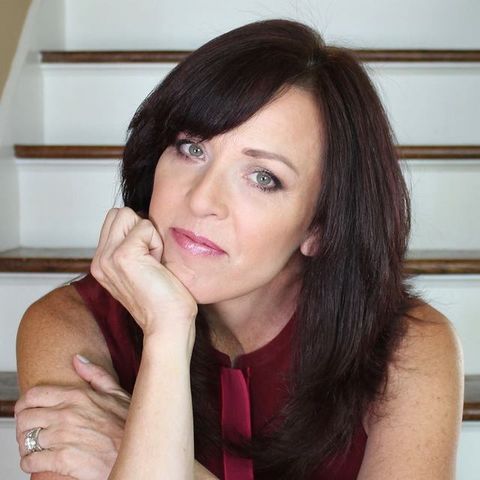
Welcome to Breakdown to Breakthrough,
The podcast that empowers you to transform your life by awakening to your true authentic self.
I'm Lisa A.
Romano,
Your host.
As an award-winning author and certified life coach,
I've dedicated my life to helping others understand the incredible power of an organized mind.
I believe that true empowerment begins with awakening to our false self.
My mission is to support you on your journey toward mental and emotional regeneration through conscious and deliberate awakening.
Awakening in this podcast.
I'll share insights tools and transformative stories that illuminate the path to healing and self-discovery So today I want to explain the absolute importance of understanding why as a child you needed to disconnect from your feelings in order to survive.
This is one of the things that we have to face if we're ever going to become self-actualized,
If we're ever going to beat codependency.
If we're ever going to be able to love other people in a healthy way without enmeshing with them.
Without pushing ourselves into their life and trying to control outcomes,
Without trying to fix people.
And caretake people.
And force these emotional dependencies upon us,
Which is what we do as codependents,
Although we're innocent,
We don't know that we're doing it.
This way of being that we are as codependents comes from tremendous pain.
Our ability to look at our behavior.
Is so important,
But all too often I see with my clients is this incredible pitfall.
So they have the ability to look within,
They have self-awareness,
But they don't have self-understanding.
They don't have self-gnosis.
And so when they start to judge what they're doing,
Their enmeshment with their children,
Or trying to control the spouse that just won't stop drinking,
Or trying to control what the children are doing and how they're relating to their spouses.
Else's business.
It happens at an emotional and psychological and neurological level,
And it comes from tremendous pain.
It comes from feeling so unsafe.
And so unloved and so unnurtured and emotionally attuned to as a child that the only way that we could survive was to disconnect from our feelings.
Because when we are children and we are in these unpredictable homes,
Let's say we grew up in homes where mom was a rageaholic,
Or dad was an alcoholic,
Or you had two parents that fought all the time.
One parent had a mental health disorder that was not recognized.
Or we have alcoholism in the family and the family is really,
Really struggling.
We're all focusing on the alcoholic or we're all focusing on the sibling that has bipolar disorder.
So there is this command.
For the family to try to damage control the person who is really creating chaos in the family system.
So what happens then is that there's a lot of stress,
The children not being attuned to.
The children have fears.
The children are going to school pretending that they're okay.
If there is other form of abuse that makes everything so much worse.
And so these little people are completely frozen.
In an emotional state.
Which is so unnatural.
Little children need other or mother.
They need the other person outside of them to tell them that everything's going to be okay because they don't know that everything's going to be okay.
So when you're thinking about yourself as a codependent,
It's really important that you add this self-compassion piece.
Otherwise,
Your self-understanding is going to create a hellish situation for you.
Or I should say your self-analysis without self-understanding is going to just re-traumatize you and trigger shame.
Because you don't have these missing pieces.
This is very delicate work.
Because if you're just looking at your behavior and you're not understanding,
You're not excavating why you have that behavior.
You're seeing a pattern but you don't understand the beginning of the pattern.
That's why I love the opening line of the Bible.
It's in the beginning there was the word and it's so true because in the beginning of you There was the word.
You began to speak to yourself a certain way.
I'm not worthy.
I'm not good enough.
No one's here for me.
I have to rationalize why mom can't take care of me.
I have to rationalize why dad is the way he is.
I have to rationalize why I'm going to bed hungry.
I have to rationalize why I have to go to school and stuff my emotions.
This is what children do to survive.
But the other thing is to consider is that this is not done.
By volition it is an automatic i think beautiful default setting thank you creator that within a child's psychological system is the ability to dissociate from these painful,
Painful emotions.
You dissociated from your emotions to survive.
And it wasn't even you.
When I say you,
It is the default you.
It's not the conscious,
Self-aware you.
You had no choice in this matter.
When I was a little girl and I was living in fear,
I mean,
The things that my mother accused me of were just bizarre.
Remember her telling me a story about my brother being just born and The story I was 15 months old 15 months old and she told a story about how she caught me With the pillow putting a pillow in my brother's crib and the way she framed the story Now you got to remember I'm I'm a young girl listening to my mother tell people neighbors the story about this evil child that I was her story was I was trying to suffocate him.
When I'm doing this self-recovery work and I'm thinking about the things that my mother accused me of as a little girl.
That's how she saw me,
And I thought,
Wow.
She had to be right,
Right?
She's my mom.
I must have been suffocating this my brother But then I thought about I was like,
No,
I wasn't suffocating him.
He was a baby.
I had a pillow I was trying to give him a pillow but you see how a mother who is not right a mother who is projecting onto her her first child a In my case,
I was the first child.
A mother who has a distorted view of reality,
A mother who is so angry and frustrated and annoyed by the needs of her older child now that she has a second newborn.
Can you see how easy it is for a mom to twist what she sees when she's not rooted in compassion?
That was not my fault.
And there were a number of other things that my mother accused me of that just did not make sense.
But I carried that with me.
So imagine being a little baby in that situation.
And that's your mother's distorted lens.
You're a bad girl.
You're doing this on purpose.
Children don't do things on purpose.
They don't even understand lots of times when there's no cause and effect.
The brain is even wired for cause and effect until you're about 27 years old.
But imagine having a mother like that.
That or a father like that that's constantly on you,
Where do you go?
When you have no one in your family with your emotions,
I'm scared.
Please don't leave me.
I'm horrified.
I'm hungry.
I just feel so lonely.
You know,
I don't know what to do.
I'm so frustrated.
I feel so bad.
Where does a child go with all of those painful emotions when there's no one there?
You have to dissociate from them.
Because if you could touch them,
If you psychologically were in the emotional realm,
You could not survive your reality.
And so what happens is a lot of codependents get thrown into the thinking mind.
So now they don't recognize that it's really the iceberg analogy where the subconscious mind is in control.
So now we're acting as adults from our patterns of thought,
From caretaking,
From fixing,
From overanalyzing.
From needing a connection to others at all costs.
So what we want to understand is that codependent adults were traumatized children who had to dissociate from their feelings and focus on the feelings of others to survive.
The real problem with that that I see.
Adults and I've coached thousands and thousands of people at this point is that when someone comes to me when a client comes to me and Now they have children now.
They're seeing they're not connecting to their children as deeply as they want to and now they're judging themselves So that's why I say a little bit of information or knowledge isn't always a good thing Because if you don't get help working out What you're discovering if you don't develop self gnosis true self-understanding then self-analysis is a rabbit hole.
And that's why I think it's so important that we really respect how deep codependency is.
This is the human wound of abandonment.
The disconnection from the mother or the other,
The disconnection from love.
And when there is a disconnection from love,
From my mother or the other,
I feel so separate from the world.
And now I can't connect to the love that I am.
I am in an abyss.
And so now,
What am I left with?
I'm left with this little,
Very young mind that can only do a few things,
Which is stuff my emotions and smile on cue.
And pretend that I'm not afraid and to suck it up buttercup.
I went to school with a chip on my shoulder as a kid,
Not because I thought I was a tough kid,
But because I was dying inside.
I was crippled with anxiety on the inside.
But I knew that.
I could not let that out because I would be seen as so vulnerable and I would be taken more advantage of.
But I had stomach issues.
I would throw up on the way to school.
I had boils and rashes.
I eventually blew out my thyroid.
I had so many physical manifestations of this stress.
And at home,
I'm just getting blasted by my mom,
Blasted by my mom on a daily basis,
Right?
To the point where I developed panic and anxiety disorder.
And left nursing school in a panic.
I just didn't have the.
.
.
Inner spine.
To overcome the stress of performance anxiety.
Another thing that we struggle with as codependents is we have an aversion to uncertainty.
We want everything to be certain.
So if I stuff my emotions and I focus on others and I caretake,
There's a certain level of certainty in that.
And that's all I can control.
I can't control you,
But I can control me.
And I can control whether or not I try to control you and get you on board with me.
Me needing you to need me so that I can feel safe.
That's what we do.
Codependents associate safety with proximity.
Safety with speaking.
This is why codependence if you're in a car with a codependent I almost guarantee you if there's silence,
The first one to speak is usually the one that's most codependent,
Because we don't like silence.
Like,
Talk to me.
I got to know where you are.
I got to know how you feel about me.
I got to feel stable.
Like,
Don't not talk to me.
It wigs us out as codependents,
Because when people aren't talking to us,
We don't know how they feel about us.
And it makes us feel so incredibly vulnerable.
The sad thing is that we will give up the self.
Order to maintain that connection even if that connection is not good for us.
And so I really hope that this session has really helped you develop a little bit more insight as to why you as a child had to disconnect from your feelings and why even as an adult it might be hard for you to emotionally connect and attune with your children.
You are innocent.
It is not your fault.
And once you,
I think the clock starts ticking,
Once you Once you know that this is an issue,
It's your responsibility to do something about it.
Because it's not going to get better,
It's going to get worse.
The latter stages of codependency are depression,
Body failure,
Like organ failure,
Like you're failing as a person.
You cannot thrive under the pressure of codependency and sacrificing yourself and ignoring your emotions and staying out of alignment with the love that you are.
You need to be taught how to look within.
From a higher state of consciousness.
And this work is so beautiful.
And it,
To me,
I know it's saved my life.
And it is absolutely transformational.
And we can liken codependency to the path to enlightenment.
We can liken codependency recovery to the hero's journey that Joseph Campbell's always talking about.
We can liken codependency recovery to Plato's Allegory of the Cave,
Where the people that were chained in the cave cave believed the shadows on the wall were real.
They didn't understand that the shadows were being cast by people walking behind them and a fire.
They didn't understand that they believed that the voices that they heard were coming from those shadows.
That's living below the veil of consciousness.
That's believing the story that's in your head.
I'm not good enough.
And that's just not true.
You are good enough.
You are a facet of the divine.
And however,
Without this self-understanding first,
Without this really,
This really clear understanding of why we are the way we are,
Self-analyzing often becomes a hellish experience.
So I hope that this has been beneficial.
Namaste.
Until next time.
Bye for now.