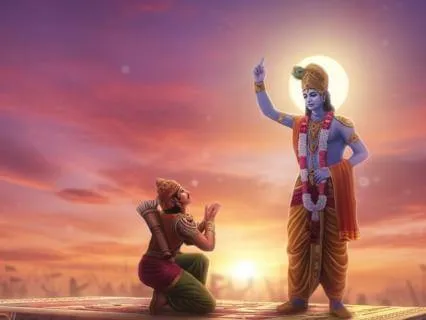
The Bhagavad Gita is a story of Arjuna.
And Arjuna.
Is you and me.
This is the story of the human being trying to.
Experience the life that we were born to live.
Because very often,
We live a life that.
.
.
Has nothing to do with our soul.
It's like we have this life that was given to us and it's some combination of what our parents thought.
Of adaptations to trauma and difficulty,
Survival instincts.
Hopes and dreams or feelings of success and self-worth And so our life becomes this,
These really interesting,
Interwoven tapestries of a whole pile of things that have nothing to do with our personal journey.
It's kind of like.
.
.
If I was to take everybody that was here right now.
And I was to say,
I want to be like this,
The way Jennifer is.
And I want to be this,
The way Lady is.
And I want to be this,
The way Johanna is.
And I want to do this.
And I kind of create this tapestry of all the ideals that I think I want to be.
After I've absorbed,
You know,
Like 20,
40,
100 different people.
I may have no idea who I am.
I may have absolutely no idea who the sole Katrina is.
And very often that's where we end up.
It's not like we got here because we made mistakes.
We got here just because.
We want to be happy and we want to feel clear and we want to do it and we just absorbed all these things from the world around us.
So Arjuna has come to a place in his life which is shown to be like a battlefield in the Gita.
Where he doesn't know which way to turn.
Everything he's ever been taught,
Everything he's ever learned,
Everything he's ever you know,
Developed within himself.
They all seem to be at odds now.
And he just has given up.
He's like,
I don't want to play anymore.
Krishna is his family friend,
Also God,
Also our highest self.
Our guides,
However you understand this.
And Krishna is helping him.
To get back in the game.
To get engaged,
To strip from him.
The parts of him that aren't actually him.
That maybe they're parts that just got there.
Added on or maybe there are even things that we tried.
Maybe we tried this one thing and.
.
.
It isn't really what we're into.
But maybe it's still hanging around and it's lurking because maybe we're afraid to let it go.
So at this point,
You know Krishna's been talking about what would it be like if you truly meditated,
If you truly realize that you are a divine being here on earth.
What would it be like to release the attachments from?
Everything that the world thinks is so important,
Like the world is a funny place.
The way it is right now.
I don't think it'll always be like this,
But the way it is right now.
It's almost like everything.
The value of everything is based on how much it costs.
You know,
How many little green pieces of paper can you exchange for that thing?
You know,
This is how you gauge your rent.
This is how you gauge how much.
You bake a loaf of bread.
Oh,
Well,
How many little green pieces of paper is it worth?
Like everything's about the little green pieces of paper,
Also known as money.
But that's weird because none of that even brings happiness.
It brings comfort because we need a roof over our head.
Like that's the challenge with the whole money thing is that.
We actually do need shelter,
And we do need food,
And we maybe need braces,
And we maybe need to fix our car.
And all of these things.
Are done in the context of money.
So we can't actually get away from it.
But it sort of blinds us to.
What life's really all about.
So the yogic traditions,
Tantric traditions,
You know,
They're all about There's a bigger world out there.
The money,
Sure,
Make the money.
You know,
Render unto Caesar what is Caesar's.
Like,
That's okay.
That's not who you are.
Even the stresses about money and health and all these things,
They're real.
But they're not who you are.
They're just what you're doing.
They're just sort of what's happening today,
That life is always flowing.
In this moment,
Someone could come onto the porch and have a conversation with me.
And then they're gonna leave.
And then someone else is going to come onto the porch and have a conversation with me.
And then they're going to leave.
And then maybe I'm going to walk over there and I'm going to stand on someone's porch and have a conversation with them.
And then I'm going to leave.
Like what's real is that life just keeps flowing.
And what the yogis and the tantrics say,
We don't want to get too attached to the person standing on the porch.
Or the circumstance.
Anything at all because as soon as we stop flowing with life We stopped living.
Suddenly we're terrified that,
Oh,
I really like this.
I like this person on the porch,
Person,
Thing,
Money,
Opportunity,
Whatever the thing is that has now appeared.
And it's like,
I like that.
And then all of a sudden you realize that it has to move on and you're like,
No,
No,
No,
No,
No,
No,
No.
Stay,
Stay,
Stay,
Stay.
It's like we,
And we create this big stress.
Because it's almost like we don't understand the nature of life.
The nature of life is that it continues.
So I live in Canada.
And Canada has pretty distinct.
Seasons.
You know,
They get longer and shorter.
Winter seems to be getting longer sometimes and I personally could use with a longer summer or fall but They're very distinct.
Growing up in Canada,
You do become accustomed to the changing of the seasons.
That it's like.
.
.
Summer lasts from maybe June to August.
Late September and then fall comes and then eventually winter comes and we live in a snow belt here so it's massive snow.
Do you know how much struggle we can create inside of us resisting the seasons?
Just think of the difference between someone who fully embraces the changing of the seasons,
Not because they like it or it's right,
Because it's what is.
It's reality.
Fighting the seasons is crazy making.
Like if we don't want seasons,
We need to move.
Somewhere where there's no seasons.
But to live in Canada and fight the seasons.
Like it's funny,
Like last winter,
For example,
Like I'm not a winter person because I'm quite naturally very cold in temperature wise.
And so.
I don't like being cold and it gets really cold here.
It gets like minus 30 minus 40.
Like it's good Celsius.
And it's really hard driving out here where we live.
It's very dangerous in the winter blizzards.
And I can really get myself complaining about the winter.
And so last year,
As the winter came on,
I really watched my thoughts.
And I thought,
The winter is coming,
Katrina.
You're 57 years old.
Well,
I was 56.
Why don't we just allow winter to come?
All these weird thoughts and things i say that oh i hate winter i'm so oh why can't it like It does nothing but kind of poison my system.
So it actually became my daily practice,
My daily sadhana.
To find something beautiful about winter.
About that day.
To feel the crunch of the snow,
To feel the coolness on my skin.
Because it doesn't change,
Like me complaining doesn't change winter.
And so with the Gita and what Krishna has been trying to teach.
Arjuna is that Life goes on.
Having attachment to this or that or repulsion to this or that.
Doesn't really matter.
And you're actually cheating yourself of actually being in the moment.
Like in this moment,
You're alive.
Krishna's been talking all about how,
You know,
This is what it would be like if you actually were.
A person who was clear and wise.
I might just read back a little bit before we go on with today.
So this particular dialogue,
Arjuna says,
How would you describe the man whose wisdom is steadfast,
Krishna?
How does the wise man speak?
How does he sit,
Stand,
And walk?
And Krishna says,
When a man gives up all desires that emerge from the mind and rests contented in the self by the self.
He is called a man of firm wisdom.
He whose mind is untroubled by any misfortune.
Whose craving for pleasures has disappeared.
Who is free from greed,
Fear,
And anger.
Who is unattached to all things.
Who neither grieves nor rejoices if good or bad things happen.
That man is a man of firm wisdom.
Having drawn back all his senses from the objects of sense,
As a tortoise draws back into his shell,
That man is a man of firm wisdom.
I'm going to come forward a little bit.
Restraining his senses,
Disciplined,
He should focus his whole mind on me.
When the senses are in his control.
That man is a man of firm wisdom.
If a man keeps dwelling on sense objects,
Attachment to them arises.
From attachment,
Desire flares up.
From desire,
Anger is born.
From anger,
Confusion follows.
From confusion,
Weakness of memory.
Weak memory.
Leads to weak understanding.
And weak understanding leads to ruin.
But a man who is self-controlled.
Who meets the objects of the senses with neither craving nor aversion.
Will attain serenity at last.
So we talked about all of those verses in previous talks that are all recorded,
And you can listen to them on the playlist.
Today,
We're looking at chapter two.
Verse 65.
And this is what it says.
In serenity.
All his sorrows disappear at once.
Forever.
When his heart has become serene.
His understanding.
Is steadfast.
This is Paramahansa's version.
In soul bliss.
All grief is annihilated.
Indeed,
The discrimination of the blissful man.
Soon becomes firmly established.
In the self.
So I'm going to reread.
Stephen Mitchell's version.
And I would love to know what you guys think.
Feel or think about this.
In serenity.
All his sorrows disappear at once,
Forever.
And when his heart has become serene.
His understanding is steadfast.
What comes up for you when you hear that?
What thoughts or what words or what emotions even rise.
In serenity,
All his sorrows disappear at once,
Forever.
When his heart has become serene.
His understanding is steadfast.
To live in the wisdom of the self.
Capital S,
Exactly.
Makes me want to think of the Ananda Mayakosha.
Causes me to imagine myself as an oak tree,
Steady,
Strong,
Peacefully blowing in the wind on a grassy hill with the view of it all.
Serenity.
Peace.
You know,
It's interesting when I read that,
My first thought is,
Wow.
To come to a place where we have no sorrow.
This feels like a very.
.
.
A distant idea.
And I can imagine,
You know.
Times in life where we were like,
Whoa.
How could I possibly not have sorrow if you knew what I was going through?
I wouldn't,
You know,
You would understand that this was impossible kind of idea.
I think of how I did not hold this frequency Saturday night when working with my mom.
Right?
Like we can think of all the times when that serenity was definitely not there.
But what's interesting is the Sanskrit.
Yeah,
There's a word,
The very first word in the Sanskrit is prasada.
And Prasad means Oh,
It's chapter 2,
Verse 6.
Prasada means Well,
Pra means fully,
Intensely,
And sada means to settle down.
To sink,
You know,
To relax.
So prasada,
As much as it means serenity and that kind of thing.
What it really means is to settle down completely.
Or in the words of yoga,
Of classical yoga,
To completely calm the mind.
The thought forms,
They'll call them vrittis,
Like we would spell it v-r-i-t-t-i.
Vritti,
Which is like a thought.
Thoughts,
Thoughts,
Thought,
Thought,
Thought,
Thought,
Thought,
And then this thought creates another thought and that creates another thought,
You know,
That kind of thing.
Imagine the feeling inside.
When all the thoughts have stopped.
All the stressors have gone.
There is no anger,
There is no longing.
There's no grieving,
There's no tension in the body.
This is Prasada.
This is the context especially.
Sanskrit words have a million meanings and they all mean different things depending on the context.
But in this context.
It's actually a boat.
Resting.
And this is really important.
Because.
We often think of serenity as something that only the gurus up in the Himalayas can experience only after years and years and years of training.
And even then,
I may never feel that kind of inner peace.
But Prasada isn't.
This,
You know,
We think of serenity or we think of prasada like,
Oh,
This ecstatic peak that I have reached because I am such a devote.
You know,
Practitioner.
But the reality is it's actually.
Almost like the natural neutral.
That we all have within us.
Every one of us.
Has experienced.
Quiet,
Neutral.
When all the crazy has disappeared.
So for example.
If you think of a place that you really love to go.
Maybe you love to go to the beach.
And so you gather all your stuff and you get everything together.
And maybe even the kids,
Like whatever,
Who knows who you're taking to the beach.
But let's imagine you're going by yourself for some reason.
If you have children.
And you gather all your things.
You get in your car,
You drive to the beach.
You get all settled.
And you take a deep breath in.
And you gaze at the water.
There's a quiet there.
You didn't have to create it.
That quiet?
Is always there.
The only difference is.
Most of the time it's covered up with emotions and thoughts and life and all that kind of thing,
Right?
But it's always there.
And this is really important.
To know that every single one of us has access to it.
Every single one of us.
It isn't something out there that we need to develop.
It's actually.
Already here.
It's interesting,
Vijayram,
When he says,
A gracious gift.
This is a very common translation of prasada.
And there was someone who said something interesting.
Hmm,
One person described it as residing in tranquil benevolence.
Or another person called it an omnipresent divine broadcast.
This is the grace.
This is the grace of being human.
What we do beyond that.
That's just life,
Right?
We're living in a dualistic world where I like this and I don't like this and can you believe that's happening and that's no good and I don't like that person and I don't like what this person said but I do like that and I love chocolate but I don't like broccoli or whatever like that's the world we live in but all of that chit-chatter That's just all right on top.
Of this tranquil base.
It's inside of every single one of us.
And that's interesting.
That's why we meditate.
That's why we chant.
That's why we do yoga kriyas.
That's why we do yoga.
Or whatever practice you do.
Is to slowly quiet the mind.
Or yoga nidra,
Exactly.
Anything that quiets all those pieces.
So that you can feel that quiet inside.
And the wild thing is,
The more you experience it,
And sometimes we even have to simply recognize it.
Like I can do this.
Sometimes I will bounce from one job to the next job,
To the next job,
To the next job,
To this project,
To that project,
And maybe even be doing,
Be doing three different projects all at the same time,
Because this is,
This video is uploading and this over here is doing,
You know what I'm doing,
All these things.
And it's like we never stop and breathe.
Imagine taking a moment to breathe.
All the time.
So it's like.
Let's say you have a big project.
And you work on it,
And today you're like,
You have a to-do list.
Let's just say you have a to-do list.
And every time you cross something off your to-do list,
You go outside,
You sit down.
And you just take a deep breath.
And all the thoughts that were needed for that particular thing to do are gone.
Because you did it.
You've completed it.
It's finished.
How good is that?
And it's like you get to taste.
This prasada,
You get to taste it.
And then maybe an hour later you finish something.
And you stop.
And you go and you taste it again,
You just breathe.
I honestly think this is why many people love smoking.
Because it's a reason to stop.
The mind stops,
Everything stops,
And you just breathe for however long it takes to smoke a cigarette.
I used to love smoking.
It would calm my mind.
It's terrible for my body.
Like absolutely so bad for me.
Wow,
Did it ever break up the day?
You know,
Into these little moments of breathing deeply,
Going outside.
What if we did that all the time?
Because then what happens is the more time we spend in that settling down,
That total relaxation mode.
Because even sometimes at night,
We think,
Oh,
I'm just going to sit and relax in front of some Netflix.
I'm not saying it's not relaxing.
I enjoy watching a show or two,
You know.
But it isn't prasada.
It isn't?
Actual quiet because now we're being stimulated by the show.
Always being stimulated.
The feeling of not being stimulated is right there.
So now you imagine,
Take it a little bit further and say,
What would happen if I lived in that state?
What would happen if I deeply connected to that state?
So for example,
Let's just imagine this right now.
So let's everybody,
You can close your eyes.
Go to a place in your mind like the beach or the mountain or the forest or even your favorite chair with a cup of tea,
Whatever it is that brings you to that Exhale.
Just feel what that feels like for a moment.
What would it feel like?
To have that awareness all day long.
What would it be like to live in that awareness?
What would happen?
When something didn't go your way.
There's like a different context.
If we're running at a million miles an hour.
And suddenly you spill a glass of water or something.
It's like ah you know it's it's it's it's the response is in the same juju as wherever my mind is if my mind's going a million miles an hour my reaction to spilling the water.
Because it's a million miles an hour.
But what if you're in this quiet state?
And you walk and you spill water.
You kind of look at the water.
Then you kind of go.
.
.
And you go and clean up the water.
Like,
We don't even have to have an emotional response to it.
Because sometimes we spill water.
Or maybe someone was supposed to come over for coffee.
And in another mindset,
They might call and they say,
Oh,
I can't come today.
And in another mindset,
You know,
That you're,
When you're all attached to the world and all this stuff and your own junk and everything,
You're like,
Ah,
Damn,
They always cancel.
Why are they always canceling?
Why does everyone cancel on me?
Do people not like me?
How come you,
Well,
I mean,
They did,
They always go for coffee at that person's house,
But they don't come to mine.
How come that is?
Like,
You know,
So all of a sudden the vrittis,
The thought forms are just going at a million miles an hour.
But now imagine you're in this prasada state.
And you're really there.
And your friend texts and says,
So sorry,
I can't make it today.
And you're sitting in this prasad state,
And you're like.
Well,
I guess not today.
Something else is supposed to happen.
Like this is a real way to live.
And it's not like some Pollyanna.
Always seeing the positive in everything.
It's just merging with reality.
It's settling down.
It's relaxing into the flow of life.
And it doesn't mean that you have to take every single thing that comes.
Like all I know is when I'm really in that calm state.
One,
I'm way clearer on what I want to do.
And it actually becomes clear the actions I want to take in order to do it too.
So it's not a passive state.
It's an extremely clear state.
You know,
Very often many yogis,
They'll talk about how the goal of quieting the mind is like a lake.
And the thought forms of vrittis are just like stirring up the surface so much.
It's just so turbulent.
So as we meditate or we do practice,
Whatever we do,
Slowly those waves calm down.
And the lake becomes clear.
And suddenly we can see the reflection clearly.
Of what's going on in our life.
Can you imagine?
Someone disappoints you.
And that experience that is the truth which is happening.
The reflection that we experience comes from a choppy lake top,
Which is our mind.
All these waves.
Now imagine all these waves fueling our response.
Oh,
I can't believe it.
That should never have happened.
As opposed to the lake being clear.
And something happens.
And you just see it for what it is.
They're not coming for coffee.
That's it.
That's the only actual reality.
Everything else is a secondary thought.
And this brings us to this whole idea that when we live in serenity,
Or a person who lives in serenity.
All sorrows.
Are eliminated.
Now to understand that sorrow is not the same as pain.
Sorrow is not the same as misfortune.
Sorrow has nothing to do even with our outside circumstances.
Someone could be in perfect health.
Have zero pain in their body.
Have a full bank account,
A roof over their head,
A family who loves them.
And they could live in total sorrow.
Sorrow is a fabrication of the mind.
If you were to imagine that,
Very often in our lives.
There's something that we want.
It's normal.
This is what brings us forward.
This is what we walk forward doing.
So this is where we want to be.
That this is the situation where we really are.
This is what is real.
And there's a distance between what is and what I want.
That's normal.
It's normal.
To have.
Life not necessarily line up with what we're desiring right now,
With what our ego desires,
And not in a bad way,
Just in,
Yeah,
This is what I want.
Like,
It could be something as simple as,
I really need to make more money to pay the bills this month.
But the reality is I don't have that money.
That's real.
It's not like some weird sign of a lack of enlightenment.
Or Megan talks about,
You know,
Living with chronic illness,
Chronic illness and pain.
It's exhausting.
There's no,
It is not easy.
So there is a distance between how I wish I felt and how I do feel,
Like this is the actual state of my body.
This is what I'd love it to be like.
There's a distance.
So this is quite a normal human experience.
That I desire something.
And to me,
I think there's something that's very healthy about that.
We still are seeking.
Something new.
That we haven't given up hope.
That something could be different.
So I think it's a very healthy thing that there's a distance between what is and what I would love.
The question is,
How do we respond?
To the fact that there's a distance.
Because that.
.
.
Is completely in our control.
That is 100% in our control.
It could be that.
You want to lose weight.
And at this point,
I weigh this much,
But I would really love to weigh this much.
So there's a distance between this and that.
So what do you do with that distance?
Do you beat yourself up every day?
Do you just like,
Oh,
I can hardly wait.
When will that happen?
And you become impatient.
Do you get angry that it's the food industry's fault?
It's my parents' fault.
It's genetics.
It's my ex-husband.
What do we do with it?
Everything I've just said.
Is a hundred percent fiction.
I'm not saying that those ideas aren't coming from reality.
None of them have to be there.
The only thing we know for sure is there's a distance between where I am and where I want to be.
That's it!
Sorrow comes when the mind kicks in and now starts feeling really sad.
You know,
Starts feeling really sorry for ourselves.
That's different.
You know,
It's that whole story that,
You know,
I once wished I had a new pair of shoes,
And then I met a man that had no shoes,
And then I met a man that had no feet.
We can always find a worst case scenario.
We can always make it worse.
We can always make it better.
But you can feel like the difference in there,
Right?
Like the man with no feet,
The man with no shoes,
The man with,
You know,
Who wants new shoes.
They all have a distance between what is and what they want.
Whether we have sorrow about it.
Is up to the person.
You know what I mean?
Like it's a really interesting thing.
So this is where when he says,
I'm just going to reread.
The Sutra.
In serenity,
All his sorrows disappear at once,
Forever.
When his heart has become serene.
His understanding is steadfast.
In serenity all sorrows vanish.
Now the other piece I want to mention though is because that may feel also like something that's very far away.
Like,
It's like,
Yeah,
I can intellectually understand what you're saying,
But that's a long way off for me.
My understanding of that and in my own experience.
As I deeply believe that we carry stories and trauma and joy.
In our DNA.
In our bodies.
Our bodies carry the memories of traumas and difficulties in our lives.
And just intellectually deciding,
I'm just not going to have these thought forms.
I'm just not going to do that.
I'm not going to react like that.
It doesn't work.
Because it's like.
.
.
It's like you've got 40 kids and you've locked them in the house.
These are the traumas in your body.
Well,
They're going to wreak havoc.
No matter how often you say,
You guys have to be quiet,
You guys have to be quiet,
You guys have to be quiet.
They don't want to be in there.
The traumas don't want to be in our bodies.
So they will try to get out.
They want to heal.
The body wants to come back.
To homeostasis.
It wants to come back to serenity.
That's our natural state.
And so all of a sudden,
When something happens,
The body will respond with these crazy emotional flare-ups and difficulties and thought forms and everything.
This is the journey of yoga.
This is why we do physical practice.
This is why we do pranayama,
That we don't just sit and breathe and meditate.
When we do very specific pranayama,
Which is like a meditation,
But you use specific mudras or very specific breath patterns or very specific eye focus,
Because they are doing this to actually rewire the brain.
And help develop our ability to observe ourselves.
And to work the trauma out of the body.
Like it's one of the reasons I love Kundalini Yoga.
Because Kundalini Yoga is physical,
It's movement,
It's sound,
It's breath,
It's all the things.
And it actually helps release the trauma out of ourselves.
Which is why a lot of people don't like Kundalini Yoga.
Because when they do it,
Weird emotions rise.
There's a lot of reasons why people choose different kinds of yoga.
Don't get me wrong,
But.
All of a sudden they're doing this yoga.
And they're suddenly having all these dark thoughts and they all of a sudden are really angry and they're thinking,
God,
I hate this yoga.
I just feel like crap and I'm having all these negative thoughts.
But this is what's really interesting when we realize that this is the point of the yoga.
The point of the yoga is to very slowly let one kid out of the house at a time.
Just like that one out.
Okay,
That kid's ready.
Let's look that it's weird I don't know what I'm talking about locking kids in houses,
But we're just one kid at a time just out And then as one kid comes out,
The whole ecosystem changes in the house.
And then all of a sudden there's another kid that's ready to come out.
So you do a different kriya and another kid leaves the house.
But we can't heal the mind without healing the body.
Where we can't heal the mind without releasing what's stored in the body,
Which often shows up as illness and pain and all kinds of things.
Not always,
But often.
So it's a very interesting thing and that's why like in the yoga and the tantric worlds.
The practice is so important.
Find a practice that really works for you,
Not just that you like.
You know,
I recently did a little video here on Insight Timer about how a personal practice should be a little difficult.
But not difficult like.
Oh,
Look how strong I am.
I'm going to do 14 pushups today or something.
I mean,
Challenging on a soul level.
That wow this is really bringing up some emotions.
But that's stimulating,
Interesting thought.
Which is stimulating interesting memories,
Which is leading me to realizing something about my current state.
And then eventually healing and integrating all of that.
And that's where it's so interesting,
Right?
Because once it's resolved,
It's resolved forever.
You don't ever have to return to that.
Our final.
Reading of this.
In serenity all his sorrows disappear at once forever.
When his heart has become serene.
His understanding is steadfast.
So my hope for all of us today,
And this is definitely for me as well.
I don't know,
Maybe we just need to take more time today.
In between tasks.
In between whatever we're doing.
To just go outside and just breathe and feel.
That deep,
Settled quiet.
What is that deed?
Settled prasada.
All of us have within us.
All of us have as our base natural state.
It's so cool.
Thanks,
Everybody.
Thanks for being here,
And I hope you have a wonderful week.
And we'll see you later.