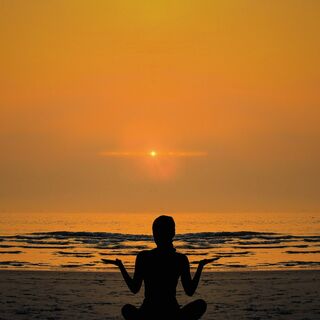
Please take your posture,
Seat,
And adjust as necessary.
We'll begin by taking three deep breaths,
Inhaling through the nose,
And exhaling through the mouth,
Noticing any tension that might be in your shoulders or your arms.
Feel free to adjust as you see fit.
Gently allow your breath to return to a natural rhythm.
Draw your attention to where you notice the breath to be strongest.
That sensation may be felt as it enters the nostrils,
Or you may notice it with the rise and fall of your chest.
Become curious to the act of breathing.
So notice your body as you're breathing and how it's moving,
How it's feeling,
The sensations.
As thoughts arise,
Just make note of them and return to the breath.
The practice of meditation is the practice of coming back.
And today we're using breath and sensations as an anchor.
As you're noticing your breath,
You may choose to count the exhalations,
Where you count starting with one,
And you take the count up to five,
And then you go back to one with each exhalation.
If you notice your mind wandering,
Come back to the count and start at one.
As you notice your exhalations,
You might see that the inhalation happens naturally,
That the exhalation is where you have a choice to take deep,
Sharp exhalation or long exhalation.
And so consider holding that space between the inhalation and exhalation a little bit longer and rest in that moment of awareness and then exhale.
If you notice that your breath remains at your nostrils or in your throat,
Try to draw it deeper into your abdomen.
Visualize a channel from your nose coming down through your body,
Where the breath is entering your body and dissipating throughout your body.
Now turn your awareness to the sounds in your environment.
It might be small noises that you hear from fans or from the computer.
Perhaps there's something farther that you can reach to.
Allow all these sounds to enter your space without judgment,
Without story,
Just allowing them to enter.
Notice if you become fixated on one sound and gently return to hearing all that's in your environment.
You may notice that the only sound is your breath and my voice,
And if so,
Rest with those.
Notice the quality of the sounds,
The pitch,
The tone,
Perhaps the rhythm.
We practice with sounds in the stillness of our homes so that when we enter the outside world,
We can use the sounds as grounding points.
As anchors,
Similar to the breath.
Those sounds that we may feel are rough or challenging to hear then become simply sounds.
We let go of the story around them.
So let us spend five minutes now in silence,
Either staying focused on sounds or your breath,
Whichever feels more natural to you.
And then we will return to the meditation.
As thoughts arise,
Return to the breath or the sounds.
Become curious to their sensations,
To their nature.
Allow yourself to gently return back.
Now let us take a moment to set an intention for our day.
Who do we want to be in this space?
How do we want to approach our day?
Is it with open awareness or curiosity?
Perhaps it's an intention of remaining present.
Keep note of this intention throughout your day and return to it at the end of the day.
See how setting an intention during a practice can help you with a reminder of the practice throughout the day.
Now let's just take a moment to offer ourselves some gratitude for showing up,
Starting the day with a practice.
Some self-compassion in the beginning of the day leads to the ability to take on whatever we're going to be facing.
Now,
When you hear the bell,
Please take a few moments to still remain seated,
Take a few deep breaths,
And then you can return to your day.
Bell.