Today,
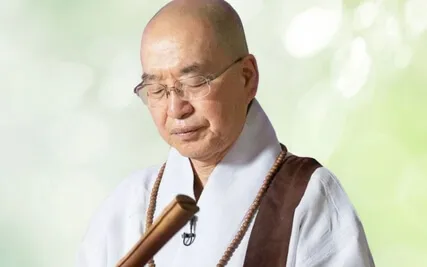
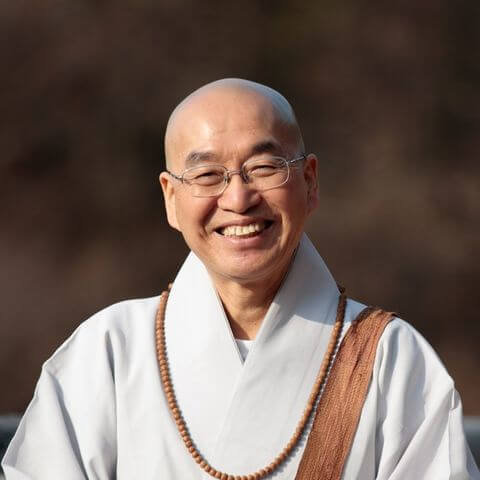
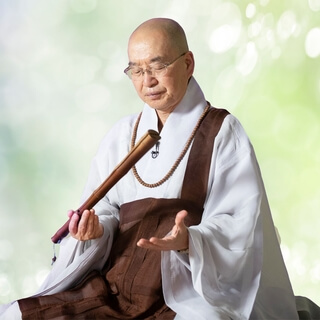
Venerable Beomjune spoke about incorporating mindfulness into a person's practice in farming.
In my experience with farming by hand,
I find farming or gardening to be a mostly repetitive activity.
Planting seeds one after the other,
Hoeing a row with repetitive motions,
Or carrying buckets of water in a similar fashion.
Can mindfulness work the same way with more complicated endeavors?
How can I incorporate mindfulness into my work,
In which I must have complicated discussions with many other people,
Or perform difficult calculations?
Can mindfulness work the same way for me?
The reason we're practicing mindfulness while sitting down is that this is the easiest way to practice.
And doing this,
Practicing in a quiet place,
Practicing with your eyes closed,
What we're trying to do is create an environment which minimizes external stimulus or interference.
So being mindful of the breath,
That's the simplest way that we can practice focusing our awareness on something that's simple,
Simple activities.
But doing it in such a simple way,
In such an advantageous situation is still difficult.
And that shows how much we lack our capacity to focus,
And how in a kind of a world of ignorance we live in.
So we live as if we're driven by an autopilot of karma that kind of leads us here and there So what we find out when we start practicing this is that at first that we're not calm,
We're not at peace all the time.
And second,
We realize that we're in a constant world of distractions.
And third,
We realize that we're living a life that's characterized by a cognitive dullness.
We're not awake.
So what we realize is that when something happens,
We're the ones who know best what happens.
So although we're in the best position to realize what actually happens to us,
We don't always do that.
We actually let things happen to us and then go back to it once it has passed and realize,
Oh,
This happened to us.
And so we're not really awake in the here and now to fully experience what happens to us.
That's why it's most stable for us to sit down when we're not at peace.
So we sit down.
And then we focus on the tip of our nose to recognize the breath.
But if we keep our eyes open,
We lose focus.
So what we're practicing by sitting down,
We're practicing being calm within ourselves.
And by focusing on the breath with our eyes closed,
And really focusing on the inhaling and exhaling of our breath,
We're trying to increase the capacity to focus.
And by focusing on the breath,
We're trying to increase the capacity to focus on the breath.
And once you have developed a certain capacity,
I know it's difficult,
But once you have developed a certain capacity,
You will be able to focus on the breath.
And once you have developed a certain capacity,
You will be able to focus on the breath.
And once you have developed a certain capacity,
You will be able to focus on the breath.
And once you have developed a certain capacity,
I know it's difficult,
But once you have crossed a certain threshold of practice,
Then if you stand,
And if you're in motion,
You're able to maintain such mindfulness in motion.
So it's probably easier for you to lose focus while you're in motion.
So at that point,
What you have to do is practice moving very slowly,
Very deliberately while maintaining your mindfulness,
So that you don't lose that focus.
So if you reach this threshold,
Then you can farm and be able to be mindful as you engage in small repetitive activities.
And you can slowly increase that to kind of faster and more frequent activities.
Then you can also increase that mindfulness to apply to your everyday activities.
So the next stage is,
While you engage in everyday exchanges with other people,
You have to be mindful of how your mind works.
So you have to be mindful of how your mind works.
So you have to be mindful of how your mind works.
So you have to be mindful of how your mind works.
So you have to be mindful of how your mind works.
So you have to be mindful of how your mind works.
So you have to be mindful of how your mind works.
While you're engaged in everyday exchanges with others,
And you're engaged in very busy activities,
And you see,
Hear a lot of things,
In that sense,
It's not the breath that you should be mindful of.
It's that in the midst of all those activities,
You are mindful of how your mind actually reacts to those stimulus.
So ultimately,
When you engage in everyday activities with others,
Say there's an insult,
And you feel the anger rise,
Or there's a flattery,
And you feel kind of excitement rising,
Because in the midst of all those activities,
You are mindful of how your mind actually reacts to those stimulus.
So ultimately,
When you engage in everyday activities with others,
Say there's an insult,
And you feel the anger rise,
Or there's a flattery,
And you feel kind of excitement rising,
Because in the midst of all those activities,
You are mindful of how your mind actually reacts to those stimulus.
So ultimately,
When you engage in everyday activities with others,
Say there's an insult,
And you feel the anger rise,
Or there's a flattery,
And you feel kind of excitement rising,
They say inoculation is the best cure,
Right?
So instead of trying to cure something once it happens,
Once you are infected,
Try to prevent the infection in the first place.
So the best meditation is to inoculate yourself against stress that comes from everyday interactions.
But what usually happens is that we receive all the stress,
We experience all the stress,
And we let it build up,
Then engage in meditation to try to extinguish it.
So I suppose that if you are stressed,
You should try to relieve yourself of stress.
But if you are mindful,
I don't think you should try to relieve yourself of stress.
You should try to let go of all the stress.
But if you are mindful,
I don't think you should try to relieve yourself of stress.
You should try to let go of all the stress.
But if you are mindful,
I don't think you should try to relieve yourself of stress.
You should try to let go of all the stress.
But if you are mindful in your everyday activities,
You have basically inoculated yourself against accumulating the stress in the first place,
Which is the best way.
So instead of using meditation as a relief for stress that we have accumulated,
If you go on a little more,
You'll be able to use meditation as a way to kind of vaccinate yourself against accumulating stress in the first place.
So going back to the question,
Right?
If you are a beginning practitioner,
You know,
Trying to do a lot of things,
You know,
Trying to do a lot of things,
You know,
Trying to do a lot of things,
You know,
Trying to do a lot of things,
You know,
Trying to do a lot of things,
You know,
Trying to do a lot of things,
You know,
Trying to do a lot of things,
If you are a beginning practitioner,
You know,
Trying to maintain equanimity and calmness,
If you are engaged in everyday complex activities with others,
You know,
That's going a step too far.
Let's focus on the foundational piece instead of trying to crawl before we can walk and fly.
So what I'm saying is that it's really important to focus on the here and now So what I'm saying is that it's really important to focus on the here and now as we take this baby step by baby step,
Not really allow ourselves to be distracted as,
What does it look like when I get there?
You know,
What's there?
What is it good for me when I actually get there?
You know,
What does it look like when I get there?
You know,
What's there?
What is it good for me when I actually get there?
And be distracted by those.