So yeah,
In this talk,
We're gonna be focusing a lot on.
.
.
Stoic joy which isn't talked about.
That much.
A lot of modern stoicism focuses on resilience.
You know,
How you can become emotionally tougher,
The dichotomy of control,
You know,
How you can not get so stressed out by the things that are not up to you,
Which are all super important.
But it's not enough to just not.
Be miserable,
Right?
There's this other side.
That happens.
Sometimes it happens as a result of removing negative emotion.
Joy is just this thing that exists as a fundamental attribute of the human mind when there are no clouds in the sky.
That's one view.
Like it's in joy and contentment is innate to all of us if we're not thinking in these distorted ways.
That's a view I actually believe the Stoics would believe.
But I think we can say a lot more about joy and happiness from a Stoic perspective.
And that's something that I want to explore here with some core habits and exercises and practices.
So the first thing I want to do is share two important quotes.
When it comes to stoicism and how the Stoics think.
About emotions and their worldview.
The first quote is from Epictetus.
Very simply,
He says some things are in our control and others are not.
Okay,
This is really basic and people often say this to us when we're having a bad day is,
Oh,
Just focus on the things you can control or don't worry about that.
It's not within your control.
It's one thing to say it and to kind of think it on the surface level,
But the Stoics.
.
.
Really embodied this fundamentally and they viewed all of life and all of thoughts into these two categories.
What can you control?
What can't you control?
What is up to you?
What is not up to you?
And they put all of their effort into the things that they could control.
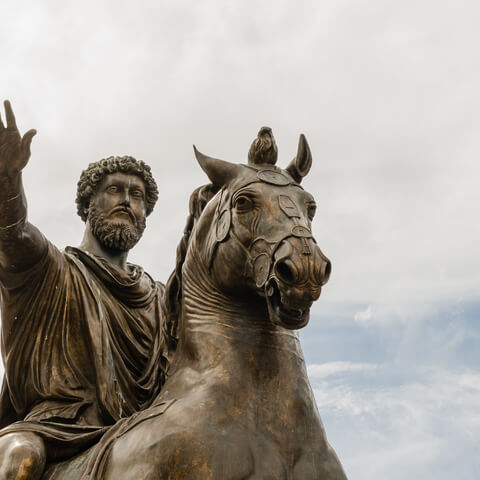
The next quote from Marcus Aurelius,
The Stoic philosopher emperor of Rome.
He said something similar to Epictetus.
He said,
You have power over your mind,
Not outside events.
Again this is the same thing and the reason why it's so similar is because the Stoics essentially sought out judgments.
And our intentions and our thoughts are up to us.
Whereas pretty much everything else like our body,
Our reputation,
Our wealth,
Our status,
All of those things are not up to us.
So he's saying the same thing.
You have power over your own mind.
This is the thing that is up to you.
This is the thing you can control.
The only way we're going to really start embodying the dichotomy of control is to turn it into a habit.
And the way that I like to teach this is the seven second stoic check.
So as you're going through life,
And you can practice this today,
You can practice it right now as I run you through it.
Something happens.
The first thing you do is you pause.
Okay,
Stop.
I feel emotion.
This has not gone as I wanted it to go.
Stop what you're doing.
The next thing is put a label on it.
This is in my control.
This is not in my control.
Pro tip,
Most of the things will not be within your control.
Like you get stuck in traffic,
That's not within your control.
Someone says something mean to you,
That's not within your control.
Most of the time it will not be in your control,
But it's good to put a label to it.
So step one is the pause.
Step two is to put a label to it.
And now step three is to take an action that is on the side that you can control.
One small action.
And then you just exhale the rest.
Epictetus had a phrase,
That is none of my concern.
It's essentially the same thing.
So as you're going through life,
Bring to mind a situation now that happened to you recently that frustrated you.
Imagine you're back in that moment,
You're practicing visualization,
You're putting yourself back there so you can train in stoicism.
The thing happens,
Now stop.
Now say to yourself,
This is in my control or this is not in my control.
Now,
What one single action can you do?
And it could be a change in attitude,
It could be a certain thought,
It could be a mantra,
It could be a physical thing you do.
Can you do that is within your control.
And then think of all the stuff that is not up to you,
All of the other people.
All of what they think and what they're doing,
The circumstances of life and the weather.
And then breathe that out.
Okay,
So this three-coil.
.
.
Philosophies embodied in this seven.
Second stoic check.
So first of all we have the dichotomy of control which we've talked about.
The next principle is called pro-hiresis,
And this is your faculty of choice.
This is the true freedom you have.
The true freedom you have to make the decision your own.
And then you have impressions versus judgments.
So the Stoics in their psychology.
Would say that an impression is this unverified,
Untested.
Pattern or shape or thought that forms before you've had a chance to rationally appraise it,
To endorse it or not.
So someone could be,
You know,
Say something to you and then the impression could be.
They don't respect me.
That's the knee-jerk impression that the mind forms.
A lot of us just accept these impressions as facts.
But the Stoics would say that,
Hang on a second.
You haven't thought much about this.
You haven't really tested it.
Before you start applying a value judgment like this is bad and this is what it means about me and this must be true,
Test it.
You know,
Say to yourself,
Is this actually true?
Do I have evidence for it?
May I be thinking in a distorted way about this?
Is this actually within my control?
So on and so forth.
So then your judgment would come along.
And test it.
And so as you go through life,
One of the best things you can start doing is to start putting things into categories.
This is up to me.
This is not up to me.
This is mine to control.
This is not mine to control and so on.
And you just keep doing that.
But it needs to be a practice.
A lot of us,
We read about the dichotomy of control.
And we think,
Okay,
That makes sense.
That makes so much sense.
And then maybe we tell other people about it.
And now and again we think about it.
But we don't truly embody the dichotomy of control.
And the only way to embody it regularly is to actually practice it regularly.
And so I would recommend looking out for at least five moments a day.
Where you can do this sorting.
Think of two people.
Person A.
Does like one dichotomy of control check a week and then person B does five per day.
Where are they going to be in a year from now in terms of their ability to practice with this dichotomy of control?
So that's the first habit.
And the mantra for this habit is,
I act where I have power.
And I release the rest.
The second.
Stoic joy skill.
The 24-hour virtue experiment.
Marcus Aurelius said,
Waste no more time arguing what a good man should be.
Be one.
And he also said,
If it is not right,
Do not do it.
If it is not true,
Do not say it.
So fundamental in Stoic philosophy was virtue.
Or nowadays we might say values,
Living according to the right values.
Which makes a lot of sense.
If you have,
If you rationally map out what you think is important in life and what you value and then you consistently live according to those values.
That is probably a lot better than just winging it and letting your emotions tell you what to do.
One of the exercises I did with one of my coaching clients.
Recently was to run through all of the messages both spoken and unspoken that they got from their family growing up.
So like how did your family What were the family rules about kindness?
What were the family rules about sadness?
What were the family rules about asking for help?
Spoken and unspoken rules.
And what you could see as my clients would kind of go through this and think about these rules is that they were acting.
Still from these rules.
It's not okay to be upset.
It's wrong to ask for help.
And then what I had them do is I had them rewrite new adult rules.
And the goal now for them is to,
When they feel these emotions,
When they feel like this tension for asking for help,
To think about the rule that they have,
That they've rationally thought about,
And then to live according to that rule.
That is how you grow.
Otherwise you're just going to keep falling back into those old patterns.
So that's what the Stoics did.
They were like,
What are the values that I want to live by?
Four cardinal values,
The most essential.
They're kind of sub-values and other things that are still important,
But the four cardinal values.
Is wisdom,
Courage,
Justice,
And self-control.
So wisdom,
So it's sort of like knowing what is up to me,
What is not up to me means to the right ends.
Courage is doing the right thing,
Even if you're afraid.
Justice is acting.
Fairly and justly and for the betterment of society and self-control is not taking things to excess,
Acting with moderation and so on.
So the 24-hour virtue experiment.
And again,
You can do this today,
Starting from now,
The next 24 hours.
Is that you pick one of these virtues,
Something that you think you might struggle with the most,
Whether it's wisdom or courage or justice or self-control.
And then you try to live according to it.
So you use an if then cue.
So if.
Something happens,
Then I respond with Insert Virtue.
So if I get cut off in traffic,
I respond with moderation.
And you go through it.
And think of something that you are likely to face today,
A difficult conversation or a certain type of event in work or in your family.
And then you run through it.
If this happens,
Then I'm going to respond with this virtue.
And then at the end of the day,
You do the three yeses.
So you ask three questions.
Was I aligned with my virtue?
Yes or no?
Did I follow my values over my moods?
Yes or no?
And did I act in a way that would be teachable?
To others.
I want other people to learn.
Those are the three things.
The guiding principles and philosophies for this habit,
For the virtue,
Is first of all there's this principle called arati.
Which is this idea that excellence.
Character and virtue and being the best kind of person you can be is the only true good.
The next one is Okiosis,
And this is the idea that we are all social animals by nature.
And virtue serves the common good.
It's not just a selfish thing.
And then the third principle of philosophy is identity is more important than outcome.
So you measure each day.
By who you were,
Not what you did.
Or what you achieved.
So for example,
If you worked really hard with the best intentions.
And maybe you didn't do the things you set out to do,
That's fine.
Okay,
There's no big deal there.
You worked hard and you focus in on that.
So that's the 24-hour virtue experiment.
What virtue will you be picking for this one?
Yeah,
Please let me know what a virtue and how you plan to practice it.
The third Stoic joy.
Practice is the view from above.
Marcus Aurelius said,
Confine yourself to the present.
And Seneca said true happiness is to enjoy the present without anxious dependence on the future.
So the core habit that we're going to be practicing is presence.
There's no point.
Thinking about all of these things that may happen.
Or may not happen in a worried,
Irrational sense.
It's different if you genuinely contemplate it.
Like if you run an actual analysis of,
Oh,
Here are the things that could go wrong.
Here are the things I'm going to do about it,
Like in a business sense,
That's fine.
Know if you plan to go traveling it's I think it's wise to think of potential hiccups and snags on the journey so you can plan according to them.
Just worrying about it and wasting your time doing that is not a good idea.
So the first habit We're going to use the acronym NOW.
And the first thing we're going to do is we're going to stop and we're going to notice.
Where is our mind?
Is it in the past,
The future or the present?
Step two,
The O,
Is to orient the senses.
So we're going to think of something we feel.
Something we see,
We're going to pay attention to it.
Something we hear.
And then W is work.
We're going to work the next right action.
And you can set a little alarm on your phone.
Set a little alarm or put a little reminder,
N-O-W,
With dots in between.
Notice,
Orient the senses,
Work the next right action.
And then if you have a bit of time,
You can do a quick view from above exercise.
And when we do the view from above exercise,
We practice rising up from where we are,
Rising up.
Looking at ourselves in our house,
Looking down on our roof,
Zooming up above our city,
Our country,
Up into the world,
Up into the atmosphere,
Above the earth.
And then we see our problems and our issues and our unique grievances from this vast perspective and we put things in perspective by doing that.
We realize we're just one small cog in something more complex than it feels when we're down here identified with ourselves.
Three guiding principles and philosophies that I recommend you explore.
Pro Saci,
This is vigilant attention to the present impression,
So this is a sort of mindfulness of thought.
Not going to be able to practice stoicism or stoic psychology that well if you're not paying attention to your thoughts.
If you can't tell the difference between an impression or a judgment.
Or anything in between,
You're not really gonna be able to run through this process.
So we need to start recognizing,
Oh,
Thought,
Oh,
Impression,
Oh,
Judgment.
And start paying attention to how our mind is working.
The next principle is cosmopolitan perspective.
So recognizing that you are part.
Of a vast shared order.
And that scale shrinks panic.
So if you zoom out,
Like with the view from above exercise,
You will start to feel a lot less panic.
And recognizing that.
One of my coaching clients said yesterday that It's okay to depend on others.
I thought that was a nice,
A wise insight because a lot of us so desperate to be independent.
We miss the fact that we are actually all reliant on each other.
The phone or laptop that you're tuning in from right now.
You didn't make yourself.
And that's just one tiny little aspect of your living space.
So in many ways we do rely on others.
Electricity is not something we generate ourselves for the most part as well.
And then the third guiding principle is impermanence.
And this is that everything is always changing.
The Buddhists had a similar view.
Change is constant.
You,
As Herakles said,
You can't step into the same river twice and you use this to soften any fixation on anything.
If you want to do a slightly longer three-minute version of the exercise I recommend doing one series of deep breaths so you can breathe in 4,
Hold for 2,
Exhale for 6.
Then you can do a body scan.
And then you can do a view from above.
That's like a three minute exercise you can do.
If you are.
Struggling with that.
So the mantra for this is be here,
Rise above,
And do the next thing.
The fourth habit.
For happiness from a stoic perspective.
Is turn obstacles into training.
Mark has already said,
The impediment to action advances action.
What stands in the way becomes the way.
Another quote from him,
Choose not to be harmed and you won't feel harmed.
What they're pointing to here.
Is that Ultimately,
It's our framing of an event or our.
.
.
Interpretation of the event,
Of the judgment we put onto the event.
That makes all the difference.
William Beer,
A Viennese Stoic writer and philosopher,
Said,
Imagine that you hear,
Imagine that you are running.
And someone comes up and tackles you from behind.
What is that good or bad?
And A lot of people say,
Yeah,
That's really bad.
That's not good.
But then he says,
Well,
Hang on a second.
You should have asked what was I doing,
What was happening,
When it happened.
And he gives the example that if you were running at night in a park.
Someone came up and tackled you from behind of course that's going to be you know,
Maybe call the police,
You know,
It's like a crime is being committed,
I've been assaulted.
But if you were playing football or rugby on a pitch.
.
.
Then you may actually feel exhilarated by the tackle.
Or if you were in wrestling practice and your best friend tackled you.
Again,
You may laugh about it.
So the same physical action,
Because the intent and the context is different.
There's a very different emotional charge behind it.
And you can play around with these frames yourself.
So William B.
Irvine has this frame,
He calls it the Stoic God frame.
He doesn't believe.
In a stoic god,
But what he does is when something difficult happens,
He imagines that there is a Stoic God looking down on him,
Asking him,
How are you going to handle this?
Handle this in the way that surprises me and that I'm impressed by.
So that's an example of a frame that you can play with.
The acronym that I like to use here is PAUSE,
P-A-U-S-E.
And here's how we go through it.
So the first thing,
Again,
A lot of these exercises,
It's always good to pause and breathe first.
Every time we do a meditation,
There's a short breath work at the beginning.
Because it's very difficult to think rationally if our nervous system is hijacked.
So we pause and we breathe.
The A is for acknowledge.
What is the story that is unfolding in my mind?
Then the U is to untangle control.
So look at what you can control,
What you can't control.
What is the context of this?
Could this serve me?
Might not serve me?
And then the next,
The S,
Is to select a frame.
Is this a form of training?
Is this a discovery?
Maybe the frame could be,
Is this going to matter in five minutes,
Five days,
Five months,
Five years?
And then you always end an exercise with an action.
So you execute an action.
So you pause,
Acknowledge the story and tangle control.
Select a frame that is empowering and you execute the next step.
There's a technique that I think is very.
.
.
Underrated and that is premeditatio malorum.
And this is to rehearse likely hitches so that you can prepare for them mentally and see how you can respond to them.
This is done in business.
It's called a premortem technique.
So a lot of businesses do this exercise where they think of all the things that could go wrong in the next 12 months.
They make a big list.
And then they do everything they can,
They make a plan to prevent all of those things going wrong.
I believe that Elon Musk did this,
I think he was talking about when he was building a ship that is going to be going to Mars.
The way that he went about it was by systematically looking at every possible thing that could go wrong on a trip to Mars.
Really brainstorming hard about all of the issues that could come up.
And then using technology and engineering to prevent those things from happening.
This is not negative thinking.
This is not dwelling on negatives and manifesting a negative future.
This is more sort of scientific.
That's the frame of premeditation of adversity.
You essentially say,
You know,
How am I going to travel to the airport?
Oh,
I'm probably gonna get a taxi.
Okay,
But what would happen if the taxi.
.
.
Wasn't there or was too expensive,
Then I should probably have a backup,
Right?
I'll get an app on my phone just in case.
You know that there's a 95% chance that you can do option A but the fact that you've spent a bit of time not worrying about it but just being prepared and mature now you are more likely to get to the airport.
So this is the idea of premeditation.
But we can also use this exercise with our emotions and our life.
So we can premeditate on that talk or presentation we're going to be doing.
And imagine what are the things that could go wrong with it.
What if people don't like it?
We could pre-meditate on an exam that we've got coming up and ask,
You know,
Could this be super difficult?
What if it asks me a question I'm not prepared for?
What if there's a curveball there?
And you make a list of all those things and then you can either physically do the action to prepare for them or mentally rehearse how you would prepare for them.
And another concept that I love,
I've got to talk on this is.
Amor Fati is the idea that we love whatever fate brings.
We don't just accept it and go,
I don't really like that happening,
But I accept it.
Instead,
We go a step further and we say,
I'm so happy that this has happened because And we often need to change a frame there.
The fifth stoic habit for joy is gratitude and acceptance.
William B.
Irvine has this theory,
He says,
It's the gap theory of happiness.
A lot of us act like.
We are here on one side of a chasm and across the gap.
There is the thing that we want,
Okay?
So we are here and there's a gap between what we'd like.
I want a new car.
I want a new relationship.
I want new knowledge.
I want this new piece of technology,
Whatever it is.
And so we think if we can cross the gap.
Then we'll be happy.
And this is how most of us live.
If you think about your goals and where you want to go,
You are always trying to close this gap.
I want more money.
How can I close the gap?
I want this extra thing,
How can I close the gap?
I want a better body,
How can I close that gap?
I'm not saying these are morally wrong in any way.
But it's worth analyzing them and asking,
Is this the best strategy for happiness or is there a different way?
A slightly different way.
The Stoics would say that instead of wanting things across the gap,
How about learning the skill of wanting the things you already have?
Wanting the things on your side.
And the truth is,
However you're living right now,
Whoever you are tuning into this.
You have elements of your life that would truly be.
Another person's dream.
10 billion people on the planet?
You don't think that there's a few people?
If not millions of people.
That would consider the things that you have,
The resources that you have to be a dream come true.
Even basics like clean water.
Fast internet.
The ability to meditate without,
You know,
And having the luxury to do that without being in survival mode for your next meal.
You know,
The fact that you are not knocking on death's door.
And that you have some level of health.
That you can actually have goals.
All of these things would be another person's dream.
Fortunately,
We don't recognize that and we don't have the gratitude of what we already have.
Epictetus says he is a wise person who does not grieve for what he has not but rejoices in what he has.
Marcus Aurelius says,
Receive without pride,
Let go without attachment.
Cool habit.
For this would be three blessings.
So think quickly of the three things that you want.
That you already have.
Do you have that?
You could be grateful for.
Clean water,
A cozy shelter,
People that love you.
And then you just have a very quick moment of imagining losing them.
You just imagine losing them very quickly,
Not much,
Just imagine life without this.
And then you accept.
Situation.
Appreciate that you do have these And then you can say,
This is here,
I cooperate with life.
So the guiding principle here is enoughness.
Master the art of enoughness.
Wealth is wanting less,
Not having more.
I'm all fatty.
Again,
Which we've looked at as well.
So instead turn with events rather than against them,
Go with the flow,
The current of life.
And another one is to delight in other people's qualities and virtues.
This is something Marcus Aurelius did a lot.
Be grateful for other people.
A common pitfall with gratitude is that you start seeing gratitude as denial.
So instead,
Keep it specific,
Embodied,
And honest.
Grateful heart,
Open hands.
Now we're going to get into the nuances of how do you actually create a stoic joy routine.
So now we're going to get a little bit technical.
So the first thing is we want a morning Practice.
5 minutes.
The acronym here is A-I-M,
AIM.
So the first thing we do is anchor,
That's the A.
And take a few deep breaths.
Then we set an intention,
That's the I,
Name a virtue.
And then the next M is map one next action.
So we anchor with deep breathing,
We set an intention for the virtue that we want to practice.
And then we map one next action.
And if we meditate on it.
Obviously and embody it and rehearse it in our mind,
It will be more powerful than if we just quickly run through it.
So that's the morning thing,
Soon as you do when you get up.
Marcus Aurelius says the soul becomes dyed with the color of its thoughts.
Then the next thing,
We need an evening practice,
A short one.
So the evening acronym is SEE or SEE.
So we scan for those three S's.
Which we looked at earlier.
Which was,
Did I act with virtue?
Did I choose values over moods?
And was this teachable?
Would I be okay teaching this behavior to other people?
So we'd scan and look through those.
Then we extract a win.
And a lesson.
We let go of something.
We do three gratitudes and one acceptance.
And then the E is for envision two if-then plans for the next day.
So we scan,
Extract,
And envision.
And to make this work,
We need to practice continually.
We need lots of self-reflection.
And we need to show up in our roles as we should each day.
The Stoics believed in role ethics.
So looking at what each role in your life is and how you can show up to that to the best of your ability.
So what does it mean to be a good partner,
A good father,
A good mother,
A good brother,
A good sister,
Good whatever you do for your work.
And yeah,
So this is a really good overview to get you started.
So yeah,
That concludes the core six habits as a run through.
I just wanted to give you some things to work with and to practice with today.
I'll just recap.
Them now for reference.
So the first thing is we want to do the seven second control check The next habit is the 24-hour virtue experiment.
Then we want to do the presence and view from above element.
We want to turn obstacles into training.
And we want to practice the joy of enough.
And then finally we want to.
.
.
Put it all into practice.
Good luck guys.
Thanks for coming.