Okay,
Have you ever had this experience?
You're lying awake in bed replaying a conversation that you had.
Something that didn't go so well.
Maybe you're replaying what you should have said or shouldn't have said,
And it's keeping you awake.
You can't let it go.
You're ruminating and going over and over and over in your mind.
And then you go beyond just thinking about this conversation.
You're now thinking about what it means,
About you personally,
About your life,
About everything in your world.
The crazy thing about these thought loops,
This type of overthinking,
Nobody talks about the thought itself.
It's often not that serious.
It could be a look that someone gave you,
Something that was implied,
Something that wasn't said,
Maybe an email.
But the meaning that we give it.
It makes it snowball.
It makes it pick up its own sort of gravity.
Your mind took this thought and went wild with it.
And that's something people don't address when it comes to overthinking.
Overthinking is not a deep analysis.
It's not a neutral report.
It's a loop.
It's often something small that just gets bigger and bigger,
Loops more and more,
Gets more meaningful every time it loops around.
My goal with this video is to give you a stoic diagnosis of overthinking and to give you practical tools that you can start using today.
It's probably going to contain advice that you've never heard about before if you're quite new to stoicism.
Most of the common advice when it comes to dealing with overthinking has you look at the thoughts themselves.
You're having too many thoughts you're having the wrong thoughts so let's journal about it let's unpack it let's dissect it Maybe we can replace the negative thought with a positive one.
We can breathe.
We can run.
We can meditate.
They focus a lot on thoughts.
What is the content of the thought?
Whereas the Stoic,
View is,
Well,
What if the thoughts themselves aren't the problem?
Maybe the thoughts themselves are neutral.
Maybe it's more to do with what we are doing to the thoughts that causes the issue.
It sounds kind of radical in a way,
But what if overthinking is not even a thinking problem?
Epictetus was a 1st AD Roman Stoic philosopher.
He was originally a slave,
And then he earned his whoever would listen.
And in the end,
He had some pretty influential students.
And he's widely regarded as one of the greatest philosophers,
Greatest thinkers,
And certainly one of the greatest stoic thinkers of all time.
And Epictetus had this idea that he kept coming back to.
It's not events that disturb us,
But are judgments about them.
You may have heard that before.
It's quite popular.
It's been stolen and rehashed many times in popular self-improvement.
But I'll say it again.
That disturb us but our judgments about the events.
So say you're stuck in traffic.
It's a common experience we all have.
The traffic isn't the problem.
As tempting as it is to believe that it is.
It's the thoughts that we are going to be late and what that means and what we're going to miss and what this will mean for our reputation.
All of these thoughts,
The meaning that we give to the event is what disturbs us.
The Stoic diagnosis isn't trying to get you to think better thoughts.
It's just trying to get you to notice when you add a judgment to what is otherwise a neutral event.
It is that judgment that causes the disturbance and the suffering.
And if we don't notice the judgment,
Then we're just going to assume that the event itself,
Reality itself,
Is inherently bad.
And we are a victim of this bad circumstance.
So the Stoics had this word called fantasia,
Which means impression.
So we're always getting these different impressions as we go through life.
We could call them sort of knee-jerk reactions or our first storyline that pops into our head about a certain situation.
And then we are asked,
Do we assent or not assent or withhold assent,
Which means agreement,
To this impression?
So to give assent means to endorse it.
So if someone looks at you in a sort of strange way.
A Stoic would say,
Do you assent to the impression that they disrespected you?
And a seasoned Stoic would say,
I can't really.
.
.
Bet the house on that because i don't really know i couldn't say with 100 certainty that was the case that's why they looked at me that way because they disrespected me so i'm going to withhold assent The untrained mind will say,
No,
They disrespected me because I felt that was the case.
They give assent.
They endorse.
They agree.
They fully believe the impression that first hits them.
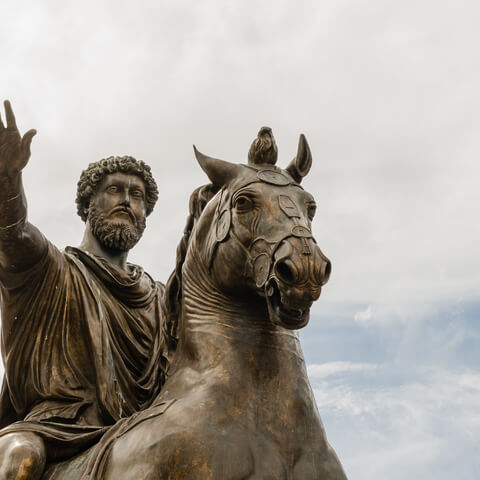
Marcus Aurelius.
Had this great line.
He said,
If you are distressed by anything external,
The pain is not due to the thing itself,
But your estimate of it.
He's sort of paraphrasing Epictetus here,
But the estimate,
I like that word,
The estimate of it,
Not the thing.
And so coming back to the topic of overthinking,
It's not a thinking problem.
The Stoics would say the reason why you're lying awake ruminating several layers deep into this overthinking chain is because somewhere along the lines you added a judgment and your job isn't to stop thinking isn't to replace the negative thoughts with positive thoughts but to locate the judgment what was the first judgment you added to this event and more importantly when i examine this judgment does it hold up the first practical exercise to help with overthinking is Really simple.
It's to try and find the first impression.
And to do this,
You just ask the simple question,
What actually happened?
In a lot of CBT exercises,
Right at the top before you do anything else,
They'll say,
Describe the event in neutral terms.
What actually happened?
Not your judgment,
Not the storyline about it,
But what actually happened?
And then when you've located that,
You can ask yourself again,
Okay,
But what really happened here?
What was my initial impression?
What did I think the second this thing happened?
As you ask yourself this question,
You still find that your mind wants to interpret and add judgments.
So just keep going.
What actually happened?
What actually happened?
This is not to dismiss how you're feeling.
Here but it's just to find out what was the actual event what was the first thing that happened before we added any judgments to the situation to our surprise we'll often find that not much happened it's usually pretty small most of the time.
The second exercise is to filter the thoughts through the dichotomy of control.
A lot of us have heard of the dichotomy of control,
Right?
It's like something happens and we can do some things about it and other things we can't do,
Right?
It's almost like the world is divided into things that are completely up to us and things that are not completely up to us.
So the weather is not completely up to us,
But how we respond to the weather is up to us.
But it can also be applied to thought as well.
Some thoughts just come to us.
They sneak up on us in the middle of the night.
Minds are not blank.
They're thinking machines.
So when a thought comes,
You can ask yourself,
Is this thought up to me?
And usually it's not,
Right?
It just comes.
But what you do with the thought is up to you.
So you can ask when the thought arrives,
How can I interrogate the thought?
How can I challenge the thought?
Is it up to me to.
.
.
Follow this thought down the rabbit hole.
Do I add any extra judgments to this thought?
So the dichotomy of control can also be used in the internal space as well,
To some degree.
And then when a thought does arrive,
Especially if it's like a heavy,
Difficult thought that might make you feel anxious or down,
Asking yourself that question,
What part of this thought is up to me right now?
And sometimes it will be nothing.
And sometimes it will be one or two things that are up to you.
And it can be quite liberating to see that a thought is telling us to do something that is literally impossible.
We can't change the past.
We can't predict the future.
We can't control other people.
So we can just say to that thought,
Okay,
Thought,
You're asking us to do something that is not up to us,
That is literally impossible for me to do.
And yeah,
I guess this is the end of the road here.
But sometimes you do have an opportunity to send a message or to put right or wrong.
You know,
It's not always impossible to do things,
But often it is.
The overthinking loop is often a substitute for taking action.
And that's why the dichotomy of control can be very useful because it's asking you to actually take action if there's anything you can do to take action.
It takes you out of this abstract.
Chain of rumination and puts you back in the driver's seat and asks you,
Well,
Where are you going to spend your effort now?
Thinking is cool.
I get it.
It's nice in a way,
Even though it can be painful,
But it's sort of entertaining or therapeutic in a sense.
Let's put down the thoughts that we don't have control over and let's ask ourselves what we can actually do today or tomorrow to solve this.
The third exercise that I recommend is the rational observer exercise.
Role models they would say you know what would socrates do in this situation it's a good exercise to do or they have this contemplation of the sage which means the ultimate wise person I don't think we need to go that far.
Just asking ourselves the question,
What would a very calm and rational person do in this situation?
How would they process this event?
If you want to make it even more tangible,
Just think back to a time when you meditated or you did yoga or you went for a long run or you did something that made your body feel very grounded and very calm.
And imagine what that version of you would think,
Say,
Or do in response to this event.
Nice bit of separation between us and the overthinking that we're experiencing.
And the idea here is when you're ruminating and when you're thinking,
Not to suddenly feel good about the thoughts.
But it's a question of,
Do I check my phone for the ninth time?
Do I catastrophize that everything's going to go wrong in the world?
Is that what the wisest,
Calmest version of me would do?
And we usually know the answer,
But that can give us a little bit of a push just to get us out of that loop.
So those are the three stoic moves that I recommend.
The first one is to strip back.
The impression,
Go back to the original event and keep asking what happened,
What happened.
The next thing to do is to ask what is within my power here and what is not up to me using the dichotomy of control.
And then the third technique is the rational observer technique,
Asking what would a role model do or what would the wisest,
Most calm version of myself do in this situation.
You don't need to use all three techniques all of the time.
Sometimes just one will be enough.
But the idea here is that we stop thinking,
That overthinking is a thinking problem.
And instead,
We realize that it's those subtle judgments we're adding to the event that is causing the suffering.
And what's really useful about these three tools is they get you out of the loop.
They give you something concrete to actually do the next time you're stuck in one of these spirals.
If you just want a really simple practice that you can start using today,
And you can do this even when you're actually happened and what am I adding to it?
You can journal about that.
You can think it through.
You can meditate on it.
But that is really,
Really useful.
And it's a core stoic technique.
If you can get good at answering that,
Here's what happened and here's what I added to it,
And it can become an automatic skill,
You will be shocked.
You'll find that overthinking happens way less and you'll have a much more clear head to be able to deal with situations as they come.