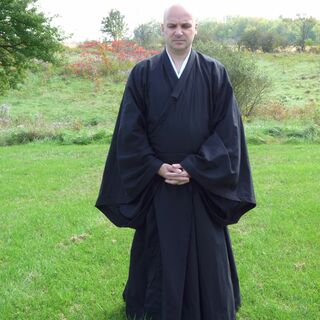
Hello,
It's me,
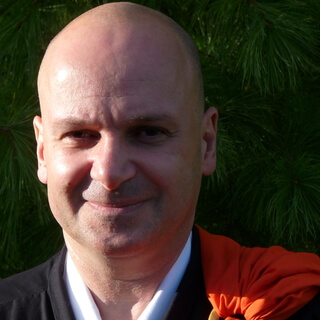
Joe,
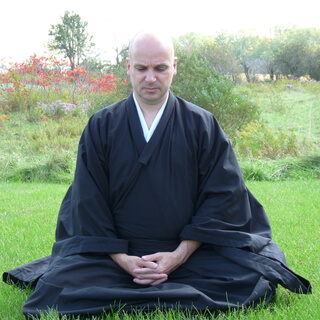
The Autistic Buddhist.
And today's session is called trying.
So I'm going to start with.
Something I recently read.
And it's about.
.
.
A Buddhist temple in China where the abbot of the temple the head monk.
Was sentenced to 24 years in prison for embezzlement,
Bribery.
And misappropriation of temple assets.
Investigations revealed that he had misused over.
.
.
$42 million between 2003 and 2025.
And therefore he was.
Charged.
Now,
When I first read this,
I became a little disappointed.
Disappointed because.
I would think that a Buddhist monk who had achieved the level of being a Buddhist abbot a leader in the Buddhist community.
Would have been beyond this type of behavior.
And sometimes when I talk to people about being a Buddhist and they mention some sort of scandal,
Whatever it may be,
Or some sort of wrong behavior.
They will add.
A sense of confusion to their statements by saying,
You know,
Joe,
I thought Buddhists weren't supposed to be like that.
In a way.
I think the same thing,
Although it's not a correct way of thinking because we're all human and we're all capable of making mistakes and taking the wrong path.
And I reflected on this abbot's life.
As a Buddhist,
How he got into Buddhism.
His initial intention was to be a good Buddhist,
I'm sure of that.
He didn't get into Buddhism too.
Steal money?
I would assume.
And believe that his original intention was to be a good Buddhist.
And although.
.
.
As a Buddhist,
He participated in all the rituals and he studied Buddhism and he completed the practice.
He's still failed in his attempt to be a good Buddhist.
I was surprised at myself and my perception of this incidence because I didn't focus on him being a Buddhist and then committing a crime.
I was focused more on him trying to be a Buddhist and failing.
And that made me think about what I'd like to talk about here today.
So let me explain that.
If a person says.
.
.
Perhaps like.
.
.
This individual said.
I'm going to be a good Buddhist or.
An example more pertinent.
To us all,
If a person says,
I'm going to run a whole kilometer or a mile.
Let's stick with kilometers.
I'm going to run a whole kilometer and they fail.
There's a sense of self-blame that attaches itself to that failure.
Because the statement is,
I'm going to do something.
I didn't do it.
I didn't achieve it.
So now I feel negative,
Guilty.
Because I didn't do what I set out to do.
But if you change that perception a little bit.
To instead of aiming for a goal,
Like running a kilometer,
To trying it.
The self-blame seems to evaporate or seems to be reduced in its significance.
Because when you try something.
.
.
You've already included the possibility of failure.
When you say,
I'm going to try.
What you're really saying is,
I'm going to try,
But I might fail.
I may not do it.
I thought of my life under that framework.
In my early years.
I had been in a few relationships that ended badly.
My goal was to be in a happy,
Supportive,
Mutually satisfying relationship and I did not obtain that goal.
In case you're wondering the reason.
Why that happened.
Is it was me.
I could not hold on to relationships because I was,
At the time,
A very controlling person.
When the relationship with my current partner.
Almost failed for the same reason.
I realized that I needed to try something different.
I needed to try a different approach to reaching that goal.
So.
.
.
I became a Buddhist and I started meditating.
Even the practice of meditation included several attempts that failed.
I tried several types of meditation until I found one that worked for me.
But my determination was not to get there,
It was to try to get there.
Not focusing on the goal,
But making attempts to get to the goal eventually.
And that took away a lot of the heaviness and responsibility of completing this.
My ego wasn't able to self-sabotage what I was aiming for as effectively as it would have done.
Perhaps a better example is like this.
Driving to a destination and then suddenly you find that the route to that destination is blocked.
So what do you do?
You try a different route.
Also,
Trying and failing kept the door open for me to try again,
Which is also something different.
Going back to my driving example.
If you're going to a destination and you find that the destination route,
The route to your destination,
Your goal is blocked.
You don't stop the car and say,
Oh,
Well,
I guess my.
.
.
Journey ends here.
Then I thought about all the things that I have been successful in,
In this life,
And thought about the ones I had not been successful in.
And I was able to see that in my past,
When I wanted something and failed at getting it,
The self-blame would then shut it down.
And a further attempt at moving forward.
.
.
Was sabotaged because I set myself up.
To achieve a goal and then I failed so I might as well just forget it because I wasn't good enough to achieve it.
I came to a decision that.
.
.
Perhaps it's better for me to change the way I speak about my goals.
To change the way I describe them to other people.
Instead of saying,
I'm going to buy a new car in January 2027.
I will say to myself and others that I'm going to try to buy a new car in January of 2027.
Right there with trying to buy the new car,
I've already declared that I may not meet this goal and that's fine because I'm trying.
I would ask you,
What goal do you have in your life right now that you're trying to get to?
What happens if you don't reach that goal?
How are you going to feel?
You can focus on your attempt to reach the goal.
And that you tried to get there,
But couldn't.
So,
You try again.
And if you're going to try again,
You're going to need to try a different path to the goal.
And if that second attempt fails,
Then you can try a third time.
The idea that you are being defeated is significantly less.
Because you are trying.
In essence,
What you're doing is you're reorientating the way your mind thinks about getting something you want.
And also keeping the ego at bay so it doesn't interfere with what you want to achieve.
I thought of an example where,
If someone had brought to me three boxes.
And put them on the table.
And they said,
Joe.
There's a prize in one of these boxes.
And you can open the boxes to find the prize.
What would happen?
I think most of us would agree that I or you would open a box.
And if the prize was not there,
You would move on to the second box.
That's trying.
Now,
Imagine a scenario where you open the first box and there's nothing there and you give up.
And that's aiming for the goal and then realizing you haven't achieved it.
There's a big difference in the mental process there.
This is a real life example that happened just a short time ago.
If I haven't mentioned it before,
I run regularly.
For exercise,
And a few days ago I got up early,
Put on my running gear,
Got into my car,
Went to my running destination,
And it started to rain lightly.
When I got to my running start point,
I got out of my car.
And started to run a few minutes the rain got heavier and it got colder so I jogged back to my car,
Got in and drove home.
And when my partner asked me.
You're home early.
I thought you were going for a run.
My response was,
I tried to go for a run,
But I didn't make it.
Which is the center of really what I'm talking about when I talk about trying,
Because I felt like I had made an attempt.
Which would have been different than me saying,
Yeah,
I was aiming to go for a run,
But then I couldn't because of the rain.
I hope that insight that I've had over time.
Will be useful to you in reframing your attempts to get to a destination or achieve something.
Because.
.
.
We're hard on ourselves as it is,
And when we.
.
.
Want to get something or want to be someplace,
And we fail.
And in one of my previous sessions,
I've mentioned that failure is fine.
We still have a sense of self-judgment.
And if we can reduce that,
Even by a little bit,
It'll make us happier.
Thank you for listening to this session,
And I hope it will be of use to you.
Goodbye.