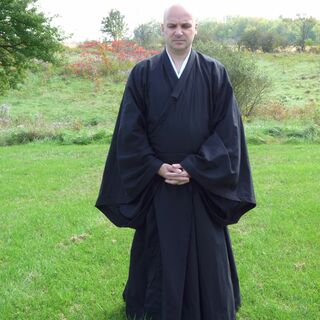
Hello,
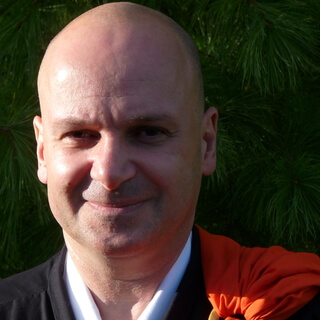
It's me,
Joe,
The Autistic Buddhist.
Today I would like to talk about Second Thoughts,
More specifically,
The Zen practice of Great Doubt.
But let's start with Second Thoughts.
Second Thoughts,
As we know,
Is a gap between thought and action.
A pause in between what you want to do and actually doing it.
It's mental hesitation,
The mind's own built-in break pad.
It's a useful defense mechanism,
And its aim is to protect you from potential harm.
Not entirely similar,
But related,
Is the Buddhist practice of Great Doubt.
In the Zen Buddhist tradition,
Doubt,
Unlike other religions,
Isn't seen as an obstacle.
Great Doubt,
As its term,
Does not weaken the practice,
Rather it intensifies it,
Driving the practitioner to seriously question not only Zen Buddhism itself,
But more importantly,
Great Doubt aims to explore your belief in the self.
Simply,
Who do you believe yourself to be?
For example,
Doubt doesn't accept that the mind is,
That you are who you are.
Instead,
It asks,
Who am I?
What is this mind?
What is this reality?
There are no academic or intellectual answers to this question.
This exploration can only be realized through direct experience.
This exploration can also lead to spiritual frustration,
And that's okay,
Because we're raising the question of,
I am not this,
Which leads to the other question,
If I am not this,
Then what am I?
And for some of us,
That is the core question.
But this spiritual frustration guides us to a deeper level of awareness,
Awareness that indicates we are not a solid I.
We have emotions that contradict each other,
Different thoughts about the same thing,
We act a certain way in one situation,
And yet faced with the same situation later,
We act in a different way.
How do you make sense of that?
And when we can't make sense of these waves of contradictions within ourselves,
We suffer.
The practice of Great Doubt in Zen Buddhism adds to these contradictions purposefully.
Along with Great Doubt is Great Faith,
Faith that the practice will reveal something about yourself to you,
And Great Determination,
The ability to stick with this exploration until you start to discover who you are.
When I started to practice Zen Buddhism,
I did so because I had reached a crisis point,
A point where my life was starting to fall apart.
I thought and thought about what was happening.
Why was I unable to maintain relationships?
Why did I need to exercise control over people and things to feel secure?
Why did I oppose those who disagreed with me?
And the central core of these questions was the I.
Why do I do this?
Which led to the question of who is this I that is destroying my life?
And that's where the practice of Great Doubt or having second thoughts kicked in.
What if this I is not me at all?
As I learned through Zen Buddhism,
Doubt is not something to be eliminated,
But something to be refined.
It's a tool that causes us to think about the bigger picture,
Exactly like having a second thought about an action we're going to take.
Second thoughts are automatically activated within us by nature.
With second thoughts,
There is a sense that an action that you are planning to take may have negative consequences.
Great Doubt,
Though,
Has to be activated by yourself.
It needs to be encouraged.
I often practice Great Doubt by accessing it when I'm about to take an action that doesn't seem to have any negative consequences at all.
If I'm going for a walk on a pleasant day,
I may say to myself,
Is this a good idea?
This exercise for me is kind of fun and sometimes even silly,
But it serves a purpose.
Ultimately,
The question is,
Does this practice actually strengthen our exploration of the self?
For me it did,
But then again,
Did it?
Thank you very much for listening to this session and goodbye.