Welcome to your practice.
Before we begin,
Make sure that you're in a comfortable position.
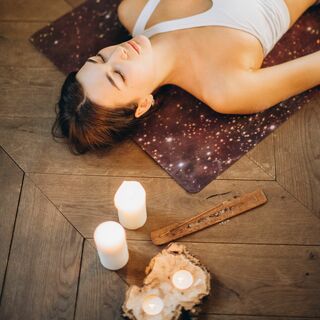
Yoga Nidra is traditionally practiced in Shavasana.
That's lying on your back with the legs open so that the feet are a little wider than hip distance apart and with the feet falling out towards each side.
Bring the arms a little away out from the sides of your body,
Keeping the arms straight and turn the palms of the hands to face upwards.
You can support your body here if that feels best for you by placing a rolled-up blanket or mat under your knees or your feet or by placing a block or a pillow under your head.
And for some people,
Shavasana isn't going to be the best position.
So if you don't feel like you'll be able to rest comfortably on your back like this,
Choose another position that feels better for you.
You could take your feet to the mat at hip distance apart and drop the knees in together or bring the soles of your feet together and your knees out to the sides,
Perhaps supporting the thighs with blocks or pillows.
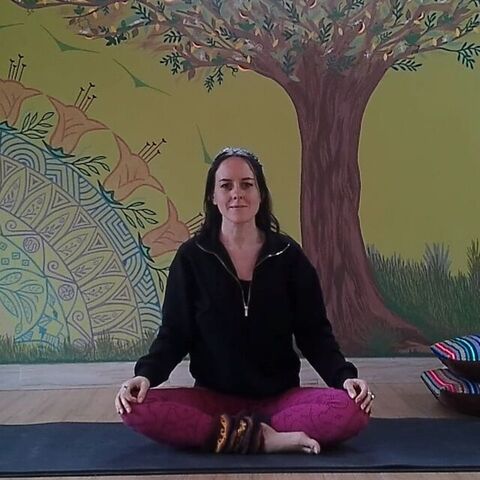
And this practice can also be done sitting if that's what feels best.
So just take a moment now to make sure that you're as comfortable as you can be.
And once you are sure you're feeling comfortable,
Warm and supported,
Close your eyes and feel into the feeling of your body resting into the surface beneath you.
Feel into all of the meeting points where your body connects with the surface beneath you.
And now bring your awareness to the breath.
As you breathe in,
Feel the breath filling your lungs and feel the chest expanding.
And as you breathe out,
Feel your body relaxing a little more deeply and sinking into all of those meeting points beneath you.
Continue to breathe like this.
Inhale to feel the chest expanding.
Exhale the whole of the body relaxes.
Now send the awareness out to the farthest sound that you can hear in the distance.
Without getting involved in what the sound is or where it's coming from,
Just observe that that faraway sound is there.
Acknowledge it and draw the awareness in closer to closer sounds.
To the sounds outside of this room.
To the sounds inside this room.
To the sounds closest to you.
The sound of your heartbeat.
The sound of your breath.
And as you acknowledge the sounds,
Know that none of these sounds are going to disturb you as you practice.
That they can only assist you in relaxing even more deeply.
We're going to practice the 61 point rotation,
Known in the Himalayan tradition as Shava Yatra.
During this practice we move the awareness through some of the main marma points or energy centers of the body.
As the awareness passes through each point,
We relax deeply on the physical and energetic levels and prana or life force energy is encouraged to flow more smoothly around the body.
All of the benefits of this practice are received through relaxation.
There is nothing that you need to do.
Simply allow my voice to guide your awareness from point to point.
We'll begin by bringing the awareness to the eyebrow center.
Rest the awareness at the space between the eyebrows.
And bring the awareness down to the space between the collarbones.
Rest at the space between the collarbones.
And the right shoulder.
Bring the awareness to the right shoulder.
The right elbow.
The right wrist.
The tip of the right hand thumb.
The tip of the right index finger.
The tip of the right middle finger.
The tip of the right ring finger.
The tip of the right little finger.
The right wrist.
The right elbow.
The right shoulder.
The space between the collarbones.
The left shoulder.
The left elbow.
The left wrist.
The tip of the left hand thumb.
The tip of the left index finger.
The tip of the left middle finger.
The tip of the left ring finger.
The tip of the left little finger.
The left wrist.
The left elbow.
The left shoulder.
The space between the collarbones.
The centre of the chest.
Rest the awareness at the centre of the chest.
The left side of the chest.
The centre of the chest.
The right side of the chest.
The centre of the chest.
The navel.
The lower abdomen.
The right hip.
The right knee.
The right ankle.
The tip of the right big toe.
The tip of the right second toe.
The tip of the right third toe.
The tip of the right fourth toe.
The tip of the right little toe.
The right ankle.
The right knee.
The right hip.
The lower abdomen.
The left hip.
The left knee.
The left ankle.
The tip of the left big toe.
The tip of the left second toe.
The tip of the left third toe.
The tip of the left fourth toe.
The tip of the left little toe.
The left ankle.
The left knee.
The left hip.
The lower abdomen.
The navel.
The centre of the chest.
The space between the collarbones.
The eyebrow centre.
Float the awareness down through the space between the collarbones.
To the centre of the chest,
The heart centre.
Rest the awareness here in the peace of the heart centre.
Keeping the awareness at the heart centre,
If you have a sankalpa,
Now is the time to invite your sankalpa to arise.
The sankalpa is a deep prayer or vow from the heart for something that you wish to attain or achieve in this life.
There is no need to force a sankalpa.
It will arise very naturally if it's going to come.
Perhaps it will come in words as a short positive statement or you may experience it as an image or a feeling or a deep sense of knowing.
And if you don't have a sankalpa,
Simply continue to rest at the heart and observe whatever arises at the heart.
It is not necessary or important to have a sankalpa but allow yourself this time to listen to your heart and invite your heart's prayer to arise if it comes.
And now,
Very slowly,
Begin to turn the awareness back outwards.
Bring the awareness back to the sounds that you can hear around you.
Allow the awareness to jump from sound to sound without getting too involved in any one sound.
Just acknowledge that those sounds are there.
And now become aware of the feeling of your body resting into the surface beneath you.
Become aware of the feeling of your clothes or your blanket against your skin.
The feeling of the air against your skin.
And in your mind,
Can you paint a picture of your body resting so peacefully and still?
Can you picture your body in the room that you're in?
Can you picture the walls,
The ceiling,
The floor,
The furniture and all of the different objects?
Slowly begin to deepen the breathing and very gently begin to make some small movements as you prepare to end the practice.
Begin to move the fingers and the toes the ankles and the wrists and give yourself a long stretch in any way that feels comfortable for you.
Take your time.
There isn't any rush.
When you're ready,
Slowly blink your eyes back open and make your way back to sitting.
This practice of Yoga Nidra is now complete.
Thank you for listening.