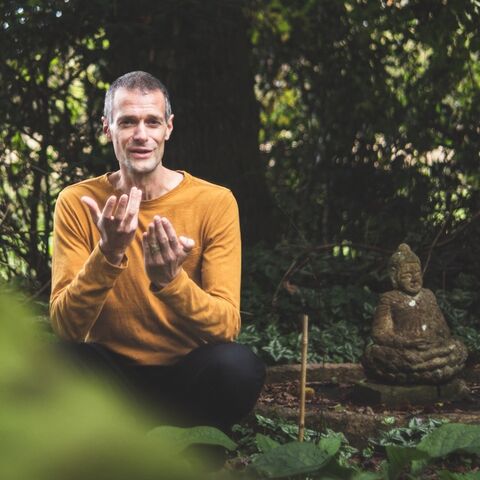
Wendy and I have started this meditation Q&A.
So the question we have coming in here is,
Will you ever feel like you're meditating right?
Actually,
I'm going to talk about being right.
How about that?
Would you rather be right or be happy?
Let me just go here.
I had this really clear understanding yesterday.
I was meditating and I was going,
Yeah,
The whole issue is really that we think that when we are good,
We are right,
That we will be happy.
It's a very conditional experience.
So what I would say is,
If you want to be happy,
Don't worry about being good or being right.
Just kind of sit with kind of where you are.
And that's hard,
Actually,
Now that I say that kind of it's hard.
You've just got to recognize that you're going to mess up.
What do you reckon,
Josh?
Like there's no right way to meditate.
It just means like,
Here you are.
I would say definitely,
And especially starting off,
This is what I tell my students and folks meditating with me,
Is for a while they did have this kind of fear that,
Oh,
I can't do this.
You know,
I just sit down,
My mind's all over the place.
And I'm like,
You cannot mess it up.
If you're doing it,
Especially starting off,
You can't get it wrong.
There's no way to fail.
And so just that starting point where people are kind of conditioned that they have to go and compete things,
And if they can't do,
If they can't meet their idea,
Then they give up right away,
Because they don't want to be seen as a failure.
So I just flip that around.
You cannot screw it up,
No matter what you do or don't do,
Especially when starting out,
Okay?
That is the starting point.
And then it just builds more skillfully from there,
Right?
So there's more wisdom and skill that starts from there.
But if you have this perception that I'm doing it wrong right out of the gate,
You'll never even get out of the gate.
Yeah,
So I think it's really important to not be disheartened.
What's this person's name that I'm talking to?
This is Tea Lady Nat.
That is her Insight Timer handle.
Tea Lady Nat,
Very nice.
And as a big tea drink drinker,
I just want to say thank you very much for being a tea lady,
Because it's like I live on that stuff,
So thank you very much.
And I want to add to what Josh has said,
Because often teachers just talk about this thing,
About don't worry about it,
But it's really hard.
We're really conditioned to thinking we've got to get it right.
And then it's sort of not really helpful to just go,
Just bum on cushion,
And then that's just good enough.
But I want to say something a little bit more.
So what I've really been looking at is that,
So can Josh,
So if you can just ask her,
Is it because,
Does she feel like she's doing it bad because her mind is wild?
What is it that makes her think that she's not doing it right?
Yes,
And Tea Lady Nat or Natalie,
I'm sure you've heard,
So what,
Again,
To relay,
What is the,
What makes you think that you're not getting it right?
Or that you'll never be able to get it right?
And she says,
I love that you said that you can't mess it up.
That gives me so much more confidence and freedom knowing that.
Okay,
So I think she was doing that typing.
So the question for Natalie is,
What makes you think that you'll never get it right?
Or that you're not even getting it right right now?
That's a very key question.
Okay,
So I want to add something to that.
So what I realized in everything is that that wild mind,
So there is the conversational mind,
Which is just thoughts.
And it's not that those thoughts are bad or wrong or anything like that.
You know,
There's that,
I was actually speaking to my partner this morning,
I think therefore I am,
But actually I am,
Therefore I think.
So it's kind of the other way around.
So thoughts will just arise and they will do that thing,
Because that's what thoughts do.
But we're really hooked into that.
And the reason we're hooked into,
We get pulled and swayed,
Is because that's,
I call it the ego part of the mind.
So there's a lot of identification in that.
And the ego arises because there's an emotion that sits underneath that,
Which is wanting to be known.
So what I would say,
There's a couple of ways to work with the really wild mind.
And one of them is to try and come back to like,
Just go,
Oh wow,
I'm kind of off and I'm in the Bahamas or I'm in an argument,
Or I've reliving some hideous whatever thing,
Or I'm suddenly having sex with my partner,
Whatever it is.
Just,
You know,
Commonly people will say,
Just come back to the breath.
But I want to kind of say,
Try something else and just explore and become curious.
So when you find yourself getting,
You're like off doing whatever it is that you're doing,
To just pause for a moment and simply ask,
What is the emotion common to all these thoughts?
And often what I found is when I'm in that space is I'll go,
Ah,
I feel ashamed or I feel desire or I feel seduced or I feel angry or something like that.
And then by simply going,
I feel ashamed.
Yes,
It's true.
I feel ashamed or I feel angry.
Yes,
It's true.
I feel angry or I feel hurt.
Yes,
It's true.
I feel hurt or sad.
Whatever it is,
I feel joyful or I feel distracted,
Whatever it is,
Doesn't matter.
And I feel confused or I feel I'm failing like you're talking about failing.
Then just to allow that emotion to be and then it's,
And then that wild mind will actually slow down because what the wild mind is doing,
It's like a child having a temper tantrum.
It has a temper tantrum because it's seeking to have its need met.
It's telling you something really important that it needs,
But it doesn't have the vocabulary and the capacity to articulate that well.
So the ego has no emotion.
All it has is an image and a concept and a story.
So by simply allowing the emotion that is kind of the fuel for that,
It's going,
I want you to feel this emotion.
And if you get caught in the storyline,
Which is not a problem,
But instead to focus on the emotion that's driving that,
That will allow,
It's like that then you kind of can feel the body drop and it opens up the space.
And then what happens over time is the emotional hijacking and the distractions become less intense and less pushed and pulled.
And they allow,
It means you start to get a bit more space with that.
So T Lady Nat,
What do you say?
Please give me some feedback about whether that's helpful.
And then she also said about three minutes ago,
How long that I am doing it as in being still,
The other thoughts that I can't seem to get out of my head.
And so this is the emotion thing is,
And I'm not really sure I understand this exactly,
How long that I'm doing it as in being still.
I guess,
Does that mean?
She's asking,
Is that,
Is she asking,
You know,
Do I need to have a still mind?
And then I want to ask,
Do you think that's what that means?
I think maybe,
Or how long can,
If she's judging it by how long she can sit still,
Because she did join me in a live set.
And,
You know,
Since I'm a seasoned meditator and I can sit 45 minutes,
No problem really without moving,
Then of course,
It's natural sometimes for us to compare and judge like,
Oh,
If I'm not sitting still for 45 minutes and formal,
I'm doing it wrong.
That's not the case,
Obviously.
Right.
So,
Um,
You go,
You go.
Can I just speak to that?
Can I just speak to that?
So when I start,
So I want to tell you about,
Uh,
Venerable Robina Caughton,
Who's very,
Very,
She,
She's a tough cookie.
Let me tell you,
She started because she just hated everybody and she ran out of people to be angry with.
And so she just went,
Oh,
Well,
I got to do something about this.
I've run out of people to be angry and I'm still angry.
So I got to do something.
Took her seven years to get the,
Her bum on the cushion.
She was,
She was a nun for seven years before she could get bum on cushion.
So it's totally not a problem to be able to,
To not sit for a long time.
Really.
I've been thinking a lot about this lately and how difficult it is.
So I,
I learned sitting in a center and I don't know about you,
Josh,
Presumably you started sitting in a center.
So no,
All by myself actually.
So it was,
I'm a rare case.
Yeah.
Okay.
Most people start in a center and it's much easy because there's something about the group that holds you.
I'd definitely say get an app is another thing to do.
Um,
That totally helps,
Uh,
Because that will help you.
That's kind of like having other people around you.
And when I started,
Gosh,
I started and I was in a,
In a class,
In a group.
And my body just wanted to explode.
And I just,
I had to leave the sit in the room before everybody.
It was like 10 minutes before the end.
And I was like 15 minutes before the end,
I'd already been sitting for half an hour.
My body was about to blow up and my mind was about to blow up.
I left.
And then somebody came back and said,
You can.
And I,
You know,
Like I had a lot of support is all I want to say.
But it is difficult.
Like run around like a mad chicken,
Like for 30,
40 years,
Whatever.
And now sit still and be,
You know,
Have a calm mind for 20 minutes.
Like it's nuts.
You can't do it.
Just start small.
Start.
If you,
All you can do is five minutes.
What you can do is one minute.
Start there.
Like just bum on cushion for one minute,
60 seconds.
Turn the phone onto airplane mode.
Just try there and,
And do that for a week and then expand two minutes.
And then I've got one client for four,
For four or five months.
She's been at four minutes.
She's like,
I cannot get beyond that.
So it's a process for sure.
And this is the,
This is restlessness you're talking about,
Right?
You're not talking about you were in pain or anything.
It was just sitting,
Just that momentum stopping that train.
Right.
And then because it's been going and going and going.
So like people have to have constant stimulation,
Right?
And it's not like the judge,
It's just how we've been conditioned,
Right?
And so when we take that away,
It's just like freaking out and not knowing what to do.
Right.
And not knowing how to sit still or,
Or do anything because there's no,
There's no reference point or no training.
It's just,
You have to do it to just jump in the deep end,
But it's not really the deep end because you can leave whenever,
You know,
It's not like you're taking a heavy psychedelic or you're being locked up or something.
Right.
You know,
If it gets too intense,
You just get up.
Yeah.
Just like when he was saying,
So it is a training.
And when I tell people a lot of times with this hindrance of restlessness is go and exercise.
It's like this,
A lot of this energy and walking meditation,
I can find helps too,
Or just regular walking because if there's too much energy,
Walking balances the energy system and slows us down.
If there's not enough energy,
Well then walking will give you know,
Summons energy and give energy too.
And it's a,
It's a nice balancer.
And,
And I also want to go back,
I'm sure you have some,
Or maybe you have some things to say about this too.
Then I want to go back to this emotion thing.
I found that really helpful about just really identifying the emotion and feeling it and acknowledging it and saying,
Yes,
It's true.
This is present.
And how important that is for people like me that are more cerebral,
How a lot of times I don't see the emotion.
I have to actually kind of bring that to mind to identify it.
And then they,
They feel each other.
So the emotion can fuel the thoughts and the thoughts can fuel the emotion until they're kind of seen,
Acknowledged and felt and felt by,
Okay,
So that whatever we name as an emotion,
Where can we actually feel that in the body?
Right?
So if it's anger,
Maybe my head is a little hot or maybe there's a,
There's a tightness in my stomach.
If,
If it's sadness,
Maybe I feel droopiness around my eyes or I feel sleepy,
You know,
And sometimes sleepiness can feel like actually kind of pleasant and just kind of wanting to check out.
Right.
But,
Um,
Yes.
So this is,
This is a common,
These are common things,
But the emotion thing I find is really helpful,
Especially for those oriented more around motions and thoughts too.
You know,
I,
I have a very intellectual bent,
So I,
I'm quite conceptual.
Oh yeah,
You are,
Yes.
Yeah.
By the way,
For anybody that wants an introduction for Wendy,
Because we just jumped in here a time or two,
Please see our previous show that we've done for Wendy's background and to get a better idea of who Wendy is and what she does.
So I'll just,
I will just say something.
Um,
So just to give people a bit of a heads up about who is this nutcase at the other end?
Yeah,
Including me though too.
I didn't,
You know,
I just,
I just want to say I've got about 20 years of practice in a couple of different traditions,
All in the Buddhist stuff that,
And I started because I was basically so wound up like a clock and my psychotherapist said,
You need to chill.
So that was my starting point.
I had heaps of trauma and meditation is not the cure for everything.
I'm definitely not a believer in that.
It's just one part of the puzzle.
Um,
And I did a psychology degree for years.
I did my honors thesis,
Uh,
On loving kindness meditation.
Cause I found that because I had so much anger,
I was really,
Really angry and I found love,
The loving kindness meditations,
Um,
To be the most beneficial.
And,
Um,
And I also have a psychotherapy training,
A somatic psychotherapy training.
So,
And I've been meditating for 20 years.
So just to give people a bit of a heads up.
Yes.
Okay.
One more thing.
And I also have just,
And I've also just been,
I've got a diploma in meditation teacher training,
Which I've just finished and I've got the next one starting,
Which is,
Um,
With Tara Brack and Jack Kornfield meditation mindfulness,
Uh,
Teacher certification program.
So that starts next year,
Two years.
So that's cool.
Yes.
So I remember I was talking about this previously.
So yes,
When he has some cred to say the least here.
So yeah.
Uh,
So let's see,
And then I,
I,
I want to finish up tea lady,
Nats here comment.
And then I also sense that you've had experience with,
Uh,
Trauma.
I want to,
Uh,
Get into how,
Um,
We ought to approach those with,
Uh,
Trauma in meditation versus kind of,
You know,
I not,
I guess maybe to draw a distinction here,
But I think it maybe might be an important distinction to,
To,
To,
To delineate here of those with,
Uh,
Really severe trauma and how they might approach meditation differently and how you coach them.
But before we do that,
The other thought,
Um,
Tea lady,
Nat says here,
The other thoughts that I can't seem to get out of my head.
So now this is a classic meditation question,
Right?
If,
Um,
Uh,
Basically saying thoughts are the enemy is what it kind of comes down to,
Right?
And which is not the case at all.
Thoughts aren't the enemy.
Um,
And it even goes so subtle that a lot of teachers that I hear that if they're not here that they're like,
They say the same thing and then they proceed to go on and on and on about how,
Um,
To kind of,
Uh,
Do substance,
Substance,
Or fuse,
Why can't I pronounce this word now?
So,
Yes,
With thoughts are just kind of like underhandingly saying that,
Um,
Oh,
They're not a problem,
But yes,
They are.
And here's how you deal with it without really,
Really saying there.
So it's like this double edged sword,
Right?
It's like this almost hypocrisy in a way maybe,
But it's a really tricky thing.
I'll just put it that way.
It's a,
It's a tricky,
Sticky situation.
And I see so many different techniques in so many ways to approach this,
But I want to hear Wendy Nash's approach on thoughts in meditation.
Oh,
Well,
I think they're probably a bit like breathing.
If I didn't breathe,
I wouldn't be me.
And if I didn't think I wouldn't be me and if I wouldn't exist.
So I think that,
You know,
We can have,
I think some,
I think,
You know,
I think what tea lady Nat,
And I like her name tea lady.
I'm just so,
Cause I have,
I'm so partial to a cup of tea.
Um,
In fact,
I have two tea plants out the back.
So,
Um,
I've got a cup on my table by the way.
So,
So I think is the issue that a thought arises or is it that it hijacks?
I think it's more there because actually if you,
When you meditate,
I want,
I want tea lady Nat to try this next time you meditate.
I want you to get to the end of the meditation and try and remember all the thoughts you had.
So get,
You're not allowed to use pen and paper.
So just at the end of that,
Maybe five,
10 minutes,
Just sit down even for five minutes after this show and just go,
I'm going to meditate and then try and remember every single thought,
Every one of those thoughts within five minutes or 10 minutes or one minute.
And you'll see,
They just go and they just,
They dance.
They're like fish in a tank,
You know,
Or like the butcher birds at the back,
Which sweep me at the back and try and clip my ear,
It's breeding season here.
Scary.
So,
And,
And actually that's not,
Not a bad analogy because the butcher,
You know,
We do get scared by the thoughts.
So it's more that they are unsettling.
And at that point,
I want to just say,
Like,
Imagine that any images that you have or any experiences or emotions,
They're like a little baby.
Imagine you have a little puppy in your arms that's a little bit wild and ratty and you've got this little puppy and it's trying to squirm and it's trying to bite you and everything.
You know,
You want to handle it really gently.
You don't want to whack it over the head,
Nor do you want to step on it,
Nor do you want to kind of ignore it.
You know,
It's a little puppy that's a kind of wild and isn't used to human handling.
So you want to be super tender and notice that it's,
That it's there and just sort of look and observe what does it really want,
Actually,
This little puppy?
What is it hungry?
Is it cold?
Is it tired?
So go from that perspective.
What do you think,
Josh,
And what does T Lady Nat think?
Yes,
T Lady Nat,
Please chime in with your thoughts,
Our response to these things.
And I think that's wonderful advice,
You know,
And it's interesting for me because sometimes I have kind of the opposite dynamic where I kind of derive self-worth and respect and honor from actually amping up some of the thoughts,
You know.
And so I know it's constantly reminding myself that,
You know,
This is not an intellectual exercise,
This is meditation.
Okay.
So a lot of times I will start with this,
The underlying emotion a lot of times is fascination with just phenomena and what's happening in meditation.
And that's actually can be a very good thing.
However,
It can also spin off into things that have,
You know,
I could be,
You know,
Who knows what the mind can be doing and then I will just have no idea that I'm actually sitting there breathing and I'm just off in this kind of like virtual reality planning and brainstorming and,
You know,
Just,
Oh my God,
This is so fascinating,
This genius machine of the mind.
And it's just like,
I'm starting to worship this thing and it's just like,
Okay,
What the hell is going on here?
Wait a second.
Seduction.
You know,
Seduction comes in many forms and,
You know,
There's a whole thing about,
Oh,
You know,
Well,
When I get really,
So in Australia we say some really up yourself,
You know,
Like full of yourself conviction or something,
You know,
Like,
Wow,
I'm really the best,
You know,
When you get really up,
Bigger,
Okay,
Whatever the American term is.
Yeah.
So yeah,
Really up yourself,
You know,
This to kind of like cut yourself down.
But I actually think it's better to go,
Wow,
Look at the seduction and this is what the trance that we're in and really,
Really sort of see the trance for what it is.
I really,
I think that is a very nice thing because then it stops being the enemy and it just is,
You know,
Like my,
You know,
My foot is itchy or something.
It's just the mind is doing its thing.
And so it's a matter of allowing it to be,
But not getting really hijacked.
One of my teachers,
He says,
You know,
When he's doing the planning thing or whatever,
He says,
Is this useful right now?
Because sometimes it's really useful to think through.
You've got something on your mind.
You know,
I was at uni and I was at university,
College,
And I was writing essays.
And so I would write essays in my mind and my partner,
He writes policy documents.
So he's often thinking about policy and how these texts and all that are coming together.
And sometimes there's really useful parts to that,
You know,
Because he goes,
I know what I'm going to say in that actually.
And that's fine.
Sometimes that's actually the best thing.
So it's a good question to go.
Is this the best use of my time?
I find that's a really helpful question.
It is.
And this even boils down more to priorities.
Like,
Okay,
What's important right now?
Okay.
Am I?
And then also to give myself,
Allot myself other times of the day to give myself to whatever seems so pressing,
You know what I'm saying?
So if something really comes up that needs addressing,
Then I can,
If it's possible to set aside other part of the day to address that and then say,
Okay,
Well,
This is actually meditation time now,
And then look at that kind of what we're prioritizing in meditation or art is our med.
If we're doing an object,
Are we prioritizing that object?
What,
You know,
What else is coming up?
And yes,
A lot of important things do come up that do need attention.
And then how do we kind of manage when we should give those attention and when we should not?
Yep.
And,
And actually I realized I didn't answer the question about trauma.
So what meditation is not a cure for trauma and ruminate.
Like it took me a long time to realize that I was ruminating out of trauma because I thought if I just did more loving kindness for one particular person,
I just did more loving kindness,
More loving kindness.
Eventually it would shift a dynamic in the relationship.
But actually all it did was keep me traumatized and in a really bad space.
So there,
It took me a long time to realize that these kind of really intense thoughts actually was trauma and it was rumination.
And that was,
So I've been meditating for 20 years and I've done all this training.
And it was last year that I went,
Oh my goodness,
That's rumination.
That's how long it took me to realize.
So,
Cause I just kept,
And I still,
You know,
I still have these thoughts that arise and,
And it's like,
It's,
There's something about the locked nature of it that becomes problematic.
So when it feels like you're just saying exactly the same thing over and over and over and over and over and over in,
And it's quite violent in the mind,
I want to say,
And it's evoking shame and humiliation and guilt.
Then it's,
It's worth going to a psychologist or a psychotherapist to work with that.
And the best trauma treatment that I personally have found is EMDR.
That's the one.
And you can look up EMDR on the website and then find a practitioner local to you.
That's definitely that.
Very cool.
And so that's a wonderful insight,
Great insights.
I've heard things like sometimes when trauma gets kind of brought up again,
It can actually trigger the same kind of chemical response in the body.
So like reliving it,
Like this huge flood of internal chemicals coming.
I guess maybe the equivalent might be to someone who's never experienced this is like,
It's like taking a really strong,
Heavy drug potentially.
I mean,
I don't know where I'm getting with this is that some people talk about exposure therapy.
So can't sometimes when some of these memories come up and get triggered,
Can that,
I guess,
What is helpful around that and what's not?
Because usually in regular meditation,
At least I know in my experience,
Let's just talk about my experience.
I had,
I just heard of this psychological term called splitting.
Puts everything to a T.
So when I face a situation in life that I'm not really able to handle or I don't want to,
Then that splits off and it kind of goes into the unconscious or whatever.
And then I just keep going about my way.
And so when I was finally set down to have all this stuff catch up and this stuff started surfacing,
These memories that I totally had,
Didn't even realize were kind of below the surface coming up.
I tell people this in meditation context every once in a while that I wept a lot.
First,
I was able to do that because I was by myself,
So it was socially appropriate.
But it wasn't necessarily re-traumatizing for me.
And maybe in a way it was,
But it was kind of like a release,
A healing.
Now I can definitely understand though that if some of these traumatic memories get triggered in certain situations,
That they're so intense that they could possibly not be appropriate.
So I guess I don't know,
Like you're saying,
A lot of it can't be done in meditation.
So I guess if maybe the question here is what happens if something does get re-triggered that's not ready to handle with,
How can it be addressed then?
I don't know.
Help me out here,
Wendy.
What else can be said about this?
So I think I would say seek some kind of trauma therapy of some kind.
Meditation is not the panacea.
There's a whole thing about it'll cure cancer in the morning and heart disease in the afternoon.
So it's supposed to cure everything and it's just not good to do that.
You can break the mind.
I was on retreat very early on and for a month and a woman had psychotic,
She had had some psychotic episodes and stuff and she went on a month-long insight retreat,
High concentration,
And she flipped and she had to go into,
Her sister had to come and collect and put her in the psych ward.
You know,
She was in a full psychotic episode.
So really trust your kind of wisdom,
Your inner knowledge that you are at an edge.
That is your mind is saying this is something you need to look at and meditation is maybe not like really listen to your inner voice.
I would also,
One of those things that I find really,
I have found really helpful is when I'm in that space,
What am I not saying about this?
And that's a question often when I've got a big problem,
What am I not saying about this?
That really helps me because something will emerge because it's like there's two parts of the mind.
There's the ego mind,
Which is that very conversational one,
Which is just going,
And then there's this other one,
Which is like more wise and discerning and clear,
But you need to,
When your mind is kind of,
When the conversational mind is like going on steroids,
Then you need to have,
You need to invoke it because it's a softer,
Quieter,
Sort of more patient one.
We're at one minute left,
Josh.
I know.
This is so great because we need wisdom and to meditate,
To even begin with,
And then it cultivates wisdom too.
The great thing too is you can just get up,
Right?
You don't have to like stick with it.
You can immediately come out of it.
So thanks so much for everybody for joining.
Never did hear a T Lady Nat for that,
But I'm looking forward to our next one.
I think it's November 5th,
No,
Is it,
Oh,
I have this written down.
It's the November 2nd,
I think it's 7 p.
M.
Central.
We moved it.
We moved it.
Yes,
We did.
We originally planned to do the end of the month and well,
Thanks everybody so much for joining and looking forward to doing several more,
If not many more of these.
All right.
It's so great,
Josh.
Thanks,
Everybody.
Thank you.
All right.
Bye.