Holiness and welcome.
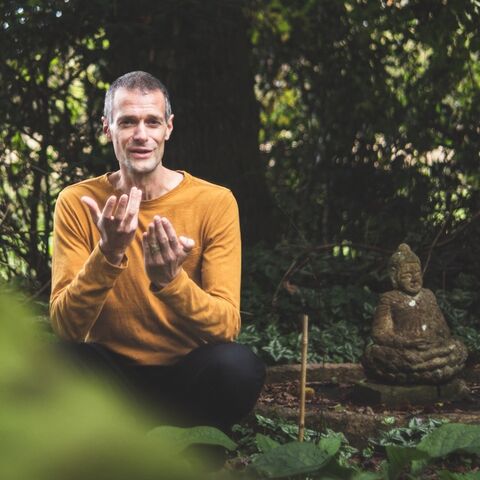
Today I have Michael Halbeka with me.
So we're here at Amravati Monastery and it is,
Just for the sake of the recording,
It's June 2023.
I'm going to do what I often do,
Is just throw it back to Michael here to have him introduce himself.
No,
That's a difficult question actually.
Because I've been retired since August last year.
I was a lecturer at Cardiff University for many years,
Teaching German.
And then later I did a PhD in counselling at Päridinia University in Sri Lanka.
And I've been travelling a lot in Asia and many Vipassana centres around the world.
And now I'm here in Amravati and meeting you.
It's great to have you here as well.
Michael is very humble.
We've talked about all kinds of things all over the world.
And especially in the Buddhist world too.
To say you have quite a bit of familiarity,
I think is quite an understatement.
I mean,
We've talked about everybody from Bhikkhu Annalyo to different monasteries in Sri Lanka.
The different political situation,
Relics.
We've talked about early Buddhist texts and preserving early Buddhist texts.
Well,
I guess more of just everyday life.
What got you into all this anyway,
As far as inspiration goes especially?
I guess the way to get into Dhamma is usually the classical way.
The classical way is just experience or the conscious awareness of having dukkha in one's life.
The experience of things not being the way one would ideally wish them to be.
And basically the search for some solution to the existential questions in life.
I was quite political as a student.
I was kind of interested in all kinds of alternative lifestyles and even Marxist programs.
I was very active in all the marches in the 70s.
But eventually it made me even more depressed.
Because like what Adorno used to say,
There is no right life in the wrong one.
So then I kind of understood this to be like when you're swimming in a polluted pond.
Like a fish in a polluted pond,
You cannot be healthy.
How do you find a way out of that?
So that became a kind of existential question for me.
And eventually I moved to Britain.
And through the English language I could start in a way a new life,
A new identity.
Having been brought up in a Catholic small village in Germany in the post-war time.
It was my first conditioning in that time.
It was very,
I would say,
Quite challenging for me.
But now I'm in a situation where I've lost my connection with Germany.
I've been abroad so many years.
Germany has become a kind of strange country for me now.
So when you talk about existentialism,
What area?
Is it just like existing,
Not existing?
Or is it just kind of the slog of everyday life and existence and how it's just not satisfying?
What really drew you towards that area?
Yeah,
I guess it was the time of Jean-Paul Sartre and Camus.
I read quite a little bit about existential philosophy.
But apart from that,
It's the actual direct experience of being exposed to political situations.
The time of the arms race between East and West.
And I was just at the center of that at Kassel University,
For example.
Where the Pershing program under Ronald Reagan was targeting exactly that strip between East and West Germany.
And my university was right in the center of that.
And so they were always expecting the Russians to come in and then they would sacrifice this whole strip.
So we could not be completely blasé about that situation.
So I felt somehow.
.
.
And I also remember the time when we had the first TV at home.
There was 12 black and white TV,
Two programs.
And then the first input I had was the Russians coming into Prague in the Prague Springtime with Dubček,
The Dubček era.
And also then the bombing in Vietnam.
I saw that every day.
That was my first input.
So I thought that was kind of the Third World War already starting.
So this is a real immediate concern about existence.
Like life and death situations,
At least the way it was portrayed in the media,
Right?
I mean,
They would leave people to believe that at any moment it could be all over for almost everybody even.
Who knows?
So it is kind of like this existential dread around every corner,
It seems like.
Maybe I'm exaggerating a little bit here.
But yeah,
I can imagine it would draw one's attention to growing up in that time and place in the world.
Every September or in autumn there was this big maneuver with the NATO troops in our area.
So I saw these tanks,
Miles and miles of tanks almost.
Every year we had these kind of maneuvers and it was like a normal environment for me.
Apart from the fact that I was brought up in a very strict Catholic family,
Small village,
Working class,
No education.
My first kind of desire was to become a Catholic priest because that was the only way for me to kind of try to go deeper into the underlying philosophies and so on.
It's a whole different ballgame in the States as far as warfare,
Right?
Because it's the patriot programming and the waving the flag,
But nobody's ever really attacked that land.
The theater,
They call it,
Is in Europe a lot of times more so than not.
So I had this degree of removal from all that.
And it's not really that fathomable for me.
Speaking of getting deeper into this though,
I forgot the name of whoever asked the Buddha,
Right?
After enlightenment,
Will I exist?
Won't I exist?
Will I both exist and not exist?
Will I neither exist nor not exist?
And the Buddha basically says,
None of that even applies.
And to me that was just,
It just blew my mind.
It's unfathomable.
But in a way that is kind of an aspect of the Buddha's teaching that I like very much because it throws you back onto this life.
And so you have to kind of make sense of this particular life you are given now,
From birth to death in this life.
And I think if we can find some kind of solution for that,
That it's good enough,
Isn't it?
So we don't need to worry about what's happening after death so much as how are we living today.
Absolutely.
So yeah,
Most of the existential writings and philosophies,
I'm not too familiar,
But it seems like a philosophical exercise.
And if on the path to enlightenment,
Right,
If none of that even really applies,
Then it throws it back,
Like you're saying,
To this very life.
Can get out of the philosophical aspect of it all the time,
Perhaps.
How does things in our lives stir the heart,
Right?
What touches the heart?
It teaches you a way of inquiring,
Of looking deeper into what your situation is right now in this particular moment in time.
Especially when you think about all the social programs that have been kind of set up in the 60s and 70s,
Which were very optimistic at the time,
Or maybe we could say from today's perspective,
Looking back in hindsight,
It was over optimistic.
And then you're left to your own devices ultimately.
So every day you are kind of thinking,
Where is my refuge?
Or where do I feel?
Where do I belong?
And you cannot find an ultimate answer for that.
So ultimately you have to kind of confront your own existential existence as being kind of on your own.
And this feeling can lead to some kind of loneliness if you don't have any refuge in yourself.
So how do you deal with that?
Yeah,
And it's a really important question.
I hear more and more teachers and just folks in general talk about belonging.
And this is on the external,
I feel it's really important,
Through times where if we didn't belong,
Then we're kind of on the outskirts and tribalisms,
And it's hard to survive,
Or these type of things.
But going deeper inward,
I see this more and more,
The insight that came to me is,
Where do I belong in my own heart?
Especially for those identifying with others and trying so hard to fit in,
And where do I fit?
But where do we fit in in our own hearts too?
We care deeply about all kinds of different things and people and even ideas and action.
But that question came to me,
Where do I belong in my own heart?
Yeah,
I think we have to be very honest with ourselves.
It's so easy to,
The mind is very cunning,
It's very easy to play games and think,
Oh,
I just go to all these meditation centers and monasteries and I feel at home there.
You get a very peaceful environment and it's very easy to live in these places in a way.
But on the other hand,
Your kind of karma is always catching up with you.
It's like a shadow you cannot escape from.
So it doesn't really matter ultimately where you are.
The question is,
How can you confront your deeper truth and try to live an authentic life?
For me,
Someone like Carl Rogers in the counseling world was very important there.
In a way,
He had these core conditions of leading an authentic life,
Being empathic with yourself,
Having a less conditional way of accepting yourself and others.
So that was for me very compatible,
A very amazing compatibility with the Buddha's teaching.
For example,
The Kalama Sutta,
If you think about the Kalama Sutta,
Which is not very much promoted these days,
Making your own independent inquiries and not settling for first answers,
But always looking deeper and deeper.
It's a great guideline,
That Sutta,
For what we should be paying attention to and how we should be paying attention to it.
Yeah,
And it's so easy for.
.
.
I remember times when friends of mine that became very religious after having been in dissolution with political programs,
And suddenly they go inwards and kind of turn away from the outside world.
But I could never really settle for this kind of conversion programs he often had,
In the Christian churches or something like that.
You get a group high and then everyone seems to be really on the ball,
But for me it was something I always missed.
I could not really surrender to these kinds of conversion programs.
And then when you go home and you're on your own again,
Then you're even more lonely.
Yeah,
And then on the other hand,
I went through years of that too.
These days I would like,
Where do I find peace and quiet somewhere?
Even in a monastery,
Right?
There's always people around,
There's chores,
There's internal chatter too.
But even if we're living in the wilderness,
We're still in some kind of community with nature and whatnot.
And there really is no escape,
No refuge like you're talking about.
And I think the loneliness is an existential kind of dilemma because we're so interconnected with everything,
Right?
We can't live in a vacuum.
We're dependent on so many different things or interdependent on so many different things for our way of life.
But it is kind of more of a psychological thing.
Why does there feel so much loneliness in today's society?
Is there some kind of general way to look at it?
I mean,
Does it really differ uniquely from individual to individual?
Is it cultural?
What are the different aspects of it?
And also in today's society,
Is it any more prominent in today's society versus other times and places?
I think so,
Yeah.
Today,
Especially when you have been testing so many different things,
Let's say you had everything in terms of financial security and you could buy any kind of things that would give you comfort.
And then ultimately you realize it is just a short moment where you have this kind of kick or a moment of happiness.
And then the next day it's already becoming stale.
So this whole material lifestyle has eventually kind of faded and become rather just a distraction.
Of course we need food,
We need to have shelter,
We need to have friends and just the basic conditions that we could see on the Maslow Pyramid,
For example.
The hierarchy of needs.
The foundation for a kind of existential and social needs and individual needs.
But then we're always left with our own kind of deep belongings of making sense of this life and trying to have a purpose why we are here.
So these questions will always be there,
The background.
And what would you say the Buddhist purpose is for this existence?
I guess my answer to that would be to know suffering and then know the end of suffering.
Yeah,
That is in a Buddhist nutshell.
Yeah,
In a kind of simplified nutshell,
Right?
Or I should say dukkha,
In the end of dukkha.
But how do you define suffering?
I mean suffering is not just physical,
It is mental.
And even the pain that you experience of not being,
You know,
This unsatisfactoriness of not having a kind of stable situation that is kind of malleable on the daily basis,
But being exposed to so many variables that are constantly changing.
And outside as well as inside,
Inside one's body and mind.
Then it's like walking on quicksand.
So where do you find a kind of solid foundation that is reliable for the future?
And once you have been this constantly disillusioned with that kind of questioning,
Then what do you do at the end of that?
Yeah,
And you know,
My answer to that,
Just to riff on this,
You know,
Well,
First off,
I went to the monastery today,
You know,
To meditate.
I just presumed that it would just be like any other day,
Right?
And I can just go in there and sit in quiet and there's a school group in there.
Oh,
Yeah,
Okay,
Now my practice is really being tested,
Right?
So it was lovely too,
But it's just all these presumptions that are operating that I take for granted.
They're not really expectations,
But we just feel certain things will be this way.
And yeah,
The biggest thing for me is the version of Anicca I like is that arranging conditions just the way I want them is not a long-term success for happiness because eventually in the long term,
I won't be able to control all the external conditions the way I want.
And whereas there's that false operating procedure of doing that,
And then all of a sudden we can't control the external,
Especially the external conditions the way we want,
Or even the internal conditions.
Well,
Then there's a disappointment,
That stress,
And one of the other ways.
And then we get helpless.
I mean,
That's the kind of the anatta is that we don't know if we don't have any other strategies.
Well,
Then we're taught that's the way we do it in life.
You do this,
This,
This,
And this,
And you'll be happy,
And that's what you're supposed to do.
And if that doesn't work,
Then I say,
What do I do now?
This doesn't work,
This helplessness.
In a way,
We want to have a continuity.
We want to have steadiness and some kind of predictable kind of life.
And in some ways,
We are always trying that,
Despite knowing that this may not work out in the end.
But this is our kind of,
You know,
The continuity of our moment-to-moment existence.
Otherwise,
You will go mad.
Yeah,
Exactly.
And this is where wisdom steps in.
And wisdom,
I think,
Is more reliable,
You know.
And then the ethics,
An ethical lifestyle helps build up to that and support it.
So does the meditation practices,
Yeah.
Yeah,
That's,
Of course,
Very important as well.
You know,
We need that foundation of an ethical framework,
Absolutely.
Not just in counseling or in any professional field,
But as a general way of life.
Otherwise,
If there is no kind of trust which arises from this kind of ethical foundation,
Then there may not be much point in communicating at all.
So these are big things.
You talked earlier about refuge,
And I was also thinking about ground,
You know,
And trust.
These are huge things.
So,
You know,
Traditionally in Buddhism,
It's a Buddha,
Dharma,
Sangha.
But the refuge is,
The internal part of this for me is the Buddha is awareness.
You know,
This knowing,
Identifying with what knows,
That is not subject to,
You know,
Defilement or purification.
You know,
This awareness,
This awake awareness,
This heart-centered awareness.
And then,
That's a big one.
And then,
The group,
But even those,
Yeah,
I mean,
The Buddha's final words,
Right?
He talked about,
Right?
What is your take on his,
As far as,
You know?
Upamādena,
Sampadēta,
These last words,
Means you have to take refuge in yourself and be making effort,
Despite all kinds of situations that are,
You know,
To the contrary,
That are kind of questioning or undermining these efforts.
So,
That is a real challenge,
Especially when you have been doing this kind of work for many years now.
Many of the people that I see,
They eventually stop doing,
Making these efforts and then they kind of,
In a way,
Give up,
You know,
Because they just get tired.
The Buddha was so inspiring,
Ardent,
Diligent,
Resolute,
You know?
Just,
That was what he was known for,
Just relentless,
But patient and wise,
Just keeping at it.
It just,
It seems like nothing is impossible with the right instruction and persistence,
Patient persistence,
You know?
So,
Those two things.
On the other hand,
We also always look for inspiration from others.
Absolutely,
Yeah.
Where do you find inspiration?
Yeah.
As I said,
You know,
The people who have been in this kind of business,
Let's say.
It's the only game in town,
As I call it.
These people are kind of very few,
Far and few in between.
Yes.
Now,
When I look back,
Many people who started off with me have gone or have passed away already.
And then you have all these newcomers,
New people,
And sometimes I get a lot of inspiration from new people,
People in their early 20s or so,
They are so full of enthusiasm.
Yes,
Beginner's mind,
Right?
That is,
For me,
So inspiring to see that.
And I think that is a real skill in finding new ways of inspiring yourself,
Because otherwise,
You know,
You go through certain phases,
Learning plateaus,
And you get stuck there.
It's very easy to get stuck there.
And then when you get stuck,
You're sliding back.
You're already sliding back slowly.
So,
How do you keep your practice fresh?
So,
Let's come back.
Well,
Since we're on that,
I want to come back to ground and that as well,
And trust.
But,
Yes,
So what inspires you lately?
Besides the kind of the 20-year-old,
Bright-eyed and bushy-tailed a little bit,
You know,
This,
Yes.
Yes,
In the moment,
I'm reading the autobiography by Bhikkhu Ajahn Thang.
I think he's still alive in Thailand.
And I can really relate to that,
How he was inspiring himself every day through this Kayano Pasana that he did,
Working in the jungles and trying every opportunity to practice,
Really.
And he had to go through so much hardship,
But he was relentless in his efforts.
And these kind of masters are so rare these days.
I don't know where they are now.
I wish I could meet him sometime,
If he's still alive.
I always wonder about who the modern-day version of Moggallana is,
Because we have so many different wisdom teachings and wisdom masters.
But kind of nobody on the caliber of Moggallana,
You know,
Who's known for psychic powers,
Which kind of get a bad rap in academia and just kind of get written off pretty quick.
There's really not much of a space in the Western world for things like that,
I'd imagine.
But maybe that's for another time.
So sometimes we feel groundless,
Right?
Some people talk about the ground of being,
Too,
And then being ungrounded.
I mean,
It's almost a cliche at this point,
But I know when I don't feel very stable or physically grounded,
Like bare feet on the earth,
Too.
I don't know if it's more metaphorical or what we can say about this.
I mean,
Does the Tibetan tradition talk about a ground of being?
And working with this as a metaphor,
Especially in what we were talking about early with loneliness.
I think you said something earlier about being identified with this awareness.
I think the identification itself can already be a trap.
Yeah,
Yeah.
Because ultimately there is no self.
So if we have that understanding,
Then taking refuge in a way is a form of taking refuge in self.
On the other hand,
The self does not exist.
So it is taking refuge just in pure awareness without identifying with it.
And this is what I mean.
That's right.
It's not like I am awareness.
No,
That's right.
It's just like that seems a little bit more of a decent refuge than,
Yeah.
It's a stepping stone,
I would say.
Yes,
Of course.
Not as an ultimate.
There is no ultimate refuge,
I would say.
Yeah,
That's the thing.
You have to have a healthy sense of self first before you then begin to dissolve it.
Absolutely.
And as far as refuges with Dhamma,
The internal one,
I like this notion of truth.
The Buddha was a seeker after truth when he went forth.
It's said that the one thing he didn't break was truthfulness throughout all his prior lifetimes.
And then for the Sangha,
For me,
It also means this heart connection that we have with others.
This really heartfelt sense of connection and care.
I think that could be a healthy refuge internally,
At least for part of it.
Yeah,
Of course,
When you think about the interconnectedness of all life forms,
Not just human life forms,
All life forms,
Of course.
And then if you go deeper into the Paticchassamuppāda,
For example,
There you can really understand this kind of mutuality of causes and conditions and how they create certain manifestations from moment to moment,
The mental kind of conditioning process,
How it's working out.
And then if you go further,
Deeper into,
For example,
The Dikkha Pāṭhāna in the Abhidhamma,
For example,
Where you have the 24 conditioning factors that in a way influence all these 12 spokes of the Paticchassamuppāda,
That is a huge.
.
.
It is,
And if that's not big enough.
.
.
.
.
.
Discussed.
.
.
Yeah,
And even beyond that is all the inner workings of Kama,
Which is one of the imponderables that said that only a Buddha can do that because it can be maddening,
You know.
I mean,
But we have these areas of Kama that we can study that are laid out,
But the full scope of it is just beyond.
.
.
Also recently I've been kind of becoming more interested in the interplay between individual Kama,
Family Kama and cultural,
Collective Kama.
How they are kind of mutually reinforcing each other and how you are entangled as an individual within this whole web.
Yeah,
That is a kind of dimension.
This is a fascinating question because I think one of these was put to an Ajahn out at Chithurst,
And I can't remember the exact discussion,
But it fascinates me too because this notion of collective Kama,
On one level it seems like,
Well,
That would be taking responsibility for others' actions,
Right?
Because I'm responsible for the fifth reflection,
Right?
I'm the owner of my karma,
Heir of my Kama,
That whole thing.
So how does that play out collectively?
On the other hand,
We are interdependent,
Right?
Where do you draw the line?
Okay,
This is mine,
This is yours.
So it's a fascinating question when you start digging into this.
Yeah,
I think there are ripples that we create all the time and we don't know where they end.
So unknowingly we may influence a lot of other people that are in our kind of environment around us.
Just by the way we are,
We are living,
Without words,
Even silently,
How we are acting and how we are in the world.
It's fascinating too how actions and fruitive actions and how these kind of match up around other,
With certain people,
Right?
Maybe sometimes you get some feedback,
Someone telling,
Wow,
You know,
You really had a big effect on me,
But that's very rare to hear that.
But yeah,
To be also at the receiving end of collective Kama,
You know,
Be born at a certain time,
At a certain place,
And how these constellations shape your early education and your upbringing and your conditioning.
And you take that for,
You know,
This is your normality.
I feel very fortunate in a way to be a little older now,
Because I can compare what was normal for me in the 70s or 60s and what is this kind of new normality now in the,
You know,
19,
In the 2020s.
Yeah,
It's my grandmother before she passed.
It's like the world when she died was just about unrecognizable in a lot of ways.
It's from when she was younger and with all this technology and they,
You know,
Didn't have the running water,
You know,
Like all this stuff that we hear stories about,
But now expand that back to the time of the Buddha.
I could imagine how a lot of the life is just,
You know,
Unfathomable for us,
If it's that foreign in just 100 years,
You know.
Yeah,
Definitely.
I mean,
I was lucky because in the 60s and 70s,
With a very optimistic outlook in life,
We thought,
You know,
After experiencing or having experienced,
My parents at least,
The Second World War and then the post-war time,
That we would have enough wisdom now to create living conditions that would always be kind of safe and that would,
You know,
We would create conditions where the wars would become kind of impossible.
And then since then,
What happened,
If you look back?
Well,
Then acid got involved and it all went downhill,
Right?
The hippies got,
They took acid and their momentum went,
Plummeted.
Yeah,
I think that was a.
.
.
It was not the only cause,
Of course.
That was a turning point.
Yeah,
That's actually a better way to put it.
Maybe in the early 80s already it started.
No,
I mean the 60s,
The hippies,
You know,
They had quite a bunch of social,
At least in the States,
You know,
The civil rights movement and really making progress.
And then acid was introduced and it just kind of all went to pot.
I don't know.
I think that's a simple,
Overly simplistic write-off.
But also the economic condition changed.
For example,
In the 70s,
I remember we had,
I think it was in 73,
Where there was an oil crisis.
That's right,
Yeah.
And I remember we were walking on the motorways on a Sunday afternoon,
You know,
Germans going for a walk on a Sunday afternoon to the,
You know,
Forests and so on.
And then suddenly there everyone was walking on the motorway because there was no car going.
Wow.
So that was the first shock we had that,
You know,
Economic growth would not be permanent.
My father was always kind of happy to say that,
You know,
He's envying us because we are born in a time when everything will become easier and we would have a wonderful life.
These notions of utopia go ahead.
Yeah,
Exactly.
Yeah,
It's just,
But as we know,
You know,
Even as good and as perfect as conditions get,
Even in the time of the Buddha,
Probably the best conditions ever to get enlightened in,
You know,
Recent history,
Right?
Not everyone got enlightened during that time period.
A lot of people did,
You know,
Supposedly is what we're told.
But yeah,
It's just these different degrees of conditions,
Right?
It was also a collective era.
Oh,
Yeah.
We think about collective karma,
Collective kind of ideal,
Almost ideal conditions for many,
Many people between China and Greece at that time,
Ancient Greece.
And then the Buddha kind of seemed to have forecast that,
You know,
The Dhamma will decline in certain stages.
So today we are experiencing a time where people,
They still give dana,
They still give donations and they still practice Shila to some degree.
But then meditation is becoming very,
Very rare.
Yeah.
Although we have all the social media programs.
That's right.
You know,
It is a big thing on Insight Timer.
And there's a lot of people on that.
But the depth of practice,
I don't see it either.
I know there are some really in-depth practitioners,
But as far as on a scale that I think is significant,
I don't think it's there either.
It wasn't one of the signs to the die out of the Dhamma is the lack of Samatha practice.
Lack of,
Is that right?
Do you know some of the signs?
Weren't there signs associated with the decline of Dhamma?
Well,
There were external conditions.
Of course,
There were wars and so on.
Sure.
Monasteries got destroyed or the scriptures got destroyed.
And then later they were kind of re-translated.
Then later on,
Some remnants were kind of found.
I mean,
In the Pali Canon,
Did the Buddha give,
Like,
If you see this,
Then the Dhamma is on the decline or some other practitioners.
I thought one of them was actually the lack of Samatha practices,
Concentration practices,
But I could be wrong about that.
I think the most difficult part goes first,
Usually.
The wisdom practice,
The Vipassana practice.
And then when that disappears,
Then there's only the concentration practice.
And then when that disappears,
There's only the Shila practice.
I see.
And when that disappears,
Then there's only donation.
And then there's only rites and rituals left in the end.
Right,
Yeah.
And if you don't get the,
When you don't practice the Vipassana,
For example,
You don't get the benefits.
And then you have doubts and,
You know,
All the hindrances will be nurtured.
So let's circle back to this notion of trust,
Which I think is really important,
And then we'll start to wind down.
Leave folks with anything you want to tell them about,
And tell them about your book,
Too.
Any teachers or teachings or events or anything you'd like to draw people's attention to.
But this notion of trust,
I find it quite important.
And I mean,
For me,
I found internal trust,
Trusting myself,
Is a huge part of it,
Too.
But what would you say about the importance of this,
Internal,
External?
Yeah,
This in a way relates to the doubt,
Vichy Kicha,
The fifth hindrance.
Having kind of faith in one's own capability,
One's own capacity to develop on this path.
I think when we are constantly testing our limits,
Our boundaries,
And we're realizing that we are able to learn from our mistakes and expand our kind of capacity for equanimity in difficult situations,
Then our self-confidence grows through that as well.
And this is kind of helping or taking refuge in the dharma qualities within ourselves.
Rather than saying,
You know,
This is I or me or mine,
It is actually the mind itself,
The kind of quality of awareness that becomes kind of established through that practice.
And that itself has a spin-off effect on everything we are doing.
And I see it also as having that deeper trust within,
And then with a discernment,
Then you can easily and more effortlessly know who to trust,
When to trust,
How much to trust on the external,
Instead of being like,
Oh,
This fear of,
Oh,
Somebody is going to take advantage of me,
Or what degree of trust we should give out and when,
Too.
I think I've become very,
What you say,
Kinesthetic through the practice.
I'm more and more trusting my body now.
The body can discern it,
That's right.
In intellectualizing situations.
And the body gives you an instant feedback.
It's how we have to know truth is through the body,
That's right.
Yeah,
I think so.
So,
In that sense,
When you're constantly in touch with the sensations in the body,
You're constantly getting that feedback.
And you always feel kind of connected,
Body and mind kind of.
.
.
And even relaxed and expansive versus contracted and pulling away.
And then you can anticipate situations more easily as well.
And I think that has saved me many times from getting accidents or even in the jungle with snakes and wild animals in Sri Lanka.
And then the meta that comes through that.
So,
I think that is a very valuable thing to have.
And I think it grows with practice all the time.
The body base.
That's more into it.
Yeah,
It couldn't be stressed enough.
So,
What would you like to leave folks with?
Yeah,
I wrote this book,
Milestones on the Path of Dhamma,
Subtitled Stages of Inner Freedom,
As a summary of my practice.
It started in Sri Lanka.
And over 20 years I've been working on that book now.
Now I think it's in the third edition by now.
And I uploaded it at Amazon.
But ideally I would like to find a publisher where I could offer it for free.
So,
Maybe eventually I will find a Buddhist publisher that would make that possible.
So,
If a Buddhist publisher happens to be listening,
How could they get in touch with you?
I could give you my email,
For example.
Sounds good.
We'll do that then.
So,
If anybody's interested in that,
Just reach out to me at integratingpresence at protonmail.
Com or contact me other ways on the website.
And I'll pass along the message to Michael.
Michael,
Thanks so much for sitting down and chatting with me for this.
It's been a pleasure.
It's lovely to have you.
Thank you.