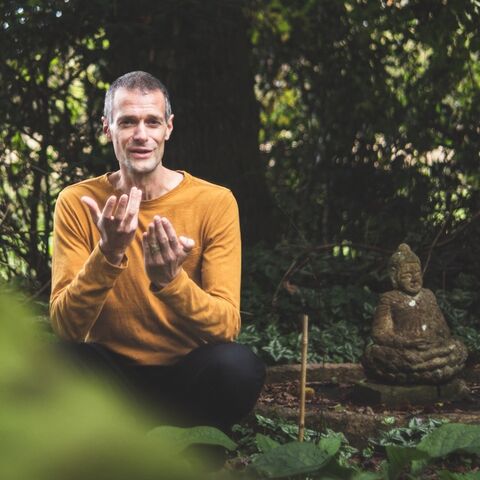
A Type of Situational Awareness,
Part 3 of a 7-part series on studying and practicing with the Idipada-Vibhanga Sutta,
An analysis of the Bases of Power.
For situational awareness,
What I'm going to be talking about here off the cuff probably sounds pretty strange.
We'll have to set aside our screens.
We're considering how much of us live our lives now,
Going back to the time of the Buddha where there was no technological devices that people spent most of their time around.
So in the same way we might be fascinated by the idle chatter that we find on devices really just on and on and on about pointless drivel for the most part or amped up fantasies and imagination that's being all contained on a screen or from a screen.
Set all that aside and think of the people in that time,
How they might have considered the mass behavior of that type of thing for today.
If you told them about that's how people would act,
Maybe they would think,
Well,
They're so disconnected from reality and the world around them.
All that time and attention on those screens.
What about all the other physical objects in the world?
Starting off with that perception,
The sitting,
Kind of modern day life and behavior on the shelf to consider some of these things.
So much of our time and energy these days goes into that.
What if it didn't?
What if we were given the same amount of time,
Attention,
Energy to other physical objects with our mind,
Interfacing with our mind,
With other objects and the type of emotional attachment some of us have and dependencies some of us have on screens and the content on them.
Seeing that aside and considering other objects.
From the text here it says,
You know,
How do we have the perception of what is in front and behind is the same as what is behind and in front.
We're dealing with perception.
Perception can be very tricky,
Can be very helpful,
Can be very harmful depending on what the perception is.
Very illusionary.
The Buddha said he likened perception to a mirage.
So there's four things here.
Well in hand,
Well attended to,
Well considered and well tuned,
Penetrated by means of discernment.
So we're looking at perceptions with discernment in these four ways of well in hand,
Well attended to,
Well considered,
Well tuned,
Penetrated.
So basically from what I understand as of now and all I'm about to say could easily change or drop or fall away,
Evolve or be completely pointless and useless.
Nothing here to be clinging to.
It's just my current understanding.
The discernment ability to discriminate,
To tell differences,
To know one difference from another.
So we can obviously see the sky is different from the ground.
It seems a little inane example,
Right?
But we can discern that the sky is not the ground.
The ground is not the sky.
There's a difference,
An obvious difference there in perception anyway.
What does it mean?
We'll go through each one of these individually.
What does it mean to have something well in hand?
I'm going to use a crystal that I have in my hand just as an example if I need to.
So if something's in hand,
It means that there's a certain amount of immediate potential for control or movement or manipulation or carrying out choices.
So if the mind says,
Oh,
I want to rotate that crystal counter-quaclise in my hand,
Easy for me to say,
Then the fingers start moving to turn the crystal counter-clockwise.
So there's kind of a very responsive,
Almost immediate feedback given one's hand and eye coordination is not damaged or something's not going right with it at the moment.
And so there's immediate physical contact with another physical object with the body well in hand.
It's also can be just there to be idle in consciousness,
I guess,
But still contacted and still temporarily kind of a part of if something's,
You're holding something in your hand,
If it's in hand.
And then the well part,
Of course,
Is something that's not by all means it's well,
Right?
So well-attended to.
I think of well-attended to,
What is it,
Putting aside the crystal example,
What does it mean to attend to something well?
Well,
Let's just think if you're a caregiver and somebody's soiled themselves and they can't clean themselves,
So how would you well attend to that?
Would you just gripe and complain the entire time you have to do it or would you just say,
Ah,
This could do a little bit now and just,
Yeah,
It can wait and come back to it.
So what's the kind of attitude that's being brought to it?
What kind of action is given?
And phones ringing now.
So we look at it kind of a room too.
By the way,
I'm on the second floor of a building.
Ideally,
What's in front and behind,
It's a little bit different on a second floor than it is on the ground level.
Sometimes you have activity outside,
Down,
And so that kind of gets confusing with,
Well,
Is that in front or behind,
Behind or in front?
So it'd probably be a little bit easier to practice this on a ground level.
But going back to the room example now,
Well attended to.
So just think about what's really important to pay attention to.
So if something's dirty and we're not attending to it,
Then what kind of effect will that have on us?
It's kind of easier to know once it's cleaned up than I'm sure everyone's experienced this where they've gone into a dirty place and how they feel.
And then once the place is cleaned up and then how they feel after that,
Maybe even how intense it is while cleaning certain things up,
Like the caretaker example.
Sometimes things are almost hidden or they're under our awareness.
And then once we discover them and then address them,
Take care of them,
Then there's a change.
You know,
A dust bunny under the bed or something.
You figure that out.
Oh,
How long has this been with a dust bunny under the bed?
And then once cleaning it out and then notice the difference in how you feel and how the space feels.
Also this can be done with space in a room too,
The absence of objects as well.
So if we go back to well in hand,
How can you have an empty space well in hand?
The absence of objects.
All of this just has to be with discernment,
Knowing that it's empty of objects.
And how long can one keep that in awareness when we're constantly looking for things to captivate our attention and distract us?
Because it can be fairly boring to just keep one's mind on empty space.
There's no kind of pull or push for attention there,
Which can actually be of great benefit when things get a little bit overly pressurized.
So well considered.
So when we use a perception to consider something with discernment,
What does that mean?
So we go back to the crystal example.
What would we be considering about that crystal?
Using discernment,
What kind of perceptions are we going to hold in regards to considering that crystal?
I would think we'd have to look at the kind of powers that are mentioned in the rest of the sutta about being able to dive through the earth like it's water,
Pass through objects,
Things like that,
Which seem fanciful in today's society because the only reference point we really have for that are on fictions on screens,
Right?
People reserve that for fictions on screens.
If we go back to the time of the Buddha where there was none of that and so much time and energy and effort can be put into practices like this and you had followers of this awakened one and did intensive training,
So who knows?
Well considered.
Could we consider a choice of if there was the option or ability,
Capacity to pass through an object with the body?
Could there be consideration for a choice to do that or not?
What would be a consideration that's considered well and what would be consideration that would be considered not well?
I think that's where it comes back to ethics,
Sila.
Non-harming,
Not taking what's not given,
Not misusing sexual conduct,
Not falsifying speech or doing wrong speech and intoxicating oneself that make the other things more likely.
What else could we consider what's in front and behind?
Just so many choices.
Just think of one object in front or behind and the choice of what all the different variations that can be done with that.
So you can rotate an object in space 360 degrees with your hands or with these powers of telekinesis right where you manipulate the movement of objects with mind.
So every object can move in 360 degrees and then think of all the different possibilities just on the ground level without it having to float above the air.
You can rotate it how many ways depending on the construction of the object and then how much space is in front and behind,
All the possibilities of where it could sit and for how long and then the spacing and timing and duration between resting in one space versus another and then the rate of the transition between those two points and then the choices from each point and then if there's a movement in space too of which way it can go while it's going from point A to point B.
But then that's just on the 2D level,
Surface level now.
What compounded how many times over and if it can go in the air right?
Front or back in the air.
So how many different planes higher and lower.
So I think maybe that's why it might get too overwhelming.
That's why the other part mentions what's above and below as in reference to the body.
So I don't know how accurate or how far we should take it into the external especially when what's above and below if I'm getting this right and the rest of the sutta is just considered within the body.
And again we're talking about perceptions here more so I guess than actual physical objects so my look on this could be skewed.
And then the last one,
Well tuned,
Penetrated by means of discernment.
So this ties in I feel to kind of the masculine tendencies with penetration.
So if you have a monk who's taken a celibacy,
This kind of red blooded male drive to penetrate sexually,
So if that's taken away,
Not given the means to do that with a partner,
Does that kind of inbuilt tendency entirely go away just like that vanish?
Or is that masculine tendency still there and it can be expressed in such a way of penetrating into other things besides sexually on a consciousness level perhaps going into an object or perception either in front and behind and really inhabiting it in a way dominating,
Asserting,
I don't know,
Either assertion over it or with it,
Just kind of like okay now there's no more being in the dark,
Not knowing,
Talk about carnal knowledge.
There's an intimate knowing and almost emerging but the well-tuned part,
Still the masculine principle,
If we're going to go with that,
Just think about someone who kind of bores you or annoys you,
You're not interested in,
Or on the other hand someone who's just kind of overly domineering,
Almost like a cartoon character where they're so caught up in themselves in such unbeneficial ways for themselves and others that it's almost comical and it's kind of hard to be around them.
But let's say you have something to say to someone,
You want to interact for whatever reasons or sometimes you have to and you can't really have the choice not to be around them.
So either way in those instances you have to set aside those perceptions,
Or at least if you want to make it beneficial for both parties,
Set aside those perceptions in a tune,
Tune in,
Well-tuned,
So you tune in to what's going on beyond those characters,
Those characters things we see on the outside.
And I liken this to like an old school radio,
You know this one station but you forgot where it's at on the dial,
So you just start scanning,
You start tuning in,
You listen and you,
Oh it's not that,
Oh set that aside,
No that's not helpful,
This one's not it,
You keep tuning and tuning and tuning and then eventually you get to the right space where okay,
You know this isn't going to be forever,
I can really listen and hear this person and tune in to where they're coming from,
We can meet and have an exchange by what we can have in common here for a few moments,
So that would be well-tuned.
So now if we take that to a physical object or something that's not as psychologically relatable like a chair,
You know,
How do you tune into or penetrate a chair?
Well this you're going to have to use your imagination or lots of lots of meditation to discern whether something like that would be similar with an object.
Some people can do this easier with crystals,
Some people will start sweating around crystals,
You have these huge crystal caverns where you can't be in them for very long without special equipment because of their piezoelectric properties,
There's a lot of physics behind the stuff that I don't know but some people are energetically sensitive and it doesn't take such a huge example to know with that and then there's certain different feelings for different types of crystals,
Different effects,
Just like if you would go into a filthy dirty run-down crime-ridden neighborhood and notice how you feel and your thoughts there compared to if you're in like kind of a lush paradise.
So that's the grossest example,
Gross energy level and then some people can just kind of know what kind of neighborhood,
I feel better in this neighborhood than that neighborhood but on the outside they might not look that different,
Just a little bit but there's a discernible difference there.
If we take that kind of tuning in and a lot of times it's done automatically which can be done with perceptions that we already have established so then we have to look at our perceptions too and what effect our current perception has,
Our past perception on something has and then what it might be like to adjust those perceptions especially in light of this well in hand,
Well attended to,
Well considered,
Well tuned,
Penetrated by means of discernment and all that plays in here,
Potentially at least.
So for this portion and here I'm referencing my notes with these two translations here,
The first one I practice the most with and it says,
There is the case where a monk's perception of what is in front and behind is well in hand,
Well attended to,
Well considered,
Well tuned,
Penetrated by means of discernment and I'll go into each of those ways of dealing with perception,
Those four different ways here in a moment.
First I want to address this second translation which reads,
In how does the mendicant meditate perceiving continuity as before so after as after so before.
It's when the perception of continuity is properly grasped,
Attended,
Born in mind and comprehended with wisdom by a mendicant.
That's how a mendicant meditates perceiving continuity as before so after as after so before.
The first translation emphasizes space more,
Why the second one seems to do more with time.
This may be one way of looking at it but the second translation about continuity,
Perception of continuity.
Well what is continuity,
It's just this perception that something just keeps continuously going on and on or existing.
We look at physical objects,
Some exist very briefly,
Some seemingly for eons like mountains.
So we look at the energy involved in physical objects applied to continuity.
So maybe some energies are more erratic and stable and a physical object won't last that long,
Will break down quicker than others.
So that's one facet of continuity is how form is affected,
The energy behind continuity,
How we perceive that if we can as changing our influx.
What do we look at or perceive as more easily noticed as something continuous compared to something that doesn't seem as continuous.
So for this we turn to meditation and we look at our own continuity of attention on a meditation object is one way to do it.
So what are all the forces and influences,
Causes and conditions that go into supporting an unbroken continuity with the meditation object.
We go into the sense spheres,
The six senses,
The consciousness of sight,
Sound,
Smell,
Taste,
Touch and mind,
The six sense gates,
How does continuity work with those?
Do we need to master continuity as a general concept?
Do we need to apply it to our immediate surroundings,
How far does the perception of continuity need to go beyond our immediate surroundings?
What can interfere with perceiving continuity in our immediate surroundings?
How can there be more stability for mastering this?
Seems when there's either a lot of energy or a lot of emotion or just increased volume and sound then that tends to grab the attention.
The attention seems to go to that which is crying out for more attention so to speak.
When we go into more subtle realms,
More subtle meditation objects,
Things without the gross energy sometimes it can be more challenging to stay with,
To meditate on.
How does consciousness come into this?
What if we're staying with a meditation object like the breath and all of a sudden we just see more dimensions,
It kind of opens up and we're starting to notice more and more nuances,
Subtleties about the breath and so that original continuity with not as much depth,
What happens to that?
Does it remain?
We have more access to more subtleties.
Does the continuity change as well when that happens?
I guess it may depend on if that first perception level of continuity is maintained throughout the greater access to subtlety.
But zooming back out here,
Why is continuity even important?
Why do we need to perceive continuity?
How is that going to develop the idipada,
The different idipadas?
One thing I guess would be unbroken attention when we get into more samatha concentration practices,
Can focus the mind for long times continuously,
Brings us stability and power,
Gathering a unification of mind.
And then when this perception itself is properly grasped,
Attended to,
Borne in mind and comprehended with wisdom,
How do we check our wisdom with this?
And so turning the wisdom to perception itself instead of developing the actual perception of continuity,
It's kind of like getting to the core of it,
I guess.
And these are also facets of mindfulness too,
If we properly grasp something,
Attend to it,
Bear it in mind and comprehend it.
They're all things that have to deal with mindfulness as well.
Back to the first translation,
There is a case where a monk's perception of what is in front and behind is well in hand,
Well attended to,
Well considered,
Well tuned,
Penetrated by means of discernment.
This has got to be one of the more interesting puzzling portions of the sutta with these different translations.
At least for me,
The second one deals with,
Like I just talked about,
The perception of continuity.
This first one deals with attending,
How to attend,
Make well in hand,
Consider well and well tuned,
Penetrated of what's in front and behind,
All using discernment.
So can this include physicality too?
And if it does,
Maybe another way of approaching this is using these notions of fields.
So the Dhamma field would just be like kind of a reality field.
What's actually going on,
Truth of the way things are.
Then within this vaster Dhamma field,
There can be other fields within it,
Like the bio field,
What's going on with the body,
The physical body,
And what's involved in that.
And then the perceptual field,
Kind of these labels we put on things as identification.
So now drilling further into well in hand,
Well attended to,
Well considered,
Well tuned,
Penetrated by means of discernment.
First off,
I feel it's okay to admit to having a little clue of what these actually mean and then asking oneself in meditation,
What do they mean and how to go about them.
So well in hand,
This is kind of an English saying,
I guess,
To have something in hand.
How do we do this without using an actual hand?
If you think about something that's in hand,
It means you are actually holding a physical object in your hand is one way.
And so with that comes a certain amount of willpower,
Control,
Mastery of a physical object in one's hand,
Very responsive and able to turn and move it and manipulate it,
Let go of it,
Pick up something else.
So if we don't use an actual hand,
Maybe we're contacting our immediate environment,
What's in front and behind with attention,
Mindfulness and awareness and going into more subtle areas.
People talk about etheric or astral or just even imagined hands when viable and called for.
So can we use that when it would be appropriate to do something like that when we're attending to what's in front and behind.
So it can also be maybe metaphorical in a way.
Think about the different sense spheres and how an object can be quote unquote,
Well in hand with our attention and knowingness and mindfulness.
So well attended to.
So we think about attending to something well in everyday life,
Talk about attendance,
Someone that's there to help another.
So if we're attending to a perception of what is in front and behind,
If you are attending to someone,
Would you just say,
No,
Just do it yourself.
I can't be bothered with this.
That's not attending well.
So we find out what's needed to do our job of attending and then when it's needed and how it's needed.
Also sometimes knowing when not to overly attend to something,
Expend extra effort,
Stirring things up or doing things unnecessarily.
And something's well considered,
That's the fourth one here.
My original notes for this say,
Would it be possible to take a radical approach,
Especially to the internal organs that are very challenging to discern and continue being aware of by assigning a temporary working ego to what needs practicing with and mastering and cranking it up to 11.
So it's dripping with neediness,
Entitlement,
Victimhood,
And codependency like so much we already encounter in life with the intent to transition into worthiness as a replacement with the caveat of doing so only if this will not detrimentally affect speech and action.
So that's pretty wild statement there.
And it's hard for me to even go back and follow that.
It seems like these core wounds of neediness,
Entitlement,
Victimhood,
And codependency are kind of ways of getting more love and attention in a negative way.
So when we're trying to stay with,
Or at least when I'm trying to stay with something,
We'll get to the 32 parts of the body,
The sections and the internal organs where for me it's very challenging to keep these in mind,
Bear these in mind with mindfulness.
So if there's a core wound there of neediness,
Entitlement,
Victimhood,
Or codependency,
Would it be more relatable to the way we operate in society with these wounds a lot of times?
And then working on healing those,
Especially if we've worked to heal some of these in general by bringing in worthiness and love to these.
It would be almost like assigning these wounds to an internal organ for consideration temporarily in order to better relate to it in context.
But this is kind of a gamble in a way,
I guess,
Because what would the outcomes of something like this be?
Would it detrimentally affect our speech and action?
I don't know,
If it's in the container of meditation and it's just kind of seen in that light,
In that container,
Then maybe it wouldn't cross over into everyday life.
And just have to put this in the practice to see if it's actually helpful,
Which I didn't do a lot.
It just,
This notion just came to me.
So I'd probably have to practice with this to see if it has any benefit.
So this might be easily chalked out.
So when we come to well considered,
How do we consider something well?
I think maybe that might have to do with choices.
Usually when we consider something,
It has to do with maybe a choice of either something we actually have to do or even kind of change our perception about something,
Our idea,
Our views.
Maybe we need to talk to somebody about something and we need to consider something they said or something that we need to consider before we talk to them.
And then this begs the question,
What is the opposite of well considered and how is that done?
Do we need that contrast to know how to consider something well?
And then when we bring this consideration into what's in front and behind,
How does that apply?
So then onto well tuned,
Penetrated by means of discernment.
I'm not sure if this means of discernment applies to each of these methods.
Well in hand by means of discernment,
Well attended to by means of discernment,
Well considered by means of discernment,
Or if it only applies to well tuned,
Penetrated by means of discernment.
Either way,
We talk about well tuned,
Penetrated by means of discernment.
So it's knowing when we're tuning into something instead of tuning it out or sometimes perhaps tuning something out instead of tuning so much into it.
And then penetrated going into something,
Not being aloof or separate.
This is assertive male quality,
Masculine quality.
And then if this is done with discernment,
We know when we're going into something,
When we're tuning into something,
When not to tune into something,
When not to penetrate into something,
To what extent something's tuned into and penetrated into,
How much force and energy is needed.
So the other thing I thought was interesting to bring up here was applying the three characteristics of existence to all these,
Which are inconstancy,
Stress,
And not self.
So for example,
When we have something well in hand,
How does that apply to inconstancy,
Stress and not self?
Kind of makes it more complicated.
So if something is well in hand,
There's still an inconstancy there,
Right?
And if something's well in hand,
How is the stress level,
Dukkha,
Apply to something well in hand and then not self?
That one's maybe more easy to see if we have something well in hand.
We know that that's not who we are.
That's not me.
That's not mine.
So I won't go into doing the other ones like that,
Asking those questions.
Anyone listening to this can extrapolate that themselves.
I'm going to go back real briefly to this first translation.
And I mentioned earlier about the wisdom portion of it.
The perception of continuity is properly grasped,
Attended,
Born in mind and comprehended with wisdom.
Just to reiterate,
How would one verify if one's wisdom is in accordance with the truth of how this actually is,
Especially on various relative reality levels?
Are there formal teachings for continuity?
Who would we consult on something like this?
It reminds me of this old sin koan,
If a tree falls in the woods and no one's around to hear it,
Does it make a sound?
And how would you know?
And how would various degrees of presence,
Consciousness,
And the observer effect influence continuity too?
I also wanted to mention real briefly just some ways that I kind of practiced with this portion of the sutta,
Just dealing with the first translation of one's immediate environment.
Sometimes when something's very hard to stay with,
Or there's a lot of pressure and difficulty within the body,
It can hover right outside the body,
Let the attention go to the surrounding immediate areas of the skin,
But beyond the skin.
Maybe there's a perception of like an atmosphere,
Or an energy surrounding the body too.
I find it helpful,
Obviously,
To gather the mind through recalling benevolent qualities in ourselves and others.
Study the awareness,
And then paying attention to the surroundings.
Sometimes the continuity is just not there,
So the techniques I use,
Kind of radiating out in all directions at once,
From the body to the immediate surroundings,
With the different sense spheres,
Could start sweeping in a clockwise circle,
Starting with one area of the room or space,
Sweeping around the body,
To however how far the awareness can extend,
With eyes open and eyes closed,
Can also start sweeping forward and back in the immediate area,
Taking awareness through the body,
To the front,
Going so far,
And then coming back with awareness,
Sweeping back through the plane of the body,
And then keep extending behind.
Do front and back,
Side to side,
Because there's a portion of the sutta that says what's above and below is the same as what's below and above,
Right?
That whole portion is just with the 32 parts of the body.
I was kind of at a loss sometimes to know how much,
With awareness,
To go in the physical 3D up and down.
So down below and up above the body,
How far to extend that and how far not to extend that.
So I kind of just stayed with left and right,
Front and back more.
Can also approach this with energy,
Kind of vibratory energy,
Waves,
Maybe feeling into that,
Visualizing that in one surrounding,
Kind of a flux,
A change in this.
Then of course,
Instead of imagining going out with awareness,
Can use the perception of something coming towards the body in awareness,
And also kind of noticing again where the limits of our perception and awareness are as far as distance and how this may change.
As far as like an energy field around the body,
Can notice kind of a sphere.
So we can do maybe a sphere as far as distance of one's immediate surroundings.
So that would obviously include above and below too.
And that's the portion of the sutta I'm calling situational awareness.