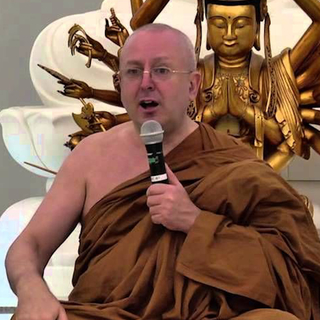
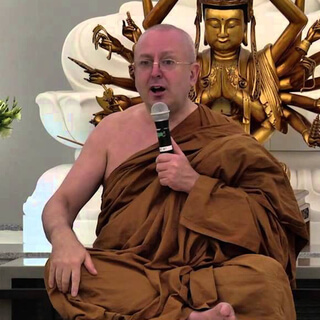
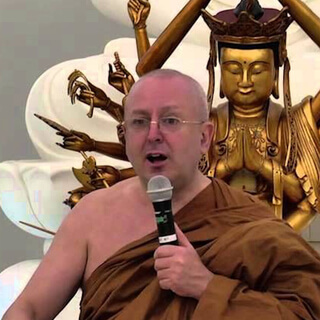
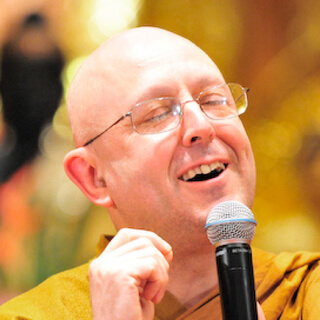
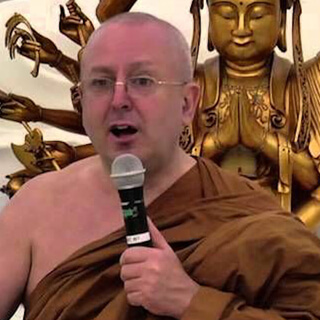
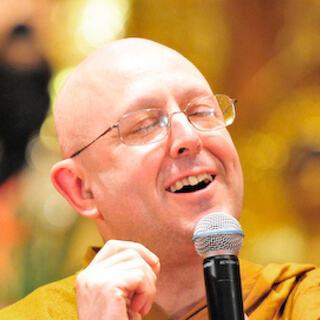
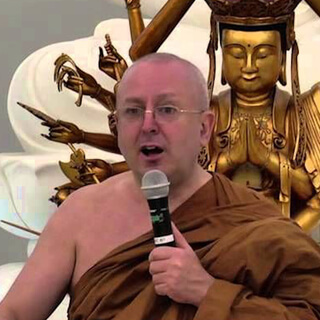
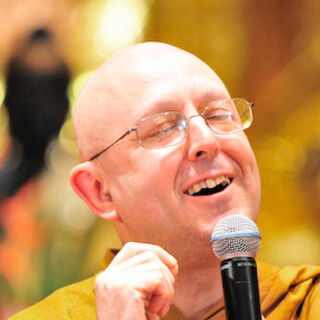
Meditation session today.
Unfortunately this is our Vah session for the monks because tomorrow we're starting our range retreats.
But don't worry because there's so many recordings.
And even though we won't be coming up here,
You can always visit down,
Actually this is down here,
Up there is up there at Serpentine on the hills,
This beautiful little place.
And it's a time when all of the monastic communities throughout the world at this particular time,
We have this beautiful range retreat.
So it's a time that we deliberately let our body stop going from place to place and stay in one place.
At the same time let our mind,
Instead of wandering from place to place,
Come back into one place.
And sometimes when you stay in one place long enough,
You get to like it and get to love it so much,
You wonder why you want to travel anywhere.
The same with the mind.
When you get into this inner place inside,
Nice and peaceful,
Nice and quiet,
Nice and comfortable,
You wonder why the mind ever wants to wander anywhere.
Because you stay still,
Stay right here and it becomes a very beautiful abiding.
Such a beautiful abiding is just one new word which somebody said of like enhanced perceptions.
It means because you're not wandering around,
Because you're not wasting energy.
I'm talking about mental energy.
Because you're not wasting that energy,
It tends to build up.
When it builds up,
You tend to get some very clear perceptions and also very powerful perceptions.
You literally see deeper into things.
And what you see,
What surprised me was you see more beautiful things.
Everything becomes as if it's like polished.
The greens are greener,
The clouds have got more detail in them and they're fascinating.
It's weird but it seems to be that there is a lot of joy and happiness in this world but we're too busy to really appreciate it.
And it's a real phenomena.
So when you do slow down,
Relax,
Get your energies back up again,
What you see is very delightful.
And that delight is something that's one of the important reasons why your mind doesn't wander off in meditation.
You know for years I sort of thought,
Why is it I'm sitting here,
Got nothing to do,
Nowhere to go,
But the mind goes wandering off,
Thinking fantasies,
Planning,
Old memories,
Some real,
Some false,
Whatever.
But anyway,
Why does it ever want to go anywhere?
And it was because what I was experiencing right now in this moment was not delightful enough.
And it's something,
It's a truth but sometimes it's more complicated than such a simple statement as I'm about to say.
But the mind needs joy and happiness.
If it doesn't find it in this moment,
It will go searching for it somewhere else.
In meditation it means you'll go wandering,
Thinking,
Fantasizing,
Remembering,
Music or football or whatever it is you had joy in the past with,
You have joy now in thinking about those things.
But if the mind is really,
Really happy,
It doesn't need those things.
And there's so much experiences in my life,
Little things like in Thailand we used to meditate all night,
Once a week.
And when I was meditating all night,
When I first year as a monk in Thailand,
Obviously about one o'clock,
Two o'clock in the morning started getting very,
Very sleepy.
Then I thought to myself,
Just about two or three years previous to that,
When I was still a lay person,
I would still go to all night parties,
All night walk concerts.
And I never felt sleepy at one o'clock in the morning when I was listening to an all night concert of Jefferson airplane and the doors.
That's a chalk farm.
I remember that,
The roundhouse.
Anyway,
Back to the real world,
That's where I came from.
But anyway,
When you start thinking about why the mind wanders instead of just trying to discipline it,
Instead of just saying,
No mind,
You can't go anywhere,
You stay put.
The whole purpose or the whole force behind meditation is ethos,
Is the word I was looking for.
The ethos is not to use force but to use wisdom.
Why does the mind wander?
And you find out it's because it's not happy here.
If it's happy where it was,
It wouldn't need to go anywhere,
Wouldn't want to go anywhere.
And that's one of the reasons why that,
What you learn in meditation also works in life itself.
In monasteries,
Why would,
Like a monk,
Want to go somewhere else other than Bodhinyana?
Because they're not happy there.
Why would a nun want to go somewhere?
Why in your job would you want to look for another job?
Why in your house you want to look for another house?
Why?
Because there's not enough happiness,
Contentment and appreciation of where you actually are.
And so in meditation what we're really focusing on,
Not so much of life.
If you're happy where you are,
You don't want to go anywhere,
You stay still,
You stay here in this mind no matter what it is,
Just because you enjoy it.
And next thing which happens is the delight,
The happiness starts to increase.
The happiness is built from stillness.
When you don't move it's like all the energy,
All the power is not used up.
Instead it increases and increases and increases and increases and you get like awake.
I don't know when you first get up in the morning,
I don't know how many of you have a cup of coffee.
Why?
It gives you a boost of energy.
You wake up quickly instead of slowly.
And also if you have a good cup of coffee or tea or whatever else you have,
You find that you are easy to talk to.
I tell the runties,
You should know this by now,
If you want to ask me a question,
If you want to ask for a favour,
Have a look to see how much happiness I've got.
And if I just come out of very nice meditation and you,
When you're right,
Ask,
Oh can I have this?
And they say,
Oh yeah sure.
Can I go over there?
Oh yeah,
No trouble.
I didn't get the message because not only are you energised but you also have a lot of happiness and joy and very easy to live with.
So little by little we learn how to increase our awareness and find more joy in life.
And it is strange but even that first year when I came to practice,
37 years ago,
We lived in North Perth in a little house in Magnolia Street and that's where we spent our first range retreat.
A tiny little,
I think,
Three or four room house with outside toilet.
It's lovely.
I had a wonderful,
Some wonderful meditation there,
Simply because you go in your room,
Close your eyes and you can bliss out.
How can you bliss out in town?
Easy,
You just go inside.
So little by little,
By going inside you just stay still.
And the other thing I should mention with that stillness,
What happens is when there's stillness,
Things vanish,
They disappear,
Which is one of the other reasons it gives you this wonderful simplicity.
And what I mean by that,
For those of you who heard this story before,
When I was only about 21 or 22 or something,
I was just desperate to go to any teachings on meditation.
I was staying in the north of England,
I went to this Zen monastery and I never knew what we were supposed to do.
So all they told us to do was to sit in a line and just to watch the wall with open eyes.
It was sort of serious because they had the Zen master and they would walk behind you with the Zen stick and they would hit you if you were sleepy.
People told me,
Oh yeah,
You know,
If they hit you,
It doesn't hurt.
When the guy next to me got hit,
I didn't believe that at all.
It worked because the guy next to me woke up,
So did I for the rest of the retreat,
I wasn't sleepy at all.
But that was out of fear,
Not really the right way of doing things.
But going back to the story,
That watching the wall with your eyes open,
Just a simple whitewash wall,
And then the wall vanished,
And it disappeared.
It left existence,
Which was really weird and strange.
I didn't take any drugs,
I didn't even have alcohol at that time.
I was a very sort of virtuous young man,
Weird but virtuous,
And because of those in the early 70s.
But I wasn't afraid.
I thought,
Why has a wall suddenly vanished?
And after a little moment or two,
Just contemplating,
It was quite clear what happens.
I'm now going to prove it to you.
Close your eyes everybody.
Now first of all,
When you close your eyes,
You can see the inside of your eyelids.
After a few seconds,
You can't see anything.
You can open your eyes again now,
Because what happens is your brain only notices things which change.
And if you're seeing something and it doesn't change at all,
After a while it vanishes.
If you hear something,
It could be the background noise of the traffic,
It could be the hum of an air conditioner,
It can be just the frequency of the air.
After a while you cannot hear it,
Because your brain only notices things which change,
Things which are still vanish.
And that gives you a clue of what meditation is and how it works.
When you're sitting here and you close your eyes and you're reasonably still,
Sight vanishes.
You're sitting here and this sound doesn't change,
Then sound vanishes.
Your body just sitting here,
Nothing really is moving and it's comfortable and your body vanishes.
You've got less things to worry about.
It's like less business on your desk,
Which means you're far freer and more able to energise.
And if you resist the temptation to go thinking,
Fantasising,
Planning,
Remembering,
If you resist that and just stay here,
This moment becomes so delightful,
So peaceful.
It's like having your own little retreat in your busy office,
Just sitting down and letting everything vanish and disappear.
So this is how we become free of so many of these things.
The idea of the mind wandering,
The mind can wander at the beginning of the meditation when you're just starting,
But you just do the meditation a little bit seriously.
I always like to start with my body awareness because the body awareness actually gets you into the present moment,
Gets you into some kindness,
Relaxing,
Feeling the body.
I don't know,
Maybe it's because of my age,
That you know,
Your body is really important,
You've got to look after it.
See many people of my age are getting sick,
But I refuse to get sick.
Can you do that?
I remember just once when I was in Thailand,
So many of the monks were getting sick.
This was mostly the food in the Northeast which was not really hygienically prepared.
So all the monks were getting sick and I remember this,
I told the monks,
I said,
I'm going to make a vow,
I'm not going to get sick this year.
I never did,
It was weird.
I made a vow to be healthy and sometimes in the morning,
You know,
We'd get up and prepare for the arms round early in the morning and all the other monks would say they just had diarrhea all night and they were sick with this and sick with that.
And they came to me and said,
I was okay.
It would be unfair really,
But sometimes your mind can be so strong,
Can actually avoid so many things.
I mean that made me believe in the power of the mind but also just the cause of that health,
The stillness of the body,
To allow the body to become strong and healthy.
And I don't know but I believe in that so much because you can feel it.
Sometimes you can feel the body when it's stressed,
It's tight and you realise that it can't last like that for too long.
When the body is nice and loose and relaxed and feels free,
Sometimes you can feel just the energy going into the correct places and hearing happening.
I've taught that to other people as well and I found marvellous success.
We're just learning how to relax the body,
Bring it to a state of ease and comfort and then health benefits happen.
So the body is so important.
So I always focus on the body to begin with and to relax it because it brings the awareness into this present moment because the feelings in the body are only happening now.
And philosophies,
State of the world,
That's always past and future,
The experience of your body right now,
Present moment.
And the second benefit of body awareness is that you can't really talk too much to yourself about your body.
You feel it and give it a name,
It's so difficult to do.
And you know that if any of you go to see the doctor,
You got some sickness somewhere and you say,
How does it feel?
It sort of hurts.
How does it hurt?
There's so many different degrees of pain,
So many different types of pain but sometimes we only know one word,
It hurts.
So I really feel for doctors,
For GPs who have to somehow rather,
From limited information from the patient,
Sometimes find what's going on.
But anyhow,
Little by little,
Find out what's going on.
But little by little,
That when we learn how to know our body and relax it,
We can become much healthier.
And also,
It's a great introduction to the meditation.
The time when the mind could wander off,
Instead we're busy with relaxing,
Looking after our body.
And you may notice that when I do this teaching,
This guided meditation,
I always pause when the body is relaxed so that people can experience the delightful feeling of relaxation.
And that's an important teaching.
Once you can notice how delightful it is,
You're aware of the delight,
You're not asleep,
You're not dull,
But it's delightful to be still.
It's delightful to be relaxed in your body,
Enjoying this moment.
You're not wandering anywhere.
You don't need to.
You don't want to.
It's happy being here.
And from there we can keep that stillness where we go into our mind and the mindfulness gets even stronger.
You feel the peace-o-meter,
You know exactly what it means,
You can just look and see how peaceful is your mind and how to bring it to even deeper peaceful states.
And then from there it gets even more delightful.
And you're having a wonderful time.
Just sit in here enjoying this moment and sometimes the minutes pass by and you don't realize,
Wow,
Is an hour gone by?
It's only like 20 minutes.
But it's great because you're enjoying every moment.
And the meditation starts to be deeper and deeper.
It gets deeper and deeper.
You don't have to be concerned about wandering off anywhere because you're enjoying this moment.
This moment is so pleasant you can't wander off.
So that joy in the moment is the antidote to the wandering mind.
Happy to be here.
And if you enjoy what I've been saying then you wouldn't have wandered off.
If you got bored then you may have wandered off.
It's a case in point.
Okay,
So now let's get into the meditation.
I usually do this 15 or 16 minute,
Just sort of a briefing and then I give the guidance.
We meditate for about 45 minutes till four o'clock.
So if you'd like to get into your meditation posture the best you possibly can.
If anyone who just came for the beginner's class,
There is no beginner's class at the moment,
I'm sorry.
But anyhow,
It's because of post-Covid that always having to adapt very quickly.
So anyway,
Because we have to adapt,
So we haven't got a beginner's class,
We've just got an expert's class.
All the experts here.
Okay,
So here we go.
So sitting down,
Close your eyes.
With your eyes closed,
Now we can bring our attention to how we're sitting.
To make sure that your physical position is reasonably comfortable.
When I was talking I could not be aware of just my bodily posture.
My belt is a bit tight.
I'm adjusting things.
I feel so much better.
So I just give a rough feeling of my physical posture,
First of all.
Then I go to more detail,
More refined,
More part by part.
I start with my legs.
Start with a rousing mindfulness.
What do you mean by that overused word?
I ask my legs,
How are you?
Just regard my legs as if they were a separate being.
Just like if I met one of you and asked you,
How are you?
I get a response.
My legs say they're reasonably comfortable.
I ask my legs,
Do you need to be adjusted?
Can you sustain this position for 45 minutes?
My legs say,
Yeah I'm fine.
I leave them alone.
It is not just checking,
Like checking a car.
See it's got enough water and oil and gas petrol.
It's just showing you're concerned.
The power of kindness,
Compassion is very strong.
Just by talking to someone and just acknowledging that you recognize them,
It's showing you care for them.
And the caring just softens everything.
So by showing I care for my legs,
My legs relax,
Become more at ease.
And when they are comfortable enough,
I go up to my butt.
See that I'm sitting on a cushion,
On the edge of a cushion.
Just sitting on a chair,
Make sure that you're sitting comfortably on the chair.
See if you can improve it if at all possible.
And I ask my back how it feels.
It's not just asking,
It's just doing something in case the back just needs some adjusting.
My back needs a good stretch.
And that feels good.
And I can feel any tightness in my back,
Focus on it and learn how to relax that tightness.
To bring my back to a deeper state of ease.
If you have any tightness and tension on the front of your body,
In your chest or stomach or breasts or heart or whatever,
Sometimes just focusing on that part of the body,
Zooming in,
Giving it kindness.
You can feel that little part of your body which you're focusing on.
Just go to a deeper state of ease and relaxation.
Your back and front does not need to be perfectly relaxed.
Just make it more relaxed.
And go up to your shoulders,
Relax them.
Just loosening,
Not holding anything tight,
Not stretching things,
Not putting things apart.
I often feel that like two ends of the shoulder muscles,
This is being pulled apart.
It's called stress.
I just learn from a bit of trial and error and from the feedback which mindfulness gives you.
So feel those muscles loosening off and relaxing.
I'm going to go,
I suppose shoulders are relaxed.
I just feel my arms.
It's like I move my attention,
My mindfulness down from the shoulders,
Down the upper arms to the elbows.
From the elbows to the wrists and the wrists to the hands.
Feeling as many sensations as I can and making sure everything is relaxed.
And those sensations,
Especially when I get to my hands,
It's suddenly nerve-ending service,
It's just alive with sensation.
A tingling.
It feels good.
To relax is to give some delight to your bodily feelings.
I go up,
Back to my shoulders and my neck.
I do this because these are the areas if I don't pay attention will be painful.
I avoid that by checking on them before I really get into the meditation.
Riveting my head back and forth to stretch those neck muscles to bring them some ease.
I'm going to the front of the face and the muscles around the eyes and the mouth.
Making sure they are relaxed,
At ease,
At peace.
I can feel the muscles,
Sometimes they are tight,
Sometimes they are loose.
The looser they are,
The more comfortable they feel.
Once I've relaxed the muscles of my face,
You can adapt this as a method to find out what works for you.
But then once I relax these important parts of my body and I look at the whole body,
I feel like all joined together,
My human body sitting here.
I tend to do as many parts as I could and I feel it as one whole thing.
It is at peace,
It's at ease,
It's relaxed.
I keep my awareness on that relaxed feeling until I feel the delight of relaxation,
The ease,
The rest,
The peace of a body which hasn't got too many problems.
Sometimes your body with aches and pains,
It's like you're overwhelmed with busyness,
With physical problems to deal with,
Within this stage of the meditation.
Hopefully there's hardly any problems at all.
It's like freedom.
I start noticing the delight of a relaxed body until that delight gets stronger and stronger.
My awareness is growing.
It's growing and being able to see more,
Feel more.
It's not so distracted,
It's going slow.
I also notice that when you get to the delight of relaxation,
Disturbances don't disturb you.
The more quiet you are,
The more resilience you have.
Making peace with your body,
Being kind to her,
Being gentle with your body.
After a few moments,
It's time to look at your inner world.
I call it the peace-o-meter.
How peaceful are you?
The opposite is how agitated,
Disturbed.
Giving it a number from one up to ten.
One is really peaceful.
The other is quite agitated.
How peaceful are you right now?
There's no need to hide the truth or bend the truth.
It's only you know this.
What causes the disturbance?
What causes the reading on your peace-o-meter to go down,
Closer to one?
What are some important insights to have for the cause of real inner peace?
What are some important insights to have for the cause of real inner peace?
What are some important insights to have for the cause of real inner peace?
What are some important insights to have for the cause of real inner peace?
What are some important insights to have for the cause of real inner peace?
What are some important insights to have for the cause of real inner peace?
And as usual,
You'll find that being in this moment,
Just avoiding anything to do with the past,
You can deal with that later.
The realisation that now is where your future is made.
This is the only time you have.
So you value this moment.
You have so much importance,
You stay here.
And you avoid giving things a name.
You don't need an internal commentary.
You feel rather than think.
Little by little,
We get really peaceful.
And peace is delightful.
Your level of awareness,
Its strength is greater.
Mindfulness is getting powered up.
And you're learning,
You're listening,
You're feeling the nature of your body and your mind.
You're getting to know these things by paying attention,
Like paying attention in a lecture.
You're allowing the information to go in.
Very often people become aware of their breathing at this point.
Just know the breath as it comes into your body.
You know the breath as it goes out.
The reason why the breath meditation becomes important is because it's the only thing which is left,
Moving.
So never try and control your breath.
Always regard the breath as a friend,
As independent,
As someone or something that you've got to know.
And just hang out together.
Watching your breath come in your body and breath go out.
I will be quiet now,
For about 15 minutes,
20 minutes.
When I start speaking again,
It will be close to the end of the meditation.
Okay.
Okay.
Okay.
Okay.
Okay.
Okay.
Okay.
Okay.
Okay.
Okay.
Okay.
Okay.
Okay.
Okay.
Okay.
Okay.
Okay.
Okay.
Okay.
Okay.
Okay.
Okay.
Okay.
Okay.
Okay.
Okay.
Okay.
Okay.
Okay.
Okay.
Okay.
Okay.
Okay.
Okay.
Okay.
Okay.
Okay.
Okay.
Okay.
Okay.
Okay.
Okay.
Okay.
Okay.
Okay.
Okay.
Okay.
Okay.
Okay.
Okay.
Okay.
Getting close to the end of the meditation now.
How did it go?
How do you feel inside?
How's it like right now with your mind?
How delightful is your peace of mind?
I may not come to your body.
How's the body feel right now?
So the last minute or so of meditation,
We have the opportunity to understand our body and our mind.
It's a time when insight can arise.
Now I'm going to ring the gong three times.
Please listen to every sound of the gong.
When the third ringing of the gong disappears,
It's a signal to come out from your meditation.
Gong Very good.
So I've got some questions from overseas first of all.
And for those of you who don't know,
These sessions are live streamed overseas.
Today we have from the Czech Republic,
From Germany,
From Indonesia,
Germany and Hong Kong.
So five questions.
And it is because the people regard this as a very popular session.
From Czech Republic,
Dae Ajaan,
How do I tell the difference between letting go and denied ignoring the Freudian displacement?
Sometimes it takes a lot of effort,
Reminding to let go.
Is that okay?
It is sometimes that many people have theories,
Whether it's Freudian or Jungian or whatever.
But sometimes it's not really denial if it just disappears and goes forever.
Denial is a suppression.
So for letting go,
Especially of past formers and past events early in your life,
Denial will never work.
Usually what happens is that you are strong enough,
You're safe enough to let it come up.
To let it come up and not to put it in the right perspective,
Some which happened to you a long time ago.
And not to give blame to yourself or to others.
And then to understand it as if the past in these situations,
Especially those very difficult ones,
Have got to teach you something.
Less than that life is a bit out of control,
Can be unpleasant sometimes.
But then a lot of times it's very pleasant as well.
We have a share of both.
We let it come up,
We open the door of our heart to it,
Just like we can have all sorts of things in this world.
And then we open the door of our heart to it,
It loses its power.
I know it's a metaphor I use every week just about of the monster who came into the Empress Palace.
And when people said,
Get out of here,
You don't belong,
The monster just grew bigger.
When people said,
Welcome monster,
Thank you for coming here,
And looked after it and cared for it,
The monster shrank until it got so small it vanished completely away.
It's another way of dealing with difficult situations in our life,
To welcome them.
And with past difficulties and problems and pain,
You can't get rid of it,
You can't pretend it never happened,
So you welcome it.
You welcome it,
Learn from it,
And then its power vanishes.
The monster gets diminished.
So when it's letting go,
Most of the letting go is just meditation time.
It's to take a break from the problems in the world.
I've got many things I'm supposed to be organising for yesterday and for tomorrow.
Tomorrow's big ceremonies and goodness knows what else.
But when I meditate,
I totally let go.
People might say,
You're in denial Ajahn Brahm,
You should be planning and thinking and all that,
And I don't believe in that.
So just,
You let things go and enjoy this moment.
There's a saying to grant yourself moments of peace.
If you don't give yourself those moments of peace,
You'll never find them.
So meditation is saying,
I give myself 45 minutes of peacefulness,
No matter what.
Probs and difficulties and things face you afterwards.
And if you can do that,
Give yourself peace.
You find that that's the letting go.
And afterwards,
Whatever problems you have to face afterwards,
You finally can face them with far more innovation,
Seeing new solutions which you were blind to before,
And also having more energy to do your duties in this world.
So letting go,
First of all,
There's a meditation letting go,
It's a temporary letting go,
But sometimes it leads to a much bigger letting go.
And so denial obviously is just,
It's a lying to yourself.
And these things don't happen,
Just trying to hide them under the carpet.
But letting go is taking the rubbish and just embracing it,
Including it,
Not hiding it,
And then it disappears.
Anyway,
From Germany,
Can you please explain your thoughts about letting it go and letting it be,
How to do it?
Also,
When to do it in regards to feelings and thoughts and when in pain?
Okay,
Letting go and letting be.
So what it is,
You let go of controlling,
Wanting,
Negativity,
I don't want or I want,
That's when one lets go of.
And when you let that controlling part of your mind go,
Let it disappear,
Then what is left is what you let be.
So in other words,
It's looking at two things from a different angle.
One is why can't we let things be?
We always want to change things,
To amend things,
To control things.
But now instead of trying to control things,
Especially meditation,
We leave things alone.
We don't want anything.
It's strange,
But many people know that the first teaching of the Buddha,
Which is what we're celebrating tomorrow on our Sahapuja day,
When the Buddha gave the first sermon saying,
Suffering is caused by wanting.
Imagine,
You don't want anything.
Just imagine,
You're totally content in this moment.
You don't want to go anywhere,
You don't want to be with anybody else except the one sitting right next to you.
You're just happy being here.
Imagine what that's like.
And really make that a perfect contentment,
Not wanting anything in the whole world.
How peaceful that becomes.
That's letting it go,
Letting wanting go,
And letting what's remaining be.
And feelings and thoughts are when in pain.
First of all,
The thoughts are so deceptive.
I just don't believe many of my thoughts.
You know my thoughts when I tell people about them and I just express my opinion about something,
I always get in trouble.
You get in trouble when you express your ideas to other people and then they say,
No,
That's not right.
But feelings,
I don't know,
I tend to trust them more than anything.
They feel,
This doesn't feel right.
It doesn't feel like I should be speaking.
It doesn't feel like I should be silent.
And those like feelings inside,
I trust those more and more.
So you don't let go of the feelings,
You just develop them and get the sensitivity,
The beautiful feelings of peace.
What a wonderful feeling that is.
It's not sort of boring at all,
It's just alive,
It's vibrant,
It's beautiful peace.
Can you hear the sounds other than my voice?
So quiet in here this afternoon.
Who would ever know we were sitting in a city?
It's peaceful.
Peace is joy.
And so those feelings are just amazing,
So I trust those.
And also in meditation you get much better by going with your feelings rather than the thoughts.
Feel your way into deep meditation.
Feel the peace,
The joy.
Don't worry about the thoughts and try to describe it all.
And when in pain,
There's two types of pain.
And there's the physical pain and the emotional response.
Physical pain you can't do too much about.
But a lot of the time it's amazing,
You can be in pain and you go into deep meditation,
You can't feel any pain.
It's amazing just how when you stop the mental response,
Most of the pain just becomes quite bearable,
An incredible pain too.
What was it?
It's a weird thing to say but when I was in Thailand,
One of the books,
We didn't have many books in our library,
But one of the books we had in our library in northeast Thailand was a book about how to give birth.
There were a bunch of men.
We didn't have girlfriends or wives or anything.
The reason we had it there,
Because there was this hippie commune in the United States a long time ago.
They called themselves the farm.
But one thing which they did do,
They were really smart and it became almost like a textbook.
They're teaching women of their community just great ways of giving birth.
Number one,
Which I always remember,
What a stupid thing to call it labour pain.
As soon as you call it pain,
It's going to hurt.
And of course it hurts then.
So they started calling it labour energy.
Just give it a different name and just labour energy.
And of course that was brainwashed into people in the commune.
They were just pretty limited to the amount of influence they had from outside,
Labour energy.
And they'd always have not just the husband or the guy,
But all the friends around.
It was a party when they were giving birth.
And when they had a contraction,
Yeah,
Go for it,
Wow,
That was amazing.
It was like a football match or a cricket match.
And it was just so exciting.
And they had one of the doctors,
I had to,
From the ordinary doctor there.
The ordinary doctor was just amazed,
Just number one,
How quick the births were.
The times of labour was so incredibly short.
And just,
There was some pain for it.
There was some energy and powerful energy just giving birth to a child.
And I said,
Wow,
That's really incredible.
And anyway,
They just,
We're talking about labour pain.
That's the reason we had that little book in our monastery,
Just to see just how perception can change what many people think is painful.
To be,
Wow,
This is incredibly moving,
It's powerful,
But I'm not going to call it pain anymore.
Anyway,
That's the guide to feelings and thoughts when in pain.
You call it pain,
It's going to hurt.
From Indonesia,
Ajahn,
Since this is the last guided meditation before the rains commence,
Can you please give a full version of the chant of the Chulamangalasuta?
Thank you.
A full version?
With the suttas,
I mean,
It was a fellow,
I'm not sure if it's the same fellow from Indonesia who suggested I do this,
But give a little chant at the end of the meditation.
But it is,
Just roughly,
It's just wishing people happiness and well-being and strength.
And just whenever you say to a person,
Have a wonderful day,
You may be happy in the world,
May you get over the sicknesses,
Whatever you say like that,
If you put many words together,
And then it has power,
Especially after meditation,
In my life after meditation,
That's the most powerful I feel.
That's why I shouldn't give out these little tricks.
After you've been on a meditation retreat,
Like I always do two weeks,
I think it's in September sometime this year,
I do two weeks,
I hide in my cave and I don't sort of talk to anybody,
Except the one that brings my food.
And then after that,
Wah,
Meditation is really powerful,
Wah.
So if you get some chanting then,
Wah,
Full power.
I'm not joking,
You've really got some energy.
So anyway,
But if you want the full version of the Chulamangalasuta,
You can get that in the book.
From Germany,
I'm in the middle of a break-up and sitting down to meditate makes me feel more anxious because it gives me room for more negative thoughts.
Do you have advice on how I can deal with this?
Yes,
Remember,
Just you partition your day,
You're breaking up,
But you don't know,
It may just come together again.
How does,
The thoughts just came to my mind.
You know that first book which I wrote,
The opening the door of your heart.
Somehow or other,
I got a couple of copies in the Australian Embassy in Thailand,
In Bangkok.
And it was passed around to quite a few people there.
And they really,
They valued it so much that I got this invitation to come and visit to give a talk.
And there were three couples,
Three couples in the Australian Embassy in Bangkok.
Oh,
Four couples,
Four couples,
Two were divorced,
Two were separated,
Four couples in all.
And they read that book and they all came together again.
They reconciled.
And it was just amazing.
They said,
We've got to get this monk over to give us a talk.
So they clubbed together and brought me an air ticket and gave a talk over there.
It was just so amazing.
Well,
How come?
And it was just,
Don't eat the two bad bricks in a wall.
Don't expect so much of your partner.
Yeah,
You can see the two bad bricks and what they did.
How about seeing the other things in their wall?
You can appreciate people more.
And don't be so critical as I can't live with that guy,
That woman anymore,
What they did to me.
Yeah,
What did they do to you?
They did some wonderful things for you.
Yeah,
They did terrible things as well.
Yeah,
Two bad bricks in the wall.
They got 998 good bricks.
So anyway,
But if they're going through a breakup,
You can't just say,
Don't you need a bit of time out,
A rest?
Hopefully you do.
You can use meditation as just a break,
A rest.
So a breakup is not the central feature in your life.
It may feel that way,
But it's not.
How many people here have had breakups in their relationships?
Put your hand up.
If I didn't have a breakup in my relationship when I was young,
I wouldn't be a monk.
When I was about 19 or 20,
The first time you fell in love.
Oh dear.
So sometimes it's a nice relief.
It's a little place you can go to get some space in meditation.
It gives you room for more negative thoughts,
But also gives you room for better perspective,
For silence.
I'm asking you from Hong Kong.
When painful memories from deep within are bubbling up,
What should I do if I need a chance for healing,
But I have a lot of work at the same time?
It's,
That is your work.
Sometimes it's,
People say,
I'm too busy to do all of this meditation or to deal with the problems in my life.
No,
You are not too busy because if you deal with those problems in life,
You find that you do become a person of more time.
You create time.
That's the old thing.
You know what the,
What stress is?
Here we go again,
One of my old similes.
I just saw my cup and I want to use it.
How heavy is my cup of water?
The longer I hold it,
The heavier it feels.
After one minute,
It starts to wake.
Two minutes,
I'm in pain.
Three minutes,
I'm in agony.
Actually I invented this simile,
But it's gone around the world.
Three minutes,
I'm in pain.
But no one actually acknowledges it.
I shouldn't actually have paid for these things.
I make a lot of money for our Buddhist Society.
Of course you don't do stuff like that.
Three minutes,
I'm in great pain and I'm very stupid.
What should I do when this gets too heavy to hold comfortably?
Put it down.
Obvious.
So if you have painful memories from deep within,
They're bubbling up,
What should you do?
It's as you put your work down and deal with this problem.
And then afterwards,
When you deal with the problem,
Then your work is very easy to do.
In other words,
Do the most important thing right now.
The thing in front of you is the most important thing in the world.
Now is the most important time.
And the key part of it,
What's the most important thing to do with this?
To care for it.
To care for the painful memories.
Don't try and cure them and get rid of them because that makes them more painful.
Care for them,
They're teaching you something.
And I often say that the teachers which I learnt the most from weren't the ones I liked.
They're sometimes painful but I learnt so much from them.
So sometimes the experiences in life where you really learn,
You don't choose them.
Sometimes they can be painful but you learn so much from them.
You understand so much.
And what you understand is a wonderful little saying in very brief and somebody in Singapore,
They asked me,
Can you please explain the Buddhist teaching of suffering?
And I said,
I've only got a minute because I've got to go to work.
I love that little,
I know because they didn't have time.
And so I told them,
Suffering is asking from the world something it can't give to you.
I thought that was quite cute and quite sort of precise.
When you ask from this world what it can't give you,
That's called suffering.
It's no one's fault,
It's just the world.
So you've got painful memories.
We've all got painful memories somewhere.
So you can't expect just to not have a life without painful memory or two or three or a dozen or a heap.
But we learn from them.
And when we're kind to them,
We look upon them as our teacher.
And soon we learn so much,
We do really become wise,
Kind,
Peaceful beings.
A lot of work at the same time,
You don't have too much work.
People say,
I do,
I do,
I do.
No,
You make work.
Leave it alone and deal with the painful feelings.
Get to know them,
Be kind to them.
Go on a walk in the forest somewhere or by the beach.
Get some great comfort and teachings from nature.
And there you can get these wonderful insights into just how healing happens.
And healing does happen,
It's wonderful to see it.
Okay,
So thank you for that question from Hong Kong.
Are there any questions from the audience sitting here?
No one ever puts their hands up but there'll be a few people in front afterwards,
Like last night.
Okay,
So let's bow to the Buddha.
Oh no,
I said the Chula Mangra Sutta,
Yeah,
The little chant festival,
Which is a nice one.
Sābharo goinimutto,
Sābhasantāpowajito,
Sābhāveramati gandho,
Nibutto,
Cattuangbawa,
Sābhitiyo iwa cantu sābharo goinasa tumate,
Bhāvanāntarayo sukhīdhi,
Gāyugopa vāpīvādhanhasīvitsa nīcā,
Uttapacchālino,
Cattarottama vātantī,
Ayuvanosukhān,
Bhālanāntarā.
Sadhu,
Yeah,
Excellent,
Have a wonderful time.
And even though I'm not coming up here for a while,
I'm always having Bodhinyana Monastery,
So you can always come and see me down there.
I've seen you many times,
So now it's time for you to come see us.
Excellent,
Have a wonderful time.
You can now come bow a few times if you wish to.
Thank you.
Thank you.