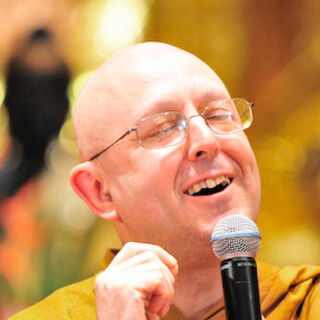
Welcome everybody to the meditation class today.
And our meditation class,
I will finish precisely at 4pm,
Precisely according to Buddhist time,
Which means maybe 5 or 10 minutes either side.
But the reason is that afterwards we're going to have our annual general meeting.
It's supposed to start at 5 o'clock,
But I give time for people to get settled and registrations and stuff.
The idea is always to make sure that the annual general meeting is as close as possible to the meditation.
So it gives me a time to make sure everyone is nice and peaceful and calm and well hypnotized,
So that when we actually do the voting and stuff,
It all goes according to plan.
That's only a joke by the way.
I know how I say these things,
People say,
Ooh,
That's how Ajahn Brahm does it.
So anyway,
The meditation,
Again welcome here.
Those people who come into the introduction to the meditation class,
That is in the room to my right,
This is the ongoing class.
And at this class we teach meditation,
We go a little bit longer in our meditation and also have the opportunity for people to ask questions afterwards.
So I think most people I'd imagine maybe coming later who are going to be attending our AGM.
But anyway,
Those of you here,
Welcome to the ongoing class.
And if you have come for the introduction to meditation class,
Again that's the room to my right.
And one of the things which when I go off teaching meditation all over the world,
The most difficult part for people is again to calm down,
To make their mind peaceful.
And there was a story I often repeat,
And I'm sure those who come here regularly have heard this many times,
Uh-oh,
You are hearing in the other room.
Yes,
So all the people in the other room welcome to the introduction class.
You're with one of the great teachers of our Buddhist Society,
Mr.
Dennis Shepherd.
He's been so well brainwashed that the soap powder has gone into his hair and made his hair white as well,
And that's even washed.
Ah,
You've got the,
Ah,
Okay,
You see he's got great powers.
He can actually see the line of the hearing loop in the carpet.
See that's only because of meditation,
Dennis,
That you can actually see deep into things.
Okay,
So anyway a few more people coming in.
Good,
They're coming into this class,
We've got a class.
Anyway,
So again this is the ongoing class,
Those who come to the introduction and meditation classes,
This room to my right.
And one of those little events which meant a lot to me was when I went to see a very great meditation teacher with lots and lots of questions in my head,
Not wanting to waste the opportunity to ask this really special monk while he was still alive.
And as soon as I went into his room,
This big room where he was sitting in a small chair,
And I went to see him,
It was amazing just how my mind went very peaceful and calm.
It was that all my questions which were really important sort of just evaporated.
The mind went very,
Very peaceful and I wondered why that was the case.
It was very pleasant not to have any thoughts.
It was as if all those questions were already answered on a deeper level than I could ever imagine.
The reason I'm repeating this now is that when one is in a space of peace,
Of acceptance,
Of safety and great kindness,
When one doesn't have to prove anything,
Answer any exams or pass any tests,
When you really are peaceful and at ease,
You'll find that questions just do not come up.
The mind is very clear and very alert but it sees that there's another way of understanding truth,
Way beyond questions and thoughts.
And the thoughts are seen not as a way of finding solutions to problems but actually what stops the problems being seen for what they truly are.
And the simile is again another simile.
I keep on thinking I shouldn't tell the simile again but these are best similes.
And that was a simile of the lake in the mountains with waves and ripples on the surface.
And when you've got waves and ripples on the surface then you can never see a true reflection of the moon and the stars in the heavens above.
So when there are ripples on the surface of the lake you can't see the truth.
And those waves and ripples on the surface of the lake,
The lake represents your mind and the waves and ripples represent thoughts.
There are times when you've got so many thoughts going on in the mind,
It's so restless,
It's not a personal failing but it's just sometimes life is like that.
You're very busy,
You've got a lot of problems which you have to face,
You've got a lot of decisions which need to be made,
You're tired,
You've been working hard.
Your lake,
Your mind is like just as a storm on the surface,
Lots of waves crashing against the surface of your consciousness.
That is like a lot of thoughts in the mind.
And if you can,
Just let things be,
Not make things worse,
Not get into fear but just allow things to settle down by themselves,
Then what happens is the waves get less and less and less,
The ripples get more and more further and further between them until the lake becomes perfectly still.
And that's like a mind which has no thoughts on it,
Perfectly clear,
Reflecting like a mirror,
The moon and the stars and the heavens above.
That's like a mind which stops all mutt of this thinking.
And where we can allow that mind to become still is learning just how to relax,
To be kind,
To not to give work to our brain,
Not to ask it to perform,
Not to criticize it as if you're like a boss at work,
Always looking over you,
Telling you what to do,
You're not working hard enough,
You're not progressing enough,
You're not making enough sales,
You're not doing this right.
All of that critical part which you have to endure when you're maybe at work,
Of course I don't have to endure that when I go to monitor because I am the boss,
Or the others have to endure for me.
But you can see what happens when we do that to ourselves and just how that causes the waves in our mind.
And imagine that you don't have anything to attain,
No goals to reach,
No tests to pass,
Nothing to work towards,
Which means you can rest,
Relax.
And so that idea of learning how to relax,
Not just the body,
But relax the mind as well.
And it's one of the reasons why the phrase which I'm trying to impress upon people,
Just almost like a slogan,
Last year it was,
Make peace,
Be kind,
Be gentle.
And this year it is,
Relax to the Max.
It's a slogan but it actually works.
So to relax to the max is where we,
Not just our body,
But our mind.
We all know how to,
Well actually,
Amazing how many people don't know how to relax their body.
But you can always relax your body a little bit more by learning how to relax the mind.
So the mind can be at peace.
Sometimes even in body sweeping,
Body awareness,
Which I've often done here.
Sometimes when I get to the final parts of the way which I do body sweeping,
Going to the face,
Then I sometimes say,
Well now go two inches behind the eyes to where the brain is supposed to be.
And imagine taking your brain out from your skull,
I mean don't do it properly,
Just do it imaginary,
Just take it out and pull it down,
Almost like in a bed or on a soft cushion and tuck it in and stroke it and wish it good night.
So in other words,
You're kind to the brain,
You can give it a rest.
Let the brain have a holiday.
Let the brain relax.
Let the brain get away from it all and just have some peace and quiet.
And so that is almost like a visualization of learning how to relax your own brain.
And it's not being dull because when the brain gets relaxed,
You actually get brighter,
More aware the less you do and struggle.
So this is how to relax the brain and you find you don't have many thoughts.
You're peaceful,
Focused,
Bright and clear.
So anyway,
That is this little focus for today's meditation.
So now if you'd like to get in your meditation posture,
Position,
And I will ring the gong this time at about 3.
50 to give an opportunity for a few questions before we break to get ready for the ATM later on.
Good.
So when you close your eyes,
Relaxing our body.
To relax your body,
You start with your feet,
Lowest parts of your body.
And to establish mindfulness,
To connect your mind with your feet,
It is asked the question,
How are you,
Feet?
Are you in a good position?
If you find it difficult starting awareness of your feet,
Just wiggle the toes.
You feel that you can know how things are experienced down there.
And if you find any compression,
Tightness,
Strain,
That's going to cause a problem later on in the meditation.
So do something about it now.
Adjust.
And then you go up your legs,
Your calves.
And when you have your calves,
If you can,
Relax and please do so.
Mindfulness allows you to have this feedback.
So sometimes I feel my calves are quite happy,
Content,
But then I just,
Even just stay a bit longer,
Can I make that feeling,
That almost like a dull ache,
Hardly much at all,
But focus on it,
See if I can make it more comfortable.
Just being aware of something and having an intention to relax it,
I find that I get feedback that the feeling of my calves does change and I become more comfortable.
Whereas at the beginning I thought,
No,
It's good enough,
I can find even more comfort with a bit of observation and trial and error and kindness.
I go up to my knees,
Making sure they're comfortable.
For those who have people who have got injuries to their knees,
There's pain there.
If you can't move,
That's wonderful,
If you can't move to alleviate the pain or the ache or the swab,
Then stay there and just see what happens when you change the way you look at that feeling of ache or pain.
See if you can,
Just allow it to be,
Opening the door of your heart to that feeling.
Initiating means exploring different ways of looking at things.
And as one explores the different ways you can establish a relationship between your mind and that pain,
No one of fear and control,
But learning how to be tolerant,
Living in harmony with you and that pain.
Trial and error gives you a lot of wisdom and you find you can be at peace with it.
It's not a problem anymore.
Sweep up through your thighs,
Making sure they're comfortable.
Any aches or itches,
Be with it,
Zoom in on it,
Get to know that feeling and discover what makes it more at ease,
Relaxed,
Less of a burden and a problem.
You can feel it and you can know how to relax.
And up to your buttocks,
They are being pressed against a hard surface like the chair or the cushion or even the floor or stool.
Be aware and ask the question of your buttocks,
Can I make you more comfortable?
By twisting or fidgeting or moving?
Are you sure you're okay?
It is real sincere care for the comfort of your body and using mindfulness as a way where you can see,
Feel how the body relaxes and how tension in the body,
Inflammation,
Wounds can be healed.
Listen to your based,
Feel it,
Get to know it,
Relax it.
Even so the lower intestines,
The colon,
All of that,
You can feel it and after a while you know how to relax.
The awareness,
The kindness,
And the whole thing just becomes so loose and open and peaceful and comfortable.
Then going up,
Up to halfway up your back,
There,
Inside there are so many organs which cause people so much problems.
Feel those organs,
Some of them they're not a problem,
So they're almost like dormant,
They're not a problem.
The other parts of your body may feel an ache here or a strain there,
Just be with it.
Just fill the mind with that experience,
That's what we mean by zooming in.
It's like you focus on that to the exclusion of all other parts of your body.
You get to know that part,
Get to understand and thereby you find how,
How to relax.
It's like in the old days as kids you maybe take a part of a motorbike,
A simple thing or an old car,
Put it back together again,
Just fiddling around getting to know how it works.
As you explore,
Fiddle around,
Just try this,
Try that,
That's where you get skills from,
You get to know how your body works.
You go further up the body,
Your chest area,
Getting to know repeated mindfulness of one area,
You just increase your data bank,
So you get to know that area.
You know how it works,
You know how to tense up and how to relax.
You relax to the max and up to your shoulders.
You can learn how to just let go of both ends of those shoulder muscles.
You can experience the shoulder muscles loosening,
Drooping,
Relaxing.
Little by little you are reinforcing your understanding of relaxation,
Its health benefits,
Its comfort.
You also understand how it's done,
Awareness together with this beautiful letting go,
Kindness.
And your arms and hands.
How are your hands by now?
How do they feel?
And go back up to your neck and throat.
And sensations.
Relaxing them,
I'm just stretching my neck,
Moving my head from back left to right,
Just to make sure that the shoulder muscles and the neck muscles are nice and loose.
And at ease.
My facial muscles.
And all my awareness just on how my eyes,
The muscles around the eyes,
The forehead,
The mouth,
Just how tense they are or how loose they are.
And lastly my brain.
To relax my brain.
How do you do that?
There's not supposed to be any possibility of knowing physical sensations inside the brain.
And no nerve endings.
So what we do,
We use our imagination,
Visualization.
You imagine a brain,
Imagine your brain just coming home from work just really exhausted and tired.
But it doesn't know how to rest.
So imagine making a nice little bed for your brain.
With a really soft,
Soft mattress and sheets and a duvet if you like duvets.
A nice soft pillow.
You put your brain to bed,
Tuck her in and wish your brain a nice rest.
Just imagining it.
You find that when you imagine things clearly in your own way,
Then actually the real thing happens not to quite the same extent but to a lot,
It gets relaxed.
Your mind is making your brain relax,
That's what's happening with the imagination.
With the visualization.
Relaxing your brain.
Relaxation is a very pleasant experience.
So when I look at my body after this short exercise of relaxation,
My body feels good.
It feels pleasurable.
The delight of a body at ease.
It's not perfect,
It's much better than when I started.
And once the body has been relaxed,
Now to relax our brain,
Sorry our mind.
Mind with all the emotions,
With all the thoughts.
So imagine your mind like a lake,
A pond,
A body of water,
Not too big.
Imagine that lake,
Your mind,
With so many waves on the surface.
If you've had a very difficult few days,
With many problems in your life,
And having to face many difficulties in the future,
Sometimes your lake is like there's a storm at the sea,
Huge waves breaking and crashing into the ground.
That's a disturbed mind.
It's natural,
You can't,
Sometimes these things happen,
It's the pressure of your work.
But imagine now,
The wind drops,
The cause of all those waves and all that foam starts to lessen,
The waves get less and less and less.
Imagine your mind being like that still forest pool,
No waves at all.
Maybe a ripple every now and again,
But that's going to be temporary.
See if you can relate those waves or ripples to thoughts and commentary.
So you visualize the thoughts,
Waves on the surface of your otherwise still and peaceful mind.
You don't force the mind to be still,
You let it be still.
You let it be stillness,
Calmness.
You recognize the space between thoughts and you respect the silence.
It's like I remember there's a small going to ceremonies in churches and people saying shhh be quiet,
I could.
Now you're asking your mind shhh be quiet and it can.
Because your mind gets beyond thought,
Once you can taste silence,
It's usually so delightful,
You don't want to have any thoughts,
Leave the thinking to later.
Now be silent,
Let the breath come whenever it wants to,
Breathing in peace,
Breathing out,
Let go,
As you practice many times.
I'm now going to be quiet till the end of the meditation in 20 minutes time.
I'm going to be quiet till the end of the meditation.
I'm going to be quiet till the end of the meditation.
I'm going to be quiet till the end of the meditation.
I'm going to be quiet till the end of the meditation.
I'm going to be quiet till the end of the meditation.
I'm going to be quiet till the end of the meditation.
I'm going to be quiet till the end of the meditation.
I'm going to be quiet till the end of the meditation.
I'm going to be quiet till the end of the meditation.
I'm going to be quiet till the end of the meditation.
I'm going to be quiet till the end of the meditation.
I'm going to be quiet till the end of the meditation.
I'm going to be quiet till the end of the meditation.
I'm going to be quiet till the end of the meditation.
I'm going to be quiet till the end of the meditation.
I'm going to be quiet till the end of the meditation.
I'm going to be quiet till the end of the meditation.
I'm going to be quiet till the end of the meditation.
I'm going to be quiet till the end of the meditation.
I'm going to be quiet till the end of the meditation.
I'm going to be quiet till the end of the meditation.
I'm going to be quiet till the end of the meditation.
I'm going to be quiet till the end of the meditation.
I'm going to be quiet till the end of the meditation.
I'm going to be quiet till the end of the meditation.
I'm going to be quiet till the end of the meditation.
I'm going to be quiet till the end of the meditation.
I'm going to be quiet till the end of the meditation.
I'm going to be quiet till the end of the meditation.
I'm going to be quiet till the end of the meditation.
I'm going to be quiet till the end of the meditation.
I'm going to be quiet till the end of the meditation.
I'm going to be quiet till the end of the meditation.
I'm going to be quiet till the end of the meditation.
I'm going to be quiet till the end of the meditation.
I'm going to be quiet till the end of the meditation.
I'm going to be quiet till the end of the meditation.
I'm going to be quiet till the end of the meditation.
I'm going to be quiet till the end of the meditation.
I'm going to be quiet till the end of the meditation.
I'm going to be quiet till the end of the meditation.
I'm going to be quiet till the end of the meditation.
I'm going to be quiet till the end of the meditation.
I'm going to be quiet till the end of the meditation.
I'm going to be quiet till the end of the meditation.
I'm getting close to the end of the meditation.
How relaxed is your mind?
How do you ease?
Content and easily satisfied.
And within the body,
Which comes first relaxation of the body,
Relaxation of the mind or mind-body,
They do interact.
The mind is more important.
Relax in the mind.
And the body follows suit.
And now we look on three times.
That's excellent.
Thank you.
Good service.
A couple of questions from overseas.
The first question from overseas.
Could you please explain the importance of sitting still during meditation?
I can still for longer periods while meditating on a chair,
But I have an attachment to sitting to the floor.
Sometimes then you can actually just change from sitting on the floor to sitting on a chair,
Sitting on a chair,
Sitting on a floor,
To alternate or maybe two sitting on the floors,
One on a chair,
Until you can actually find that you can sit still for long periods of time.
There are times when you're sitting on the floor,
Or if you're getting into a nice peaceful state of meditation,
You find you can sit for hours without moving.
But don't really worry about the periods,
That would be natural.
The importance of sitting still,
It just happens by itself.
And the importance is that you have a calm,
Peaceful mind,
And then the bodily stillness comes.
If you're still really restless here and there,
Of course people have illnesses,
Aches and pains and stuff,
But if it really is just an unusual body and you are reasonably peaceful,
Then you can sit for long.
If you are restless,
You notice it's not a physical problem,
It's more mental restlessness,
And that of course is a problem one can very simply change with kindness.
From Finland,
It's meditating,
Listening to teachings and living morally enough,
Which you have some kind of map or plan in personal contact with the teacher to progress in our path.
It's sometimes having maps and plans,
Sometimes all my maps and plans never work out like I expect.
They always make this interesting twists and turns and new opportunities and avenues.
So it's never like a plan.
So sometimes if you have a plan,
Sometimes you stick to the plan,
Even though there's many,
Many better things on offer.
So find more life,
Especially meditation,
It's much more important to have loose plans,
If any plans at all.
So you just spend more time in this moment and just adapt.
In personal contact with the teacher to progress in our path.
You do need for the very powerful moments in your development,
It's good to have the good words of a good teacher,
You get inspired.
Sometimes you get unexpected teachings like I had with one monk,
Ajahn Theodas,
So many monks.
But it's not personal contact with a teacher,
With many teachers.
Different teachers are strong in different areas.
As even for those of you who know your suttas,
There was the two really good friends of the Buddha,
Sariputta and Moggallana,
Used to say that Sariputta would focus on taking the disciples to stream-winning and then Moggallana would take them all the way to enlightenment.
In other words,
They just shared the task of teaching.
Just as if you're in a university,
Some teachers,
They teach you physics,
The first couple of years,
The next couple of years,
Another one teaches.
So it's good to have personal contact sometimes but with many good teachers.
Lastly from Sweden,
I have no problem to relax the body,
But how do I relax the mind,
Stop my thoughts interfering with my mind?
It's a good question,
That's the whole point of how I was teaching today and asked me how to do it.
So I wanted you to be aware of your mind and whether it's relaxed or whether it's thoughts of thinking.
And that's where you do experiment.
That's where you just try this and try that,
Try this and try that.
As long as you're mindful of what relaxation means,
What peace means.
And just using the simile of a lake gives you something to understand what we're talking about,
A mind and the thoughts.
And I think many of you know that the symbol of the mind being a lake,
A body of water is almost archetypal.
So in other words,
Many cultures for hundreds,
Thousands of years have used that simile of a lake.
And how does it become peaceful?
And they'll say,
I won't do this at length,
How do I get this water to be still?
You let it go,
Put it down.
Ajahn Chah's Leaves on a Tree,
Why do they keep moving?
Because wind is blowing,
Something outside of it.
When the wind stops,
The leaves are still.
The wanting,
The craving,
The desire,
The goal making,
Goal achieving,
That type of mind when that stops,
That's the wind which makes your mind move.
When that stops,
The mind relaxes.
Just like you encourage people to imagine you're like I did I think two weeks ago,
You're a Buddha under the Bodhi tree fully enlightened.
How does that feel?
Imagine.
The reason why we do that is because contented,
Perfectly satisfied,
Not wanting anything in the whole world.
The wanting which you can feel,
Visualize,
You can imagine,
You can take on board and then how it would feel.
It means that you get still,
You don't want anything.
So there's no movement left.
So that's actually how you can relax the mind and relax the body.
But you can tell all these things but sometimes you don't really have to put it into practice,
Try it,
Try this,
Try that,
And when it does get peaceful,
Ah yeah,
That's it.
And that's how you learn.
Even the Buddha said,
The Buddha's only show the way,
People have to walk that path and find out exactly what the path means.
And if you get peaceful,
Well done.
The body,
If it relaxes and the pain goes,
Great.
Now you know what letting go is.
Okay,
So questions from the floor before we close off?
Hi.
Hello,
Thank you Ajahn.
Sometimes when my mind gets still,
I'll have a problem from waking life present itself and if I allow it to stay,
I can sort of use that stillness to come to a different way of looking at it and make peace with it and let it go.
So my question is,
How can we know when to let thoughts come in like that so that we might use our wisdom and gain some insight into it and let it go and how do we know when to just let it go,
Try to let it go straight away?
It is,
I'll just,
Again,
Trial and error,
Practice.
So most of the times I just don't let it come in yet.
I'd always just keep some more stillness first of all and just like lean on the side of stillness and don't keep finding solutions to everyday problems because the more still you are,
The more power you have and the more easy it is to solve problems.
A lot of the time these problems come up by themselves and they're just interesting solutions.
So every now and again just let some problems come up and just see the solution.
Easy,
Then you can go back to meditate,
You're going to be still.
Okay,
So we're going to finish off now because again,
Just limited to questions because we're going to get started arranging for the annual general meeting.