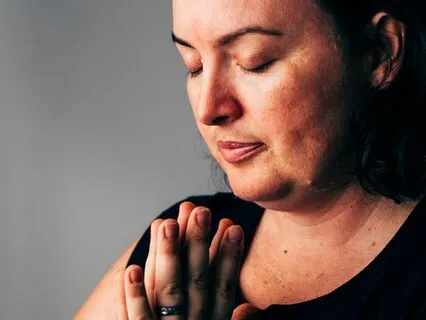
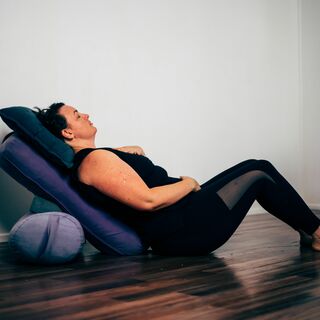
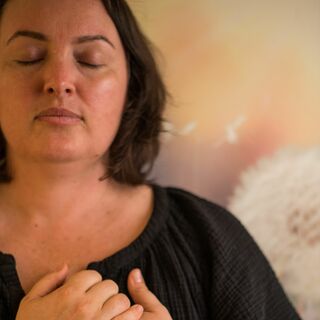
Find a comfortable position,
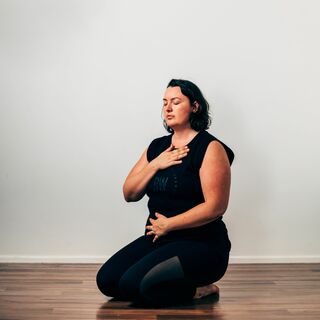
Maybe seated,
Somewhere that you can be supported and held.
And as you start to soften into this space,
Can you just observe your natural rhythm of breathing,
So there's no need to change it,
Just being affectionately curious about the flow of your breath in and out and the rhythm that it's creating.
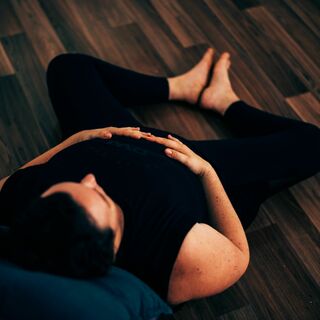
You might find it helpful to place one hand on the centre of your chest and the other on your belly.
And as you notice your natural rhythm of breathing,
Just notice,
Is there one hand that's moving a little bit more than the other?
Do you notice any tension in through the neck and shoulders?
We're just finding that natural breath rhythm and so if you notice that the mind is wandering a little bit,
Just let it latch on to the characteristics of your breath,
Noticing the temperature or the sounds,
Maybe the sensations you can feel under your fingers or within your body,
Just giving the mind something to think about that's a part of your body moving.
And now that we've started to find that natural breath rhythm,
Can we start to balance the breath?
So now just notice the number of counts that it takes to breathe in,
Maybe it's three or four and can you gently balance and make the breath out the same as your breath in?
Now a breath is very similar to waves rolling in on the ocean,
They consistently will roll in but they might be different shapes,
Different sizes.
So just match the breath in with the breath out.
So you might be breathing for three counts,
One round in and three counts,
One round out and the next breath might be a little bit bigger,
Maybe five counts in and five counts out.
Just flowing with your breathing in and out,
Balancing that in-breath with the out-breath and what we know is it starts to slowly step us down into a state of relaxation as we slow and focus our breath a little bit more mindfully.
So as you balance your breath here,
Can you start to notice which hand is moving a little bit more,
Is it the chest hand or is it the belly hand?
And if you notice that your chest hand might be moving a little bit more,
Can you invite your breath to travel down a little bit deeper in your lungs,
Maybe towards your hand?
Just broadening through the diaphragm,
The bottom of the ribs as you breathe in and out and if this feels a little bit sticky or tricky to do,
What you can do is place the hands around the bottom of the ribs and as you breathe in,
Try to send the breath down into your hands to broaden and breathe into the ribs,
360 degrees breathing your ribs outward.
So imagine that your spine is in the centre and your ribs are moving 360 degrees outward as you breathe in,
Expanding and softening and condensing inwards towards your spine as you exhale.
See if you can keep this balanced breath as you breathe in and just notice maybe where the ribs are a little bit sticky,
A little bit tight but what we're doing here is slowly breathing into the diaphragm a little bit more and each breath just helps to kind of stretch and open that diaphragm.
It also is soothing the vagus nerve and the vagus nerve is this nerve that controls our body's responses,
It will help involuntary acts like your heart beating or digestion but it also helps us move into this kind of slower relaxed state where our muscles can relax and soften and we want to do that for our diaphragm.
So as you're breathing here just kind of breathing down and letting the chest soften,
Letting the diaphragm soften and breathing 360 degrees open.
Now we're balancing the breath but let's see if we can extend the exhale.
So keep breathing in this way 360 degrees with your chest moving outwards and inwards and when you next breathe in just count how long is that breath,
Maybe it's three or four counts but can you extend that next exhale maybe by two or three counts,
Just a little bit longer.
Breathing in,
Noticing how many counts you take and then breathing out.
Breathing in,
Extending the length.
So now as you're breathing out can you start to make your out breath maybe double the length of your in breath.
So if you're breathing in for four counts can you slowly release that exhale out for maybe six or eight counts and we want to just do this really gently with a sense of relaxation.
So there's no need to be trying to inhale the room or force the air out,
Just be really responsive and connected to your body and noticing how many counts in.
Can I gently extend that within a place of comfort as I exhale.
So breathing in,
Slowly releasing the exhale,
Extending the length that exhale maybe for double the length.
We're slowly shifting the body over into this parasympathetic state,
Switching on that relaxation response.
If you want to you can now shift your hands to a different position,
Be a little bit more comfortable but hold that long slow exhale.
We've got five more of those.
Breathing in,
Slowly breathing out.
Breathing in,
Noticing that 360 degree movement of the ribs of the breath.
Breathing in,
Slowly breathing out.
And for these last two can you invite the body to soften on the exhale.
Last one.
Just releasing your breath now back to its own natural rhythm.
And just noticing what's different,
What's changed.
Is there more awareness?
Is there a lightness?
Is the mind softer?
We're just observing what shift this has had on your body,
On your mind and on your breath.
When you're ready,
Just slowly coming back into the space around you.
Noticing what you can see,
What you can hear,
What you can feel.
Just being here within your own presence before moving on with your day.
Thank you.