Hi friends,
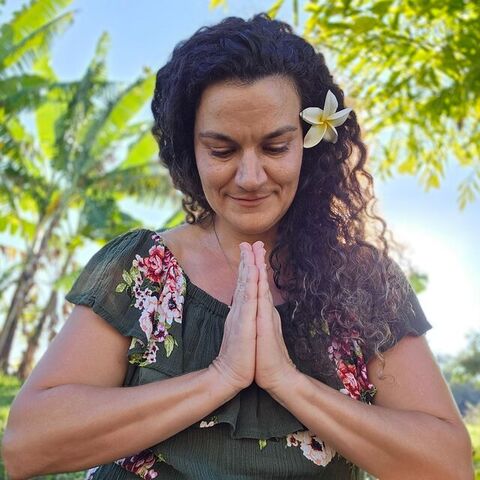
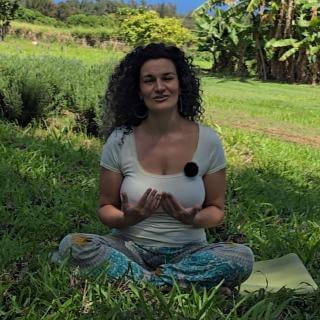
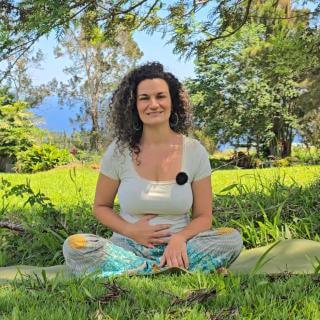
Welcome to the Big Island of Hawaii.
Thank you for joining me here as we celebrate the longest day of the year,
The summer solstice.
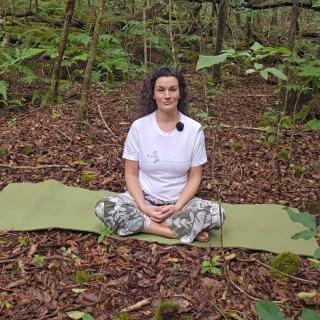
Let's start in a comfortable seated position,
Maybe with your legs crisscrossed or out in front of you,
Whatever is comfortable for you.
And we're going to do a few gentle movements as we talk about the importance of the sun and the summer solstice.
So let's begin by imagining that our belly is the sun.
And as we take a deep breath,
The sun grows and glows brightly.
And as we exhale,
Pretend to blow out the sun just like you'd blow out a candle.
Inhale and the sun grows.
And becomes a bright glowing warm ball and exhale and blow it out.
And let's inhale one more time.
Let that sun grow inside of you and then blow it out.
So we're going to start with some modified sun salutations to help us greet the sun on this special day.
So as we take a deep breath,
We're going to take one arm up.
And swoop it over our heads and looking up at that arm.
It's like we're watching the sun move across the sky.
And we'll blow out the candle as we move it back down.
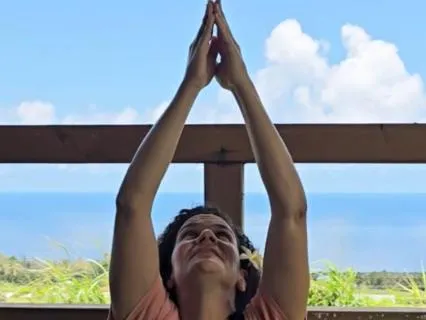
Then we're going to take both arms up.
And look at them as they go up above our heads and we're looking up at the noon sun directly above our head.
And then blowing out the candle as we bring our arms down.
And then we're going to take our opposite arm and raise it up and watch it as it swoops over our head.
And that's the sun.
Setting in the western sky and then swooping it back down.
As we take another deep breath,
We're going to place our hands on our knees.
Lift up our chin and our chest to the sun up above us and allow its rays to penetrate deep into our chest and into our belly,
Warming us up.
And then as we exhale,
We're going to curl our back.
Bring our chin to our chest and make a C shape.
With our spine.
And that's a reminder that during these solstice days,
The sun is standing still in the sky.
So let's go through the cycle one more time,
Following my movements and remembering to breathe in and blow out with each movement.
So for thousands of years,
Humans have studied and lived by the stars,
The moon,
And the sun.
And they know that the sun's movement has cycles that affect many things on earth,
Including when we should plant crops and harvest them.
When to expect warm days or colder days and longer nights.
When our part of the earth is tilted toward the sun,
The days are longer,
The nights are shorter.
And the weather is warmer.
That's summer.
At the summer solstice,
The sun rises in almost the same place.
For several days in a row.
Making it look as though the sun is standing still.
And that's why it's called the soul step.
Sol in Latin means sun.
And stis comes from sistere,
Or to be still,
In Latin.
So during the summer solstice,
The sun rises at its northernmost point.
And the winter solstice it rises at its southernmost point.
And on the summer solstice at noon,
It's at its highest point directly above us in the sky.
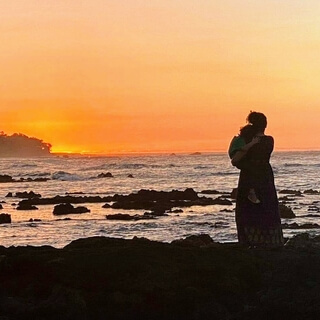
And as the sun sets on the summer solstice,
It's at its furthest northern point north of west.
Many ancient cultures even had rituals to welcome the sun on the morning of the summer solstice.
They even built structures with keyholes that would shine the light of the sun directly through those holes only on the summer solstice.
So throughout your day to day,
Perhaps take a moment to pause just as the sun appears to do in our sky and celebrate the warmth and abundance that the summer sun brings us.
More energy for us.
For our crops and plants.
More energy and warmth for the earth and people.
Perhaps you might even ask an adult to help you find a place where you can mark an arrow pointing at where the sun rises on the summer solstice and do it again on the winter solstice.
For me,
The sun rises.
Here on the summer solstice and way over here on the winter solstice.
So on my windowsill you can see two arrows pointing in these directions marking where the sun rises on the solstice.
So as you move through your day,
May you have the sun's energy and warmth with you.
Thank you so much for joining me and I can't wait to see you next time.
Bye-bye.