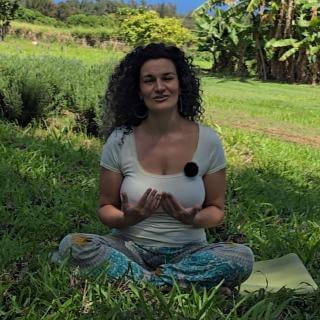
Welcome,
And thank you for coming and taking a few minutes to pause with me.
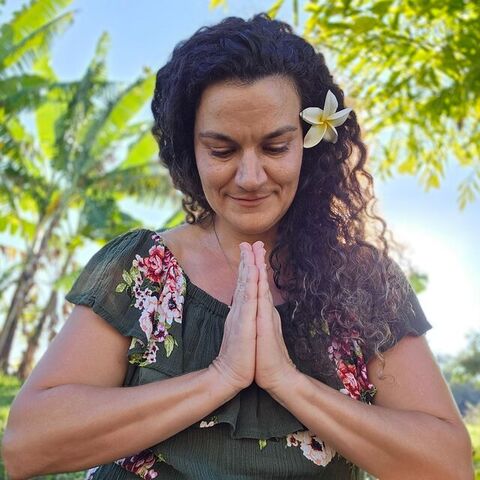
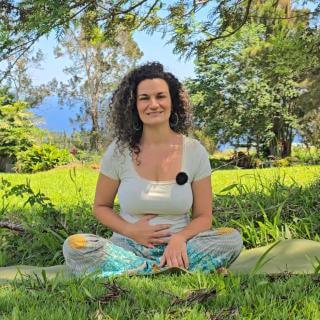
I'm Georgiana,
And I'm grateful to lead you through this guided meditation for parents,
Which will help you reduce reactivity and anger,
And increase emotion regulation in both you and your child.
As parents,
We are challenged every day,
Even multiple times a day in our patients understanding,
Compassion,
And self-compassion.
Being calm in the face of challenging emotions and behaviors from our children can be hard.
Yet research shows that when parents manage their stress well,
Their children have better lifelong outcomes,
In everything from their mental and physical health,
To academic and financial well-being.
So by taking this time today,
You are building your emotion regulation muscles,
Which has long-term benefits for you and your family.
You may start by lying down in a comfortable position,
Arms resting at your sides or on your belly.
Begin with a deep breath that makes your belly rise,
Expands your rib cage,
And brings oxygen deep into your lungs.
As you exhale through your nose,
Feel the tightness releasing from any points in your body that you may have been holding.
Continue breathing in and out.
One of the most powerful parenting tools we have is the ability to control our own behaviors and responses to our children's behavior.
Children learn self-regulation through co-regulation with us.
By understanding why certain situations trigger a reaction in us and changing our unhealthy beliefs about those situations,
We can take conscious control of our thoughts,
Feelings,
And behaviors.
When we have warm and responsive interactions which provide support,
Coaching,
And modeling to our children,
They are able to develop their ability to understand and express their emotions in healthy ways.
Let's begin by anchoring ourselves with a body scan to help us go inward.
Bring your attention to your toes,
Releasing any tightness in your feet,
Letting them fall unsupported,
Relaxed.
Breathe in,
Breathe out.
Bringing your attention to your ankles and up your shins,
Feel any points of stagnant energy or tightness and release those.
Moving up to your knees,
Your thighs,
Release.
Breathe in,
Breathe out.
Now up to your glutes,
Release any tension.
Focusing now on your belly,
Chest,
Your upper torso.
Now your face,
Dropping the tongue from the roof of your mouth and allowing your jaw to gently relax and releasing the many tiny muscles in your face and scalp,
Allowing your ears to relax.
Breathe in and out.
Finally bring your attention to your shoulders and down your arms into your hands,
Letting go of any tight spots you encounter along the way.
Take several breaths and as you do,
Repeat to yourself in,
Out.
In out.
Oftentimes the reaction we have to our children's behavior reflects internalized and perhaps unspoken beliefs about how children should behave.
And these ideas were instilled in us through society or through our own childhood experiences,
Especially for those raised with authoritarian parenting styles.
It may be difficult to self-regulate in some situations,
Perhaps when our children are dysregulated or we see their behavior as defiant.
For example,
Some parents may find meltdowns or tantrums triggering because we have internalized that parents should control their children's behavior and that crying is undesirable.
It is only natural to want to help our children through difficult emotions.
We want to learn to coach them through these moments rather than try to suppress their emotions or ours,
Which can lead to anxiety and explosions and which doesn't help them learn to self-regulate in the long term.
Let's explore a situation with your child in which you had difficulty self-regulating.
Bring back the details of that situation that triggered a reaction in you.
Imagine yourself in that moment again,
Wherever you were,
Whatever was going on around you.
Replay the situation objectively,
Focusing only on the facts and without judgment.
And continue breathing in and out.
What did you feel in that moment?
Breathe in and out.
How did you behave or react in that moment?
What did you tell yourself about the situation?
How did your reaction feel to you?
And how did your reaction make others feel?
Now take a deep breath and let the image dissipate.
And as you exhale,
That image completely disappears.
Allow yourself to move on from any emotions that may have brought up in you.
You did what you could in that moment and now you are working on doing better next time.
Let's think about the beliefs that that situation brought up for you.
Perhaps it was that children should do what their parents ask of them every time.
Or perhaps that the child wasn't complying in the moment.
So your belief is that they were being defiant.
Examine each of the beliefs about the situation and ask yourself these questions.
Is this belief based on facts?
Does this belief help me protect my well-being?
Does this belief help me behave and feel how I would like to?
And does this belief help me handle conflict in the way that I would like to?
Now that you've uncovered some of the unspoken beliefs that may have triggered your reaction,
You can be alert to these beliefs and emotions the next time a situation activates them.
If you answered no to several of these questions,
Your belief may be an unhealthy and an unproductive one.
Remember,
You can choose how to frame a situation and your beliefs around it.
Finally,
Imagine how this situation could have been different.
Visualize the details of the situation,
This time as you would have wanted it to occur.
How else could you have responded in the moment?
Now how does this new reaction feel to you?
Take a deep breath,
Allowing that visualization to dissipate and releasing any thoughts or emotions associated with it.
Remember,
Your goal is to recognize and accept your feelings in the moment and your child's,
Not to suppress them.
The more you practice pausing and reflecting on the situation,
The easier it will become to notice your emotions bubbling up in the moment and to adjust your responses in real time.
Taking another deep breath and feeling fully relaxed,
You may speak or think to yourself the following mantra,
Which will help you pause your response in challenging situations.
I can choose how I view my child's behavior,
My beliefs and emotions about the situation and how I respond.
As you continue with your day,
Feel free to repeat this mantra.
I can choose how I view my child's behavior,
My beliefs and emotions about the situation and how I respond.
Thank you for allowing me to be part of your day and for taking care of yourself so that you can take care of your family.
Namaste.