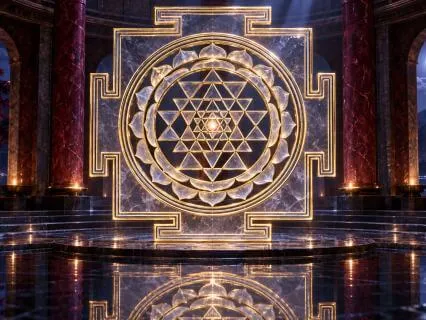
Notice this.
Nine interlocking triangles draw your eyes toward one tiny central point.
That pull is part of what makes the Sri Yantra such a powerful contemplative image.
It gives the mind a clear path from the outer world towards stillness,
Unity and peace.
And the center.
Today I want to show you what this sacred symbol means.
How its geometry works,
How it works.
Mantra can support the practice and how to meditate with it respectfully without turning it into a promise of instant results.
The Sri Yantra comes from Hindu Tantra,
Especially the Sri Bija tradition.
Where it is revered as the geometric form of the goddess Lalitha,
Three-part sundry.
Sri Yantra Sri Yantra Sri Yantra,
Sri Yantram and Sri Chakra all refer to the same sacred symbol.
The spellings vary because Sanskrit can be transliterated in different ways.
A yantra is a ritual and contemplative instrument.
As geometry gathers your attention and supports meditation.
In this case,
Nine main triangles surround a central point called the window.
Together they represent the cosmos and the union of Shiva and Shakti,
Divine masculine consciousness and divine feminine creative energy.
Its exact historical origin isn't securely dated.
So it's important to be careful with extreme age claims.
What matters is the living practice.
It can support focus,
Meditation and a spiritual connection.
Weight approach with respect.
Now,
Let's do a small exercise.
Place your hand on your heart and take a deep breath.
3.
And exhale.
One.
Too.
3 4 side.
6.
And ask yourself.
How can you simply let yourself go?
As you stare into the window.
And let it flow.
You want to begin with the outer square.
Bevor Pura.
Its four openings face the cardinal directions.
It represents the physical realm and the threshold of the sacred diagram.
You arrive there with your everyday life,
Your body and your emotions.
Your inward journey starts from that honest place.
Inside,
You find two lotus rings.
One with 16 pedals and one with 8.
The lotus shows consciousness unfolding through material life.
And the petals form a bridge into the subtler feel of triangles.
Then you reach the heart of this geometry.
Four upward triangles represent Shiva consciousness,
The masculine principle.
Five downward triangles represent Shakti,
The creative energy and the divine feminine.
Their intersections create 43 smaller triangles.
Near the center,
A small downward triangle holds Shakti in concentrated form.
At the absolute center is the window.
Pure Consciousness and the Source before anything else.
Forum.
So read the pattern outward and it expresses creation becoming physical.
Read it inward and it becomes a return from multiplicity to unity.
From the material world back to source.
And trust me.
Resting your attention,
That central point can become very quiet and powerful.
The union of Shiva and Shakti is essential.
Shiva represents pure awareness,
While Shakti represents that awareness taking form.
The yantra holds consciousness and creation together.
Some tantric approaches also understand the human being as a living reflection of this pattern.
With body and mind.
Awareness,
And energy centers allowing consciousness to interact with physical life.
There is no single universal Sri Yantra mantra across every lineage.
Formal Sri Vidya practice may include mantras received through qualified instruction.
In modern prosperity practice,
One popular Lakshmi Mantra is,
OM SHREM SHREM SHREM KAMAL KAMALALAYI PRESID PRESID OM SHREM SHREM SHREM MAHALAKSHMILYEI NAMAH It involves and invokes abundance,
Beauty,
Grace and spiritual richness.
If that resonates with you,
I invite you to chant it softly while gazing at the yantra.
If the full mantra feels difficult for you,
You can slowly repeat shrimp.
Associated with Lakshmi and Abundance,
Or Shreem,
Associated with the Divine Mother and transformative spiritual energy.
Make sure please to not force the practice if you don't feel called.
And if for some reason you want to enter a formal lineage,
You must learn from a qualified teacher.
To meditate with it you must start and set the intention for focus gazing.
Place the Shiyantra at the eye level,
About an arm length away.
Keep your neck neutral.
Take 3-5 slow breaths and soften the muscles around your eyes and forehead.
Rest your gaze on the outer square.
Move gently through the lotus petals and then through the triangles,
One layer at a time.
Until you reach the window.
Keep your focus soft and blink whether you need to.
There is no benefit in straining your eyes.
If they tie your water,
Close them and simply notice the after image within.
Remain at the center while comfortable.
Then trace the same path outward and feel your physical body before finishing.
Begin with 10 minutes and gradually move toward 20 if that feels natural to you.
I find that consistency matters much more than doing a lot one day and then stopping the next,
So keep that in mind.
Myself,
When I meditate with geometric focus,
I let the pattern gather my mind instead of trying to conquer every thought.
I like to allow the sense that the pattern is moving or feel as though you are falling inward.
It's quite cool actually.
And I like to allow the shift without pushing it.
When it comes,
It comes.
So once the image is familiar,
You can close your eyes and reveal it internally,
Letting the outer layers dissolve until only the pin-do remains.
By the way,
If you have aphantasia,
Feel the movement from outer activity into inner stillness instead.
You don't need to have a clear mental picture nor visualize to be able to get a lot out from this.
The Sri Yantra is associated with wealth through luxury,
But wealth here also includes resources,
Inner richness,
Generosity,
And receptivity.
This is important because no symbol guarantees money.
The yantra can focus your intention,
But practical choices and actions still take the main spotlight.
You want to place it somewhere quiet,
Clean and respectful,
Perhaps above an altar,
In a meditation corner or near your workspace.
Contemporary bastu-based guidance often favors an east or northeast wall,
But customs vary,
So follow your tradition if you have one.
A harmonious space can support a calmer and a more consistent practice.
And for a simple activation place the yantra,
Safely light a candle or incense if you wish,
Clear your mind and state an honest intention.
Chant,
Releasing tension and let your attention flow toward the window.
Grasping gratitude,
Then take one grounded action toward your goal.
On top of this,
Some traditions suggest Friday at dawn or sunset.
To perform 108 repetitions.
Or for a 40-day cycle.
All these are optional,
So make sure to use them if they feel natural to you.
And there is one final distinction,
The Sri Yantra and Sri Chakra are two names for the same symbol.
A Lakshmi Yantra has a more specific prosperity focus,
While the Sri Yantra offers a wider map of divinity,
Consciousness,
Creation and return.
A yantra is usually a precise,
Geometric instrument connected with a deity,
Mantra or ritual purpose.
Mandala is a broader term for a sacred diagram or cosmogram across several traditions.
So,
As a recap,
The Sri Yantra leads from the Pulpura.
Through the lotus rings.
And interlocking triangles.
To the steel beam.
It joins Shiva and Shakti,
Awareness and creation.
Use with a soft gaze,
Respect your limits,
Stay consistent,
And let spiritual intention support real action,
Rather than replacement.
If you believe this has helped you out,
I invite you to follow me and to leave one line comment and sharing how this can help you out.
If you believe this can help anybody else,
I invite you to share it with them.
You have been listening to your Daily Dose of Light with Fernando Albert.