Finland is known as the land of the saunas.
There are well over 3 million saunas in Finland,
Which is quite a lot for a country with a population of 5.
5 million.
Most of the detached houses have saunas.
There are saunas in boats.
There are portable saunas.
I have even seen a sauna caravan.
When I was a student,
There was a tiny sauna in my small student flat,
Where I couldn't even stretch my feet.
Many Finnish families have summer cabins with lakeside saunas.
But did you know that this obsession for saunas goes back all the way 10,
000 years to the time when the first hunter-gatherer tribes arrived during the last ice age?
There have been lots of suggestions made to explain the origins of the word sauna.
It is widely considered to be a Uralic word,
And its original form was sauna,
Which meant a pit in a ground that was heated and then covered with animal skin.
This kind of saunas cannot be found from Finland anymore,
And closest to them would be so-called tent saunas,
Which are similar to Native American sweat lodges.
Finnish word sauna has similarities in other Finno-Ugric and Finno-Baltic languages like Estonian and Northern Sámi.
In Finno-Ugric Komi language,
That is spoken by the Komis in Siberia,
The words saa una means lots of smoke.
Where these first ground saunas were invented is difficult to tell,
But we know that in Finland first sauna-like buildings were built in the Stone Age.
Like among several other hunter cultures,
The belief system of these early settlers was animistic,
And they believed that everything in nature had its own soul and spirit.
The Native American sweat tents were and are used the same way as ward pits were in Finland and Northern Europe and Asia.
Sweating was considered to be not just physical but also spiritual cleansing of the soul.
Sweat lodges that were used for shamanistic rituals have been found from India and Africa.
Bathhouse culture in Europe originated from Ancient Greece.
Early Greek bathhouses,
However,
Were not made for spiritual purposes,
But solely for relaxation and socialization.
Later on,
When Romans took over,
They spread bathing culture far and wide.
During the time of the Ottoman Empire,
Turkish bathhouse culture spread into Eastern Europe.
The biggest difference between a traditional Finnish sauna and a Turkish sauna is that temperature in the Turkish sauna never goes above 40 degrees,
While in Finnish sauna temperature can go up 60 Celsius and above.
In the early medieval period around Europe,
There was the custom to build bathing areas and sweat lodges next to monasteries,
And it was widely believed that bathing would have spiritual effects.
In the heart of the Middle Ages,
Europe was a constant battlefield between different religious groups and bathing started to get a questionable reputation as a destroyer of people's morals.
This is one of the reasons why most parts of Europe bathing culture disappeared and several bathhouses were destroyed.
The circle of life Bathing and sauna culture managed to stay alive and well in Northern Europe and Baltic countries simply because they were some of the last countries in Europe that were converted into Christianity.
Before any of the modern hospitals existed,
It was very common in Finland that women gave birth in the sauna.
This is believed to have its roots in an old shamanistic tradition where a sauna was believed to be a portal between our world and the spirit world.
There was a custom in Finland to take the body of a dead person into the sauna before the burial,
This was where the body was washed.
The sauna was connected to both birth and death,
And also big celebrations of life,
Like weddings.
These occasions included ritualistic sauna visits.
Going to the sauna was also part of yearly festivals,
Such as the Harvest Festival and Ukonvakat,
The summer solstice.
In ancient Finnish worldview,
It was believed that people had three souls.
These souls were called Itse,
Löyly and Haltia.
Itse was similar to the Psyche,
The human's personality,
Haltia could be described to be as the higher self or a guardian spirit,
Similar to the concept of a guardian angel.
The third soul,
Löyly,
Meant the body soul,
And all the functions of the body,
Such as breathing.
In modern Finnish language,
Löyly means the steam that comes from the sauna stove.
Löyly has similarities in other Finno-Ugric languages,
Such as Hungarian Lelek.
Going to the sauna was like going to the church,
It was a sacred ritual and a person had to follow the sauna rules.
Sauna also had its own spirit god,
Löylynhengi,
The spirit of Löyly.
Depending on which area the person lived,
Sauna spirit was either male or female.
Spirit of the sauna would not tolerate disrespectful behavior and could even hunt the person who misbehaved.
In ancient Finland,
When a person started to build a house for themselves,
First thing that they built was the sauna.
This was because of practical reasons.
Building house was a sweaty business and one could also spend their nights in the sauna,
Resting until the house was ready.
According to some folk tales,
The first person who took a bath in the sauna became the guardian spirit of the sauna later on,
After they passed away.
In Finnish folklore,
Elves were guardian spirits of buildings and often connected to ancestral worship.
The most important shamanistic aspect of the sauna were its healing properties.
Sometimes shaman would take the ill patient to the sauna and in the shamanistic trance they would travel into the spirit world to seek the spirit of the sick person and try to bring it back.
It is also possible that sauna was a symbol of the womb,
Which would explain why so many rituals were connected to birth,
Life and death that took place in the sauna.
In the old days,
Women gave birth in the sauna,
So that is where the Finnish children took their first breath of life.
There is little evidence of the early goddess cult in Finland,
But both the earth goddess Akka and Louhi,
The goddess of shamanism,
Were connected to sauna.
After all,
People were born from the earth and when they died,
That is where they returned.
Like a powerful shaman,
A sauna would help to heal the person,
Both its body and soul.
The main properties of the sauna are still recognized today.
It is scientifically proven that visiting the sauna reduces stress,
Inhaling the steam helps people with allergies and it can ease physical pain and increase the quality of sleep.
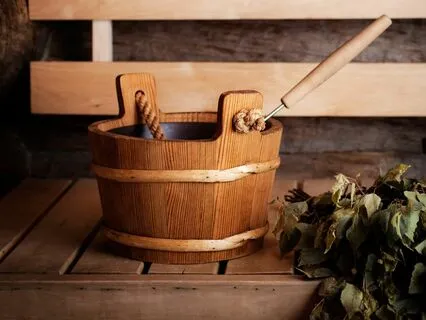
One of the elements that are part of the Finnish sauna experience is vihta,
Which is the name of the object in Western Finland and vasta in Eastern Finland.
Vihta slash vasta originally meant a leaf broomstick and it literally is a bundle made of fresh tree branches,
Usually birch branches and birch leaves.
In shamanistic rituals they were used to gently brush the body to drive away bad thoughts and illnesses.
And scientifically this increases the circulation of blood.
And good scent into the sauna water.
These bundles also created good scent into the sauna.
Because the bundle was kept in the water and that was later on thrown into the stove.
During pre-Christian times,
Making the bundle was part of the ritual because each tree had its own magical meaning.
If a person wanted to become wiser,
They made a bundle from oak leaves.
If one had problems with asthma,
They made a bundle from blackcurrant.
Midsummer festival was the time for making love spells.
Women especially made special vihtas,
Where they picked branches from trees that were connected to love and magic.
These kind of bundles were not only used in Finland or Slavic and Baltic countries,
Which also include saunas.
Several Native American tribes also used bundles made of tree leaves in shamanistic rituals,
Performed in sweat lodges.
And ancient Mayans used bundles made of corn leaves in their purification rituals.
While many of these ancient beliefs that our ancestors connected to the sauna are long gone,
Sauna still has a very important role in Finnish culture.
Going to a special holiday saunas during Christmas and summer solstice are living traditions.
Saunas are also popular in Russia,
Where they are called banja,
And in Sweden,
Sauna is called bastu.
In both countries,
Saunas can be mostly found from the countryside.
In Estonia,
Interestingly enough,
Saunas can be only found in certain parts of the country,
Mostly from southern Estonia and Virumaa.
While living abroad,
I have faced all kinds of interesting and sometimes amusing preconceptions about saunas.
One thing that often creates confusion is the fact that Finns go to sauna naked.
Sauna is a hot place,
It makes no sense to go there fully covered.
And in Finnish culture,
Sauna has always been an asexual place.
And as it is common in Finnish culture,
Even when we are in the sauna,
We respect the personal space of others.
In swimming halls,
There are separate saunas for men and women.
And open saunas near beaches and sauna ferries are often unisex saunas,
But in those places,
You need to wear swimsuits.
Thank you for listening.
Those were some of my stories about the Finnish sauna culture.
I hope you enjoyed listening to this.
Namaste.