What if part of the reason so many of us feel anxious and overwhelmed is because we become too uncomfortable with discomfort?
Modern life helps us avoid almost anything unpleasant.
We can scroll whenever we're bored.
Distract ourselves whenever we're uncomfortable.
Avoid silence.
Waiting.
Uncertainty effort,
And even difficult emotions.
And yet,
Despite all this convenience,
Many people feel more stress than ever.
So maybe the goal isn't eliminating discomfort.
Maybe it's changing our relationship to it.
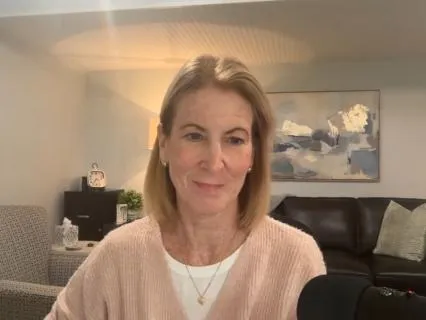
I'm Elizabeth Cronin,
A psychologist and a mindfulness meditation teacher.
And I've seen how quickly human beings move away from discomfort.
We avoid.
Distract.
Numb ourselves.
Overthink?
And try to control.
And this makes perfect sense.
I mean,
We're wired to seek pleasure and avoid pain.
But in psychology,
We know that avoidance often strengthens fear.
That's one of the reasons why exposure therapy works so well.
People gradually face a difficult experience in a manageable way,
And over time,
The nervous system learns This feeling is uncomfortable,
But it's not dangerous.
Now,
I saw this work firsthand when one of my kids struggled with severe motion sickness and received occupational therapy.
Therapist would place him on a swing and gently move him around,
Spinning him in different directions at different speeds.
So eventually he would get nauseous.
And strangely enough,
That was the point.
The goal wasn't to prevent the feeling.
The goal was to help him experience the feeling without panicking,
Without feeling that he was in danger.
So when the nausea started,
They'd stop the swing.
And they give them ginger snaps because ginger helps settle the stomach.
They had in practice.
Slowing down his breathing.
And all the while maintaining this feeling of calm and support.
And this was all to teach his nervous system that.
It's okay to feel discomfort.
You can feel discomfort and still be safe.
So that'll lesson applies so much to life.
Because often our suffering doesn't come only from the discomfort,
It comes from our reaction.
Or our resistance to it.
So there's an author named Michael Easter,
And he wrote a book about this whole thing and he called it the comfort crisis.
And he argues that modern convenience has reduced our tolerance for discomfort and any kind of challenge.
So he encourages what he calls voluntary discomfort.
Form of our own little exposure therapy.
He's suggesting that we all look for intentional experiences that stretch us.
Could be spending time in nature or.
An intentional amount of solitude.
Or physical challenge.
He goes on to say,
Even choosing to spend.
Small periods of time with less stimulation and fewer conveniences.
Is a good way to do it.
And he also tells us about something that he calls a yearly misogy.
And emisogy is a difficult challenge that stretches you mentally,
Emotionally,
Physically,
Or spiritually.
And it needs to be something that's so hard that there's a real possibility that you might not succeed.
And that's because success isn't the point.
And suffering isn't the goal.
The goal is.
.
.
That.
The challenge itself will reveal things about us.
Hanging out in our comfort zone never will.
And he says that what it does is it helps us discover and really experience that sense of I can do hard things.
And perhaps even more important.
We get that idea that I can survive not knowing how this will turn out.
So this is one reason why mindfulness practice can be so powerful.
Because mindfulness teaches us how to stay present with discomfort without immediately trying to escape it.
And as we become more mindful,
We start to notice.
This is hard.
Without adding,
And therefore something is terribly wrong.
Or we notice this is hard.
And we don't immediately go to,
I need to stop it.
What it does is it creates what we talk about a lot,
Like that little space,
The space between the experience and a reaction.
And inside that space,
We often discover that we're much more capable than we thought.
Now,
One of my favorite reflections on this comes from Pema Chödrön,
A Tibetan Buddhist nun.
And she suggests that a more interesting,
Adventurous,
And joyful way to live life.
Is to cultivate curiosity.
So she says.
If we could just become curious about our experience rather than constantly trying to arrange our life so that everything feels comfortable.
She asks us,
Can we become curious about what we're feeling?
Can we become curious about uncertainty itself?
Can we become curious about fear?
Disappointment.
Vulnerability.
So she points out that if our goal is comfort at all costs,
Then the moment we encounter any kind of discomfort or pain,
We're going to bolt.
Run!
And when we run,
We never discover what's on the other side.
We never discover.
Our own resilience?
We never discover what we're capable of.
We never discover that wisdom that comes from staying present long enough to learn from our experience.
So mindfulness teaches us that we don't have to like discomfort.
But we can learn to meet it with curiosity.
And sometimes that small shift from resistance to curiosity changes everything.
Almost everything meaningful in life involves some discomfort.
Personal growth.
Honest conversations,
Meditation,
For sure.
Parenting.
Change.
Even just trying to be authentic.
So maybe emotional well-being doesn't come from eliminating discomfort.
Maybe it comes from being less afraid of it.
And perhaps.
.
.
We can even become curious about it.
So this week you might ask yourself.
What discomfort am I constantly trying to escape?
And.
.
.
What small step could help me meet life?
A little more courageously.
Because persistence,
Not perfection,
Is what helps us grow.
And sometimes the path toward calm.
Confidence,
And contentment.
Begins when we stop running from discomfort.
And start getting curious about what it has to teach us.
Thanks for being here.
Take care.