Salaam.
Salaam.
Salaam.
Welcome to Buddha Sandra.
Majjhima Nikaya,
Sutta No.
26.
Arya Pariye Sanna Sutta,
The Noble Search.
I considered this Dhamma that I have attained is profound,
Hard to see and hard to understand,
Peaceful and sublime,
Unattainable by mere reasoning,
Subtle to be experienced by the wise.
You get it?
He is very clear that Milvana cannot be attained without experiencing,
Without knowing and seeing,
Just by lip syncing certain shlokas,
By singing certain beautiful bhajans,
By faith,
By just reciting knowledge,
You will not get there.
My reasoning of knowledge,
You will not get there.
The only way out of this cycle of birth and death is experience.
Only a wise one will be able to see and know.
But this generation delights in attachment,
Takes delight in attachment,
Rejoices in attachment.
It is hard for such a generation to see this truth,
Namely specific conditionality,
Dependent origination.
He is saying that this generation of people is so interested and lost,
Enchanted by the beauty of this samsara that they will not be able to see this truth.
And what truth?
The dependent origination.
You already know the dependent origination.
Everything has a cause and condition.
Just because an object evokes a pleasant sensation in you,
There is craving.
Because of craving,
There is clinging.
Because of clinging,
The thirst manifests even strongly.
Because of the thirst,
The actual physical manifestation or bhava or becoming happens in your life.
And that bhava or becoming is responsible for birth of that thing to whatever you were craving for.
And whatever is born is subject to old age,
Sickness,
Sorrow and death.
So there is death.
There is that dependent origination,
Cause,
Effect,
Cause,
Effect,
Cause,
Effect,
Cause,
Effect.
The link moves on and on and on and on.
This truth became apparent to Buddha in his enlightenment.
He realised that we are too seeped in maya,
Called Mara in Pali.
We are too seeped in Mara to be able to recognise this truth of dependent origination.
And it is hard to see this truth,
Namely the stilling of all formations.
All formations means all the sankaras,
They become still.
This absolute stilling of the mind.
Nothing moves,
Nothing shakes,
No thoughts,
Nothing bothers you.
Everything stills.
The relinquishing of all acquisitions.
All the acquisitions drop away.
It's not that you are giving up.
They just drop away.
There is no more thirst or lust left in you.
The destruction of craving.
Dispassion.
And then cessation,
Nirvana.
Craving gets destroyed.
Once lust is gone,
Once lust is gone,
What remains?
There is no thought.
What is the state of no thought?
Absolute silence.
Cessation.
And that cessation obviously has the quality of dispassion.
There is no more lust or craving left.
There is dispassion.
There is absolute cessation of the train of thought or the train of emotions.
The train of sensations.
There is absolute cessation.
Then follows nirvana,
Liberation.
You are liberated.
If I were to teach the Dhamma,
Others would not understand me and that would be veering and troublesome for me.
Therefore,
There came to me spontaneously these stanzas never heard before.
Never heard before means Buddha had himself never heard these.
These just how poetry comes out of you.
Like that poetry just came out of him.
Enough with teaching the Dhamma that even I found hard to reach.
For it will never be perceived by those who live in lust and hate.
Those died in lust,
Wrapped in darkness will never discern this atrocious Dhamma which goes against the worldly stream.
Subtle,
Deep and difficult to see.
Considering thus,
My mind inclined to inaction rather than to teaching the Dhamma.
We have heard many stories like this that Buddha decided it is no point in teaching them.
They will anyway not see.
Here it is in this sattva.
He realised it is very hard and difficult to see through faith alone,
Through being lost in this world of craving.
Only when you withdraw and just be,
Be,
Be,
Slowly the flowering of dispassion,
Disenchantment,
Destruction of craving.
These happen in stages.
And then finally there is the cessation of the mind and then there is nirvana.
It is very experiential.
When we learn the jhanas,
You will get a glimpse of it.
But it will just be a glimpse.
You will have to then work harder to make it your reality so that you attain your own nirvana.
Then because the Brahma Sahampati knew with his mind the thought in my mind and he considered the world will be lost,
The world will perish since the mind of the Tathagata,
Accomplished and fully enlightened,
Inclines to inaction rather than to teaching the Dhamma.
Then just as quickly as a strong man might extend his flexed arm or flex his extended arm,
The Brahma Sahampati vanished in the Brahma world and appeared before me.
He arranged his upper robe on one shoulder and extending his hands in reverential salutation towards me said,
Venerable Sir,
Let the Blessed One teach the Dhamma.
Let the Sublime One teach the Dhamma.
There are beings with little dust in their eyes who are wasting through not hearing the Dhamma.
There will be those who will understand the Dhamma.
The Brahma Sahampati spoke thus and then he said further,
In Magda there have appeared till now impure teachings devised by those still stained.
Open the door to the debtless.
Let them hear the Dhamma that the stainless one has found.
Just as one who stands on a mountain peak can see below the people all around.
So,
O wise one,
All seeing sage,
Ascend the palace of the Dhamma.
Let the sorrowless one survey this human breed,
Engulfed in sorrow,
Overcome by birth and old age.
Arise victorious hero,
Caravan leader,
Debtless one and wonder in the world.
Let the Blessed One teach the Dhamma.
There will be those who will understand.
We have all heard this story.
There will be those that will understand.
Just a little push is required for some.
They have just a little dust in their eyes.
Just by listening to the Dhamma they will get it.
Maybe it was meant for you.
Maybe it was meant just because you needed to get there.
You are that lucky one for whom Buddha started teaching.
Then I listened to the Dhamma's pleading and out of compassion for beings I surveyed the world with the eye of a Buddha.
Surveying the world with the eye of a Buddha,
I saw beings with little dust in their eyes and with much dust in their eyes,
With keen faculties and with dull faculties,
With good qualities and with bad qualities.
Easy to teach and hard to teach and some who dwelt,
Seemed fear and blame in the other world.
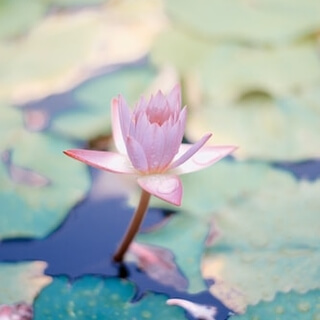
Just as in a pond of blue or red or white lotuses,
Some lotuses that are born and grow in the water thrive immersed in the water without rising out of it and some other lotuses that are born and grow in the water rest on the water's surface.
And some other lotuses that are born and grow on the water rise out of the water and stand clear unmetted by it.
So too,
Surveying the world with the eye of a Buddha,
I saw beings with little dust in their eyes and with much dust in their eyes,
With keen faculties and with dull faculties,
With good qualities and with bad faculties.
Easy to teach and hard to teach and some who dwelt,
Seemed fear and blame in the other world.
Then I replied to the Brahma Sahampati in stanzas,
Open for them are the doors to the deathless,
Let those with yours now show their faith,
Thinking it would be troublesome,
Oh Brahma,
I did not speak to the Brahma,
Subtle and sublime.
Then the Brahma Sahampati thought,
The Blessed One has consented to my request that he teach the Dhamma and after paying homage to me,
Keeping me on the right,
He thereupon departed at once.
This is interesting,
There are all kinds of people and this challenge every teacher faces,
There are some who are easy to teach and some who are very hard to teach.
Some who have little dust,
Some who have a lot of dust,
Not lot of dust,
Lot of dirt and muck.
And then the teacher decides,
Okay let me take the ones who have little dust,
Let me take the ones who have just a little bit waiting and help them because the ones who have a lot of dust will not even have faith to even begin the path.
So he chose the lotuses,
Those that are above the water,
Those that are not easily wet by the water.
That is why Buddha's jnana is for very few,
Not a lot of people can follow this because it is not about feeling pleasant.
If you notice how he started on the spiritual path because the initial things that he did on the spiritual path give you a pleasant feeling and there is nothing wrong with that.
You just felt that that which gives me a pleasant feeling is the right path,
That is the meaning of meditation.
But meditation has got nothing to do with pleasant feeling and unpleasant feeling.
By now you must have realised that.
Equanimity means when you are beyond pleasant and unpleasant.
So the people who are still stuck in wanting pleasantness in life,
They cannot really adhere to all the morals required on the path of Sheela given by the Buddha.
And they cannot meditate the long hours on the path of Samadhi given by the Buddha and definitely they cannot come to the right view and the right wisdom on the path of Panniya given by the Buddha.
So now let's see how Buddha started teaching.
I considered thus,
To whom should I first teach the Dhamma?
Who will understand this Dhamma quickly?
It then occurred to me,
Alana Kalama is wise,
Intelligent and discerning.
He has long had little dust in his eyes.
Suppose I taught the Dhamma first to Alana Kalama,
He will understand it quickly.
And then deities approached me and said,
Venerable Sir,
Alana Kalama died 7 days ago.
And the knowledge and vision arose in me.
Alana Kalama died 7 days ago.
I thought Alana Kalama's loss is the great one.
If he had heard this Dhamma,
He would have understood it quickly.
I considered thus,
To whom should I teach the Dhamma?
Who will understand this Dhamma quickly?
It then occurred to me,
Uddaka Ramaputta is wise,
Intelligent and discerning.
He has long had little dust in his eyes.
Suppose I taught the Dhamma first to Uddaka Ramaputta,
He will understand it quickly.
Then deities approached me and said,
Venerable Sir,
Uddaka Ramaputta died last night.
And the knowledge and vision arose in me.
Uddaka Ramaputta died last night.
I thought Uddaka Ramaputta's loss is the great one.
If he had heard this Dhamma,
He would have understood it quickly.
I considered thus,
To whom should I first teach the Dhamma?
Who will understand this Dhamma quickly?
It then occurred to me,
The bhikkhus of the group of five who attended upon me while I was engaged in my striving were very helpful.
Suppose I taught the Dhamma first to them.
Then I thought,
Where are the bhikkhus of the group of five now living?
And with the divine eye which is purified and surpasses the human,
I saw that they were living at Banaras in the deer park in Isipatana.
So there's a little story about these five bhikkhus.
When Buddha found that ground and started striving,
These five bhikkhus also joined him.
And they went through many years of different kinds of contemporary teachings,
Even starving,
Fasting,
All kind of yogic breathing exercises,
Name it and they had done it together.
But finally Buddha reached such a state because of starving that he almost fainted at the banks of the river and a lady passing by fed him some pudding as to revive him.
He then understood that starvation was not the way to attain enlightenment.
These five bhikkhus who were with him until then said that he was doing wrong,
He was giving up,
He was a coward.
And he said,
No I'm not a coward and I'm not giving up but I have just realised that starvation will not bring me disenchantment from the world,
Will not bring dispassion,
Will not bring cessation of craving or cessation of the mind because mind really equals to craving.
The five bhikkhus did not agree and they left him.
He then continued to strive alone and attain nirvana alone.
Now that he has attained nirvana alone,
Now he remembers them and he can see where they are.
The teaching of the Dhamma then bhikkhus when I had stayed at Uruvela,
As long as I chose,
I set out to wander by stages to banaras.
Between Gaya and the place of enlightenment,
The Ajivaka Upaka saw me on the road and said,
Friend,
Your faculties are clear,
The colour of your skin is pure and bright,
Under whom have you gone forth,
Friend?
Who is your teacher?
Whose Dhamma do you profess?
I replied to the Ajivaka Upaka in stanzas.
I am one who has transcended all,
A knower of all,
Unsullied among all things,
Renouncing all by cravings,
Seizing,
Freed.
Having known this all for myself,
To whom should I point as teacher?
He had done it by himself.
He took six years to get enlightened.
He had left his initial two masters more than six years ago.
Six years was the time that Buddha spent alone,
Striving to attain the freedom from craving.
Now that he had attained it,
Who could he say was his teacher?
I have no teacher and one like me exists nowhere in all the world,
With all its gods,
Because I have no person for my counterpart.
I am the accomplished one in the world,
I am the teacher supreme,
I alone am a fully enlightened one,
Whose fires are quenched and extinguished.
I go now to the city of Kashi,
To set in motion the wheel of Dhamma.
In a world that has become blind,
I go to beat the drum of the deathless.
By your claims,
Friend,
You ought to be the universal victor.
The victors are those like me who have run to the destruction of tames.
I have vanquished all evil states.
Therefore,
Upaka,
I am a victor.
Victor means the victorious one.
When this was said,
The Ajivaka Upaka said,
Be it be so friend.
Shaking his head,
He took a by-path and departed.
Then bhikkhus wandering by stages,
I eventually came to Vanaras,
To the deer park at Isipatana and I approached the bhikkhus of the group of five.
The bhikkhus saw me coming in the distance and they agreed among themselves thus.
Friends,
Here comes the recluse Gautama,
Who lives luxuriously,
Who gave up his striving and reverted to luxury.
We should not pay homage to him or rise up for him or receive his bowl and outer robe.
But a seat may be prepared for him if he likes,
He may sit down.
However,
As I approached those bhikkhus,
Found themselves unable to keep their pact.
One came to meet me and took my bowl and outer robe.
Another prepared a seat and another set out quarter for my feet.
However,
They addressed me by my name,
By name and as friend.
So,
You remember the story that the five of them had abandoned Gautama because they thought that,
Oh he is giving up penance,
He is giving up the practice.
He anyway was a king,
King's son.
So he has lived in luxury,
He will obviously go back to that.
So,
You know they had all kinds of wrong understanding about him.
The way,
You know,
People's minds usually work.
They all were lost in the enchantment.
Let's see now what Buddha says to them because now they addressed him still as Gautama,
Prince Gautama.
Thereupon I told them,
Bhikkhus do not address the Tathagata by name and as friend.
The Tathagata is an accomplished one,
A fully enlightened one.
Listen bhikkhus,
The deathless has been attained.
I shall instruct you,
I shall teach you the Dhamma.
Practicing as you are instructed by realising for yourselves here and now through direct knowledge,
You will soon enter upon and abide in that supreme goal of the holy life.
For the sake of which clients will rightly go forth from home life into homelessness.
Again,
Don't take it as ego.
It is coming out of compassion because the egoistic mind does not want to listen.
The egoistic mind only listens when it finds somebody at a very high pedestal.
And so he says,
I am no more than Gautama that you knew.
I am not Siddhartha Gautama.
I am now the fully enlightened one.
I am the accomplished one.
And the word for the accomplished one is Tathagata,
The one who has reached the other shore.
I will teach you and instruct you and you will also be able to get there.
When this was said,
The bhikkhus of the group of five answered Neetas,
Friend Gautama,
By the conduct,
The practice and the performance of austerities that you undertook,
You did not achieve any superhuman states,
Any distinction in knowledge and vision worthy of the noble ones.
They are talking about a time when all six of them were practicing together and striving together and they performed a lot of austerities and starvation and at that point,
They are saying that at that point you had not attained all this.
Since you now live luxuriously,
Having given up striving,
Your striving really means starvation.
You know,
You used to eat very little,
Very little,
Almost like a spoonful of rice in the entire day.
That's it.
So,
Since you now live luxuriously,
Having given up your striving and reverted to luxury,
How will you have achieved any superhuman states,
Any distinction in knowledge and vision worthy of the noble ones?
When this was said,
I told them that the Dhadagata does not live luxuriously nor has he given up his striving and reverted to luxury.
The Dhadagata is an accomplished one,
A fully enlightened one.
Listen bhikkhus,
The deathless has been attained.
Dot dot dot means we go back to where it is in the previous paragraph.
I shall instruct you,
I shall teach you the Dhamma,
Practicing as you are instructed by realizing for yourselves here and now through direct knowledge,
You will soon enter upon and abide in that supreme goal of the holy life.
For the sake of which,
Clansmen rightly go forth from the home life into homelessness.
He says that he does not live in luxury and he has not even given up his striving.
So,
They kept thinking he was a prince before,
Maybe he went back to luxury.
But he had not given up his striving,
He had just given up the fasting or starvation that they thought would lead them to enlightenment.
A second time,
The bhikkhus of the group of the five said to me,
Flinga tama.
Dot dot dot again means we go back to the previous paragraph.
By the conduct,
The practice and the performance of austerities that you undertook,
You did not achieve any superhuman states,
Any distinction in knowledge and vision worthy of the noble ones.
Since you now live luxuriously,
Having given up your striving and reverted to luxury,
How will you have achieved any superhuman states,
Any distinction in knowledge and vision worthy of the noble ones?
A second time,
I told him that the dhaagata does not live luxuriously nor has he given up his striving and reverted to luxury.
The dhaagata is an accomplished one,
A fully enlightened one.
Listen because the deathless has been attained.
I shall instruct you,
I shall teach you the dhamma,
Practising as you are instructed by realising for yourselves here and now through direct knowledge,
You will soon enter upon and abide in that supreme goal of the holy life,
For the sake of which clansmen rightly go forth from the home life into homelessness.
A third time,
The vikus of the group of five said to me,
Friend Gautama,
By the conduct,
The practice and the performance of austerities that you undertook,
You did not achieve any superhuman states,
Any distinction in knowledge and vision worthy of the noble ones.
Since you now live luxuriously,
Having given up your striving and reverted to luxury,
How will you have achieved any superhuman states,
Any distinction in knowledge and vision worthy of the noble ones?
When this was said,
I asked them,
Vikus,
Have you ever known me to speak like this before?
No venerable sir,
Vikus,
The dhaagata is an accomplished one,
A fully enlightened one.
Listen Vikus,
The deadless has been attained,
I shall instruct you,
I shall teach you the dhamma,
Practising as you are instructed by realising for yourselves here and now through direct knowledge,
You will soon enter upon and abide in that supreme goal of the holy life,
For the sake of which clansmen rightly go forth from the home life into homelessness.
You see,
The mind is so stuck,
We are so bound by our ideas,
Our concepts,
We cannot have an open mind to something different than what we believe in.
And this itself is bondage,
This is a spiritual bondage.
These Vikus believed only starvation was the way,
Only fasting was the way,
Then the lust for food is gone,
The craving for anything tasty is gone,
Then celibacy is the way,
So craving for another body's touch is gone.
But these were more suppression methods rather than really overcoming craving.
But they were not ready to listen very easily.
Finally he had to say,
Have you ever heard me speak like this before?
And they said no.
He was a very nice,
Gentle speaker who would not speak out of ego or anything.
So they had never heard him speak like that.
And their minds were thinking that this is coming out of ego.
But really,
When they finally set aside all their old concepts,
They saw that yes,
He has never spoken like this and it is not coming out of ego.
It is coming from another level of fullness,
Another level of purity,
Which has got nothing to do with the I.
I was able to convince the Vikus of the group of five.
Then I sometimes instructed two Vikus while the other three went for arms.
And the six of us lived on what those three Vikus brought back from their arms round.
Sometimes I instructed three Vikus while the other two went for arms.
And the six of us lived on what those two Vikus brought back from their arms round.
Then the Vikus of the group of five,
Thus taught and instructed by me,
Being themselves subject to birth,
Having understood the danger in what is subject to birth,
Seeking the unborn supreme security from bondage,
Nibbana,
Attain the unborn supreme security from bondage,
Nibbana.
Being themselves subject to ageing,
Sickness,
Death,
Sorrow and defilement,
Having understood the danger in what is subject to ageing,
Sickness,
Death,
Sorrow and defilement,
Seeking the unageing,
Unailing,
Deathless,
Sorrowless and undefiled supreme security from bondage.
They attain the unageing,
Unailing,
Deathless,
Sorrowless and undefiled supreme security from bondage,
Nibbana.
Knowledge and vision arose in them.
Our deliverance is unshakeable.
This is our last birth.
There is no renewal of being.
Thus all five Vikus got enlightened.
They all attained Nibbana.
Now let's look at what the Buddha taught the Vikus.
Vikus,
There are these five chords of sensual pleasure.
What are the five?
One,
Forms cognizable by the eye that are wished for,
Desired,
Agreeable and likeable,
Connected with sensual desire and provocative of lust.
Two,
Sounds cognizable by the ear that are wished for,
Desired,
Agreeable and likeable,
Connected with sensual desire and provocative of lust.
Three,
Odours cognizable by the nose that are wished for,
Desired,
Agreeable and likeable,
Connected with sensual desire and provocative of lust.
Four,
Flavours cognizable by the tongue that are wished for,
Desired,
Agreeable and likeable,
Connected with sensual desire and provocative of lust.
Five,
Tangibles cognizable by the body that are wished for,
Desired,
Agreeable,
Likeable,
Connected with sensual desire and provocative of lust.
These are the five chords of sensual pleasure.
As to those recluses and drahmin,
Who are tied to these five chords of sensual pleasure,
Infatuated with them and utterly committed to them and who use them without seeing the danger in them or understanding the escape from them,
It may be understood of them.
They have met with calamity,
Met with disaster.
The evil one may do with them as he likes.
Suppose a forest deer was bound,
Lay down on a heap of snares,
It might be understood of him he has met with calamity,
Met with disaster.
The hunter can do with him as he likes and when the hunter comes,
He cannot go where he wants.
So too,
As to those recluses and drahmin,
Who are tied to these five chords of sensual pleasure,
Infatuated with them and utterly committed to them and who use them without seeing the danger in them or understanding the escape from them,
It may be understood of them.
They have met with calamity,
Met with disaster.
The evil one may do with them as he likes.
There are many people who are walking the spiritual path.
In those times,
They were recluses.
They would leave the home and start walking the spiritual path.
In today's times,
We as householders make an attempt to walk the spiritual path.
So basically,
When he says recluses and drahmin,
He is referring to all the spiritual seekers.
So all the spiritual seekers who are tied to these five chords of sensual pleasures,
Sound,
Sight,
Taste,
Touch and smell.
Those who are infatuated with them,
Who are completely enchanted with them,
They are in a state of calamity,
In disaster.
So,
Why is he warning us on the spiritual path?
Many of us get lost in sound and think just the sound of this music is evoking a pleasant sensation in me and therefore this pleasant sensation is what will take me to enlightenment.
Enlightenment or liberation from grieving has got nothing to do with pleasant sensation.
In fact,
You are now craving for that pleasant sensation that arises from the beautiful music,
The mantra,
The sound of that particular knowledge,
The sound of a particular teacher,
Whatever sound you are stuck in.
Do you see what he is helping you understand?
Anything that you are infatuated with leads to craving.
Cleaving leads to clinging.
Clinging leads to thirst.
Thirst leads to becoming.
Becoming leads to birth and whatever is born dies,
Gives you sorrow.
So,
You will forever be lost in this cycle of birth and will.
Wake up,
Wake up.
If there are any five chords of sensual pleasure attached to your spiritual practices,
You have met with calamity.
As to those reclusers and brahmins who are not tied to these five chords of sensual pleasure,
Who are not infatuated with them or utterly committed to them and who use them,
Seeing the danger in them and understanding the escape from them,
It may be understood of them.
We have not met with calamity,
Not met with disaster,
That even one cannot do with them as he likes.
Suppose a forest deer who was unbound lay down on a heap of snares.
It might be understood of him,
He has not met with calamity,
Not met with disaster.
The hunter cannot do with him as he likes.
And when the hunter comes,
He can go where he wants.
So too,
As to those reclusers and brahmins who are not tied to these five chords of sensual pleasure,
Who are not infatuated with them or utterly committed to them,
Who use them,
Seeing the danger in them and understanding the escape from them,
It may be understood of them,
They have not met with calamity,
Not met with disaster,
That even one cannot do with them as he likes.
If you know that there is danger and you use it very skilfully knowing the danger of craving coming up,
If you use it skilfully understanding that this is not the last resort,
This is just used right now for me to anchor myself in the pleasant sensation,
So at least the negative goes away.
Once you are anchored in pleasant and the unpleasant or negativity falls off,
If you leave even the pleasant and then come to that state where you are not stuck to pleasant or unpleasant,
Where you are equanimous,
Where you have learnt to escape from that also,
Then you have not met with calamity,
Then you have not met with disaster and nobody can make you do what they want you to do.
Next homework,
You check,
Have you met with calamity or not?
Now going forward,
We will learn about jhanas.
I will not be describing all the jhana states right now.
We will do this in the 10 day retreat when we have some one on one time.
We will just read through them right now so that you understand what the Buddha really taught.
You might not be able to comprehend it or attain these states immediately by reading.
A little bit of practice,
A little bit of instruction in the 10 day retreat will get you there.
So don't become feverish and start craving for these states.
You will definitely get there in your own time.
I will take each one of you through it.
So rest assured,
Keep aside that craving and just let's read through these jhanas as if we are just trying to comprehend what the Buddha taught only intellectually for now and in future we will all do it experientially in the 10 day retreat.
Suppose a forest deer is wandering in the forest wilds.
He walks confidently,
Stands confidently,
Sits confidently,
Lies down confidently.
Why is that?
Because he is out of the hunter's range.
So too,
Quite secluded from sensual pleasures,
Secluded from unwholesome states,
A bhikkhu enters upon and abides in the first jhana which is accompanied by applied and sustained thought with rapture and pleasure born of seclusion.
Here he has explained the first jhana.
Of course by reading it you won't really understand it completely but just understand you have to be secluded from unwholesome states of the mind,
Secluded from sensual pleasures and then you enter in the first jhana.
There will still be some thoughts in the first jhana.
There is a lot of rapture and pleasure too.
When you are in the first jhana this bhikkhu is said to have blindfolded Mara because you are not getting enchanted by sensual pleasures.
So you have blindfolded Mara.
To have become invisible to the evil one by depriving Mara's eye of its opportunity.
Again with the stilling of applied and sustained thought,
A bhikkhu enters upon and abides in the second jhana which has self-confidence and singleness of mind without applied and sustained thought with rapture and pleasure born of concentration.
This bhikkhu is said to have blindfolded Mara,
To have become invisible to the evil one by depriving Mara's eye of its opportunity.
In the second jhana even the thoughts just still,
They become quiet.
You still feel the rapture and pleasure but it is very subtle and quiet.
So the stillness or the sukkha in the mind is dominant.
Again with the feeling away as well of rapture,
A bhikkhu abides in equanimity and mindful and fully aware,
Still feeling pleasure with the body.
He enters upon and abides in the third jhana on account of which noble ones announce.
He has a pleasant abiding who has equanimity and is mindful.
Then slowly you slip into the third jhana where that stillness just becomes equanimity.
You are fully aware,
Fully there,
Very very mindful.
One pointed but at the same time there is no stress,
No concentration.
It is a natural happening.
You naturally move from one jhana into the next.
This bhikkhu is said to have blindfolded Mara,
To have become invisible to the evil one by depriving Mara's eye of its opportunity.
Again with the abandoning of pleasure and pain and with the previous disappearance of joy and grief,
A bhikkhu enters upon and abides in the fourth jhana,
Which has neither pain nor pleasure and purity of mindfulness due to equanimity.
This bhikkhu is said to have blindfolded Mara,
To have become invisible to the evil one by depriving Mara's eye of its opportunity.
In the fourth jhana there is neither pain nor pleasure.
It's an absolute equanimous state,
Very pure.
Like I told you,
Pleasant sensation is not the correct yardstick to determine if the spiritual practice is correct for you or not.
Whether that spiritual practice will lead you to the supreme truth or not,
Whether that spiritual practice will destroy craving or not,
Pleasant sensation itself creates craving.
Therefore,
Getting to the fourth jhana is a very big achievement where there is neither pain nor pleasure.
You are in the centre.
Again with the complete surmounting of perceptions of form,
With the disappearance of perceptions of sensory impact,
With non-attention to perceptions of diversity,
Aware that space is infinite,
A bhikkhu enters upon and abides in the base of infinite space.
This bhikkhu is said to have blindfolded Mara,
To have become invisible to the evil one by depriving Mara's eye of its opportunity.
In jhana five,
All the perception of form is all gone.
There are no forms in your mind anymore.
It has all dropped away.
There is no perception of diversity.
There is just an experience of infinite space.
That is the fifth jhana.
Again,
By completely surmounting the base of infinite space,
Aware that consciousness is infinite,
A bhikkhu enters upon and abides in the base of infinite consciousness.
This bhikkhu is said to have blindfolded Mara,
To have become invisible to the evil eye by depriving Mara's eye of its opportunity.
So you enter jhana six.
Jhana six is the base of infinite consciousness.
So from jhana five,
You automatically slip into jhana six,
Which is from the base of infinite space,
You automatically slip into base of infinite consciousness.
You realise that that space that is expanding is within this infinite consciousness.
Again,
Don't get perplexed at not knowing or not understanding these at this stage.
We will do them soon in retreat.
Again,
By completely surmounting the base of infinite consciousness,
Aware that there is nothing a bhikkhu enters upon and abides in the base of nothingness.
This is jhana seven.
You remember that Buddha was taught this jhana seven,
The base of nothingness by Kalama.
This bhikkhu is said to have blindfolded Mara,
To have become invisible to the evil one by depriving Mara's eye of its opportunity.
Again,
By completely surmounting the base of nothingness,
A bhikkhu enters upon and abides in the base of neither perception nor non-perception.
This is jhana eight and you remember his teacher Uddaka taught him jhana eight.
This bhikkhu is said to have blindfolded Mara,
To have become invisible to the evil one by depriving Mara's eye of its opportunity.
Again,
By completely surmounting the base of neither perception nor non-perception,
A bhikkhu enters upon and abides in the cessation of perception and feeling.
Complete cessation occurs here.
That is why Buddha was disappointed with his learnings when he went to his teachers,
Alara Kalama and Uddaka Lama Buddha.
Because the disenchantment had not happened,
The dispassion had not happened with seven and eighth jhana.
There had to be something more and that is what we call now the ninth jhana,
Cessation.
The complete cessation of perception,
Sannyas and feeling,
Vedana.
That's a state where you don't feel anything and when you do not perceive anything.
As in there is no sannyas,
No vedana.
And his stains are destroyed by his seeing with wisdom.
This bhikkhu is said to have blindfolded Mara,
To have become invisible to the evil one by depriving Mara's eye of its opportunity and to have crossed beyond attachment to the world.
This is the most important part.
His stains are destroyed by seeing through wisdom and he has crossed beyond attachment to the world.
These are the two most important things that happen at cessation of perception and feeling that did not happen in the earlier dhyanas.
Those were called dhyanas.
They are from the Rig Veda.
They were being taught in Buddha's time.
But in Buddha's time,
They were being taught in a slightly different manner.
Buddha taught it with awareness.
He called them aware jhanas and then he discovered the ninth jhana.
The cessation of perception and feeling where all the taints can destroy,
Where you see the reality as it is in your own experience.
And this enchantment happens automatically.
To Buddha,
It happened instantly to people who were seeped into entanglement and enchantment.
It happens in stages.
This enchantment definitely follows cessation little by little,
Little by little.
And finally,
All the enchantment withers away.
Attachment dies.
He walks confidently,
Stands confidently,
Sits confidently,
Lies down confidently.
Why is that?
Because he is out of the evil one's range.
Evil one here is madhava.
That is what the Blessed One said.
The bhikkhus were satisfied and delighted in the Blessed One's words.
I know this has been a very long sutta,
Very interesting.
We all wanted to know how Buddha got enlightened.
Again,
The crux of his teaching is destruction of craving.
So don't let craving get the better of you.
When it is time for you,
You will learn the highest secrets of samadhi called the jhanas.
You will get there.
Start walking the path of wholesomeness so that all unwholesome states drop off.
When you become free of most of the unwholesome states,
Then you qualify to learn the jhanas.
May your search be a noble search and may it take you to the supreme truth.
Aapu,
Deetu,
Bhagavatam.
Copyright © 2020 Mooji Media Ltd.
All Rights Reserved.
No part of this recording may be reproduced without Mooji Media Ltd.
's express consent.

![MN 26 Ariyapariyesana Sutta - The Noble Search [Part 2]](https://libraryitems.insighttimer.com/slugs/mn-26-ariyapariyesana-sutta-the-noble-search-part-2/pictures/tiny_rectangle_medium.webp)