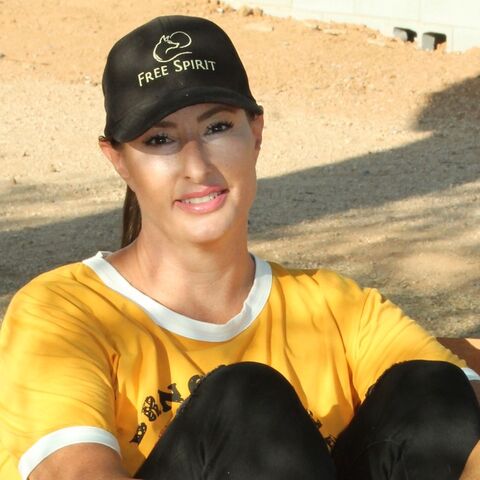
Hi,
This is Dr.
Tracey Moreno,
Psychologist,
And today we're going to talk about anxiety.
Anxiety is one of those things that often makes us feel very out of control.
Our mind is telling us that it's okay and that we shouldn't feel that way,
While our body is screaming for us to fight,
Flight,
Or freeze.
This is a stress response based on our need for survival.
When we're in survival mode,
We either stay and fight,
Run away in flight,
Or freeze,
Where we're in shock and aren't even able to react at all.
All of these responses can be a problem because they're all an extreme reaction to stress.
When we're under stress,
We're not thinking logically or rationally,
So we're going to be more likely to respond poorly or in a way we later regret.
So what do we do about all this?
Well,
The answer is nothing.
Probably not the most common or popular answer,
But the answer is nothing.
We need to accept our anxiety even when we don't understand it.
When anxiety happens,
Our mind and our body are already in conflict with each other.
So now if we fight and we're telling our body that they're wrong or they're stupid or why should you feel this way or why are you doing this to me,
We're now putting ourselves in an even greater state of anxiety.
This is when we have anxiety over our anxiety,
Which only compounds the problem.
And our body is not completely wrong.
Our body is not failing us.
Our body is actually trying to protect us.
For whatever reason,
Our body is signaling us that we're in danger even when we're not.
We may not understand why our body believes we're in danger,
But our job shouldn't be to judge it.
Instead,
We should try to understand it.
Think of it this way.
If you were talking to a loved one and they confided in you about their fear of doing something and you didn't share that same fear,
Understand it,
Would you minimize what they're feeling?
Would you say things like,
Oh,
Don't be silly or there's no reason to feel this way.
You just got to get over it.
Suck it up.
Move on.
Let go.
Get over it.
I've heard all those,
By the way.
And I hope not.
I hope that you would not minimize them and say things like that.
I think most people would say,
It's okay.
It's going to be okay.
I'm here for you.
Take it slowly.
One step at a time.
You've got this.
You're going to offer support and encouragement.
Now think about what you tell yourself in your own mind.
Which scenario is it?
Is it harsh or is it supportive?
Most of us opt for harsh.
Yes,
Of course,
Sometimes we do need a little tough love and a kick in the butt to move forward.
But this tactic doesn't work with anxiety.
The goal is to connect our mind,
Body and spirit,
Putting them in sync and supporting one another.
Not divide and conquer because one loss,
One loses.
We all lose.
So it's important that we monitor our self-talk and talk to ourselves the way we would talk to a dear friend or family member.
We need to be kind and supportive and understanding.
So what would that look like?
Our inner dialogue would go something like this.
I don't understand why you're scared,
But I accept that you are.
We're okay.
Let's get through this together.
Having self-talk that sounds more like this could potentially eliminate our anxiety over our anxiety,
Which is often half the battle.
Imagine if you could bring your anxiety that may have been at an eight on a scale of zero to ten,
Ten being the worst,
And you were able to cut that in half to a four.
I bet you'd be functioning a lot better.
So to manage the rest of the anxiety,
We need to use our coping skills.
This shows our body that we care about it and we're taking care of it.
Our words need to match our actions.
It's kind of like when somebody says,
I love you.
We want them to also back it up with actions and show us.
Coping skills like working out,
Meditating,
Being with a pet,
Music,
Taking a bath or shower.
Oh,
I love a shower cry.
And venting to a friend,
Journaling,
That can help us decrease or even get rid of some of that anxious energy.
If you want to learn more about coping skills and when to use them,
I recommend listening to the educational talk titled Managing Our Emotions.
The key to these coping skills is trying to remove ourselves from the situations if at all possible.
Excuse yourself to go to the restroom,
Take a walk outside,
Go into another room,
Take a drive,
Whatever it is that you need to do.
But if you're able to remove yourself from that stressful situation,
That's always best.
Then while you're away,
Use one of your coping skills.
And then know that if you need to re-enter the situation that was causing you the anxiety,
You should monitor your anxiety.
And if it raises again,
Then you'll have to remove yourself again and use either the same or a different coping skill.
And you will need to do this as often as needed because you are returning to that same stressful situation.
So it's not like a one-time thing and then you're all going to be cured.
Then you want to be working on being able to prevent your anxiety in general.
And with this,
You can take a holistic approach by taking care of your mind,
Body,
And spirit on a regular basis.
For your mind,
This would mean positive self-talk and affirmations and definitely no judgment.
For your body,
Yoga is great because it helps us connect with all three,
Mind,
Body,
Spirit.
Although any type of physical activity is helpful.
For your spirit,
Meditation is key.
All you need is two to three minutes a day.
Guided meditation can take the place of silent meditation.
If you do need more guidance or something to focus on,
You can do it sitting,
Standing,
Walking,
Whatever works for you.
There are no rules.
Do it your way.
Like running is a form of meditation for me.
I'm able to just tune out the world and connect internally and just process through my thoughts.
Of course,
Do it safely.
So one of the treatments would be exposure therapy,
Or it could be called systematic desensitization.
And whatever you do,
Whatever your causes you that anxiety,
Don't avoid what makes you anxious.
Again,
Don't avoid what makes you anxious.
This will only feed the beast and make the fear and the anxiety even more severe.
Instead,
Create a behavioral action plan for yourself.
This is just like taking baby steps to achieve our goals.
For instance,
If you used to have no problem driving,
But now all of a sudden you do.
You could start out by just sitting in the car and doing something you enjoy like listening to music or reading a book or calling a friend.
You want to build a positive association with the car and driving.
Use your coping skills to get through any anxiety you experience.
Once you're comfortable with sitting in the car,
Move to sitting in the car and turning it on.
You're not going to go anywhere still.
You're just going to sit in the car while it's on and in park.
You do your pleasurable activities,
Your coping skills,
Just like you did before and continue to build a positive association with the feeling,
With feeling the car on.
And I need to add,
Please don't ever turn it on,
Turn a car on in an enclosed space like a garage.
Make sure the car is outside.
And then once you're comfortable with this,
You can move to moving the car,
Maybe up and down the driveway or up and down the street by just a few houses.
And then you'll gradually extend how far you're going.
Now this part is extremely important and if you're not,
And if it's not done properly,
It can not only set you back to where you started,
But reaffirm and validate that driving is scary and dangerous.
We're trying to rework that belief system.
And the only way we're going to do that is by making sure all of the steps we take are successful.
And now successful does not mean that you didn't have anxiety through it.
Success means that you got through it safely.
So be proud of yourself for getting through it instead of being mad at yourself that you got anxious.
Remember we're trying to avoid getting anxiety over our anxiety.
In making sure each of these baby steps are successful,
We need to make the length of time we're doing it short enough so that it's a positive experience.
And again,
I'm using positive and successful in the same way.
So it just means that you were able to accomplish it.
So you might start out with sitting in the car for about 10 minutes and then you gradually could increase it to 20 minutes.
Then when you start a new baby step,
You will reduce the time again and gradually build it back up.
So you'd go back to 10 gradually build up to 20.
You'll just repeat this with every new baby step.
Don't increase the length of time or move to the next baby step until you are completely comfortable with the step you're currently doing.
After each positive or successful trial,
Be proud of yourself.
Congratulate yourself.
It might seem insignificant overall,
But we're not here to judge ourselves,
Right?
That's a test question.
We just need to start somewhere and build up to where we want to be.
It's kind of like I always think of the tortoise and the hare.
Every small step we take will get us there.
You also don't have to start as far back as just sitting in the car if you're already comfortable with that.
Start at a step that feels uneasy,
But not fully uncomfortable with the potential of having anxiety.
Another common anxiety provoking chore is going to the grocery store.
If we were to create a behavioral action plan or those baby steps for being able to go to the grocery store without having severe anxiety,
It would look something like this.
Go to the grocery store on off days and times when it's not crowded.
You're not going to want to go on a Sunday afternoon.
Instead,
Go during the week like at around 9 a.
M.
Or 3 p.
M.
If that's at all possible because that's when most people are working and the stores are less crowded.
You can sit in the parking lot of the store until you get comfortable.
Then the next step would be to enter the grocery store,
Walk around a little bit,
But don't buy anything.
Again,
You're just getting comfortable with being in the store.
Make sure you're still close to the door so you feel like you still have that escape.
That usually makes us feel better.
Then the next step could be to make a purchase.
Before you go to the grocery store,
Decide on one or two things that you're going to buy.
The objective is definitely not to buy a week's worth of groceries.
The objective is just to buy one or two items successfully.
Again,
What does successfully mean?
Just getting through it.
Think about when they're in the store.
Picture the store in your head and make a plan for yourself,
Almost like a map in your head of where exactly you need to go to get those items that you are getting.
Then the next step would be you get the items and you check out.
You did it.
Now you can gradually increase the number of items you purchase.
The more frequently you do these steps,
The quicker you're going to overcome the anxiety.
But this is not a race.
Do it on your time,
But also hold yourself accountable to a behavioral action plan that fits your schedule.
As a side note,
Behavioral action plans also work very well in overcoming a lack of motivation,
Grief,
Sadness,
And even depression.
When functioning at our full capacity just isn't possible,
Instead of judging yourself,
Figure out what is possible.
Instead of focusing on what you can't do,
Focus on what you can do.
You can do this.
It just takes starting one step at a time.
Be kind to yourself.
Use your coping skills.
Be persistent and don't give up.
Please remind yourself that you are worth fighting for.
Thank you for listening and blessings of good mental health.