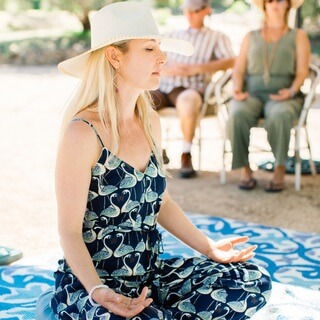
So good to have you here.
I'm Dr.
Diana Hill and this is our weekly sangha,
Our Monday sangha.
We're back in my office today after having been at Art and Soul Gallery.
Once a month we go in person to this sangha in Santa Barbara at Art in Soul on Mondays at 12.
And the other Mondays we are here.
Either at my office or sometimes outside.
I am just back from retreat.
I led a retreat at Esalen.
On the retreat,
I was thinking about what is the word to choose for this week.
And the word for the week actually came from the experience that I had of being on the retreat.
And the experience that I saw from many people on the retreat of how they came in and how they left.
The word is scattered,
Scattered.
So I was at Esalen driving through the one.
So when you go up from Santa Barbara.
Up the one to epsilon there's a period of time where you lose cellular connection.
It's like 45 minutes of driving without any cell connection.
And during that period of time,
I was driving up there with Jacqueline,
My assistant,
We noticed that the hillside was just covered in this jabata grass,
Which is.
How I grew up,
We called it elephant grass.
And elephant grass has this long stem and these big pillowing kind of soft feathery.
Tops.
And the nature of elephant grass is that,
Or this ciabatta grass,
Is that it can scatter its seeds without being pollinated.
So it ends up scattering all over the hillside and becomes this like invasive species.
That's how I was feeling in my own mind.
I also experienced this with people that were there that maybe this is what they were feeling too of this sense of scattered attention.
Scattered in their feelings,
Scattered in their motivations,
And it's sort of like all over the place without real clarity.
And over the course of the weekend,
Things started to gather together.
So today I want to talk about five ways to find your way back.
When you feel.
Scattered.
The first thing that we did when we landed at Esalen was to go to the teacher's house.
So S1 has this long history.
It's up in Northern California and some of the teachers that have taught there are teachers like Joseph Campbell and Alan Watts.
And I was staying in this house that was right on the edge of the water.
And went down after dropping off the bags and all that went down to the water where these huge waves were crashing up.
And looking out over the ocean.
Had this experience of Where I was standing or where you're standing someone else stood here before and not only that where you're standing.
There's so much more to the space than what you're all caught up in.
To be able to get from a place of scattered to clarity,
You have to start by expanding your space.
And there's some research in psychology about attentional restoration and the benefits of nature for doing this,
Where There's these four qualities associated with attentional restoration and your ability to like to get away.
From what is all scrambling up in your mind to have this soft fascination.
So looking out over the water,
There was all these little.
Bobbing seaweeds,
And then there was also the bobbing heads of sea otters.
And it's just a soft fascination of what's out there.
You also need to have compatibility.
You need to be in spaces that are compatible to your nervous system.
For me,
I'm an ocean girl,
So going out to the ocean is always a match for me in terms of my attentional restoration.
So if you're feeling scattered,
And even as we do this in our meditation,
I would recommend you.
Get to rather than being caught up in the little bits of the scatter,
The little seeds that are all over the place,
Look at the hillside that's carrying all the grasses.
And that could be going into nature,
But can also be a bit of attentional restoration by just expanding your attention as we'll do in meditation today to something bigger than all the tiny little pieces that you're trying to gather.
Whenever I go on these retreats and in general,
If I'm visiting a place,
There's usually some kind of orientation and that's always the thing that I skip.
I hate orientations.
I don't want to know where the,
You know,
The bathrooms are,
Where the meditation heads.
I want to kind of go discover it for myself.
But on this retreat,
I actually attended the orientation for a rare occasion.
And what I found was that actually attending an orientation or getting oriented can really help you when you're feeling so scattered,
Letting someone else guide you.
And in this orientation,
There was about 50 people in this room.
And the question that was asked of us.
And just the mic was passed,
Was what are you loving about yourself right now?
So we're in this group of probably 50 or so people,
And they're orienting us to the retreat space.
And Sam,
Who's the orientation leader says,
What are you loving about yourself right now?
And people stood up and held the mic and shared what they're loving about themselves right now.
And it's actually something that if you're coming from online and the chat,
Maybe you could write down your name,
Who you are,
And even share something in the chat about what you're loving about yourself.
It was phenomenal to hear because here we come in scattered.
And a lot of times when you're scattered,
You're only focusing on what's wrong about you or what's wrong about your life.
And asking that question,
What are you loving about yourself?
People stood up and said things like,
I'm loving that I'm surrounding myself with really good friends.
I'm loving that I'm learning how to set boundaries.
Like right now,
I'm not going to stand up and speak.
I'm going to sit on the floor and share.
Some people said things like,
I'm loving that I'm taking an art class for the first time.
And then when the mic was passed to me,
I had this blank of like,
I don't,
I don't know,
But all I knew in that moment was actually the truth.
Of what I was loving about myself.
And I,
I realized that in that moment,
I picked up a flower and I put it in my hair and I was like,
I love I'm loving that I put flowers in my hair like I did when I was a little girl.
So sometimes it may be helpful for you if you're scattered to ask that to get oriented.
Through self-appreciation.
And it can be something as small as something that you're doing now that you used to do when you were little or some kind of change that's happening for you.
And that gathers our attention to something that's positive about us in all of the scatter.
So expand the space.
Get oriented through self-appreciation.
What are you loving about yourself?
Put it in the chat.
I'm very curious.
And then the third piece of being scattered has to do with what's called selective engagement in psychology.
There's this attention residue.
So when you are switching from task to task to task in the way that many of us are now,
We have multiple Things open on our screens.
We have multiple devices that are capturing our attention.
We can do more multitask more than we ever have been able to.
There's a residue that gets left behind in our attention and makes us feel increasingly scattered.
There was a study that came out recently where they had folks block themselves from being able to use the mobile aspect of their phones,
Like the Internet access of their phones for two weeks.
And what they found in that study was just two weeks of a break of your phone,
Not being able to be accessing like websites and things like that.
They saw for 91% of the people.
They found improvements in well-being,
They found improvements in mental health,
And they found improvements in attention.
We're scattered because we are engaging in way too many things at the same time,
And we are not able to focus our attention on what matters most in this in this moment.
We have this.
Um,
Attentional residue that's getting distracted.
So practice selective engagement and what that means is,
You know,
For when I was on retreat,
I.
I took the time.
To just focus to the best of my ability.
On being on retreat.
And I had all of these other things coming in,
Trying to pull,
Trying to pull me away and just focusing on that attention on where you are now is important.
The fourth thing.
That you can do if you're feeling scattered is another term from psychology,
Which is called incubating.
There's actually there's this idea of incubating can sometimes feel like procrastinating,
But it's really different from procrastinating in the sense that.
Sometimes you just need ideas to percolate or you need a little bit of time with something.
You need it to incubate,
Like a.
.
.
Little uh Chick in a shell you need to incubate you need to give it some time so then it can crack out and be what it is and there is a lots of studies in terms of creativity after incubation like creativity after you've had a good night's sleep or people are something like 60% more creative after they go for a walk they solve problems more creatively.
We need to have that incubation period of time if you are scattered.
And that incubation happened for us over the course of of these three days on retreat where we would we started the day we started the retreat with just.
Exploring the places where we felt.
Like we were all tangled up.
On day one and then just letting it incubate for a while.
And then on day two,
Exploring what the strengths are that we have or what we could bring,
What values you want to point to and letting that incubate.
And then by day three,
It started to unfold.
And it unfolded in this beautiful way where we connected.
The dots.
So once you've expanded your space,
You've done a little self-appreciation,
Get oriented with self-appreciation.
You've practiced that selective engagement.
Like what is it that you want to focus on?
Can you let the rest kind of float to the side?
And then you've incubated.
You've allowed a bit of time to go for a walk or sleep or just give it a little bit of time.
To settle and percolate as it percolates.
Then you can do this last step if you're feeling scattered,
Which is connecting the dots.
This was the assignment that I did over the course of the weekend that I'd love for you to try.
And basically what you do is you take a piece of paper.
And you fold it in half.
And on one side of the paper.
You draw.
What it looks like for you to feel scattered.
And then the next side of the paper,
You draw what it looks like for you when you feel oriented.
And then you open the paper up.
And you can see if you can connect the dots,
If you can connect the scattered to the oriented in some form of creative way.
We had folks that drew things like a black box on the first day.
And then on the second day,
They drew a flower.
And then they realized on the third day that the flower could grow out of that black pot,
That black box.
I had folks that drew on the first day a stop sign.
They were paralyzed and feeling so scattered.
And then on the next day,
They drew a winding road with lots of paths.
And then on the third day,
They found that that stop sign can have an outgrowth of a winding road of lots of paths.
There's a subconscious to you.
That knows how to connect the dots.
If you give it.
Space.
If you can orient through self-appreciation.
If you can practice that selective engagement of just one thing at a time.
And if you can incubate a little bit.
Incubation comes from our morning practice,
From our meditation.
Incubation comes from nature.
And then eventually trusting that you will,
There's something inside of you that already knows how.
To connect the dots.
So from scattered.
To centered or from scattered to maybe something that's bigger that can hold the scatter,
Or even thinking about how it's the scattered droplet.
Of water that when light comes through them,
That allows for the rainbow.
The idea here isn't to get rid of scatter.
It's to be with the scatter in a different way,
Which is generally my approach with ACT.
And what I'm trying to do with myself as well,
Because I often feel scattered.