What is America's racial karma?
And how can we take the teachings of Thich Nhat Hanh and apply them to this trauma so that we can heal each other and ourselves in our daily practice?
That's what I'm going to explore today with Dr.
Larry Ward on Your Life in Process.
Today on the podcast,
We have the opportunity to speak with Dr.
Larry Ward,
Who was ordained as a lay minister and Dharma teacher by Thich Nhat Hanh and assisted Thay throughout the world,
Accompanying him in peacemaking missions in China,
France,
Korea,
Vietnam,
And the US.
Dr.
Ward is the author of the book America's Racial Karma and brings 25 years of organizational change and community renewal to his work as director of the Lotus Institute.
Larry's also a family friend.
He used to hold sangha in my parents' living room.
And in this conversation,
He talks about his experience of racial trauma and how the subtle and nuanced teachings of Thich Nhat Hanh helped him heal his own nervous system,
Understand how this trauma is a patterning of karma,
And dedicate his life to changing our ecosystem of hate and using what he calls the sacred imagination to create a different world.
Listening to Larry Ward reminded me a lot of Thich Nhat Hanh's Dharma talks.
This conversation is not going to give you six tips to heal your anxiety or four strategies to fix your relationship.
Ward's teachings are much deeper and more nuanced than that.
So I encourage you to take this on as if you're listening to a Dharma talk.
Lie down,
Put your legs up the wall,
Close your eyes,
Go for a walk,
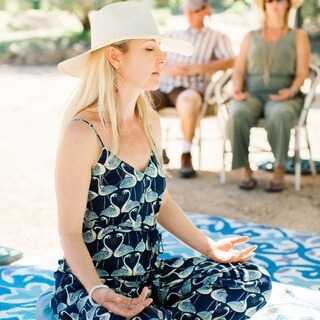
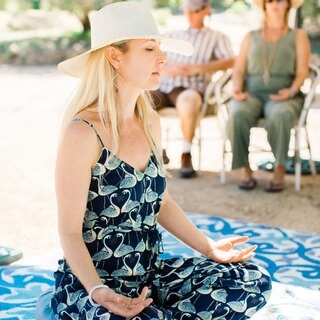
Or sit in a meditation posture.
The day that Thich Nhat Hanh died,
I asked my mom to bring over her journal where she kept paintings and transcripts of Thich's talks while she was on retreat with him in Plum Village.
And you can see one of those paintings on my Instagram page.
I'd seen this journal before and I appreciated her artistry,
But I never actually zoomed in to read what she had transcribed from the talk.
This is one of Thich's Dharma talks in the Upper Hamlet on June 19th,
2014 on a 21-day retreat on immortality that my parents attended.
And when I zoomed in to read my mom's transcription,
This is what it said.
Today we focus on right diligence or right effort.
Right diligence is the practice of choosing the right seeds,
Planting them and watering them.
If you want those around you to be happy,
Choose the correct seeds and nourish them.
Make this a habit.
We are not only our bodies,
We are also our environment.
He goes on to say,
There are neural pathways that lead to suffering and suffering becomes a habit.
To practice means to bring your wholesome seeds into existence.
You have to choose the right seeds,
Plant the right seeds and water them every day.
It is good to bring mindfulness to areas where there is wrong view.
No one should be excluded.
Thich Nhat Hanh was an early neuroscientist,
A behaviorist and a true believer that change starts with ourselves,
But that every time we change ourselves,
Every time we water those seeds,
It will help change the world around us.
So take in this conversation with Dr.
Larry Ward as an opportunity to water some different seeds in your own mind and bring some mindfulness to areas in your own mind where maybe there is wrong view,
Especially in the area of race.
We have a little bit of connection through my parents who have,
I think my mom said has known you for over 30 years.
So a long history there.
So it's wonderful to have you here today.
Well,
Thank you for the invitation and thank you for being here.
I have fond memories.
And I actually was wondering if we could start by reading a little bit from your book,
America's Racial Karma.
And I'd love to hear your response to this statement.
So you write that healing and transforming the patterns of continuation in our internalized racialized karma depends on a fresher and deeper understanding of our humanity.
To realize this understanding is beyond information gathering.
So what do you mean by going beyond just the information gathering to actually be able to heal the trauma of racial karma?
When you write a book and I was in Oaxaca finishing it all up and everything.
And now it's like,
Oh,
I wrote that.
Yeah.
To use a phrase attributed to Einstein that you can't solve a problem at the same level of energy that created it.
And this is also beautifully referred to in my grandmother's hands.
But what we have been conditioned to understand about one another as different peoples here and around the world is without context.
And without context,
Traumatic experiences embedded in the body for generations or present moment experience looks like normality.
If we don't understand our own biology and as it impacts psychology,
As that impacts our social lives,
You know,
We've divided the world up in all these pieces that are not pieces.
They are constantly interacting.
I wrote a phrase to myself of meditation yesterday that actually it's not our differences that caused us the greatest problem.
It is in fact our similarities.
And by similarities,
I mean the human nervous system,
Which is our daily experience of life.
And if we don't elevate our skills in learning how to recognize and tend to heal our nervous system patterns of reactivity,
We can't break the pattern of racial karma because it's rooted in trauma.
Trauma of the victim,
Victims,
Trauma of the witnesses,
The observers,
And trauma of the perpetrators.
And this all taking place here in the US on a ground of trauma of genocide.
And once you start to understand that life is interconnected to life,
Not as a concept only,
But as a lived experience in your body,
You realize how deep the work is we need to do with one another and with ourselves in order to heal our woes.
When I interviewed Dr.
Helen Neville from Psychology of Radical Healing Collective,
She talked about how healing requires accessing the past,
The present,
And the future.
And I was thinking about that and reading and learning more about you and your past and how much you've dedicated your life to healing,
But also your own personal experience with trauma.
And I'm wondering if you could share a bit about your experience of racial trauma with our listeners.
Oh,
Sure.
I don't say that so easily,
But I say it sincerely.
Am I sure?
Well,
One story,
I'm afraid I have a lot of stories,
But one that is still a meditation for me is our house was firebombed by a team of people dedicated to eliminating interracial couples.
They're part of the US and we had the good fortune to be able to go into Plum Village,
Spend time with Thich Nhat Hanh after this occurred.
So we had time to tend to our shock,
Our emotional pain.
For a time,
Every smell of any smoke reactivated our body's sense of fear or anxiety or potential threat.
And so spending time in the monastery was the most helpful thing,
Creating enough space inside of myself not to define myself by my trauma,
To recognize my trauma,
To honor it,
To use a phrase from Thich Nhat Hanh,
To call it by its true name,
No escape.
But to understand that that phenomenon,
That experience does not define me.
I am defined by many things.
And so without a spiritual practice,
I think it is very difficult.
And by spiritual,
I don't mean abstract intellectual thought.
I mean body centered healing and transformation and activating our deepest capacity of neuroplasticity to rewire ourselves in a good way.
And remembering that we're being rewired all the time by the society we live in,
Not just by our biology,
Not just by our psychology,
But the interaction you have to include in our technology.
No human being has ever found out so many things that are wrong so fast with the world.
It's just this tsunami of,
And that's why information is not enough.
We have to move from information into knowledge,
From knowledge into wisdom.
And that wisdom has to be body centered wisdom,
Not simply the aspiration for wisdom.
When I had heard that you had gone to Plum Village after that horrific event,
I just sort of had this vision of you with Thich Nhat Hanh and he too had to leave his home and experienced so much trauma in his life.
And I just wonder what some of the practices were,
Like the concrete practices that you were doing.
And I think our listeners that are both therapists,
As well as people that have experienced trauma may want to learn.
We spent a lot of time in silence and parts of the Buddhist tradition referred to as noble silence and nobility here means the silence that heals,
The silence that gives you time to come back to yourself,
To reconstitute yourself without judgment,
Without blame.
And so there's that piece of the practice was every day and every night,
Times in the day,
But also from like 10 at night to 6 a.
M.
Meditation,
We were wrapped in a blanket of healing silence.
The second thing is mindful walking,
Mindfulness of steps through the forest and even mindful jogging,
Which Thich Nhat Hanh used to like to do from time to time.
I remember when I was in Plum Village,
Seeing the monks in their full robes jogging and I was like,
How is this mindfulness?
But the secret in terms of movement of the body and mindfulness is not how fast we move or how slow we move.
It is how conscious are we of our embodied movement.
So once you learn how to move slowly and become conscious,
Just like when you learn to play the piano and learn to play golf,
You start off doing things slow so that you can start to build the patterns in your body and in your mind of repetition or in jazz and playing the piano.
You have to learn to scale,
You know,
Before you can become Thelonious Monk.
So it's a journey of mastery.
And for me,
It was great,
Great fortune to be in Plum Village with the monks and Thich Nhat Hanh.
The one thing he did say to us after asking how we were,
How was our dog and how sorry he was that this occurred.
After a couple of days,
We sat again together for a long time first,
Always in silence.
And he said,
You know,
That was just horrible.
But don't put your energy there.
You have bigger work to do.
And I meditated on that for a while and I realized part of the impact of an attack like that is to,
At a spiritual level,
To crush your heart,
To wrap you in trauma so that you live the rest of your life in reactivity to hatred,
Which you then embody inadvertently,
Just like you can embody the good.
So the whole slowing down part of the practice overall helped us heal in the midst of our tears and our sorrow and our anger,
All of which are legitimate human experience.
The question always is how to practice with these experiences so they while they may injure us,
They do not damage us.
One of my memories of Plum Village was also lazy days.
And Americans hate the word lazy.
We have this reaction to lazy.
But the lazy day was the Sunday where we didn't work and we enjoyed just being with each other.
And I've been thinking about that in terms of all of us,
Everyone traumatized as you write in your book,
And also the need for effort and also the need for lazy days.
And I'm wondering how you practice that in your own life in terms of you put out a tremendous amount of work and then also how you practice laziness.
First I have to say I discovered throughout my whole life that I actually enjoy doing things.
But as I've grown older,
I resist the definition of what I'm doing as work.
Because I see it and it only identifies within a commercial productivity,
All of which is wonderful and fine.
If we're producing things that don't cause suffering,
That's our human creativity motion.
So I practice laziness every morning before I get out of bed.
So what I've discovered in a non monastic paradigm of daily living,
You have to take moments of laziness.
So I start the morning lazy,
I do not rush out of bed.
I do not use an alarm clock.
I haven't for years because I don't want to be alone.
I have enough alarm,
I don't need another alarm to shock me into.
And so I begin with a body centered meditation on the five remembrances of Buddhist practice while I'm breathing still in the bed.
And only after I complete that process and remember my father's waking up words,
Which was Hallelujah,
I'm alive again,
So that I have some sense of reality and some sense of joy before my feet hit the floor.
And then in mindfulness practice,
Everything can become an object of meditation in the best sense of the word.
So I shower the water.
I remember being part of my life in places and villages and cities and environments where and here where water was so precious,
Hard to come by walking to a river,
A dirty river to get the best water you could picking out the worms.
And so when I shower,
I just don't cut on the faucet and forget that I am lucky in that sense to have that access to I am grateful for my experience of water.
So I'm thinking the water.
So I practice gratitude for being alive,
Being able to experience life in this way.
So and then I go outside to our little patios where we have lots of flowers and plants and hummingbirds and other kinds of birds and all trees nearby.
And I talk to them every morning.
And they talk back sometimes,
And I find that also that time in nature as a as a contemplative experience,
Not just a walk through or like our dog Charlie,
Who's stopped to smell all the flowers,
Learning how to do that.
And that's part of what the slowing down and the lazy day allow.
So I build laziness into my whole day every time and whenever I can,
Because I have days when it's not so easy.
But I always begin the day lazy and end the day lazy.
I have an evening process I go through sometimes with the moon when it's out and standing meditation in 360 degree experience of the moonlight around my body and up and down my body and meditation I use from my early experience in the Tibetan tradition to go to sleep.
Bathing in moonlight before bed.
That sounds like a lovely practice.
So I'd love to talk about America's racial karma and how we're all affected by it and what you mean by it.
And then it also extends you've written about how it extends beyond America.
It's not just about America.
But maybe just start by defining karma and America's racial karma.
So what I mean by karma in this instance is a repeating pattern.
So if you're a scientist or a sociologist or a psychologist,
You understand the language of patterns that repeat habits that repeat.
And so what I mean by karma in this book is habits at the collective level of our consciousness.
At the level of our shared psyche.
Which has been traumatized by our history.
And that the pattern of devaluing human being status based on skin tone is a human invention.
Not a divine code.
And so my effort with the book is to help people understand how humans create patterns that disrespect and destroy and harm others.
Both at the individual level but also at the level of consciousness itself.
The question for us as conscious human beings,
Willingly conscious human beings,
Is to always be on alert to where our thinking has been conditioned.
By our trauma,
By our motivations,
By our intention.
And as long as the intention is alive,
The pattern sustains itself.
There's plenty of examples of humanity throughout all of history that learn how to be together.
Wellness,
Justice,
And harmony is best they could.
But our state here in the US today makes everybody wonder if we are actually,
We don't have the intention to be well together.
To be just together,
To be in harmony.
And so this,
The wheel in the patterning is continuing.
That's karma.
And the only way to break the cycle is to create a new pattern.
And what I'm saying in the book,
Just a little bit,
Is in order to create a new pattern,
You must come deeply into recognition of your own humanity.
If you cannot recognize your own humanity,
You cannot recognize it in anyone else.
Hi,
Folks,
I want to tell you about a few live events that I'm offering.
First,
For the general public,
I'm going to be at Inside LA on February 11,
Online offering an introductory course to acceptance and commitment therapy.
And second,
If you are a mental health practitioner,
Join me at PESI for their body image summit,
Helping everybody find peace with food and weight on February 24 and 25.
And then finally,
In March,
If you're a clinician,
I'm offering a workshop with Praxis Continuing Education.
So you can join me there.
You can check these all out on my event page at drdianahill.
Com.
You've written about avoidance.
The type of therapy that I practice,
Acceptance and commitment therapy,
Works a lot with avoidance and the suffering that comes from avoidance.
And that also links to Buddhism and the Four Noble Truths.
But specifically,
You write about how we have these three types of avoidance,
Which is we deny it,
Then we forget about it.
So it never happened.
Or we say like,
I wasn't alive back then.
So how do you work with people that are engaging in avoidance,
Whether it's avoidance of their trauma or avoidance of their own shame or for white folks like myself,
Avoidance of guilt,
Or we'll do anything we can to get around those feelings that show up?
Well,
My experience is spiritual practice.
And in particular,
I mean,
Mindfulness of the body and the practices of mindfulness of the body we have,
The modern world has convinced us that cognition is the whole meaning of reality.
I think therefore I am.
But to use a quote from Thich Nhat Hanh,
I think therefore I am not.
Meaning when I am thinking,
You can just try this out anytime.
When I am thinking,
It is difficult for me to be aware of anything but my thought.
And therefore,
The pancakes might be burning.
Therefore,
Therefore I realized I left my keys in the car.
And because I was thinking about my next project or my next whatever.
And so our cognition gift is wonderful.
It's the newest part of our evolutionary brain.
But it is only one part and one perception of reality.
And until we both train our bodies at another level of evolutionary resilience,
It's not enough resilience just to get by now because we're inundated and interpenetrated every day,
Day and night by traumatic activation.
And so learning how to journey through our grief with respect and honor and release is part of the work we need to do.
I do meditations every day to help me recognize my sense of safety in myself,
My sense of welcoming myself in the world and my sense of trust.
So that I can recognize and cultivate safety with you,
Welcoming with you,
Trust with you.
We have such a long way to go because our trauma stands in between crossing that bridge.
Even in this moment,
You being a black man and me being a white woman.
Our trauma.
Yes.
Crossing that bridge.
Crossing that bridge.
And for me,
That bridge is there to be crossed.
And our future depends on it because the other reason I wrote the book,
I'm fully aware of other people suffering around the world historically and geographically.
But one of the reasons I wanted to highlight the African-American experience,
Quote unquote,
The black experience is because black people and Jews were the first people to experience laws actually created on the books that discriminated against them in 15th century Spain.
And so to me,
To get away with George Floyd's murder,
Don't you understand you're next.
We see this attack mentality.
And if I live long enough,
I write a book about the patriarchy,
But I keep thinking,
My God,
It would have to be too long of a book.
The conditioning of our male language and archetypes and even worship of maleness also does not help us embrace our trauma.
Because if you're on the battlefield,
You don't have time to embrace your trauma.
You are trying simply to survive.
And that survival sense that we are at war all the time since is not sustainable and it is not turned in on itself.
So I have a I have a question about that.
I really want to know your thoughts on this about anger because I interviewed Kristin Neff and she's written a new book come out called Fierce Compassion.
And so a lot of it is about anger and the balance of and really sort of the using.
Like Durga and Kali is examples of like these these mother goddesses that are both like hold the the energy of protector warrior with also the tender mother and the balance of that.
And so then I picked up Thich Nhat Hanh's book to read about anger.
Because I'm like,
What is it?
What does he have to say about anger?
Because in some ways,
Anger is what burns stuff down.
Anger is stuff that is something that is so harmful.
Right.
And also,
Anger can be the thing that can protect,
Can be that mother bear energy to protect.
How do you work with anger?
Well,
The first way I work with it is separating anger from morality.
First anger is a biological response.
Irregardless of what you think.
It's your body's information.
Talking to you,
Screaming to you,
Getting your attention.
And then what you do with that anger then moves into ethics.
But anger itself is a legitimate,
Genuine and precious source of information about our human experience in the present moment.
And and therefore,
It's otherwise we wouldn't be gifted with this through evolutionary wiring.
This is important.
Now,
Learning how to process our anger.
Just energy,
Biological energy to learn how to recognize when the anger is rising.
Thanks to many years of practice,
I can actually feel my anger,
Which I don't feel much anymore.
I mostly feel grief now.
Yeah,
Yeah.
That's what's under the anger,
Right?
It's grief.
Yeah,
Yeah.
But the process of learning how to hold it,
Respect it,
Recognize it,
Honor it is the same so that I arrive at a kind of equanimity with my anger where I keep my information and direct the energy of it toward wholesome action.
Nice.
Anger is the information and then what you do with it,
The action is the is the karmic.
Yes.
So if you look at anger as both as energy,
Then you can transmute it into some other energy as well.
And yes,
That's that's kind of how I work with it in myself.
I don't suppress I know shutting down while I was working on America's racial karma.
Every day I said to my wife,
I didn't know I had so many fears.
That was as a literal statement to me,
A nation created in trauma that doesn't deal with this trauma cannot escape this trauma.
This is what we're seeing now.
In the pandemic.
Oh,
What a teacher.
If we understood it as a teacher,
Not simply as an enemy.
That we are on one planet.
We're here together.
Yeah.
And that exists in your own household.
You mentioned at the beginning how your house was firebombed because in an interracial marriage.
And I was telling you that whenever my parents talk about you,
They talk about you like peanut butter and jelly.
Peggy and Larry,
You and your wife have founded the Lotus Foundation.
And in your description of the Lotus Institute,
You write that this work of learning to stabilize and restore the nervous system in a time of systemic collapse while focusing on building better ways of loving and caring for each other is the most important work we can do.
If we don't,
There won't be a world for us to do anything in.
What is your hope for the work that you're doing with Peggy and moving forward?
Well,
My my attention now is around understanding trauma as social.
Systemic,
Psychological,
But not separated from our life and the culture in which we live.
I've lived in enough places to know.
Rarely have I gone to the grocery store in other parts of the world and ever thought I'd get shot.
That is culture cannot be separated from individual behavior.
And so we blame individuals for things that culture produces.
Our technology produces it if it's misused.
We have to really massively reeducate enough of us fast enough.
So we don't just like kill ourselves either openly or on purpose.
Suicide rates are up.
I know you know this across every ethnicity in the United States.
The age of suicide is dropping.
How is our society creating the emotional,
Psychological,
Biological and social experiences that make a child think that's the best choice?
Not mentioning the weapons they got to do it.
But anyway,
And so this denial for me is is so deep and so wide,
But enough of us are waking up to our denial.
For me as a white woman,
My awareness of whiteness.
Kind of shows up every once in a while,
Right?
And I live in a in a in a community where I can choose to be aware of my whiteness or not.
And so I think that's that for me,
The work is is the thickness of that denial.
Like there's some effort.
Yeah.
And I like your language of effort because it would be an error for any of us to think that we don't all have to work with our trauma.
This is not simply a white people's problem.
It is a shared problem.
This again,
Because we don't see ourselves as the old cloth.
We see ourselves as pieces and we are pieces,
But we are pieces of a whole cloth.
And so trauma in San Francisco is also a trauma in New York.
We have to really re-understand the major reality because it all interpenetrates.
Our childhood interpenetrates with our adulthood.
Our genetic dispositions interpenetrate with their lived moments of life.
And so we are our society is interpenetrating.
And again,
This is a great teaching Buddhism and insight interpenetrating nature reality.
We're culture oriented around events and stories about events,
Which is fine,
But we are not very skillful and very wise in recognizing what led to the event.
This is about introspection skills.
This is about lazy days.
We used to walk to one of the very old French indigenous churches,
Which you may have gone to,
To beautiful old art.
Through the sunflowers.
You have to walk through the sunflower fields to get there.
Yeah.
I mean that's a good life.
Yeah.
And you know,
For me,
Part of our challenge is finding a lifestyle where that can happen.
Yeah.
It took me years to really understand what Thich Nhat Hanh meant by mindfulness.
What he meant was if you're not a monk,
You have to create a lifestyle where mindfulness becomes and daily life becomes possible.
You know,
I in my office,
I have two artifacts that I keep from there that I brought back.
And one is this little piece of wood and it says on it,
We enter our.
And in reading your work,
It just evoked that memory.
And I like got it down.
It's like,
I got to bring this out and have this.
And then the other one,
Which is,
I mean,
This is so Thai,
It's everywhere,
Right?
Is the piece is every step.
And I think about,
And when I was chatting with my mom about interviewing you,
I said,
He's kind of like Thich Nhat Hanh and Ibram X.
Kendi had a baby.
We can imagine what that would be.
And it might be Larry Ward because you have the peacefulness and the the interbeing,
Right?
That wisdom of Thich Nhat Hanh.
And then you also have the committed action,
Clarity,
The determination of Ibram X.
Kendi.
Right.
And so I just appreciate you and your teachings.
And I would recommend folks that want to learn more about you to go to the Lotus Foundation.
And I'm also curious if you have some recommendations of folks that want to learn from you,
Listen to Dharma talks or maybe participate in some coursework.
Sure.
Anyone who's interested can go to the Lotus Institute dot org.
So we are using this time to reimagine our future.
And I'm trying to create to help create is a narrative beyond wound.
We need to step into our sacred imagination.
About the society we want to live in,
That we want our children to live in,
That we want our plants and animals to live in and then clarify for ourselves what that feels like in our body and then bring that back to now and decide what we change to get there.
And that to me is is the practice of eco spirituality,
Evolutionary eco spirituality.
Well,
Thank you,
Dr.
Warren Ward.
It's been an honor and delight to have you in this interview and to have you in my parents lives.
They've transmitted you to me,
I guess,
Over time through through that.
And I really appreciate the work that you're doing on this in this world for eco spirituality and was it creative?
What's the word that you said there at the end?
Sacred imagination for eco spirituality and sacred imagination.
Those two words,
Those two terms.
Thank you.
Thank you very much.
Take care.
You too.
Be safe.
Be well.
I love the sound of Dr.
Larry Ward's voice and I love his teachings,
Their simplicity and the ways in which he talked about laziness,
The rituals that he does at the beginning and end of his day,
Like not waking up with an alarm clock,
Practicing gratitude in the shower and moonbathing before bed.
If you look at some of the recommendations in psychology,
They really are similar things like have a ritual before bedtime to help wind you down so you get a better night's sleep and gratitude is one of the things that can help change your happiness levels.
Dr.
Ward also talked about the benefits of noble silence,
Being with someone you trust,
Movement in nature and recognizing that your trauma does not define you,
But that you can turn it around toward greater good.
Here's the practice I'd like for you to do this week in honor of Thich Nhat Hanh and Larry Ward's teachings.
It's very simple.
Let's go for a walk in silence.
When I first met Thich Nhat Hanh,
It was on the bluffs of UCSB where he led us in a silent meditative walk along the edge of the ocean.
The monks and the nuns were in their brown robes walking behind him and the slowness of his gentle walk on the earth was a teaching in itself.
It taught us to feel where our feet are stepping and look at what's around us right here right now.
So take a break,
Leave your phone at home,
Go for a silent meditative walk,
Carry on Thich's teachings by walking gently on the earth for yourself and for all beings that we are interconnected with.
Come back home to the nourishment that exists right here and right now with something as simple as a silent walk.
Thank you so much for listening to this episode of Your Life in Process.
When you enter your life in process,
When you become psychologically flexible,
You become free.
If you like this episode or think it would be helpful to somebody,
Please leave a review over at podchaser.
Com.
If you have any questions,
You can leave them for me by phone at 805-457-2776 or by email at podcast at yourlifeprocess.
Com.
This podcast is for informational and entertainment purposes only and is not meant to be a substitute for mental health treatment.