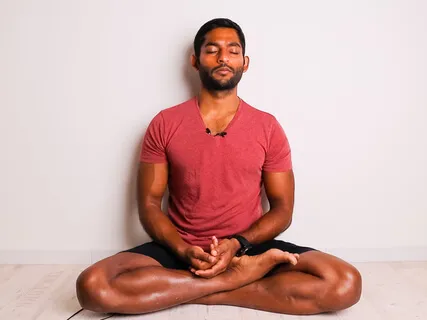
Namaste and a very warm welcome to all of you in this daily live meditation session with me,
Dhyansa.
We're going through Yoga Sutras of Patanjali and on the path of Vibhuti Padha,
The third chapter of these Yoga Sutras.
These Sutras which are eternal,
These Sutras are not mere information.
These are not mere words to be just heard and processed as information.
This is not data,
This is not information to be digested,
To be heard and intellectually analyzed,
Dissected.
This sutra,
This whole knowledge of Patanjali is a world in itself.
It's a vibration,
It's a space that you have to unfold for yourself.
Otherwise all these sutras,
All this information in words are available.
Anyone can go out on the internet and go through these sutras but nothing happens.
When you just read through these sutras as words,
As information,
As knowledge,
Nothing happens.
The only way these sutras start working and the lock of these sutras are unlocked with the key is when you contemplate over them,
When you meditate over them,
When you approach them in a certain state.
In the state of meditativeness,
In the state of silence,
In the state of being open.
Not just intellectually trying to dissect,
Trying to regurgitate what you already know,
Trying to reaffirm what you already know as your own beliefs,
As your own knowledge.
It is not to augment that.
It is not to amplify what you already know,
What you already believe,
What you already consider as truth.
This is to expand your consciousness.
This is to rise your awareness and that happens when you are open.
When you put aside for a moment what you already know,
When you put aside the mechanism of the mind,
The way you would read a book is not the way you would read these sutras.
These are to be unfolded.
These are to be unlocked in meditation,
In contemplation.
That is why we are going through these sutras very slowly,
Step by step,
In several sessions really understanding every aspect which Patanjali is pointing at and growing along with these sutras.
There are two parts to these sessions.
One is where we are having this unfoldment of the sutras and then later part where we are meditating,
Where we are sitting in silence.
I would consider the entire session as meditation.
So don't divide between what is being unfolded in these sutras and later on the meditation.
Take this entire session as one meditation.
Be open to also what Patanjali has to say and let that knowledge,
Let that space,
Let that vibration create a new reality,
A new truth for you,
A new way towards the truth that would be more accurate to say because truth is one and your path towards truth is what is unfolded through these sessions,
Through these discourses on Patanjali sutras.
Presently we are discussing Vibhuti Pada where Patanjali had laid down three different modifications of the awareness as something to practice which leads to the fourth known as Samayama.
Once again let me repeat what I have been explaining in the past sessions and we have been meditating together in the last couple of sessions is Dharna where your awareness,
You learn to direct your awareness uninterruptedly flowing towards one object.
That in English you can call as concentration.
The second Dhana where the source of this awareness,
The subject,
It moves closer to the object of awareness and the third which is Samadhi where the object and the subject they meet,
The source of awareness and the object meet.
And when you do these three steps one after the other,
When you repeat them on one object that is known as Samayama that leads to the ultimate knowledge of that,
The ultimate vibration,
The unfoldment,
The unmanifested energy of that object becomes clear to you.
You learn about it,
You become it and that is the only way to acquire true knowledge,
To acquire to truth and when you focus the same process,
The same Samayama on yourself,
On your being,
On your construct,
Not just the body,
Not just the mind but the entire construct that is the path towards self-realization.
That is the only way to know yourself unless you can direct the energies inwards and in a way that it is a structured process,
In a way that you know what you are doing,
In a way that your awareness is while it is turning inwards,
It knows when it is in dharana,
When it is in dhyana,
When it is in samadhi so that you can regulate that process.
Let us hear what Patanjali has to say on this topic of Samayama continuing from where we left off yesterday.
Patanjali says,
Its practice is to be accomplished in stages.
So here while Patanjali laid down Samayama,
He here is very simply saying that this practice of Samayama you have to attempt this in stages.
You have to learn dharana,
You have to learn dhyana,
You have to learn samadhi,
You have to learn to put all of them together in what is known as Samayama and you have to also do this in stages meaning you start with very simple objects.
You start with your breath,
You start with the sound of Aum,
The tangible objects and then you move towards intangible,
Then you move towards yourself,
Your inner space,
Your inner emptiness,
Again starting maybe even from the tangible which is your body,
Then your mind and then moving deeper inwards.
So here Patanjali is only indicating that in order to successfully apply this Samayama,
Learn to do it in stages from the tangible to the intangible,
From something that you can feel in the physical like your breath,
Like the sound of Aum and moving towards the intangible towards yourself.
This is the tool when you apply this on the path of self-realization,
There is the knowledge of oneself,
One's own truth and in that knowledge there is liberation.
Then he says,
These three are more internal than the preceding five limbs.
Here he is reminding the yogi of the eight limbs of Ashtanga Yoga.
Once again he is saying don't forget the first five limbs,
The Yama,
The Niyama,
The Asana,
Pratyahara and Pranayama.
These five limbs I had discussed in detail in the previous sessions.
Here Patanjali is saying,
Yogi don't forget these five limbs.
These five limbs are for you to manage the external.
While you have learnt to manage the external,
Once you have learnt to manage the external,
Then you move to Dharna,
Dhyana,
Samadhi,
Move to more internal.
Because these three,
The modifications of awareness,
The Dharna,
The Dhyana,
The Samadhi,
These are very fine topics.
The first five limbs which are related to the rules and the regulations and the body postures and the breath regulation and so on,
All these are more physical,
They are more gross and Dharna,
Dhyana,
Samadhi,
These are very fine.
These are how you learn to maneuver your awareness.
So these are so subtle,
He is saying practice the first five has to be in place from gross to subtle and then you move towards this internal,
These three modifications of awareness once you are established in the first five limbs as well.
Then he goes on saying,
Even these three are external to the seedless Samadhi.
I love Patanjali because he always puts a perspective on every little detail that he is taking you through.
He is taking you always into the depths of what is possible but then he is always keeping you with a bird's eye view on the higher perspective as well towards your North Star,
Towards your goal always as well.
He is saying even these three,
Even Dharna,
Dhyana,
Samadhi,
Even these amazing abilities,
Amazing modifications of awareness,
This is not even the ultimate.
This also has to be left behind.
These are also external.
These are external to the seedless Samadhi,
Meaning to a state of pure emptiness where there is nothing inside,
Where there is no seed,
Where there is no object upon which you are doing Samayama.
You are not in your awareness.
There is no object.
There is only pure awareness.
That seedless Samadhi where the experience is very pure,
It is only pure consciousness,
Pure awareness,
The clarity is 100% there and you see the truth the way it is without any modifications.
So he is considering even Dharna,
Dhyana,
Samadhi which are supposed to be very internal,
Very fine,
Very subtle,
Also external as compared to the ultimate state of pure consciousness.
Then he says,
Vyuthana nirodha samskaryo abhibhava pradyu bhavau nirodha xana citta anvay nirodha parinama The impressions which normally arise are made to disappear by appearance of suppressive efforts which in turn creates new mental modifications,
The moment of conjunction of mind and new modifications is nirodha parinama.
This sounds complex as a sutra but let me give you the gist of what Patanjali is trying to say here.
It is a very very important sutra.
Here he is saying that while moving into meditation,
While moving into these different states of awareness,
You are making a certain modification,
You are making a certain effort,
Not a physical effort,
Not a mental effort,
Not necessarily a psychic effort but you are collectively making an effort to move and to modify your awareness.
You are moving towards something,
There is an effort involved.
He is saying that to an extent there is an effort involved and because of this effort there is still a thought left.
There is still something left which also has to be dropped.
Think of it like this.
In meditation there is no thought but in order to achieve you may have to go through the thought,
You may have to go through to the thought,
You have to accompany the thought until the end of the thought and then there is this last thought that I am in meditation,
I have no thought,
I am in silence,
I am in peace.
This very last thought,
This very last sensation,
This very last modification in the mind,
He here Patanjali is saying that even that has to be dropped.
That last modification also has to be dropped.
So through the process he is guiding how to move from wherever you are in your mind all over the place to a state where you are one pointed,
Where you are in meditation,
In concentration,
In samadhi and whatever has brought you there,
Even that vehicle,
That last thought has to be dropped in complete emptiness,
In complete surrender to the true,
The pure consciousness.
Let us practice this in Samayama.
So moving from the ordinary states of mind where you are to Samayama and let's do this Samayama on the sound of Om.
I will utter the sound of Om,
You can practice,
You can chant the sound of Om along with me but what is more important is along this chant of Om,
With every chant of Om you practice Dharana,
Meaning you bring your awareness to the whole vibration and the sound of Om.
When you start feeling the sound of Om,
The Dhyana,
You bring full awareness to it,
You move closer to that sound of Om and ultimately you merge in the sound of Om,
You become the sound of Om.
So let us do this Samayama on the sound of Om.
It is again a very powerful practice and from there on we will leave even the Samayama,
We will leave even the last tool,
The last thought,
The last modification and move into complete silence.
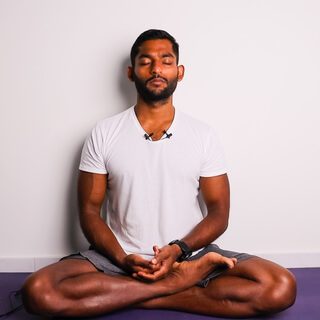
Please close your eyes and take a posture that is comfortable for you,
Where your body is at rest,
Your back straight,
Face relaxed and your awareness inwards as we chant Om bring all your awareness to the chant,
Feel the chant,
Be one with the chant.
Om.
All your awareness on the sound,
On the vibrations of Aum,
Feeling the reverberations,
Being one with the chant,
The vibration of Aum.
Aum.
Beyond the sound,
The vibrations that are eternally present in this universe,
Move towards those vibrations,
Be one with those vibrations.
Aum.
Awareness on the vibrations,
Feeling the source of these vibrations,
Being one with the source of these vibrations.
Aum.
From sound to the soundless,
Move your awareness from the sound to the soundless,
To the eternal,
Opened up in the sound of Aum.
Aum.
Aum.
Allowing your energies to reorganize,
As you become one with chant,
Of Aum moving towards the soundless,
From sound to the soundless.
Aum.
Aum.
These sounds taking you to the soundless,
There is enlightenment,
There is meeting the truth,
There is realization of oneself,
Beyond meanings,
Beyond comprehensions,
Beyond grasping.
Stay in the silence,
In the soundless,
Unmanifested space,
Empty space,
Leaving behind all effort,
All ideas,
All concepts,
All shapes,
Forms.
Making a jump into endless emptiness.
Leaving behind your identifications,
Your past,
All your thoughts,
Even the thought of meditation,
Even the thought of I Am.
Don't leave any hooks in your past.
Aum.
Aum.
You may continue in this space as long as you like,
Or very gently and slowly you may open your eyes.
Remain connected to the soundless,
To the space that is eternal,
That you just tasted in the last minutes.
Take that taste,
Take that realization in your day,
And share this wisdom,
Share this experience of yoga,
Of meditation,
Of this soundless space with your friends and family.
Namaste.