Hello,
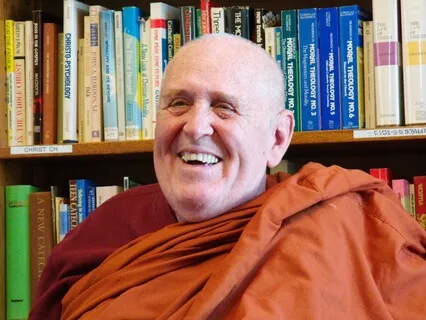
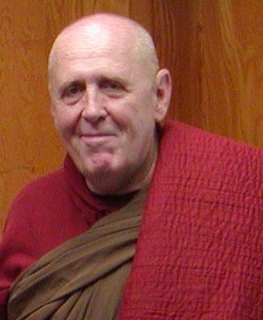
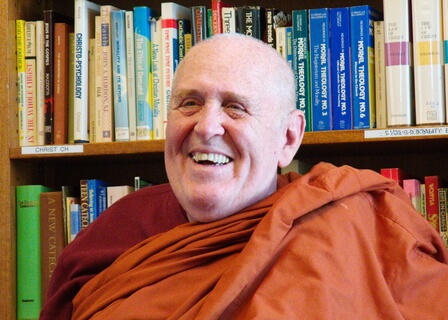
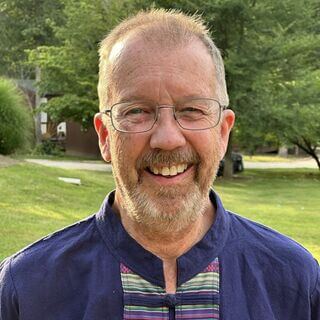
My name is David Johnson and I'm here with Venerable Bante Bimalaramsi and we're going to be talking about a number of topics in a continuing series of interviews.
A little bit about Bante,
He majored in history from the University of San Diego.
He became a Buddhist monk in Thailand in 1986 and has been in the robes ever since.
He's trained in Thailand,
Burma and Sri Lanka.
He did many many retreats in the Mahasivasaya tradition,
Including under Upandita,
But now has found his own path that has taken him back to the teachings found in the suttas themselves.
He teaches retreats at his Missouri center in the US and conducts retreats in Asia and around the world.
He is the author of many books including his major book on meditation,
Life is Meditation,
Meditation is Life.
We'll be doing a number of interviews so we won't cover everything in this one discussion.
We'll move into other areas and I also have a number of questions submitted from our friends in the social media.
So without further ado,
Let's get started.
Bante,
Hello,
Greetings.
Are you ready to talk about the Dhamma?
Let me start with the fact that you've been a monk for over 30 years.
What made you want to do that?
Well,
Let's just start out when I started meditating.
Okay.
Okay,
I started meditating with straight Vipassana,
Without a proper teacher,
In 1984.
No,
1974,
Excuse me.
Time goes fast when you're having fun.
And I found a teacher in San Jose at Stillpoint Institute and I went and did a one month retreat and then they asked me to stay because I was a handyman and I kind of worked around and got things back into shape.
So while I was there,
The teacher that was there,
His teacher,
Who happened to be the same teacher of Joseph Goldstein,
Anagarika Munindra from India was coming to America and he was going to be giving a retreat,
I think it was about a six week retreat.
It was a one month retreat and it might have been two months,
Another month after that,
I don't remember.
That's what happens when you get older.
Well I knew there was a June retreat.
Is that the one you're talking about,
1977?
Or is it much earlier?
When Munindra was there.
He was definitely there.
And he gave a retreat after that one,
After the big retreat.
Oh,
Okay.
I don't remember.
And it got me real enthusiastic and I wound up staying at the meditation center and doing a lot of meditation there and helping in whatever way that I could.
In 1978 I went with Kamala Masters to Maui and I wound up staying there for a couple of years and just generally kind of chilling out a little bit,
Not doing so much meditation,
But really enjoying being on Maui is a wonderful place.
I would imagine.
I got hooked on waterfalls there.
Waterfalls,
Mangoes,
Pineapple.
And somebody sent me a book on the five visions that happened right before death.
And that got me really enthusiastic to go back to the mainland and be with a nursing home that my mother ran so I could be with people as they were dying so I could check out whether those visions were real or not.
Were they?
Yes.
And I helped a lot of them to let go of the lower kind of visions where they would be reborn in not nice places so that they would be either reborn as human beings or devas.
While I was there I was also teaching a meditation class a couple times a week.
I was helping set up a hospice and worked at the hospice.
And I did that for about eight months and I was like,
Okay,
I've seen all of this,
Now I'm going to go up to San Francisco.
So while I was in Hawaii I happened to hear that Mahasi Sayadaw was coming to the United States and he was going to be stopping in Hawaii.
And I went and I met him.
And he had other teachers with him,
Sayadaw Janaka,
Sayadaw Ussila Nanda.
And both of these later became my teachers.
After I went back to the San Francisco area,
Mahasi Sayadaw said that he wanted Ussila Nanda,
Sayadaw Ussila Nanda to stay in the San Francisco area because there was a lot of Burmese there.
And he was going to set up a monastery.
And when I heard about this I thought,
Well,
I haven't got much better to do right now.
So I went up and asked him if I could be his attendant.
And being his attendant,
There's a lot of work involved in that.
I had to offer the food every day,
Breakfast and lunch.
I washed all the dishes,
I vacuumed the place,
I kept everything clean and generally kept everything up.
And I would take Ussila Nanda wherever he wanted to go.
As a result of being there for two years,
He was my teacher but he was also my friend.
Now Ussila Nanda,
As a meditation teacher,
Was very much like a ballet dancer.
He was very light and he would just mention things and keep you on the path very lightly.
He wasn't over strict like some of the other Burmese teachers.
I remember that sing-song voice of his.
Yeah.
And a little smile.
I always had a little smile.
Yeah.
He was an amazing man.
Brilliant.
Absolutely brilliant.
After two years I decided,
Well,
I'm going to be a layman again.
See what it's like.
Then I started working as a roofer to start off with and then I got into construction.
Because of my ties to Ussila Nanda and the Burmese community,
There were a lot of Chinese that were coming that were Chinese Burmese.
They started introducing me to people that needed work.
I met some very wealthy Chinese businessmen in Chinatown.
They started seeing the work I was doing and they were impressed with it.
One of them said,
I want you to build my house.
He had the blueprints and all of that sort of thing.
It was a very expensive,
Very big house.
And while I was doing that,
He introduced me to other CEOs of banks and presidents of banks and all of these kind of guys.
So I started building more than one house at a time and had a fairly large crew working for me.
And I wanted to see if I could earn a whole bunch of money really quickly.
And I did.
Then I said to myself,
Well,
I can do that.
Now it's time to figure out something else to do.
So I basically gave away the business and decided that I was going to go to Thailand.
In the back of my mind,
I had the idea that I might be a monk.
But I didn't want to stay a monk for very long.
Maybe a year or something like that.
And when I got to Thailand,
I went to a meditation center,
Mahasi Meditation Center in Chumburi,
Where one of the more famous Burmese teachers was.
And it was in December,
And the anniversary of my father's death was on the 27th of December.
So I decided to ordain and share the merit with him of that.
And as soon as I put the robes on,
They wouldn't let go.
They had me.
And I told other people about this,
That they just ordained.
I said,
You know,
I got these robes on.
They don't want to let go.
And they're looking at me like I'm some kind of crazy.
What are you doing?
Well,
We're not going to stay monks for the rest of our lives.
We just want to see what the experience is.
That was in 1986.
And I've been a monk ever since.
Over 30 years.
Well,
31 now.
This Rains Retreat is 32.
Oh,
32.
Okay.
Yeah,
They start at one.
They don't start zero to one.
So that's pretty much my interest in monk.
And meditation is the thing that drew me to meditation.
Back in the 70s,
I was reading Carlos Castaneda and Don Juan and all of these kinds of things trying to figure out what they were talking about.
Then I ran across other meditation teachers,
But they weren't teaching how to do the meditation.
They just said,
Well,
Just sit and meditate.
This is when there was a lot of Indian gurus that were coming into the country.
And I wasn't really happy about that until I went to a Theosophical Society that was advertising on the radio that they would give meditation.
So I wanted to go see what kind of meditation and whether it was really,
They were going to give me some instruction.
So we're going back a little bit into the 70s now,
A little bit.
Kind of the early days.
And they happened to have a book there called Practical Insight Meditation.
And that's the only meditation that I came across that actually told you how to do the practice.
So I was real enthusiastic about that.
And I started doing the practice and I decided to quit my job at the time I was a manager of a store.
And I quit the job and did a two-week retreat on my own with the book,
Practical Insight Meditation.
And I got to a place that I didn't really understand and decided,
Well,
How about if I go to India or go to Burma,
Actually.
And I got the money together.
I went up to San Francisco the night before I was going to be leaving.
I went to a YMCA downtown where they have,
You can pay for a shower and that sort of thing.
And somebody stole all my money,
My passport.
And this is right before you're going to… The day before I was going to leave.
And then what happened?
How did you recover from that?
Well,
I hitchhiked back down to Los Angeles where I had some friends and then I started working again and getting money together.
But the thing that's really amazing about that time was I called up an operator and I said,
I want to call Burma,
It's in Rangoon,
Chanmi,
No,
Mahasi Center.
And I was wondering if you could help me do that.
And they called back the next day and they said,
We have Burma on the line,
Take it.
A little bit before Google.
Yeah.
That's when they still had dial phones.
They had to talk to somebody else to find out.
Yeah.
Very good.
Anyway.
So you talked to them.
I talked to them and they said,
Well,
If you come to Burma,
You can only stay for one week because that was a limitation at that time by the government.
Why don't you stay in America?
There's a place on the East Coast and there's a place on the West Coast that you can practice.
And because I was on the West Coast,
I checked out Still Point Institute and went up there and did the retreats and became very much hooked on wanting to do more and more.
When I became a monk,
This is something that I haven't said for a long time.
I have done numerous one month retreats.
I've done,
I did a six month loving kindness retreat.
I did an eight month in Burma Mahasi Sayadaw retreat.
I've done about a dozen three month retreats.
As I said,
I was very much a fanatic and I was a dumb American.
I didn't know anything about Buddhism.
I didn't really care about Buddhism.
All I wanted to know was about meditation.
And it's a big relief to find out that Buddhism is not a religion.
Buddhism is a way of learning how to develop your mind.
I did a two year retreat.
In 1988,
I did the eight month retreat with Stephen Armstrong and he was one of the yogis.
So we got to know each other fairly well.
This is in Burma?
This is in Burma.
Okay.
At the Mahasi Center?
At the Mahasi Center.
The amazing thing is they wanted all foreign yogis out of the country.
They were shooting people and they were doing all kinds of things that was really not very nice in the country itself.
There was,
They shut down all kinds of communication.
There was no way to communicate out of the country for a period of time.
And they stopped all the food from coming into Rangoon.
What did you eat during that time?
There was rice.
Rice.
That's what it was.
It's no longer your favorite thing,
I'm thinking.
Well,
I was in Asia for twelve years.
After six years,
I finally decided I better get used to it.
But when I was leaving to go back to Thailand,
And then I decided that there's a meditation center that I could stay for a long time if I wanted to at Penang in Malaysia.
And that's where I decided to go do the Metta Retreat.
Nothing but Metta for fifteen hours a day for six months.
A lot of loving kindness.
It is.
Then while I was there,
I was also asked to help set up a monastery in Kuala Lumpur.
When I started,
There was,
I can't remember the exact numbers,
It was either twelve or eighteen families.
When I left to go to Burma two years later,
There were six hundred families.
And they'd started building the,
They had a piece of land given to them and they started building a monastery there.
Anyway,
I went back to Burma to practice with Sai Dha Ujhanika.
Sai Dha Ujhanika spoke English.
It's helpful.
Mahasi Center,
They don't.
Had to go through a translator,
Which was very frustrating at least.
Tell us how that works.
I think that's a good story,
How the translator works.
Well,
I would go in and I would tell them precisely,
Exactly what was happening with my meditation.
And he would say one sentence to the teacher.
And the teacher would go on and talk about things that might be helpful to me and all of that.
And the translator turned back to me and gave me one sentence.
So I didn't really feel like I was getting a good rounded kind of teaching.
The answers were a little lacking then.
Well,
I was pretty lost.
Anyway,
Going to Chamyayeta in Rangoon and being with Sai Dha Ujhanika,
I was with him for two years.
And I experienced the insight knowledges.
I went as far as you can go with the insight knowledges.
These are the jnanas,
The sixteen knowledges,
Or nine knowledges,
Or twelve knowledges,
However you're following.
Depends who you're talking about.
It started out with only nine insight knowledges.
And I don't know about twelve,
But the sixteen knowledges.
Maybe I made that up.
The sixteen knowledges came out of Mahasi Sayadah's sub-commentary to the Visuddhi Magga.
And that's where that meditation came into being because it was in his commentary.
Yeah,
That's definitely in the progress of insight.
The sixteen knowledges.
But I wasn't satisfied with that.
I wasn't satisfied as I still felt like my mind wasn't as pure as it could be.
So there was still more to do in your opinion.
There's still more to do in my opinion and I had to start looking for a different way because I went as far as I could and it didn't work the way I thought it should.
So where did you go after that?
I went back to Malaysia and they were all excited having me come back because I'd been in.
.
.
Yeah,
They knew you really well.
Yeah.
And they really wanted me to teach them Vipassana,
But I couldn't with an open conscious.
I couldn't do it because I still saw that there was some problems.
And there wasn't much personality development in a positive way.
There was personality development and being more critical and harder to get along with people.
That did seem to happen with that meditation.
And it's not only me.
But I decided,
Well,
I'm in Malaysia,
There is Chinese,
There is Indian people from India,
And there's Malay and there are about a third of the populations.
Malay run everything.
Chinese are very,
Very ambitious and they get pushed down a lot by the Malays.
So they're walking around being angry all the time.
So I decided,
Well,
I'm going to give a loving kindness retreat.
And the first loving kindness retreat was for 60 people.
That's a lot.
It was a lot.
Because I try to see everybody every day.
Daily interviews.
Yeah.
So 60 times 60 is many hours.
And did you also throw in a talk on top of that?
Well,
Two talks a day.
Oh,
Two talks a day.
Yeah.
Well,
Okay,
You were pretty busy.
I was pretty tired by the end of that weekend,
I'll tell you.
So how long did,
Was that a weekend?
It was a week.
It was three days.
Three days.
But they got so excited about loving kindness that they started teaching loving kindness on their own once they found out a little bit about how to do it.
And about,
It was about 10 months after I came back for my two year retreat.
The chief monk of the Mahavihara Monastery in Kuala Lumpur,
It was the biggest Theravada Monastery in the area in all of Malaysia.
And the head monk was Keshri Dhammananda,
Who was a very famous monk because he writes these books that are practical.
Yeah,
He's written a lot of books,
A lot of interesting things.
Yeah,
You learn a lot from him.
And I was quite thrilled that he asked me to come and teach meditation there.
So I said yes,
I left the other monastery and moved over to this one.
And I started teaching meditation classes.
And I was teaching meditation at different places all over Kuala Lumpur every night,
Except Friday nights.
Keshri Dhammananda asked me to give a Dhamma talk every Friday,
Every other Friday night.
He was doing it every Friday night.
At the time he was 78 years old,
He said,
I'm getting old and I get tired easily.
I want you to do it every other.
So it gives me a break.
But I really suspect he was more interested in what I had to say than wanting a break.
After all your experiences in Burma and Malaysia and everywhere else.
So I started teaching there and there was 300 to 500 people every Friday night.
Then it got time to be the Rains Retreat.
And I went to go take part in the ceremony for the Rains Retreat.
And there was a couple of thousand people there anyway.
It was a huge hall.
They might have been able to hold 3,
000.
I really have no idea.
It was big.
And one of the things with the Sangha is that you go by seniority.
That's how you walk in line.
How many years have you been a monk?
And at that time I think I was a monk for seven or eight years I think.
Well that was 95.
So it had to be,
Yeah that's eight years.
No nine years.
Anyway there were a lot of senior monks that were supposed to be walking in front of me and sitting according to your seniority.
And K Sri Damananda pulled me over and put me in front of the most senior monk.
I was a little bit not liking it so much,
Wondering what was going to happen.
And he gets up and he starts talking and he said,
Well we're here for the Rains Retreat and we're really,
Really lucky to have a very famous meditation teacher here.
And I started looking down the aisle to see where the meditation teacher was.
I thought that was interesting.
And he handed me the microphone.
Wow.
So you were the famous meditation teacher.
I was a famous meditation teacher and I didn't even know I was famous.
I had no idea.
It doesn't matter to me one way or the other.
I'm not hooked up on that sort of thing.
So he said,
Why don't you give a talk for an hour and a half.
Now this is with no preparation,
In front of thousands of people.
And there was a lot of pressure on that.
But I finally got through it.
I did it.
And then on every other Friday he wanted me to give at least a two hour talk.
I did this for a couple of years.
And I got in the habit of making long talks.
Yes you have.
Old habits,
Hard to let go of.
So this was right about the time that Bhikkhu Bodhi had released his new book,
The Majjhima Nikaya,
The Middle-Link Sayings.
And the only Middle-Link Sayings that we had before this book was from the Pali Text Society and it was in Old English.
And their use of words was very peculiar in some ways that they were describing things.
It was hard to understand.
But Bhikkhu Bodhi modernized the language and did a great job with translation.
And somebody gave me a copy of that.
And I was real enthusiastic.
But I was still kind of hooked into what it said in the Visuddhi Magga and the commentaries and that sort of thing.
Now after a short period of time,
A month or two,
A monk came to visit from Sri Lanka and his name was Venerable Poonaji.
And he came down and ate breakfast with me one morning and he said,
I understand you teach meditation.
How do you teach it?
So I went and started talking about how I taught it.
And he said,
What you're teaching is exactly right.
But you're using the language of the Visuddhi Magga.
Why don't you let the Visuddhi Magga go and just use the language of the suttas?
Now this was a very novel thing because all of my Burmese teachers,
They were very much pushing the Visuddhi Magga as that's the actual teachings.
Yeah,
That's what the practical insight meditation is based on,
Right?
Yes.
So when he said that,
I started thinking,
Well,
I've been looking for something new and I've tried reading suttas before and they didn't make sense because it didn't agree with the Visuddhi Magga.
But I kept holding on to it.
So now I put it aside.
I started picking up the suttas.
And the first sutta that I read,
Of course,
Was Anapanasati,
Mindfulness of breathing.
Then I started looking at the instructions and comparing it with the instructions in the Visuddhi Magga and the Burmese style of meditation.
And I found out that it didn't agree with it.
It didn't agree with the sutta instruction.
And I'm starting to have little light bulbs go off in my head going,
Now this seems right.
I didn't take it just because it seemed right,
But it got me real interested.
And I decided to try sitting that way.
Now,
When I was teaching loving kindness meditation,
I was using the word soften a lot.
Soften your mind.
But when I got to the Anapanasati Sutta and also the Satipatthana Sutta,
Their instruction is exactly the same.
The thing that I found interesting was that they tell you to focus your attention on your nostril tip or your upper lip or your abdomen.
Put your attention there.
Focus on the breath.
See how the start of the breath is.
See how the middle of the breath is.
See how the end of the breath is.
See what the pause is.
Then do it again.
So this sounds like present day mindfulness.
Yes.
But that's not the instructions that were given in the sutta.
It says you understand.
There's no mention of any area in your body in the instructions.
It's just about the breath.
You understand when you take a long breath.
You understand when you take a short breath.
The key word is understand.
It doesn't say focus.
It doesn't say concentrate.
It doesn't say follow the breath.
It just says you understand when you take a long breath and when you take a short breath.
You just know when you're breathing.
You know that you're breathing.
Here I am breathing.
When you start to focus,
Then you start practicing a kind of meditation that is called one pointed concentration.
That's what I call it anyway.
The thing is the next part of the instruction is very much misunderstood.
It says he trains thus.
Now this is the actual thing that you do while you're doing the meditation.
You understand when your breath is long and when it's short.
Now on the in breath,
You experience the entire body.
On the out breath,
You experience the entire body.
Not body of breath that a lot of people add,
But the physical body.
Then it says he trains thus.
On the in breath,
He tranquilizes the bodily formation.
On the out breath,
He tranquilizes the bodily formation.
Now I've had a lot of people come to me and when I change the word tranquilize to relax because that's an easier word to understand.
I've had people come to me and say well if you do this one pointed absorption concentration your mind becomes tranquil.
But when it's saying he trains thus,
That doesn't mean that you wait around for your mind to get tranquil.
It means you tranquilize.
It is an action verb in Pali.
You're actively doing this.
You're actively relaxing on the in breath and relaxing on the out breath.
Now,
Should I do it again?
Yeah,
Sure.
This is the brain.
Is that your brain or is that?
Well,
Some people think it is.
You have a membrane that goes around your brain on both sides of the brain.
It's called the meninges.
It's basically a bag.
Anytime you have a thought,
Anytime you have a feeling arise,
Anytime you have a sensation arise,
The brain expands and pushes against the meninges and there's tension there.
Now,
What is that tension?
We're going to back step a little bit again.
When I was doing the meditation in Burma,
I almost always had a constant headache,
Tightness in my mind.
Yeah,
I think that's a common thing for most meditators.
They have a tightness in their forehead,
A knot of tension.
And sometimes it can get really,
Really intense.
So I'd go to the teacher and I'd say,
I have this tightness when I'm walking super slow,
I mean super slow,
And watching all of the little movements of my foot going up and going forward and coming down again,
Which by the way,
Mahasi Sayadaw did not teach.
He taught to walk at a normal pace.
How did that get in the book then?
Well,
They started,
It didn't get in the book walking that slowly.
That's something that the teachers later started to say,
Well your concentration is better when you walk slower.
Anyway,
When I went to the teacher,
I said,
I have this tension and tightness in my head almost all the time.
Oh,
Just ignore it,
It's nothing.
How can you be mindful by ignoring something?
That's an interesting question.
Anyway,
When I started seeing this tension and tightness and I started relaxing,
I was doing it mostly mentally and it didn't seem to work.
But as I was walking along from one place to another,
I started thinking about this tightness in my head and tranquilizing and relaxing,
Trying to follow what the Buddha is talking about,
Of the tightness in the head.
I wonder if that's what they're talking about.
So you're walking down the street and just kind of trying to figure this out on your own.
And I relaxed,
I relaxed that tightness and I had a shock of my life.
I didn't have any disturbance in my mind.
My mind was very alert.
There's no thoughts.
And it was very easy to bring that mind back to the object of meditation.
And I started working with that.
The first sitting I had doing the sutta instructions meditation,
It lasted for about two hours.
I had no pain in my body,
Which was an absolute relief.
How was that not of tension?
Was that gone?
Well,
It would come and go.
Every time there was a little thing that started to come up,
It would get tight.
And then you just let that go.
So I went deeper into meditation after being considered to be a very advanced meditator.
I went deeper in that two hour sitting than I'd ever gone before.
And I was very pleased and shocked by that.
And that got me real enthusiastic.
After a little while,
I went to the head monk and I said,
I have to do a retreat on my own.
I'll be gone a couple weeks.
And I went to Thailand.
I told him where I was going.
There's a cave there.
If it was free,
I got to use it.
And I was close distance to a village so I could get food.
And I got up every day and in Thailand,
When you can see the wrinkles by doing this,
When it's light enough to see the wrinkles in your hand,
That's when you start going on.
Go for your arms.
And I would come back and clean up and eat.
And then I had the Majma Nikaya with me and I started reading it.
Now,
Always before,
I couldn't understand it because I was comparing it to something else.
I was comparing it to a commentary.
Now when I just had the suttas,
I understood the suttas.
I didn't have this pushing away because it didn't agree with something else.
And I had light bulbs going off all over the place and I understood what they were talking about.
It was really kind of exciting.
And I would do that until right around noon.
And then I would start sitting.
I was sitting and walking and the sittings were longer.
Not an hour walking,
An hour sitting.
It was sometimes,
If the sitting was good,
I just stayed with it and I would sit for three hours.
Yeah,
That always seemed kind of,
If you're in an hour sitting and your sitting is going good and then somebody says,
Well,
That's the time where we got to go up and walk now.
That just seems to defeat the whole purpose of getting deeper.
It interferes with it for sure.
So you were sitting up to three hours?
Yeah,
Three to four hours sometimes.
But the understanding that I had because I was reading the suttas,
I mean,
I just,
I was experiencing what it was talking about.
And there wasn't any pain in the sitting?
Well,
Sometimes there was pain.
I mean,
There was some meditation pain,
But I learned from vipassana to not get involved with it and let it be there and allow it and it'd go away after a while.
So after two weeks I was so enthusiastic and I was learning so much,
So quickly,
That I couldn't stop.
No.
They weren't going to drive you out of there.
They're not going to,
No.
I have a lot more to learn and experience.
So I wound up staying there for about three months until.
.
.
They did drag you out of there.
They did drag me out of there.
Yeah.
Now what was with the cobra in the cave?
We got to hear about the snake.
Well,
He was there before I was.
Okay,
So you kind of invaded his cave.
Yeah,
And I made an agreement with him that I wouldn't bother him if he didn't bother me.
And it sounds dumb to talk to animals,
But they do understand and they understand feeling very well.
So he was helping me quite a bit because there's a lot of mice and rats,
Especially out in the country,
And they go after robes and they go after.
.
.
They'll eat anything.
They'll eat anything.
Because he was there,
They didn't bother me.
So it was real nice.
If I would not be as mindful as I could and notice where he was,
He would let me know.
And he would go.
.
.
And I'd say,
Sorry,
I didn't mean to do that,
And just walk away and he was fine.
So I didn't pet him,
But I also tried not to annoy him as much as possible.
Right,
He was a good roommate.
And sometimes I would throw some food to him and he would eat it.
Now let me go back.
When you were experimenting with the tension and tightness,
I think you talked about a mango,
Something about a mango.
What was that about?
Well,
Right after I learned about this,
I was starting to get more of a grasp of what happens with the links of dependent origination,
How a feeling arises and craving and clinging and all of these other links.
And I thought,
Well,
If this is really true,
Then I should be able to do it with the tongue sense store.
And there was a bowl of mangoes there.
And I picked it up.
Now with mindfulness,
I was trying to see where all of the little tastes were.
Yeah,
This mindfulness.
It's salty,
Then it's sweet,
And then it.
.
.
So instead of raisins,
You've got a mango going here.
Much better.
And I saw the feeling come up and I relaxed and I let it be.
And I didn't have any thoughts after that.
And I was experiencing the mango by itself without any kind of distraction,
Without thinking,
Oh,
I had a better mango than this last year.
That didn't even come up.
It was just the thoughts and the stories.
It was just the taste.
It's just the experience without any kind of disturbance.
Now that relaxed step is how you recognize craving.
What is craving?
Craving is the I like it,
I don't like it mind.
A painful feeling arises,
Craving arises right on its heels.
If it's a pleasant feeling,
I like it.
If it's a painful feeling,
I don't like it.
So it doesn't matter whether it's a like or dislike.
What matters is that you recognize that as craving and that's the very beginning of the wrong,
The false belief in a personal self.
Okay,
Now this false belief,
If you don't let it go and relax and let it be there by itself,
Morphs into your clinging,
All of your thoughts,
Your opinions,
Your ideas,
Your stories.
And if you don't catch that and relax then,
Then you have your habitual emotional tendency.
This is where all those emotions are that the psychologists are looking for.
In the Satipa Tana Sutta you have body,
You have feeling.
One of the things that Bhikkhu Bodhi said at this particular place is he put feelings with an S and it's not feelings because that's misunderstood as emotion.
This is a feeling.
Feeling is always pleasant,
Painful,
Neither painful nor pleasant.
So when that emotional feeling comes up,
That's when you start to really judge,
Condemn,
Have fear,
Anxiety,
Anger,
Sadness and you're taking it personally.
Anything you take personally,
That is going to stay with you and it will come up again and again until you think,
Well,
This is the way I am.
But,
And this is a misunderstood concept pretty much,
It's impersonal.
And impersonal process means that there's no I in it.
But it's not a mental,
This is not me,
This is not mine.
You're not letting go of the craving when you do that.
So you're still going to have these fears and anxieties and angers and criticisms and whatever sadnesses come up.
You're talking about to try to see no self by thinking about it.
And that doesn't work.
This is experiential.
How does it get to be experiential?
By relaxing that craving in your head,
In your mind.
So with the mango you got back to the actual feeling where there was no identification.
There was only pleasant feeling.
And from there everything,
The story,
The self appeared and came into existence I guess.
If I didn't catch it.
And you'd relax.
I didn't see the rest of the story because my mind was clear.
There wasn't any thoughts coming up.
There wasn't any kind of distraction.
I experienced completely the taste.
And I thought,
You know that was pretty amazing.
So I said I wonder if I can do that again.
Yeah.
I put the contact.
Touched my tongue.
And feeling arose.
Craving started to arise.
Relax.
I experienced the complete experience of taste at that time.
So what you're saying is that when there is no desire there's still a pleasant taste.
There's still a pleasant taste.
You can still have the pleasant feeling and yet not identify with that.
Take it personally.
Where some people think well if there's no craving or no desire there's nothing.
But actually the flavor is.
It is there.
That's the Dhamma when it arises.
And it's pleasant.
And it's okay to be pleasant.
It's okay to be painful.
It has to be okay because that's the truth of the present moment.
Not present moment.
The present.
Moment by moment.
Yeah.
I wound up eating that whole bowl of mango.
So much pleasant feeling.
Well not because I wanted pleasant feeling.
I wanted to keep experimenting to see whether it really worked that way or not.
I've learned over the many years of practice that I just don't go along with what somebody else says.
I have to experience it if I can't experience it then I'm not going to do it.
And that seems to me very close to what the Buddha is talking about especially in the Kalamasuta.
Don't believe what somebody else says.
Don't believe the scriptures.
Don't believe him I guess.
Don't believe him.
Try it for yourself.
Try it for yourself and see if it works for you.
So you're saying in the cave,
So you've been there for three months,
That something was definitely going on but they sent somebody to get you I guess.
Yes.
They did.
And I was starting to think that it was time to come back anyway.
Three months.
I did have that responsibility.
I was supposed to be giving a talk every other week.
Oh wow.
Okay.
Yeah.
Now when I came back the only thing I would teach was loving kindness meditation with the relaxed step.
And I also wrote my first book on the Anapanasati Sutta and I started seeing how much sense there is in that and it was talking about Jana practice.
And not just breath but whatever object you were bringing that tranquilized to that tension.
The Visudimagga says there's 40 different kinds of meditation.
No that's not right.
There's 40 different objects.
There's one kind of meditation.
And that is the tranquil wisdom insight meditation.
Now that sounds like something that you teach.
It's Twim isn't it?
Yes it is.
Oh wow.
Isn't that remarkable?
But don't believe me.
I don't care whether you believe me or not.
Try it.
See for yourself.
You have no idea how many people email and get in touch with me in one way or another.
Thanking me for exposing that relaxed step and how important it is.
A lot of physical problems.
They happen because craving arises,
A painful feeling arises,
Craving arises,
I don't like it.
And then you get into your story about why you don't like it and your emotional upset and getting mad at it for being there.
And it just makes that pain bigger and more intense.
When you start using this right effort of recognizing when your mind goes to that pain,
Allowing that pain to be there by itself.
Then you relax right then.
So you're not keeping your attention on it.
Then you're bringing up something wholesome.
Smile.
Relax.
And bring your attention back to your object of meditation.
This idea of just let everything be and watch what happens.
You can do that for mahakapas and you will not get off the wheel of samsara by doing it.
Because you're not actively releasing that tension.
You're not releasing,
You're not relaxing.
And you're just caught up in your thinking.
And this doesn't have anything to do with thinking.
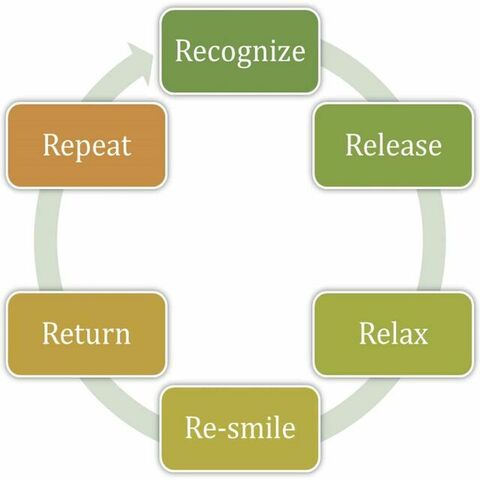
Now you call this I think the six R's right?
Yes.
So you really you recognize that your mind is distracted.
Oh,
There's one more thing I wanted to say first.
Well,
Two things.
In the Samyutta Nikaya,
The Buddha talked about the correct way to practice and the incorrect way to practice.
The incorrect way to practice is taking everything as suffering.
The correct way to practice and that suffering,
That's the first noble truth.
And people that get into their suffering,
They really suffer.
They cause themselves an awful lot of pain,
Fighting with the present moment because that pain is there.
So they're not doing the second noble truth.
But the proper way to practice is the third noble truth,
The cessation of suffering.
Let's focus on that.
Not focus on the suffering itself.
And when you start focusing on the cessation of suffering,
Your mind naturally tends to be more happy and in balance.
And you want to smile more.
So you use smiling in your meditation.
I use smiling in my meditation for good reason because it makes your mind light.
When you're smiling,
You don't try so hard to control something.
This isn't about control.
This is about remembering to observe how mind's attention moves.
So when you're seeing how this process works,
You're also seeing that this is in agreement with the good qualities of the Dhamma.
It is immediately effective.
Why is it immediately effective?
Because you recognize when an unwholesome thing comes up,
What is unwholesome?
I am that,
Always.
You let it be and relax.
Now you're not focusing on the suffering.
And you're focusing on relaxing.
And then you bring up the wholesome,
You smile where your mind can get light.
And you stay with your object of meditation for as long as you can.
That's the six R's.
It is right effort.
And it is immediately effective.
And the progress in your meditation is much faster with this kind of meditation than any other meditation that I've ever done.
I'm a slow learner.
It took me five years to figure out what Vipassana wasn't before I could start figuring out what it was.
Because it's very complicated.
The thing with this meditation is you only have to remember six things.
Recognize,
Release,
Relax,
Smile,
Return to your object,
Stay with your object.
So in that case,
Give us your definition of mindfulness.
I just did.
That's what I thought.
Let's go through that again.
Let's do that again.
Okay.
It's remembering to observe how mind's attention works,
How it arises,
How these things can be there for a little while and disappear.
It's remembering to observe how mind's attention moves from one thing to another.
So you're just observing,
You know that what's happening,
But you're not getting into the every single little moment concentrating on it.
Right.
And if you don't have that relaxed step in there,
That craving and letting it go,
You're not going to be very successful with your meditation.
Okay.
So that's a really pretty new definition of mindfulness then.
And it works 100% of the time.
Now you have to remember that this is the Buddha's definition of this.
Yeah,
This is from the suttas.
This is from the suttas.
I get this image of when you're releasing,
Relaxing,
It's like you've got this little fire extinguisher and the tension comes up and you're starting to grab hold and then you spray your fire extinguisher at the little fire that's starting to burn.
And pretty soon,
You know,
It's a conflagration,
But you get it before it burns everything and takes over.
And pretty soon you get just,
You'll see a little spark and you get that.
And now,
Now then all the cravings gone.
Now,
As you do this,
As you use the six hours and you catch this,
You're going to start staying with your object of meditation where your mind is very pure,
By the way,
Because there's no distractions in your mind at that time.
And your mind tends towards agreeing with the jhana practice as it's taught in the suttas,
Not as it's practiced with most people.
Okay.
So explain that the jhanas,
What are those?
Okay.
Most people give the definition of jhana as concentration,
Staying on one thing at a time.
And that's great while you're in the jhana,
But when you come out,
Your mindfulness has gone and you still get caught with the same anger,
The same dissatisfaction,
The same sadnesses,
The same frustrations as before going into it.
Now when you practice that one extra step of tranquilizing the bodily formation later in the jhana panasati,
It says tranquilize the mental formation.
Every time you relax that you're letting go of nama,
Rupa,
Rupa,
Material,
Nama,
Naming,
Or it's feeling,
Perception and other things,
And consciousness.
So every time you let go of that,
Your mind is becoming more pure.
And because you start recognizing hindrances when they come up and you catch it and let it be,
What happens is the hindrance doesn't last as long and you start staying on your object of meditation for longer periods of time,
Where joy arises and happiness and true equanimity,
Not a mental kind of equanimity,
Trying to talk your mind into being in balance.
This is experiential equanimity,
Which is different.
So there's how many levels of jhanas?
Well that gets tricky because honestly there are only four levels of jhanas.
But the fourth level has four parts to it.
And now they call these jhanas,
But these are actually states or realms.
It still has the equanimity of the fourth jhana,
But the equanimity starts to get deeper and deeper as you get into these states and see other things.
What are the differences?
What makes them different from each other?
Well they're very much different from each other.
In the Samyutta Nikaya it describes that very well.
It says that when you practice loving kindness meditation,
As high as you will get with loving kindness meditation,
Is the fourth jhana.
As you continue on,
Now you don't feel your body anymore unless there is contact.
If there's contact,
And you can carry this jhana with you while you are walking.
You're saying you can be in jhana while you're walking.
Which is somewhat different than what's being taught.
Well I'm sure everybody will really wonder about that,
But I guess we can invite them to try it before they make up their mind.
Usseo Ananda didn't believe it until he tried it.
But he's a believer now.
So what are the characteristics of those top four jhanas?
Well they include the Brahma Viharas,
The way that I teach.
As you go deeper and with loving kindness your mind will become calmer,
And your mindfulness is a little better,
And your understanding of how mind works is a little better.
That feeling of loving kindness changes to a feeling of compassion.
It is a feeling.
This is a feeling meditation that I teach,
Not a mental meditation.
So as you go into feeling that compassion,
Another thing that happens is in your mind you start feeling expansion,
Just going out in all directions at the same time.
This happens by itself.
You aren't doing it.
This just happens.
And that is called infinite space.
This is the state that the Buddha sat in every day.
He sat in compassion with infinite space.
As you go deeper the compassion changes to a feeling of joy.
Now one of the things in the suttas they try to talk about sympathetic joy and altruistic joy,
But those are concepts.
And you haven't got time for concepts when you're in this.
It is joy.
It is the awakening factor of joy.
It's a very happy feeling,
But it doesn't have excitement that the lower jhanas have.
Yeah,
You have that equanimity going along as well.
And this is called infinite consciousness.
And what happens is your mind becomes so still and settled and alert that you're starting to see individual consciousnesses arise and pass away,
Arise and pass away,
Arise and pass away.
Now this is the way that I teach it.
That was roughly a hundred thousand arising and passing away of ear consciousness.
So you get an idea how fast this is really happening.
Almost everybody when they see something they think it's one continuous thing.
And then when you hear something you say,
Well,
I'm hearing and seeing at the same time.
It doesn't happen.
It's arising and passing away of seeing consciousness,
Arising and passing away of sound consciousness.
But they happen so fast and we take them so personally that that's the way we think.
I see,
I hear.
Right.
Now the lessons you get from this particular state are great.
You're seeing up close and personal.
You're seeing it.
The impermanence of everything.
Because you're seeing birth death,
Birth death,
Birth death,
Birth death all the time.
Very fast.
You're seeing it.
It's not an intellectual trying to say,
Oh,
I know everything is impermanent.
That's intellectual.
Now you're having the direct experience of it.
You see that because everything is arising and passing away so quickly,
It's a form of unsatisfactoriness.
It's there.
It's disturbance of a kind.
And this is a big one.
You see that everything is impersonal.
You see it deep down.
You understand it.
So you're seeing anicca dukkha anatta.
You're understanding anicca dukkha anatta not on an intellectual level,
But on a real level.
Now what's that mean,
Anicca dukkha anatta?
For people to go around?
Impermanence,
Suffering,
Not self.
Okay,
That's the Pali.
So as you continue on further,
And this is really interesting,
This whole path,
As you continue on further,
Then that joy changes to an even deeper kind of equanimity where there's no excitement in the mind at all.
And it's always kind of funny when students come to me and they have this state and I listen to their voice and their voice is very quiet.
Well,
How's your meditation going today?
Fine.
Everything is fine.
Do you have any new stuff coming up?
No.
Everything is fine.
And this is called the realm of nothingness.
What does that mean?
It means mind is not looking outside of itself anymore.
Now you're watching how mind actually works.
And you're staying with each of these different Brahma Viharas,
You're using that as your object of meditation.
So now when you get to this level where there's nothingness,
Your object of meditation is equanimity.
And I won't go into deeper how to do it,
Because that way I'd be teaching.
This is almost a two hour talk.
So then what happens?
Well,
You stay with that equanimity feeling and it starts getting more and more subtle and quieter.
Now if you put too much energy into watching that,
Your mind is going to start to get restless.
If it's not quite enough energy,
Your mind is going to get dull,
Not sleepy,
But dull.
So you're learning how to truly keep a balanced mind.
Now you can walk,
Do this meditation and walk too.
Now as you go deeper,
You will get to a place where it's called neither perception nor non-perception.
Perception is the part of the mind that names things,
But it also recognizes things.
And it's hard to tell when some of these things happen.
What happens when you get to that state is it'll be like being asleep and being aware at the same time.
Mind gets incredibly subtle.
You might see some slight color or patterns or geometric designs or things like that.
But that'll last for a short period of time and then your mind goes even deeper and you get into what I call exquisite peacefulness.
There's no disturbance in your mind at all.
There's no movement of mind's attention at all.
But if your mindfulness slips even a tiny little bit,
You'll start to see some movement or vibration of mind's attention and you relax right then.
And you'll be able to sit for long periods of time without any disturbance in your mind.
Now this is where the good stuff comes.
Well,
It sounded pretty good so far,
But sure,
Let's bring it on.
What happens next when your mind has had this peace and calm long enough?
People ask me,
When is it going to happen?
I'm not a fortune teller.
I don't know.
But it can happen that all of a sudden the cessation of perception,
Feeling and consciousness occurs.
Everything turns off.
It's just like flipping the light switch and there's no light around.
It'll be like that for a period of time.
And then when it comes back on,
First you'll feel real relief.
It's like somebody took a big weight off of your shoulders that you didn't even know you were carrying.
You will begin to see little tiny movements and that is the actual dependent origination.
You won't necessarily be able to recognize it as such because it's very weak at that time.
And joy arises like you've never experienced before.
What has happened?
Something that people in this country don't believe is possible anymore.
Nibbāna occurs.
And your students are experiencing this,
I take it?
My students are experiencing this worldwide.
Every retreat I have given in the last five years,
There are a few.
Sure.
So how does that change you?
Why do we want to have that experience?
Your perspective of everything is different.
You start seeing more vividly.
You start seeing colors.
You start seeing ideas coming up.
You start seeing all kinds of things arising but it's clear.
And your perspective is different because you know that this path is the right path.
There is no more doubt in your mind at all.
You know that chanting and rites and rituals don't lead to Nibbāna.
That doesn't mean you can't do it.
You can but it doesn't lead to Nibbāna.
And you see beyond any doubt that everything that happens is impersonal.
This changes your perspective.
Now when this happens you have a lot of joy and it will last for a few days until you get used to it.
And you have experienced the path knowledge.
And I have people that have gone beyond that.
But another thing that happens is you will keep your precepts without breaking them as closely as you possibly can.
Because you understand when you break a precept it's going to make a guilty mind.
It's going to affect your meditation negatively.
You don't want that to happen.
And there's no God in heaven that's going to throw a lightning bolt out at you and zap you because you break it.
These are suggestions that really lead to more prosperity for you and protection for you.
Yeah so there's this understanding that morality is good but so how do we implement morality?
Well don't kill even insects.
Don't steal.
Don't take anything that's not given.
Don't have any wrong sexual activity.
And that means no sexual activity that causes pain to arise in anyone including yourself.
And no sexual activity with somebody that's underage,
That's too young,
Still under the care of their parents.
You can cause yourself all kinds of problems if you do that.
And the speech can be broken up into four parts.
Don't tell lies.
Little white lies are lies.
If you tell something,
You say something that's not true,
In your mind you're going to hear this little voice that says,
I shouldn't have said that.
And you can have a guilty feeling arise because of it.
Now the thing with these precepts is there is a way that you can purify your mind.
You don't have to go ask somebody else to purify your mind for you.
Recognize that you broke a precept.
Forgive yourself for breaking the precept.
Take the precepts again.
They should be in your mind so that you really do understand them.
And make a determination,
I'm not going to do that again.
So the precepts are very,
That's the basis for meditation.
Now there's three things to meditation.
Generosity.
That doesn't mean just material generosity.
It means can you say something that makes somebody else happy?
Well you're practicing your generosity then,
Aren't you?
You're helping other people around you to be happy.
You're being generous.
And what does that do for your mind?
Makes your mind happy.
Be able to help somebody that's in the blues as they call it.
Well now there's something that you can do about that.
You can make other people laugh.
Help them in whatever way that's appropriate.
The second part of this is keeping your precepts.
It is a protection.
If you run across people that don't keep their precepts,
What you'll see is that when they get in a stressful situation,
They don't know what to do,
They get overexcited and they wind up hurting themselves or somebody else because they don't use the right action.
If you keep your precept,
You will do the right thing at the right time,
Naturally.
Also keeping your precept leads to more and more tranquility in your mind.
So this goes back and helps you with your meditation.
Absolutely.
All of this helps with the meditation.
So this is morality in the sense there's morality,
Generosity,
And then wisdom or the meditation itself.
Right.
And that's another word that is very much misunderstood.
Wisdom comes from seeing how the links of dependent origination actually work.
That's where your deep wisdom comes from.
How the mind works.
How the whole process works.
Yeah,
I don't think we have time to get into that subject,
But we've touched it a little bit.
It basically is the definition of all these processes that are happening.
Right.
We see them.
And they're not dictionary.
Yeah.
You could really see this stuff for yourself.
Right.
So there's a lot to learn and it's super interesting.
People ask me,
How can you be a monk for so long?
I'm never bored.
There's always something happening.
There's always something new to learn.
I guess you've written some books on all of this.
Yes,
I have.
Life is meditation.
Meditation is life.
What about that book?
Is that one to go to?
Absolutely.
And that helps you to be able to carry your meditation into your daily life,
Which is a big question that a lot of people have.
Meditation is life.
Right.
And how to have mindfulness all the time.
And then you've written a book about the Anapanasati Sutta itself.
With everything you've talked about in far more detail.
And there's books on your discourses,
Moving Dhamma.
So there's a number of books.
Great.
Where can they go to learn more about all this?
Dhammasukha.
Org.
Yes,
I thought so.
The website dhammasukha.
Org.
And you.
.
.
There's a lot of real interesting stuff in there.
And you teach retreats.
I teach retreats.
And that's here in Missouri.
I teach retreats here from May until October or November.
I wind up being invited to other countries.
And this year I'm going to be going to Sri Lanka and Malaysia and India.
And I will be spending on.
.
.
When I give a retreat I try to not have more than 30 people in the retreat.
So I have enough time to speak to everybody.
One on one interviews with everybody every day.
And if you need to talk longer,
We'll talk longer.
How long are your retreats?
10 days.
And you think that's enough?
You don't need 3 months,
6 months like many people.
Oh no.
You will have enough understanding at the end of the retreat that you can carry on on your own.
And that's not something that's generally.
.
.
So you can take this meditation home and continue.
And if you have any questions,
We have online retreats that are very successful.
Once or twice a month.
I don't know which it is.
And you can get in touch with us at dhammasukha.
Org and we will help you in any way we can.
And there are people that have attained Nibbana by doing the online retreats.
Who knew?
It must be immediately effective if that's the case.
Well Bhante,
Thank you for your time.
This is most informative.
And I encourage everybody to go visit dhammasukha.
Org and learn more about this meditation.
Because there's a lot of fun stuff to come.
Look us up on the YouTube.
There's about 400 talks there.
Right.
I think that's up to 550 talks that you've got up there.
So we're going to make it one more tonight.
So thank you very much and we'll talk further in other evenings on other subjects.
So thank you very much.