Welcome to the Religion of the Month Club,
A podcast where we discuss texts from the world's scriptural traditions.
Today is the first day of the sixth month of the year 2564 of the Buddhist calendar.
In this episode,
We will be discussing the Heart Sutra.
Avalokitesvara,
While practicing deeply with the insight that brings us to the other shore,
Suddenly discovered that all of the five skandhas are equally empty.
And with this realization,
He overcame all ill-being.
Listen,
Sariputra,
This body itself is emptiness,
And emptiness itself is this body.
This body is not other than emptiness,
And emptiness is not other than this body.
The same is true for feelings,
Perceptions,
Mental formations,
And consciousness.
Listen,
Sariputra,
All phenomena bear the mark of emptiness.
Their true nature is the nature of no birth,
No death,
No being,
No non-being,
No defilement,
No purity,
No increasing,
No decreasing.
That is why in emptiness,
Body,
Feelings,
Perceptions,
Mental formations,
And consciousness are not separate self-entities.
The eighteen realms of phenomena,
Which are the six sense organs,
The six sense objects,
And the six consciousnesses are also not separate self-entities.
The twelve links of interdependent arising and their extinction are also not separate self-entities.
Ill-being,
The causes of ill-being,
The end of ill-being,
The path,
Insight,
And attainment are also not separate self-entities.
Whoever can see this no longer needs anything to attain.
Bodhisattvas,
Who practice the insight that brings us to the other shore,
See no more obstacles in their mind,
And because there are no more obstacles in their mind,
They can overcome all fear,
Destroy all wrong perceptions,
And realize perfect nirvana.
All Buddhas in the past,
Present,
And future,
By practicing the insight that brings us to the other shore,
Are capable of attaining authentic and perfect enlightenment.
Therefore,
Sariputra,
It should be known that the insight that brings us to the other shore is the great mantra,
The most illuminating mantra,
The highest mantra,
A mantra beyond compare,
The true wisdom that has the power to put an end to all kinds of suffering.
Therefore,
Let us proclaim a mantra to praise the insight that brings us to the other shore.
GATE GATE PARAGATE PARASAM GATE BODHISVHA GATE GATE PARAGATE PARASAM GATE BODHISVHA GATE GATE PARAGATE PARASAM GATE BODHISVHA This is commonly known as the Heart Sutra.
The translation I just read was by Dichat Han,
A famous Zen Buddhist monk from Vietnam who was very active in,
Well,
Still active,
But came to prominence I think in the 60s and 70s.
And he translates the title of this as the insight that brings us to the other shore.
If you've ever been to a Zen monastery or similar kind of setting,
There's a good chance that the Heart Sutra was chanted at the end of the service.
At least that was the experience that I had when attending services at the San Francisco Zen Center,
I think at other places too.
Zen,
Of course,
Being the Japanese for Chan.
Zen is the version that's most commonly known in the United States to the point where Chinese and Vietnamese versions of the same tradition are typically referred to by the Japanese name Zen.
It may be chanted in English,
Some version of English translation,
Or in Sino-Japanese,
Which is essentially Chinese but pronounced with a Japanese translation.
So it's not exactly Japanese,
And it's not exactly Chinese.
It's sort of somewhere between the two.
One of the things that's kind of interesting about versions of the Heart Sutra is most historians believe that the Heart Sutra was composed in China and then was essentially back-translated into Sanskrit in order to make it seem more traditional.
We have versions of the Heart Sutra in a variety of languages,
Including Chinese and Sanskrit and Tibetan and so on.
Now,
This is most recent of all the texts that we've read so far.
This one was written supposedly around 661 of the Common Era.
So that makes it about 1100 years after the first turning of the wheel.
This is referred to sometimes as the second turning of the wheel.
So one of the things that's kind of interesting about this Sutra is that it in some ways actually refutes the first turning of the wheel.
So if you go back and listen to episode 3,
When I read the sermon that Gotama Buddha or Siddhartha gave outside of Varanasi,
You'll recall the statement of the Four Noble Truths.
Now,
The Four Noble Truths make an appearance in this Sutra as well,
But in a slightly different way.
So when Avalokitesvara says,
Ill-being,
The causes of ill-being,
The end of ill-being,
The path,
These are the Four Noble Truths.
Ill-being being life is suffering,
The causes of ill-being being that suffering is caused by desire,
The end of ill-being being nirvana,
And of course the path being the Eightfold Path.
So in this translation it's ill-being,
The causes of ill-being,
The end of ill-being,
The path,
Insight,
And attainment are all not separate self-entities.
Whoever can see this no longer needs anything to attain.
So this basically pulls the rug out from under the established wisdom of the first turning of the wheel,
Which is why it is considered to be a wholly separate or wholly new turning of the wheel.
In the tradition of Buddhism,
Obviously,
It's still Buddhism,
But one that goes beyond the original insights that were laid down 1100 years earlier.
Now returning to Thich Nhat Hanh's translation of this sutra,
Entitling it the insight that brings us to the other shore,
And that phrase being repeated several times throughout the sutra,
There's something important to be noted here,
Which is this terminology around bringing us to the other shore.
This goes back a long way,
Especially it's used a lot in Mahayana Buddhism,
This idea of Buddhism being a vehicle.
So you might recall in episode 3 I referred to Theravada Buddhism versus Mahayana Buddhism,
Mahayana meaning literally great vehicle,
And the Mahayana Buddhists referring to the Theravada tradition as the Hinayana,
Or little vehicle tradition.
It's sort of a variation of the idea of it as a path.
In the first sermon,
It was referred to as the eightfold path,
But it's a different metaphor,
And it has some interesting connotations when you think of it more as a vehicle instead of a path.
Part of the idea of thinking about it as a vehicle is that it is useful to get you where you're going and that's all.
So when you reach the other shore,
You don't need the boat anymore.
And that's something that is a big part of Mahayana Buddhism,
Is this idea that the tradition itself,
The teachings themselves,
Are useful only insofar as they get you where you're going.
This is related to the concept of Upaya.
Upaya refers to skillful means,
And it's significant that it's a means to an end.
The end is liberation,
The end is enlightenment.
The means are more circumstantial.
And that's why there are many skillful means.
One of the things that's interesting about Buddhism,
And this is also true in Hinduism,
Actually,
But this idea that there are many paths or many ways,
Some better than others,
Some more effective than others,
Some more effective maybe in certain situations than others or with certain people than others.
So when this second turning of the wheel refutes the first turning,
It's not saying that the first turning was wrong.
It's just saying the first turning maybe may have some limitations and that this approach may be more effective.
That's up to you to decide.
It's up to millions of Buddhists to decide.
Some prefer one,
Some another.
Many American Buddhists will often start with one tradition and then switch to the other when they find that that works better for them.
But I think one of the things that they would all agree upon is that it's really about what works,
That the goal is what's important.
In Zen there's this idea of the finger pointing at the moon.
Don't confuse the finger for the moon.
The moon is what's important.
Now if we return to the beginning of Avalokitesvara's sermon to Sariputra,
He starts by saying,
The body itself is emptiness and emptiness itself is this body.
Then he repeats that saying,
This body is not other than emptiness and emptiness is not other than this body.
So he really is trying to reinforce this unity of body or form with emptiness.
In this translation,
The implication seems to be the body is referring to the human body that the speaker is referring to.
But you can also think of it more broadly as,
Or I've also seen it translated as form,
The word form and body being synonyms of course.
Saying form is emptiness,
I actually prefer,
Well I think this body itself is emptiness is a little bit easier to wrap your head around because a body is a physical thing and it's easier to think about a body.
When we see the translation form is emptiness,
That's a little bit more abstract.
When I first heard it and read it,
I really had trouble wrapping my head around it.
However,
I would encourage you to consider that translation as well because I think it opens up a lot more when you think about it in those terms of form as an abstract principle of existence,
Being emptiness.
So when you think about this body itself as emptiness,
That can be actually a really powerful and useful meditation of just meditating on the body itself as emptiness,
And I encourage you to do that.
Whereas thinking of form as emptiness is more of a mental exercise,
But can also be very powerful and effective in its own way.
The same is true of feelings,
Perceptions,
Mental formations,
And consciousness.
There's a lot of lists in Buddhism,
And this is inheriting that tradition.
It says the same is true of feelings,
Perceptions,
Mental formations,
Consciousness.
This is a reference to aspects of mind or of self that have been well established within Buddhism.
We don't really need to go into the details of that just to be aware that that is what's going on there.
And we see that again repeated.
That is why emptiness,
Body,
Feelings,
Perceptions,
Mental formations,
And consciousness are not separate self entities.
Basically bringing together this paradox of form and formlessness.
So Avilluketoshvara starts with these aspects of self being empty,
But he then goes on to say,
All phenomena bear the mark of emptiness.
Their true nature is the nature of no birth,
No death,
No being,
No non-being,
No defilement,
No purity,
No increasing,
No decreasing.
So these four dualities,
Birth,
Death,
Being,
Non-being,
Defilement,
Purity,
Increasing,
Decreasing,
These are essential aspects of the universe.
One of the things that occurs in Taoism,
And of course this is being composed in China in the seventh century CE,
So long after the Tao Tsing was written.
We can assume that the authors of this were well aware of Taoist philosophy.
Taoist philosophy has this idea of the beginning of duality and that you can only understand one aspect of duality by considering the other by considering its opposite.
So from a Taoist perspective,
There is no birth without death,
There is no increasing without decreasing.
This doesn't negate that,
But it does seem to riff on it in a way.
It's basically going back to the source.
So you might recall in my episode on the Tao Te Ching,
The distinction between source and mother.
And so here we see this returning to the source.
So the translation goes,
The eighteen realms of the phenomena,
Which are the sixth sense organs,
That is eye,
Ear,
Nose,
Tongue,
Body,
And mind.
The sixth sense objects,
That is form,
Sound,
Smell,
Taste,
Touch,
Or thought.
And the six consciousnesses,
That is body,
Feelings,
Perceptions,
Mental formations,
Consciousness.
These are not separate self-entities.
So it's essentially breaking down everything that we experience,
Both in terms of the objects of experience and the ways in which we experience them.
It's here that Avalokitesvara goes on to say not only are the twelve links of interdependent rising and their extinction not separate self-entities,
In other words,
Dissolving everything that we think is real,
Sensorially,
Cognitively,
And so on.
It's only at this point that he cuts to the heart of Buddhism itself by saying ill-being,
The causes of ill-being,
The end of ill-being,
The path,
Insight,
And attainment are also not separate self-entities.
Another translation puts it even more bluntly,
Saying,
Also,
There is no truth of suffering,
Of the cause of suffering,
Of the cessation of suffering,
Nor of the path.
There is no wisdom and there is no attainment whatsoever.
Now,
When Thich Nhat Hanh translates this part,
He says,
Whoever can see this no longer needs anything to attain.
So this is one of those places,
Again,
Where translation of the same concept can produce very different interpretations.
And of course,
Every translation is an interpretation.
So the way Thich Nhat Hanh puts it,
Whoever can see this no longer needs anything to attain,
That's a lot more gentle,
Perhaps,
Than the more brutal,
There is no wisdom and there is no attainment whatsoever,
Which is actually the translation that I'm more familiar with.
So if you prefer Thich Nhat Hanh's translation,
That's fine.
That's certainly a more easier to approach understanding.
Whoever can see this no longer needs anything to attain.
However,
The more stark translation,
Or more brutal translation,
If you will,
There is no wisdom,
There is no attainment whatsoever.
I think that this translation is also worth meditating upon.
It's a bit more paradoxical,
Right?
Because if there is no wisdom and there is no attainment whatsoever,
Then what are we doing?
Why are we even listening to this podcast?
But I think the paradox of that is actually part of what's at the essence of this sutra.
Now,
Moving on to the end of the sutra,
After saying,
All Buddhas in the past,
Present,
And future,
By practicing the insight that brings us to the other shore,
Are capable of attaining authentic and perfect enlightenment,
It closes with,
Therefore,
Sariputra,
It should be known that the insight that brings us to the other shore is the great mantra.
Now remember,
Insight that brings us to the other shore is the translation of the title that Thich Nhat Hanh gave us for this sutra.
So there is a self-referential quality now at the end of the sutra.
So he says,
It should be known that the insight that brings us to the other shore is the great mantra,
The most illuminating mantra,
The highest mantra,
A mantra beyond compare,
A true wisdom that has the power to put an end to all kinds of suffering.
Therefore,
Let us proclaim a mantra to praise the insight that brings us to the other shore.
And then is the sort of strange phrase at the end,
Or incantation.
It really is like an incantation.
It's a mantra,
But it's sort of this weird hybrid of Chinese and Sanskrit.
It doesn't really translate,
Although people have tried to translate it.
So in the version that Thich Nhat Hanh gives,
He does not try to translate it.
He simply includes gatte,
Gatte,
Para gatte,
Para sam gatte,
Bodhisvaha,
Repeats it three times.
That's pretty traditional.
I have seen the translation gone,
Gone,
Altogether gone,
And so on.
There's a translation by Douglas Fox,
Which is kind of interesting because in this translation,
He finds it appropriate to translate wisdom,
Prajnaparamita,
To personify it as,
Oh,
As a woman or like a goddess.
This is not that unusual.
In the Greek tradition,
We have Sophia,
Meaning wisdom,
But wisdom is personified in that case.
We also have in the Jewish tradition,
Shekhinah,
Which isn't wisdom exactly.
It's more just like the power of God,
Which is actually more like Shakti in the Hindu tradition.
So the idea of personifying these powers or these aspects,
Of the universe is certainly not unusual.
However,
This is the first time that I've seen it in this particular context,
Having wisdom personified.
So the way he translates it is,
Oh,
You who are gone,
Gone,
Beyond,
Gone utterly beyond,
Hail wisdom.
He puts brackets lady after you.
So it actually says,
Oh,
You lady who are gone,
Gone,
Gone beyond,
Gone utterly beyond,
Hail wisdom.
I think that the translations of that part are a bit speculative.
I think that it does mean that,
But I think that the power of the end of the sutra is more in the sounds and in the incantation of it than the actual literal translation.
But one of the things that you see in this tradition is that,
And this is sort of a arguably defining characteristic of scripture and what makes scripture different from other texts,
Is that the text itself takes on a special quality.
So going back to what I said at the beginning about how if you go to a Zen service,
There's a very good chance that you will hear this mantra,
The sutra chanted,
Either in English or in some other language.
And it's because it's partially to remind the people there of the wisdom of the sutra itself.
And it's also because the tradition that simply reciting the sutra has transformative powers.
And I think this is kind of an interesting concept that is maybe lost in the modern world,
Where information gets sort of commodified.
But it's part of what allows these words of wisdom to be passed down and memorized and recited.
And the idea of a self-referential scripture is not that unusual.
In Exodus,
The Torah is named.
Now,
The Torah that is referred to in Exodus is probably not,
Should not be considered to be the same as what we now call the Torah.
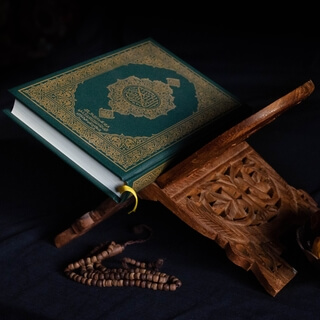
The same thing in the Quran.
The Quran refers to itself.
But you shouldn't necessarily understand the Quran that's referenced in the Quran as the book that you're holding.
But there is a kind of a,
The self-referential quality of these texts is,
I think,
Very interesting and very unusual,
Because you don't see that very often in non-sacred texts.
The one example of a secular text that I can think of that does that is the novel House of Leaves by Mark Danielewski,
Where the book House of Leaves actually appears in the book House of Leaves.
It's the kind of thing that you might expect from an author like Philip K.
Dick in Man in a High Castle.
But those are all,
Of course,
Techniques that were taken by these speculative fiction authors from scripture.
They're essentially imitating scripture when they do that.
So I will leave you with that.
And I will read the sutra one more time,
As I have done in the past.
This time I will read Fox's translation.
But before I do,
I'll leave you with a couple practices and a question.
So the practices are,
One,
To meditate on your body as nothingness.
So just sit down for a few moments,
Or lie down however you wish.
Just close your eyes and just visualize empty space in the space of your body.
And the other is a practice that I didn't actually mention when discussing this text,
But would have been probably a practice that the people who first listened to it would have been practicing,
Which would be attending to the senses and objects of sense.
So going back to sight,
Sound,
Touch,
Smell,
Taste,
And mind,
In the Buddhist conception there are six sense organs,
Mind being one of them.
I encourage you to spend some time with those senses and just try experiencing,
Sitting for a moment and really tuning into each sense systematically,
One at a time,
And distinguishing the sensing and the thing being sensed with each of your senses,
Ending with mind itself,
With the contents of consciousness.
And I also leave you with one key question,
Which is to think about whatever path you're on or whatever it is that you find as a source of wisdom,
And think about what does it mean to be a vehicle and not necessarily the truth,
But a means to an end.
I guess it's not really a question,
I guess it's another practice.
But anyway,
With all that said,
Here we go.
Honored to the Lady,
Noble Transcendent Wisdom.
The noble Bodhisattva,
Avalokitesvara,
Was brooding in the flowing depths of the course of transcendent wisdom.
Looking about,
He seized the five skandhas to be empty of essence.
He said,
Here,
Sāri Putra,
Form is emptiness,
Emptiness is form.
Form is not other than emptiness,
And emptiness is not other than form.
That which is form equals emptiness,
And that which is emptiness is also form.
Precisely the same may be said of form and the other skandhas,
Feeling,
Perception,
Impulse,
And consciousness.
Here,
Sāri Putra,
All dharmas bear the marks of emptiness,
Which are not to have arisen nor to have been suppressed,
Neither to be corrupt nor pure,
And neither unfinished nor complete.
Therefore,
Sāri Putra,
Emptiness is not form,
Nor feeling,
Perception,
Impulse,
Nor consciousness.
It is not the eye,
Ear,
Nose,
Tongue,
Body,
Or mind.
It is not shape,
Sound,
Odor,
Flavor,
Nor object of touch or thought.
It is not the experience of vision,
And so on,
Until we reach.
It is not elements of mental discrimination.
It is not learning or ignorance.
And it is not the elimination of learning or ignorance,
And so on,
Until we reach.
It is not senility or death.
And it is not the elimination of senility and death.
It is not suffering,
Beginning,
Ceasing,
Or a path.
It is not knowledge,
Not attainment or realization,
And therefore neither is it non-attainment.
The bodhisattva,
Bound to transcendent wisdom,
Lives with nothing clouding his mind.
Lacking confusion,
He is intrepid,
And having passed over error,
Reaches nirvana.
All Buddhas of the past,
Present,
Or future,
Bound to irrefutable transcendent wisdom,
Reach completely full understanding and the highest awakening.
Therefore,
Transcendent wisdom should be known as the Great Mantra,
The Great Knowledge Mantra,
The Invincible Mantra,
The Unsurpassable Mantra,
Causing all suffering to cease.
It is trustworthy because it is not false.
It is the mantra proclaimed in the Pradyapana-Rimita,
And it is thus,
O you who are gone,
Gone,
Gone beyond,
Gone utterly beyond,
Hail wisdom.
With these words,
The heart of transcendent wisdom is complete.
Thank you for listening.
I hope you will join us next month when we discuss the Katha Upanishad.