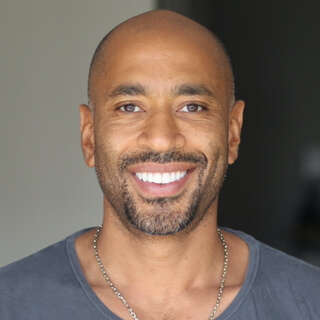
Welcome to the 30-minute body scan.
The body scan can be practiced sitting up or lying down.
So if you're lying down on the floor or on the mat,
Have your arms relaxed by your sides.
And if you're sitting.
.
.
Making sure you're sitting comfortably with a straight back.
Now our mind's default is to think,
To plan,
To worry,
To ruminate.
The body scan helps us realise just how often we're stuck in our heads,
Often with thoughts that aren't particularly useful to us.
Noticing the constant chatter and running commentary in our heads is the first step to putting an end to this noise.
Or at least it's the first step in turning down the volume.
We're not trying to relax today and we're not trying to feel anything in particular.
We're simply noticing what's already there.
Letting go of any expectations.
The more we expect,
The more we interfere.
And letting go of the striving.
The body scan isn't a competition or a skill that we need to strive for.
We're simply learning to take care of ourselves.
And closing the eyes whenever we're ready,
Or keeping them open with a soft gaze.
Letting your body begin to relax.
Knowing that it's okay to move at any time during this meditation.
And starting off by taking a few deliberate deep breaths.
Breathing in through the nose.
And breathing out through the nose or the mouth.
We're allowing our bodies to become still.
Becoming aware of the breath as it enters the body.
And as the breath leaves the body.
Noticing the cool air coming in through the nostrils,
The lungs and the chest and the stomach expanding.
And then the warm air leaving the nostrils.
And the body relaxing.
And softening.
Taking one more full breath in and a full breath out.
And now allowing the breath to return to its natural rhythm.
Noticing that we don't have to do anything special or make any effort to breathe.
The body knows exactly what to do.
With each out breath,
Allowing your body to become heavier.
Sinking deeper into the chair or into the floor.
Breathing in,
And breathing out.
And choosing an anchor now.
Choosing a place to come back to whenever we get lost or distracted.
Now the breath is always there for us as an anchor.
But if the breath doesn't feel like a comfortable place to rest today.
Choosing somewhere neutral instead.
We can choose the feet.
Or the hands.
Or even the sounds in the room.
Now bringing our attention to the top of the head and the scalp.
And we're feeling whatever's happening in this area.
We might feel tingling or pulsing.
Heat or coolness.
There might be soft vibrations.
There might be strong sensations or subtle sensations.
Or maybe we can't feel anything at all.
There's no right or wrong,
We're just noticing whatever's there.
And now releasing our attention from the top of the head and lowering our attention to the face.
Including the forehead.
And the jaw.
The face is somewhere we often hold tension.
And not that we're trying to change anything about how the body's feeling.
But often simply by bringing attention to a tense area.
That part of the body naturally softens and relaxes.
So just noticing whether or not this is the case.
Noticing any sensations in the face in the nose.
The lips.
The eyes.
The years.
The temples.
Look back at the head.
And if there are no sensations.
Just noticing that.
And whenever we're ready.
Bringing our attention now to the neck and the shoulders.
Another area where we can often carry tension.
What sensations can we feel here?
Is there any tension or strain?
Noticing whether bringing our attention to the neck and the shoulders changes the way that they feel.
Whatever you feel or don't feel is perfectly fine.
We're just observing.
And bringing our attention now to both arms.
What sensations can be felt here?
From the shoulders.
Down the operams.
The Elbows The forearms.
Wrists.
Noticing any sensations that might be there.
Is there coolness or heat?
Tingling all.
Pulsing.
Itching or burning.
Or perhaps no sensation.
Moving our awareness down to the hands now.
Feeling into the palms of the hands.
The backs of the hands.
The fingers and thumbs.
Or even feeling the spaces between the fingers.
For some people,
The hands are an area with lots of sensations.
But for others,
Not so much.
So just noticing any sensations that might be present here.
And whenever we're ready.
Releasing our attention from the hands.
And bringing our awareness to the chest now.
Noticing the rising and falling of the chest as we breathe.
Breathing in,
And breathing out.
Seeing also if we can feel anything inside the chest.
Perhaps the heart beating.
Perhaps the lungs expanding and contracting.
Just noticing whatever's there.
And the mind will get distracted.
It's what the mind does.
And when the mind gets carried away on a train of thought thinking about the day.
Planning the week ahead.
We gently and quietly come back to the sensations of the body.
When the mind wanders,
If it helps,
We can acknowledge the thoughts by saying silently in our minds,
THINKING Planning.
To-do list.
And without giving ourselves a hard time.
We patiently come back to the part of the body that we're scanning.
And we simply pick up where we left off.
Moving our attention now to the upper back.
And the middle back.
Perhaps there's contact with the floor if we're lying down.
Or contact with the chair if we're sitting.
What sensations can we feel?
Perhaps there's pressure.
Maybe pain or discomfort.
Or tingling.
Or maybe there's no sensation.
As best we can,
Not judging our experience.
Not labeling our sensations as good or bad.
Pleasant or unpleasant.
Just noticing what's there,
Like an impartial observer.
And when we're ready.
Moving our attention now to the lower back.
Noticing what sensations are there.
And if we notice unpleasant sensations coming up.
We have a couple of options.
The first option is to allow the sensation to be.
Without giving it power.
We can observe the sensation.
We can label the sensation.
The sensation is too unpleasant or too difficult to hold in our awareness.
Then we can always shift our posture.
Or scratch that itch,
Or.
.
.
Move our awareness from the uncomfortable sensation.
Back to our anchor.
And our second option is to move away from the discomfort.
Kindly and patiently.
And come back to our anchor.
And if it's really unpleasant.
It's always okay to stop.
We can always give it another go tomorrow.
We're playing within our tolerances.
And bringing our attention round to the stomach area now.
Noticing whatever we can feel here.
Noticing the surface of the stomach.
The insides of the stomach.
What sensations can be felt here?
Seeing if we can notice feelings of digestion or fullness.
Emptiness or tightness.
Observing any sensations of the breath entering the body and leaving the body.
The stomach rising on the in-breath.
And falling on the out-breath.
Moving our awareness to the pelvis now.
To the bottom.
Into the hips.
Noticing whether body is making contact with the floor or with the chair.
What sensations are there?
Maybe pressure.
Tingling hardness.
Perhaps softness.
Not trying to change anything.
Simply observing what's there.
We're trying to accept whatever we find.
So if the mind is busy,
The mind is busy.
The body's tense,
We allow the body to be tense.
And now bringing our attention to the legs.
And the thighs.
The hamstrings.
What sensations can be felt here?
In and around the knee joints.
The cards.
And the shins.
Noticing if there's any sensation.
Perhaps the touch of fabric from our clothes.
To be warmth.
Coolness.
Itching.
Tingling.
Or maybe no sensation.
Moving our attention to the ankles.
To the feet.
The soles of the feet.
Tops of the feet.
The toes.
Noticing the spaces between the toes.
What sensations can be felt here?
And whenever you're ready.
I invite you to expand your attention.
So that we include the whole body in our awareness.
And noticing that our attention can have a narrow focus while we investigate a particular part of the body.
Or we can have a wide focus,
Where we hold the whole of the body in awareness at once.
So bringing the whole body into awareness now.
From the tips of the toes.
To the tips of the fingers.
And the top of the head.
We're getting a sense of the entire body and all its sensations.
And as we approach the end of this practice.
Just taking a couple more breaths.
Feeling the body once again connected to the ground or to the chair.
Just noticing how the body's feeling right now.
Does the body feel different in any way?
Just noticing.
And keeping our eyes closed,
Bringing our attention now to sounds inside the room.
And sounds outside the room.
Gently wiggling our fingers and toes.
Perhaps having a little stretch.
And when you're ready,
Slowly opening the eyes in your own time.
And coming back to the room.
Congratulating yourself for having taken time to look after yourself over these last 30 minutes.
So I hope after this you're feeling a bit more centered,
Maybe a bit more relaxed.
And even if there are lots of thoughts running around the mind.
Don't worry about that,
It's perfectly normal.
Mindfulness takes practice,
And the more we do it,
The better the results will be.