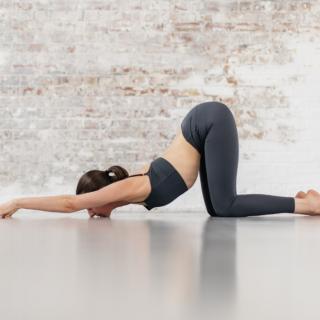
So kidney meridian,
Kidneys sit physically at the base of the ribs on the back of our body.
The right one sits down a little bit lower than the left one,
So they're slightly off center there.
But the meridian lines itself,
It starts around the foot area,
But it travels along the sole of the foot,
Okay?
So we have a pressure point,
Which we'll be touching later,
Which is on the very center of the sole of the foot.
It then travels up the inside of the leg,
And it's the line that gets closer to the groin and it comes in and it runs up the very center of our body really really close to the base of the spine and Then it travels all the way up on the front side of the body and it comes out towards this area towards the armpits Okay,
So it's back bending and opening the legs out wide that's going to get into those particular areas and then the urinary bladder is it's it's yang partner because everything always works in in partnership in the Chinese medicine system yin and yang and Urinary bladder starts on around the forehead eye area.
Okay,
So let's say for ease forehead area.
It runs over the top of the head.
It dips down into the brain or more specifically into the pituitary gland inside of us.
Comes back out,
And then it runs down the back of our head,
Back of our neck,
Down the very center of the back of our spine,
And then runs down the back of each of the center of our legs,
Okay,
To the foot.
So the entire back line of the body.
And it's the only meridian line that goes into the brain,
And it's the only meridian line that has the longest amount of acupressure points in it,
Okay?
So it's kind of known as the meridian superhighway because it's the longest in there.
And I'll tell you more as we go through the practice about the emotional parts So that's where they sit in the body.
So you can use that information.
Sometimes it's helpful to just imagine and visualize,
Right?
So what we're going to do is grab our bolster,
But this time,
You're going to take your blocks as well.
And.
.
.
Depending on how solid your bolster is,
You may or may not put a block underneath it.
So let me explain.
We're going to come straight into a shape.
First block is on third height.
And second block is on the first height.
And then I'm putting my cushion on top.
Now,
If you've got one of these super-duper thick,
Cozy,
Round cushions,
Then just the cushion is going to be fine.
Don't worry about the block,
Okay?
And this cushion is going to sit directly underneath your chest or directly underneath your shoulder blades.
And eventually when we lie down,
There's a little bit of a gap between your armpit and the cushion.
So let me show you how that looks.
Legs are just going to be relaxed.
And I'm lying myself down over that cushion and there might be a little clicking,
That's okay.
And then you want to make sure that all four corners of the block beneath your head are flat to the ground,
So there's no nasty surprises.
And then your arms are going to come out a little wider.
So mine naturally touch the corner of my cushion here,
Okay?
So that's your option.
If for any reason that that doesn't feel good,
Turn the bolster around so that it's parallel with the length of your spine instead.
And that's going to affect you in a similar way.
Okay,
And then just let the legs fall freely.
If it happens to be comfortable for you to bend your knees and bring the soles of the feet together,
Coming into a butterfly with the legs.
You can,
But I really want to make sure the focus is on the heart for this shape.
And then once you're settled.
Really check in,
Make sure you're able to relax here as much as you can.
Make any little adjustments that you need to so that once you do come into the shape itself you're able to be as still and relaxed as possible.
And then once you're ready,
Just close your eyes.
Let there be a lightness to the upper body.
Let there be a softness in the space in between the eyebrows and around the edges of the eyes.
Relaxing the tongue away from the roof of the mouth if you happen to find it there.
Teeth lightly falling away from each other,
Up and lower lips.
Shoulders just drawing down away from the ears so there's no tension lingering around the neck or jaw.
Just notice how it feels to breathe here as you breathe in through the nose or mouth visualize the breath working its way into the lungs.
With that knowledge now that the quality of our breath dictates the health of all of the other organs inside of us.
So let the breath be long and deep and indulgent wherever you can.
And that gentle lifting of the heart with the help of the props beneath us.
Accessing lots of different meridian lines here,
The lung,
The heart,
The stomach.
And for today's focus,
The kidneys.
And then notice how the exhale feels,
Just that gentle drawing back towards centre.
Of everything you need to hold on to but that letting go.
Feeling as you exhale.
And in Chinese medicine,
The.
.
.
The kidney and urinary bladder are very,
Very closely linked into the nervous system.
In fact,
200,
300 years ago in Chinese medicine world,
We didn't refer to the nervous system as the nervous system.
We referred to it as kidney yang and kidney yin.
And that's referring to the sympathetic nervous system that you may know as the fight or flight mode.
Versus the parasympathetic nervous system.
The rest and digest side of it.
So I want us to think about this idea of consciously being aware of the breath rather than just letting it come and go.
As it does for us every single day.
We're going to choose a number to count to.
And we're welcoming back into our practice today,
Samavriti,
Equal breathing.
And the number might be four or five.
And you're going to let your inhale last for that chosen number.
And then when it's time for the exhale to begin,
Exhale will be the same number.
As the inhale.
And you can start any time that you want to.
And just keep in the back of your mind that you're.
.
.
Choosing to draw your awareness to your breath and in doing so,
You're choosing to move yourself into that calmer part of your nervous system.
That ability to choose to move away from fight or flight mode anytime that we need it.
And step calmly through choice.
Into that rest and digest mode that we need so much.
So I'll leave you to breathe in silence for a little while.
Samavriti,
Equal breathing.
Everything else in the body nice and relaxed.
Notice how it feels to have this single focus for your mind,
This anchor for the mind to stay present.
Ability to come back to the here and now just by noticing that you're breathing.
Something that happens,
Luckily enough for us,
Without us having to do much about it.
But when we choose to be aware of it,
When we choose to add an element of control to it,
It allows us to surrender into this calmer way of being and thinking,
Slowing down our world.
Notice how it feels around the shoulders,
Around the heart and the chest.
And this feeling of ease all the way around the jaw and the neck and the eyes.
Two more breaths just like this.
When the second breath is complete,
Just invite yourself back to a natural breath.
No counting,
No control.
Just the breath as it happens to be.
Notice how you feel.
Having moved from that place of doing.
And thinking to simply being in a place of surrendering and accepting.
All of those qualities of yin starting to arrive into our whole way of being now.
Two more natural breaths.
Now when the second breath is complete.
Just slowly start to bring a little bend into the knees as you walk your arms in closer to the center of your body.
And there are two ways that you can leave the shape.
You can either roll very carefully and slowly to the left side away from your props or gently bring the hands to the ground and just push the ground away as you draw the chin to the chest and lift yourself up.
So either or.
Eventually coming up to a comfortable seat here.
Okay.
Alright.
So we're going to use all of the props again.
So just have them within reach.
First shape is butterfly pose,
Which is for me,
The classic kidney meridian line shape.
One of my favorites to come into,
Whether it's in a yin or a yang practice for the effect of opening up around the groin here.
So our feet are going to come together.
Our knees are lowering out to the side of the mat.
And I don't use any props to prepare myself.
I prepare my body first and then add the props in,
Okay?
So my spine is long to begin with.
And then I'm just gonna really lazily,
Permission to slouch,
Let go of all effort,
Doesn't have to look pretty,
Curling forward through the spine.
And then I notice the gaps that I have to fill,
Okay?
And I'm going to try out different options.
So some days,
It'll just be blocks stacked on top of blocks that I'm resting my forehead onto here.
Some days I'm a little higher up,
So it might be blocks either side of my feet.
Second or third height.
And then grabbing my bolster to rest on top of those,
And then leaning forward,
Maybe making a pillow with my arms.
For my head to rest on.
And then those days when we're a little taller still.
Cushion is on the long end.
And forehead is gonna rest onto the thin end of the cushion.
Your arms can then rest onto the blocks almost like they were designed to be your arm rests.
Take as much time as you need.
There's lots of different ways to support yourself in between those three options as well.
That's the beautiful thing about this practice is it recognizes that each of us has a unique skeleton,
A unique body.
And that nothing is intended to look the same.
Person-to-person,
Body-to-body,
Day-to-day,
Morning-to-evening.
It's a practice of meeting ourselves where we find ourselves,
Moment to moment.
And working with accepting that.
Accepting what we find.
So find your shape.
Settle in and just notice in the first minute or so of being here.
How this feels.
Where you're feeling it.
Notice the areas.
Of intensity.
The areas of resistance.
Becoming aware as the minutes pass by of how that shifts and changes in your body today.
Letting go of how the shape might have felt for you on a different day.
Letting go of how you want the shape to look in the future.
So that you stay present.
With the shape that your body's in right now.
The thing that I love about this shape is it starts to open up that area through the center of the groin,
The inner thighs.
And as we fold forward,
We're getting into the meridian line on the back of the body as well as the kidney.
So I feel like we get even more potential to release tension here.
And the kidneys govern so many different things within us.
We generate our brain and our nervous system.
Fertility,
Reproduction.
Our desire,
Our creativity,
Our libido,
They rule the health of our bones.
They rule the health of our spine.
They rule the health of our knees even.
So if you're somebody that struggles with.
.
.
Difficulty in the lower back or around the knees.
Through the spine.
Might be an indication that there's a little deficiency in your kidney chain,
Which case Welcoming this shape into your daily practice is always a good idea.
As women,
This is a shape that is so welcome in our body to practice every day,
To help us to find a balance in our hormones.
And we have so much stress that we carry in the body and often.
.
.
It gets stored around the hips.
And this shape just reminds us to relax,
To let go.
No more gripping or holding on.
Think about how it feels in your physical body when there's a.
.
.
Feeling of fear,
Feeling of anxiety.
We tend to tighten up into a tiny little ball.
We grip and hold on into the center of our body,
Making ourselves small.
Almost as though we're hiding away.
And this fear,
When it gets stuck in our tissues,
It's very,
Very depleting for the kidney meridian,
For the kidney chi,
For the health of the organs itself.
Start to notice if you can make any adjustments to your shape here.
Are you able to go a little further into the shape?
Perhaps you'll slow down your breath,
Maybe make adjustments to how you're using your props.
Just under a minute or so left here.
And long-term,
That chronic stress mode,
That chronic fear mode can have an effect.
Similar to adrenal fatigue,
Sometimes even experiencing adrenal fatigue.
So we use these shapes to be able to balance our system out,
To remind us to fill our cups up with energy.
There's a tendency that we think we can take on the world.
We can keep on going and going and going at this incredible rate of doing.
And while it's such an achievement-based feeling when we fit a lot into our day,
Actually what we need to practice more of is doing less.
Let's take three more breaths here.
When the third breath is complete,
Let's just slowly start to roll ourselves up.
Vertebrae by vertebrae and just gather your hands underneath your knees,
Guide the knees towards each other in center and walk the feet a little further forward here.
We're going to just take our hands down next to our hips on the ground and windshield wipe the knees from side to side.
So we're going to get a little flow of chi.
And energy back through the body.
And I would like you to just notice how your body's feeling here.
In a moment,
The next shape is another forward fold.
Forward folds are very,
Very nourishing for our nervous system.
And they fit very nicely in with the kidney and urinary bladder theme as well.
And you may well find that some of the sensations from the shape we were just in continue into the next shape a little bit.
One more movement from side to side.
And then come into stillness.
Just guide those legs out ahead of you,
Nice and straight.
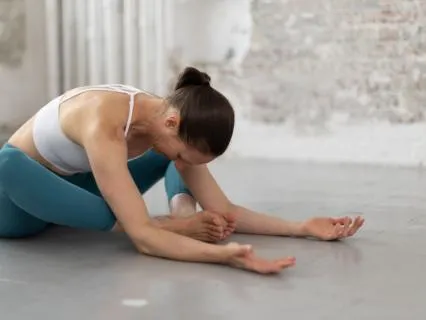
So this is our shape of the day,
Caterpillar pose.
So have your blocks and everything handy nearby once again.
And you're going to just sit up tall,
Legs are relaxed,
So your feet are going to flop in whichever direction they naturally do,
So there's no control of the quads or anything at all.
Spine is long.
If you feel like you roll backwards before you go forwards,
Grab a little cushion or blanket to sit on that will tilt your pelvic bowl forward.
And then we're gonna lazily,
Same as we did with butterfly,
Curl our way forward into our shape.
And then just notice the gaps that we need to fill between the head and the body.
The floor and for some of us it might just be a stacking of blocks on top of each other.
Some of us,
It might be taking the blocks out,
Either side of the legs.
And remember,
Third height or second height,
Closer in towards you,
Holds you up higher.
Further away takes you deeper.
And then using your props in exactly the same way as the shape before.
And remembering that this is a journey,
So we don't need to go into our deepest version of the shape.
Let time and gravity control that for you so that there's no need to be in charge of anything here.
All you need to do is notice when space arrives and then move yourself into it.
Once you're settled,
Just close your eyes.
Try if you can to let the elbows be a little wider than the shoulders so that there's a little bit more ease around the neck.
In the upper back.
There's an opportunity in this shape to support the forehead,
So the starting area of the urinary bladder meridian line.
Remember that this line runs down the entire back of the body,
So you may feel it anywhere along the back of the legs,
The lower back,
Upper back.
And while you're here,
Just remind yourself that forward folds generally.
As a category within yoga are super nourishing.
Super grounding,
Super calming for our nervous system.
So as you follow the breath,
As you follow space arriving into your body,
Welcome the knowledge that you're inviting every cell and organ within your system to slow down.
Fear is the emotion that presents itself.
When things are out of balance in the kidney and urinary bladder,
Can be fear of anything at all.
Pharaoh of the future.
Of jumping off a cliff.
Fear of a spider walking along the floor nearby to you.
Can be rational or completely irrational.
And none of that matters because remember in the Chinese Meridian way of thinking.
The fact that an emotion is present means that there is an imbalance.
It means that something needs addressing.
And the kidneys are linked into the season of winter.
And winter is typically a season where we slow down.
We put on our warm clothes,
We stay inside more,
We keep ourselves cozy.
We hibernate,
We see less of people.
It's a time of self-reflection.
Time to assess how the seasons before have treated us.
What worked for us,
What didn't.
What do we want more of?
What do we want less of?
Time to think about ourselves.
Self-reflect.
And then gives us this chance to really build a strong immune system,
A strong,
Calm,
Grounded nervous system.
We train ourselves to get better at coping with life's changes,
Life's curveballs.
And in training ourselves to stay calm despite the unknown ahead of us.
We're training ourselves to stay in the calmer part of our nervous system,
Which is so much better for our organ health and our mental health.
The practice of meditation,
The practice of pranayama.
Each of these three to five minute shapes a mini meditation in its own right.
Are all ways for us to remind ourselves of our inner strength.
Our willpower.
Our wisdom.
The ability to stay calm under pressure.
So notice how it feels to take a nice big breath in and if you have the capacity to go a little deeper into your shape for the final bit of the shape.
Go ahead and make adjustments to deepen the pose.
Otherwise,
Just breathe into that back line of the body.
Breathe energy in.
Breathe calmness in.
I'm the best friend of kidney and urinary bladder.
Meridian lines and organs is living a slower life.
Knowing when you're busy that you need to welcome in pockets of stillness.
So that you can start to think ahead to when you need these practices the most.
Three more breaths.
Where the third breath is complete.
See if you can keep your eyes closed,
Just gently roll yourself up vertebrae by vertebrae.
Reach for the blocks and just move them to the side.
Make sure you've got enough space behind you and then take your cushion behind your knees.
And we're going to lie ourselves down into Shavasana.
Move everything out of your way so that you can take up as much space as you need here.
Cushion behind the knees is just an option,
So if it doesn't feel good for you,
Feel free to just let the legs relax down to the ground.
Hands can rest on the belly or arms can be out wide.
And just closing the eyes when you're ready.
And coming back to this place of stillness.
Surrendering.
And as you lie here in stillness,
You might become aware of some sensations in the lower back.
Other areas along the back of the body,
Maybe even the inner thigh,
Still a little.
Try not to focus too heavily on what you might feel.
Breathing into the body,
Breathing into the lungs as you come to this place of stillness.
Starting to bring just a little awareness back into the body.
As you wiggle the fingers and the toes.
Gently reaching the arms all the way up overhead.
Inviting a full body stretch.
And drawing the knees slowly in towards the chest as you give them a hug.
Eventually coming to roll over and rest for a moment on your left side.
Keeping your eyes closed,
Using your hands to push the ground away and just gently lift yourself up to a comfortable seat.
And as you sit here in stillness,
Just take a moment to reflect on how you feel now compared to when you first sat down.
And hopefully everything's slowed down,
Relaxed a little bit.
And let's see if we can carry this awareness of the benefit of pausing.
When we recognize that we need the balance into the rest of our day,
The rest of the week.
The month,
The year ahead.
Knowing that this calmness is always there inside of us to come back to any time that we need to.
Bring our hands gently together at the heart center.
Bowing our head to our hands in gratitude for the practice.
And gratitude for our health.
Namaste.