Hush,
Give a name.
I don't know Welcome to the Tour of Awakening Jewish Meditation podcast.
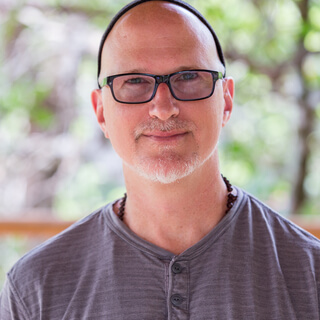
I'm Rabbi Brian Yosef Schachter-Brooks.
We're often driven psychologically from a sense of incompleteness,
A feeling of not quite being there yet.
That's what seems to be the underlying motive of Korach,
The one who rebelled against Moses and Aaron's leadership.
He craved status and power for himself because he wasn't content to just be as he was.
And so it is with us.
When our sense of identity is dependent on external forms defined by our thoughts,
We tend to grasp at an imagined future,
Barely conscious of the miracle of the present.
But there is a deeper level to who we are.
And to the degree that we can make contact with this deeper level,
There is a wholeness and a rootedness that's far greater than we can get from any external changes of status or power or anything else.
How do we get beyond that feeling of insufficiency on the level of ego into this authentic wholeness?
That's what we'll explore in Parshat Korach,
Followed by a guided meditation on the Hebrew letter Gimel,
Which represents that inner reality of wholeness beyond ego.
Enjoy.
To begin,
I want to look at this beautiful verse from Psalm 23.
This is the famous psalm that begins,
The Lord is my shepherd,
I shall not want,
And so on.
And this verse says,
So let's look at the first little piece of this,
The imagery here.
The word that's translated here,
Tormentors,
Tsor-rai,
Is from the root tsa-di-resh,
Which means narrow or constricted.
It's the same as Mitzrayim,
Because Mitzrayim,
Egypt,
Is a narrow country.
But again,
In Hasidic teaching and in Kabbalah,
The word for Egypt,
Which means narrow,
Has come to represent that inner state of constriction.
Away when it's talking about my tormentors,
We have a hint of the inner tormentors.
What is the phenomenon within,
In our inner world,
That causes a sense of being squeezed or constricted or limited in a negative kind of sense,
In an unpleasant way?
Okay,
But then shulchan is kind of the opposite imagery,
Right?
A table is a big a big open space upon which you can put things.
And what is on this table doesn't say explicitly what's on the table,
But we can kind of infer that really yummy delicacies are on the table.
So,
You know,
It's spread out before me.
This word taroq,
Again,
Has this,
The root of that,
That means wide or expansive.
So you have this expansiveness before you.
And not only that,
But on that expansiveness,
From it are things we need for nourishment and things that are going to be delicious,
That are going to bring enjoyment.
But it's before my tormentor.
So you might have an image of sitting at a table with this delicious feast spread out before you.
And then at the other side of the table are your enemies looking at you.
So that's one way of seeing this imagery.
But another way of seeing it is just to notice that this word lefanai before me and the word neget against me,
They can actually mean pretty much the same thing.
And so it's possible to see that perhaps the delicacies on the table,
The feast itself,
That is our tormentors.
Our tormentors are the yummy things we want to eat.
So how can this be?
Well,
Of course we know how it can be.
Whenever we see something in front of us that we want,
Right?
We don't have it yet.
We didn't put it in our mouth yet.
It's just there,
But we are longing for it.
But we know that perhaps it's not good for us,
Like maybe too much sugar or something like that.
Then there's a tendency to become,
To feel trapped on the inner sense.
Like I want something,
I want to go for it,
But I also don't want it.
So now I'm in a state of conflict.
That's why those delicacies,
Or we might expand it to mean anything we want,
Anything that we think is going to make us feel more complete,
Because we're not feeling like we're overflowing.
We're feeling incomplete and we need to complete ourselves by having this experience of whatever it is,
These delicacies that are set upon the table.
But we also don't want to because we know it's not good for us.
So there are tormentors.
So did I.
So what is the solution?
Dishan tavashemin roshi.
You anoint my head with oil.
Now,
Oil in many places is really a metaphor for consciousness.
We see it most clearly in the imagery of the menorah,
Of lighting the sacred lamps.
Oil is anointing the head.
Of course,
The head is the place where our nervous system sits and it is the seat of consciousness.
And so anointing my head with oil is cooling down my identification with the desires for the tormentors that are on that table.
I'm just seeing people are putting things in the chat,
So I'm going to check real quick what's happening.
Oh,
I see.
Regime,
Yeah,
Alex.
Beautiful.
So it makes me think of pouring some nice cool water on the head when it's,
When it's feeling hot,
Uh,
Like it is nowadays in Arizona,
You can get a lot of relief by cooling down the head with water because we start to get overheated.
It's the same kind of thing.
You build up that inner heat when you're,
When you have inner conflict,
When you're thinking that something outside yourself or some experience that you're imagining in the future,
Even if it's the very near future.
Like in the next second,
I'm going to put this thing in my mouth and I'm going to feel better.
But anointing my head with oil is really a metaphor for presence,
Which means doing something different with the desires.
Doesn't mean that we're getting rid of the desires,
Like shutting them out or pushing them away.
It means that we are anointing them with oil.
Anointing them with oil means bringing our consciousness to that inner impulse.
Arises from a sense of incompleteness.
I'm not good,
I want to be good,
So I want to take that thing.
And instead,
To just be present with that impulse.
And an amazing thing happens,
As many of you know,
When we do that.
Which is that our identification can take that little shift from feeling trapped,
From feeling constricted by the impulse,
To being the open space of consciousness within which the impulse arises.
Then we get the last two words,
Kosi rivaya,
My cup overflows,
Because we are literally overflowing with consciousness constantly.
What does it mean for a cup to overflow?
It means that you poured some stuff in the cup,
And then you keep pouring,
And so it starts leaving the vessel.
That's exactly what's going on,
Because our consciousness is the vessel within which all perception,
All experience is arising.
But the consciousness is not limited by the form of the experience.
The consciousness is bigger.
We might say infinitely bigger.
This is verifiable within our own experience right now.
You're feeling,
Everything that you are seeing,
Everything that you are sensory awareness,
The sense of the body and space,
The sounds vibrating in the air,
All of it is arising within this vastness that is far more vast,
Infinitely vast actually,
Beyond whatever the experience happens to be.
How does this relate to the Parsha?
The opening words of the Parsha,
Vayikakh Korach.
It's translated here as Korach separated himself,
Because this is the beginning of this story where Korach is going to incite a rebellion against Moses and Aaron.
But it's interesting that it uses the word for take.
It doesn't say what he's taking.
He just took.
And that's an idiom to mean that he took himself away from everybody else.
But we can also see it as a hint of the impulse to take,
Right?
Just as we like,
Want to take some experience,
Take some delicacy.
He wanted to take something,
Too.
In this case,
Though,
He's not trying to take a piece of candy.
He's trying to take power.
He's trying to take status.
He's trying to take control.
And they gathered against Moses and Aaron,
And they said to them,
It's too much for you.
Like,
Who are you?
What are you doing?
Because all of the people,
All of the community is holy,
And the divine is among all of them.
Or we could even read the divine is within all of them.
Why then do you raise yourselves above Hashem's congregation?
And then what happens next?
So what does that mean exactly?
Why did he fall on his face?
There's a wonderful Hasidic story that an opponent of the Hasidic movement came to the altar,
Rabbi,
The founder of Chabad Hasidism,
Rabbi Schnur Zalman of Liadi,
To attack him with accusations of arrogance.
He said,
You claim to be a holy man,
Leader of Hasidim,
But look how you sit alone in your study,
Separate from the people,
And with an attendant at your door,
Only admitting people according to your command.
We might wonder how he was able to get past the attendant,
But he must have had some kind of good story to get past him and then start making these accusations.
So you have an attendant at your door admitting people according to your command.
To your command how fancy of you.
Isn't that arrogance?
Who do you think you are anyway?
So when the Tzadik heard this,
He put down his head.
Resting it in his arms,
As one does during the Tachanun prayer,
Which is a prayer of asking for forgiveness.
And after a few minutes,
He lifted his head and spoke.
The expression the Torah uses for leaders of the people is Rosh HaAlfe Yisrael.
Okay,
So leaders of the people in the Torah is referred to as Roshe.
Alfe Yisrael,
Heads of the thousands of Israel.
And the word Rosh is,
Is a word for head,
Literally like the head,
But also leader.
So from this,
He says,
We know that our leaders are like heads.
Now it is true.
The head and the body are joined together and neither can exist without the other.
Nevertheless,
They're clothed separately and differently.
Different,
Probably strimals,
Big fur hats we put on our heads,
Or whatever.
But why is this?
Why is the head clothed differently?
Because the head must be distinct from the body,
Just as the heads of any generation must be distinct from the people.
The questioner was impressed with the answer and went on his way.
But the Rebbe's little son,
Who would eventually be known as Reb Dov Berevlobovich,
Had a different question for his father.
Abba!
Abba!
That was a great answer you gave.
But in order to give that answer,
There was no need to rest your head on your arms.
Why didn't you just tell him the answer right away?
The altar Rebbe replied,
In Parshat Korach.
When Korach and his followers accused Moses and Aaron of abusing their power as leaders,
We read that Korach accused them with these words,
Umaduatidnasu,
Why do you exalt yourselves?
Then we read,
Vayishma Moshe,
Vayipol Alpanov,
Moses heard and fell in his face.
Only after he fell in his face did Moses answer Korach.
So we might ask the same question there.
Why did Moses have to fall in his face first before giving his answer?
The reason is because Moses suspected that perhaps there was some truth in the accusation.
Perhaps there was a bit of ego involved in his leadership,
So he had to go inside himself first and search inwardly to see if there was some truth there.
Then,
After searching within and purifying himself from any ego,
As the Torah says,
V'ha'ish moshei anav me'od,
Moses was very,
Very humble,
Then he was able to respond with clarity.
A similar thing happened with me here today.
So it's interesting in the story,
There's a piece of the story that kind of just goes by quick that you may not have noticed,
Although I did bring a little more attention to it when I was telling it,
Which is that the Rebbe had an attendant at his door admitting people according to his decision,
Who was allowed to come in,
Who wasn't allowed to come in.
And this is a wonderful metaphor for how we attend to our own heads.
The leader of the generation,
But our own heads are the leaders or the directors or the root of how we operate through the rest of this,
Through our bodies,
Meaning through our actions,
Even what goes on in our head,
Even our thoughts,
Our intentions.
To the degree that we can bring consciousness to all of that,
Then we can determine the course.
The dependent was able to admit things that were decided upon,
So we're also able to admit.
The tricky part that we have to understand is that when an impulse of insufficiency arises,
I need that in order to feel complete.
I'm unstable in this moment.
I'm in a state of,
I'm not resting in the moment.
I lack something and I'm looking ahead toward when I'm going to be able to rest because the rest comes from getting that thing,
That external thing.
Something to eat or whether it's a feeling of being in more control of having title that I like or having or being respected or being seen by people being acknowledged,
Right?
All these things of the ego.
That I crave in order to become complete.
We don't want to literally not let in those impulses.
What we want to do is not let in the identification with the impulses.
If we're trying to keep out the impulses,
Then we're already automatically in a state of insufficiency,
Right?
Because we're not okay with those impulses.
Those impulses are arising,
And that's what's preventing me from being enlightened or being complete or being spiritually fulfilled,
And so I have to try to get rid of them.
That's already a contradiction.
So we have to understand that metaphor of the attendant,
Of being the attendant of the mind,
As meaning that of course we let them in.
We let in everything,
But we be the presence that is aware of them rather than being captured by them.
We don't come into the tsar,
The narrowness of the impulse,
But rather we can be be present with them.
That's the key right there.
That's the magic bullet,
In a sense,
For Kosi Rivaya,
Because the awareness itself that allows everything to be,
Then can experience its own,
Or I should say our own,
Transcendence of any particular experience.
There are many qualities of presence.
But today we're particularly talking about the quality of wholeness,
Of sufficiency.
That is,
When we do the act of presence with,
Of allowing all to be,
But also making a an inner strength,
A barrier,
In a sense,
So that we are not pulled into those impulses,
Those thoughts,
Those feelings that are arising,
But we can remain in that relationship of presence rather than that relationship of being captured,
Of being the prisoner,
In a sense,
Of our own experience.
Demon.
The letter gimel,
Which is wholeness,
Abundance,
Completeness,
Sufficiency.
So let's call this quality together with a chanting of the Kavanah for Gimel.
I am overflowing,
I am whole,
I am abundance.
And again,
When we say these words,
It doesn't matter at all whether you actually feel these qualities right now or not.
Just knowing that this is the quality that exists at awareness on the deepest level,
We're telling ourselves the story about that rather than telling ourselves the lie of insufficiency,
Which is what we automatically do so much.
That just tends to be how the mind operates.
And so we're doing this counteractive inner medicine.
I am overflowing,
I am whole,
I am abundance.
On long out breath,
Deep breath in.
I am overflowing,
I am whole,
I am abundance.
I am abundance.
One more time.
I am overflowing.
I am whole.
I am abundance.
In our chant that we'll use for Gimel Kosi Rivaya,
My cup is full.
Whoops,
Sorry about that.
Kosi Revaya,
Kosi Revaya,
Kosi Revaya,
Kosi Revaya.
Kosi Revaya.
Kosi Revaya.
Kosi Revaya.
Kosi Revaya.
Kosi Revaya Kosi Revaya Kosi Revaya Kosi Revaya time.
Bringing special attention to the vibrations of the words in the body,
Letting the meanings of the words sink in,
Awakening that sense of inner wholeness,
Relaxing into that field of consciousness that you are,
Singing.
Yeah.
Kosi Revaya Kosi Revaya and preparing for a meditation,
Bringing some attention to the position of your body.
To be comfortable,
Alert,
Aligned,
Relatively straight.
Head lifting as if a string is pulling the top of your head toward the heavens.
Spine aligned with your hips,
Feet connected to the earth below.
And bringing forth that attitude that you can only have if you have that sense of inner abundance,
Which is that quality of chesed,
Of offering,
Bringing your right hand to your heart and taking that attitude of offering your attention to the fullness of whatever arises.
You are the attendant of the mind,
But not to block things,
Not to push anything in your experience away,
But rather to give.
Give abundantly.
Give of your attention.
And in the giving of the attention,
Not being manipulated or captured by any of it.
Just being the vast open space offering attention to what is in your experience right now.
The fullness of all of that.
With Lecha and a long out breath.
Deep breath in.
Lecha and bringing your left hand to your belly.
Awareness dropping down.
Filling your belly with consciousness.
Awareness pouring down like fragrant anointing oil.
Permeating your organs,
Bringing healing.
Expressing gratitude to your body.
For being the vessel of consciousness all these years to this moment.
Awareness pouring down like oil down through and over your legs.
Anointing consciousness down to your feet.
Seeping down,
Overflowing down into the earth.
And tension rising up from your belly.
Chest,
Upper back,
Shoulders and neck,
Releasing any excess tension there,
Flowing down,
Anointing your arms,
Hands and fingers,
Connecting back with your heart and belly.
Bringing your attention more deeply into that.
Life-giving flow of the breath.
Each breath a gift from Hashem,
A kiss from the Divine.
Awareness,
Rising up face and facial muscles,
Brain and nervous system,
Bringing little smile to your lips,
Being that loving,
Benevolent,
Indwelling presence.
Life in the body and affirming,
Naa say.
Deep breath in.
Naseh and bringing right hand up from your heart to lightly touch your forehead as awareness shines out like light.
As if the oil of consciousness is burning like the menorah.
Extending light out from the body into space.
Resting on the sounds vibrating in the air,
The shape of the room,
All of it.
And knowing that the outer world as it appears,
As well as the inner world of thoughts and feelings,
Are all temporary finite forms or modulations of consciousness.
This consciousness is far bigger than any of it.
Boundless and you are this field,
Without limit,
Without shape,
Without border.
Vanishma.
Deep breath in.
Venishma.
Kissing your fingers,
Relaxing your hands.
Vona Shalom.
Bless us in our practice.
Help us to meditate deeply as we bring our mind and our attention to you.
You who are the underlying presence of being in all things.
Not separate from anyone or anything we encounter.
Not separate from this awareness we are.
Atahu Atahu.
Divine Atyahu Atyahi.
Atau,
Atau Aadhyao Aadhyaye ATAHU Atau.
A-T-Y-A-O ājāhi ATAHU Atahu.
Ātyāhau ātyāhi A-T-Y-A-U Atau.
Adiao!
Ajay!
Atau Tahu,
Resting the mind in the silent repetition.
Overflowing with consciousness,
Giving generously to everything that arises moment to moment,
Knowing your own nature of completeness,
The fullness of being.
Ta Hu.
Ta Hu.
As we come into silent meditation.
You you Amen.
And bringing some movement back to your body,
Taking a nice stretch.
And closing our meditation,
Bringing your hand to your heart.
Offering your presence from the heart,
Being the generous,
Overflowing offering of consciousness.
L'cha deep breath in.
Lecha and bringing left hand to your belly,
Feeling awareness down into the body.
Filling the temple of the body with consciousness,
Na Se.
Na Se.
And bringing right hand to your forehead.
Vast,
Boundless field of awareness that you are Vinishma.
Vinishma.
Kissing your fingers.
Just relaxing your hands.
As we prepare to come back into our ordinary activities.
May we be imbued with this recognition,
This realization of Gimel,
That we are like a cup overflowing,
Consciousness boundless and infinitely larger than any particular experience we're having in the moment.
To remember that,
To have that,
That confidence,
That inner resting in that space.
Oh,
Say shalom bimramav hu ya'aseh,
Shalom aleinu.
V'yakoy Yisrael,
V'yakoy Yoshevei tevel.
V'yimru.
Amen.
Shalom.
I hope you've enjoyed this Torah of Awakening.
I'm Rabbi Brian Yosef Schachter-Brooks.
Until next time,
All blessings.