Hush,
Give aim away Adonai.
Welcome to the Tour of Awakening Jewish Meditation podcast.
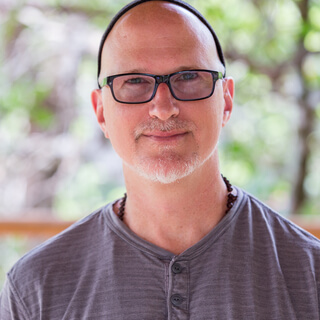
I'm Rabbi Brian Yosef Schachter-Brooks.
The fruit of meditation could be described as a homecoming into the place you already are.
It's the realization that this little piece of earth upon which you now find yourself is,
In fact,
Your Eretz Kodesh,
Your Holy Land on the inner level.
But all the stresses and concerns and distractions of life normally block this realization.
How do we deal with these obstacles?
There is a hint in the Torah.
In Parshat Shelach Lecha,
The children of Israel are about to enter their holy land,
So they send out spies to check it out.
The spies bring back wonderful reports and delicious ripe fruits from the land,
But they're also afraid of the giants they encountered there,
And so the people become discouraged.
But just as the Israelites in the story are fearful of the giants,
For us,
Fear and anxiety are the giants.
How do we overcome these obstacles so that we can partake of the spiritual fruits?
That's what we'll explore in this episode and then put it into practice with the guided meditation on the Hebrew letter Lamed,
Which really contains the secret.
This is the opening verse of the Parsha.
Kol nasivahim,
Each one a leader or a prince among them.
So we know what's going on on the literal level.
We have the children of Israel about to enter the land,
And they're going to spy it out to check it out,
And we have that drama.
But what is going on on the metaphorical level?
What does the land really represent?
So there's a wonderful hint in Pirkei Avot.
Pirkei Avot is the book of wisdom aphorisms in the Mishnah.
And this.
Piece of this verse from Isaiah,
Isaiah 60-21,
Comes before each chapter of Pirkei Avot.
It says,
So we have the mention of the land and we have the mention of the people.
But interestingly,
All of the people are called tzaddikim.
Now,
What does this mean?
That Sadiq is a spiritually perfected person,
A completely perfect person.
That's a Sadiq.
So what does it mean to say all of your people are Tzaddikim?
That doesn't make any sense.
We know that all Jewish people are definitely not Tzaddikim.
So if we're understanding the word tzaddikim in relation to the people in a deeper way,
Then there's an invitation there to understand the idea of the aretz,
The land,
In a different way as well.
So how can we understand that all people or all Jewish people are tzaddikim?
We have a blessing in the morning,
Every day.
I'm reminding myself as I wake up in the morning,
Oh Hashem,
The soul you placed within me is pure.
So in other words,
There's a level of our being that is a tzaddik.
There's a level of all of our beings that makes us all tzaddikim.
On the outward level,
In the flow of life,
We're human.
We make mistakes.
Even if we were to engage in a spiritual practice with the aim of aspiring to beat Zadikim,
That means that that potential is in there.
And what does that potential come from?
It comes from a what's called nishama tahor,
Or tahorah,
A soul,
A pure soul,
Which of course is that level of our being that is consciousness.
All of the qualities of being a human being arise out of the consciousness,
But the consciousness itself is just openness.
What does it mean to not be exotic?
What's the opposite of being exotic?
It means that we have.
.
.
Fear,
That we have anxiety about what's going to happen to me,
Particularly.
What's going to happen in the future?
How are things going to unfold?
And.
.
.
There is a focusing on that which we are uncertain about and that which we can never be certain about.
So on the level of our ordinary sense of self that we call ego,
All of these various qualities that are the opposite of being exotic naturally arise.
Judgment,
Anger,
Jealousy,
Comparing oneself to others.
And at the root of all of them is what we might call fear.
Whether it's an active terror or just a low-grade anxiety,
Just a dis-ease,
A sense of dis-ease with being here in this reality that we're in,
In this moment.
And so the opposite of that,
Which is the aim and fruit of spiritual practice,
The fruits like the giant grapes and pomegranates and figs,
What do those fruits represent?
They represent the spiritual fruit,
And that spiritual fruit is a sense of knowing that this moment is exactly as it should be,
And I am exactly where I need to be in this moment.
A complete oneness with the reality in which we find ourselves.
That's possible because we have this tzaddik level of our being,
What that verse in Isaiah calls tzaddikim.
But really it's just the consciousness that's hearing these words right now.
The consciousness that hears the words underneath whatever feelings are arising,
Whatever preoccupations of the mind are bubbling.
About that level of our being,
We can say,
Le'olam yeshu aretz.
For all eternity they will inherit the land.
Because the land is the land upon which we stand in this moment.
In the ordinary external level.
It's talking about the land of Israel.
It's talking about the home of the Jewish people.
But at the same time on the inner level.
It has another meaning.
It has an internal meaning as well as an external meaning.
And on that inner level.
The Holy Land,
The Promised Land.
Is the little space of ground upon which we stand at this moment.
It's the knowledge,
And it's not really knowledge exactly,
It's just a.
.
.
I was going to say it's the knowledge of what we're doing here,
Of what our purpose is.
We may not have that knowledge intellectually,
Though.
Really what it is,
Is it's a dropping away of thoughts that disconnect us from the moment in which we find ourselves.
Thoughts and feelings which disconnect us.
Those are the obstacles,
The bringing forth our tzaddik nature,
Our n'shama tahora.
That purity that we are underneath it all.
And so,
In the story,
Those are the giants.
That the 10 spies are so afraid of.
We can't possibly.
Inherit this holy land forever.
We can't enter into a state of spiritual realization in which we let go of resistance and we simply are a manifestation of divine energy in the form of this.
Of this that I am and of that that you are.
We can't possibly defeat all those obstacles.
We're afraid of them,
We can't go do that.
It's interesting in the story,
The spies are fearful of the giants,
But on this deeper level,
The giants themselves are fear.
That's what they represent.
It's like that saying,
We have nothing to fear but fear itself.
That's really true because it's the buying into,
The being captured by.
The being possessed by that visceral sense that this moment is not as it should be,
That something is wrong.
That sense of dis-ease.
We are not,
In fact,
Home.
We are not,
In fact,
In the Holy Land.
We are in some wrong space.
That's what the fear is making us think.
That's what we're buying into when we get possessed by that.
So how do we overcome that?
So I mentioned that the verse which is talking about v'amech kulam tzadikim,
Your people are all tzadikim,
They're all perfected beings.
That's the introduction to the chapters of Pirkei Avot.
And there's another Mishnah in Pirkei Avot that says such a wonderful suggestion about what to do about this.
It's his Rabban Gamliel.
Rabban Gamliel Hayya Omer,
He used to say,
And by the way,
This is such a wonderful construction that happens again and again in Pirkei Avot.
It says,
It's also in the Talmud,
It says it all over the place in rabbinic literature,
Haya omer.
It doesn't say they omer.
It doesn't just say they said.
It's not just some saying that the guy said.
Haya omer means they used to say it over and over again.
And so the hint here is that people who are teachers,
Spiritual teachers,
People who feel called to do this kind of work,
Usually have a thing they say over and over again.
And that's definitely true.
You're here to transmit a certain something.
And every one of these teachings that I give really are saying the same thing over and over again.
Vehista lek min ha-safek,
Remove yourself from uncertainty.
And then the last part is about tithing and being precise and so on,
But let's look at the first part.
Ase lecha rav means,
Literally means,
Make for yourself a teacher.
But we can also understand this word lecha,
Which is the same word we use in the meditation.
We put the hand on the heart and we say lecha.
It's like an offering word for you.
For yourself,
As it's understood here.
But it can also be understood as to yourself.
Make that which is to yourself into your teacher,
Meaning whatever is in your present moment experience,
Make that into your teacher.
So here is the hint about how to deal with these giants.
In other words,
These obstacles from coming into the Holy Land of this moment.
End.
And if you're not sure what it means,
Then the next little piece clarifies.
On the plain level,
It seems to be saying you should find a teacher so that they can answer your questions and you won't be confused,
Right?
But on a deeper level,
Remove yourself from uncertainty means stop focusing on the things that you don't and can't possibly know.
That's what creates the fear.
That's what creates the anxiety.
That's what separates yourself from the moment when you keep dwelling on things that are not in the moment.
And actually.
.
.
It's not that difficult.
If you asse lecha rav,
That is,
If you make what is in the moment,
You make the truth of your present moment experience into your teacher.
What does that mean?
If something is your teacher,
It means you're paying close attention.
You're listening very attentively.
That's the opposite of our tendency.
Normally we go through life not paying attention because we have some aim in the future,
Or we're just distracted with some other thoughts that are more entertaining,
More interesting,
Or more compelling in some way,
And so we're not really paying attention to what's going on in the moment.
If we make it into our teacher,
You see,
The point is not some specific nugget of knowledge we're going to learn.
The point is the relationship.
How do we make this moment into our teacher?
Well,
It's very simple.
It means we just have to pay attention to what's happening in the moment.
Then we remove ourselves from that obsession with that which we can't know.
It is the most natural thing in the world to dwell in an ocean of anxiety if all we're focusing on is stuff that we can never get a real answer about.
That's what anxiety is.
That's what fear is.
And yet there's so much we do know,
But we just ignore it.
So it's saying.
Don't ignore what's actually in your experience.
If you fill yourself.
.
.
And we can do it right now.
Fill yourself with what you know right now.
Not what you know intellectually,
But what your awareness is receiving.
Can you make the present moment into your teacher?
Each breath.
Each sustaining breath.
Not to put it to the side,
But to make it into our teacher,
To listen attentively.
And if you're doing this,
If you're bringing your awareness into what is present,
If you're removing yourself from those thoughts,
Obsessions,
Of things that we can never be certain about.
And you may notice that something is beginning to happen.
There's an inner shift that happens.
There's a growing and a shrinking.
A shrinking of dis-ease,
A shrinking of anxiety,
A shrinking of disconnection.
And a growing,
A blossoming of the field of consciousness that notices.
And in and as this field of consciousness We are together right now coming into the Holy Land.
And when we do that,
We can realize that all those obstacles.
That sense of dis-ease that tends to come when we obsess about the things that we do not know and instead bring ourselves into conscious,
Present awareness of whatever is present.
Even if,
Even with the giants,
Even with whatever feelings may be there or may have been there,
Which are now kind of reducing,
They're kind of losing their power,
Losing their significance as we come into greater Wholeness with where we are?
At-homeness with where we are?
Then those giants,
Those feelings of fear,
That sense of anxiety,
They're actually helping us.
They're not our enemies because.
.
.
They are reminding us.
They're like reminders.
Oh.
You seem to have lost your presence.
You seem to have come out of connection with the moment.
Come out of connection with Hashem as this moment.
And when we become present with them,
We allow feelings to be as they are,
We are actually nourished by them.
They are like our food.
We might say.
As it says,
In the verse.
As it says in the verse where Caleb and Joshua and Moses are trying to tell the people,
Don't worry,
Don't be afraid.
They say,
Ach,
Badonai,
Al timrodu.
I'll team Redou.
Don't rebel against Hashem,
Meaning.
.
.
Don't rebel against the way this moment is unfolding right now.
Don't be resistant to the truth of your experience right now.
And here's the important part.
Ve'atem al tiru et am haaretz.
You should not be fearful of these giants,
Of the people of the land.
Ki lachmenu,
For they are our bread.
Don't be afraid of fear,
Rather be the presence behind the fear.
And in doing so,
Your awareness is nourished by it.
It's not damaged by it.
It's not a.
.
.
The obstacle is actually the help.
The obstacle is actually the help when we take this attitude of being the student of what is present.
And this attitude of curiosity,
Of learning from whatever is arising,
Is the quality of the letter Lamed for this month of Sivan that is coming to its sunset in a few days.
So let's chant together the.
Affirmation of this attitude.
I am learning.
I am curious.
I am curiosity.
Chanting on long out breath,
Feeling the vibrations in your body.
I am learning.
I am curious.
I am curiosity.
One more time,
Letting the vibrations really draw you into presence with your teacher,
Which is what is here now.
I am learning.
I am curious.
I am curiosity.
In our chant for the letter Lamed,
Also from Pirkei Avot.
Ezehu Chacham.
Who is one who is wise?
Ha'lomed mikol adam.
One who learns from every person,
Which we can extend to every experience,
Which we can extend to whatever is here now.
E ZEHU CHAHAM HALO MED MIKOL HADAM Eizei hu chacham,
Ha lo med mi kol adam.
Ezehu Chagham,
Halomed Mikoladam.
Eizei hu chacham,
Ha'lo med mikol adam.
May Zehu Chaham ha-lo-med mi-kol adam.
Eizei hu chacham ha'lomed mikol adam Eizei hu chacham ha'lomed mikol adam Eizehu ha-cham ha-lo-med mi-kol adam and preparing to come into meditation together.
Bringing ourselves into a state of attentive learning.
Being the student of the moment.
And being the student also means.
.
.
Having this loving relationship with our teacher.
Where attention is.
An expression of generosity.
We pay the teacher,
So to speak,
With our attention.
So bringing your right hand to your heart.
Attitude of offering attention from the heart.
Attentive presence with love.
With l'cha,
Deep breath in.
L'cha.
And bringing your left hand to your belly.
Awareness dropping down,
Filling your belly with consciousness.
Awareness permeating your organs,
That inner Tzadik,
That inner pure soul of consciousness,
Indwelling presence,
Bringing its healing and gratitude to all of your organs.
Awareness flowing down through your legs,
Down to your feet,
Connecting with the earth below.
Attention rising up,
Upper back,
Chest,
Shoulders,
And neck.
Spilling down arms and hands and fingers,
Connecting back to your heart and belly.
Bringing your attention deeply into the sensation of the flow of your breathing.
Letting your receiving of life in this moment be your teacher.
Giving it all of your attention,
All of your presence,
Feeling that flow of breath in and out.
Awareness rising up into your face,
Facial muscles,
Brain and nervous system,
Bringing a little smile to your lips.
Being the loving,
Benevolent,
Indwelling presence,
Life in the body.
Pure soul energy,
Pure consciousness in the temple of the body.
Deep breath in.
Nah say and bringing right hand to lightly touch your forehead as awareness shines out from the body,
Out into the space around you.
Coming to rest on the vibrations of sound in the air.
And all that is in your environment right now,
All arising in this field of awareness.
And you are this field,
Vast and spacious,
Boundless and free.
Completely at home.
In the reality of this moment.
Receiving it as Hashem's words to us,
Being a student of the Divine.
Through this attentiveness,
Vanishma,
Deep breath in.
V'Nishma.
And kissing your fingers,
Relaxing your hands.
Rabona Shalom.
Please bless our practice today.
Help us to merge into the essence that we are.
Let us know that place within ourselves that are called.
Sadikim,
Where the essence of our being is perfect and pure.
That is not dependent on anything external,
Thoughts,
Feelings,
Or actions,
But is simply that pure divine essence that is our awareness.
Let us merge with that.
Let us know ourselves as that as we chant.
Atahu Atahu Aadhya ho Aadhyayi ATAHU ATAHU AH-CHA-HO!
AH AH CHIA HEE ATAHU ATAHU A-T-Y-A-O Aadhyayi Atahu.
Atahu.
Atyaho Atyahi Ataho Resting the mind in the silent vibration of Atahú.
Thoughts will come,
Let them be lach menu,
Let them be our bread.
Not worried or concerned about them,
Rather letting our attention be brought to them because when we bring our attention to them,
They dissolve into that field of attention.
Whereas if we try to push them away,
Make distance between ourselves and our thoughts,
Then.
.
.
And they remain separate.
They remain bound up in a sense in our awareness in a place that's inaccessible,
Suppressed.
Don't suppress,
Let it all in.
Be the embracing presence of all of it and watch them simply dissolve back into the field.
Atahu,
Atahu as we come into silent meditation.
You you Amen.
I mean back from the stillness.
Bringing some movement to your body,
Taking a nice stretch.
And closing once again with the three portals,
Bringing your right hand to your heart.
Offering your attention with Lecha,
Deep breath in.
Lecha Bringing your left hand to your belly,
Awareness filling the inner space of your body.
Being the indwelling presence in the temple of the body,
Na'ase.
Naseh And bringing your right hand to your forehead,
Aware of the space around you.
Noticing that this awareness is a vast boundless space and you are this spaciousness,
Vinishma.
Vinishma.
Kissing your fingers,
Relaxing your hands.
As we prepare to come back into our activities,
May we be imbued with this quality of the letter Lamed.
Of being the curiosity,
Of being the space that explores what arises.
Let's the truth of our present moment experience be our teacher.
Let that come forth,
Develop,
And be more and more integrated O say Shalom Bimra Mav.
Hu Ya'aseh Shalom Aleinu Ve'al Ko Yisrael Ve'al Ko Yoshvei Tevel V'imru Amin.
Shalom.
I hope you've enjoyed this Torah of Awakening.
I'm Rabbi Brian Yosef Schachter-Brooks.
Until next time,
All blessings.