Welcome and thank you for joining our second meditation in the five element mudra series.
My name is Sarah and I will be offering guided meditations and mudra methods to enhance our awareness of the five elements within our bodies and the five elements within our natural surroundings.
In each mudra introduction we will review the origins of the philosophy of mudras.
Take some time to write down your mudra and its methods so you can practice on your own.
The Vedic teachings outline the relationship between the five elements and the five fingers as follows.
The thumb and the fire element,
The index finger and the air element,
The middle finger and the space or ether element,
Ring finger and the earth element,
Pinky finger and the water element.
Mudras are associated with the various levels of consciousness in the body.
The word mudra means seal or energetic lock as it locks the energy within the body and doesn't let it leak out.
This internalization of energy improves the mind-body connection that keeps us focused and helps balance our physical and mental energies.
Mudras are described as gestures,
Attitudes,
Symbols expressed through our hands,
Body,
Eyes and face.
In Hatha yoga mudras are not only practiced in the hands but also associated with internal actions involving the pelvic floor,
The diaphragm,
Throat,
Eyes,
Tongue,
Abdomen and other parts of the body.
Mudras are also used to tell stories,
Express deities,
Perform imagery and stimulate the flow of energy called prana.
The second element in our five element mudra series is the water element.
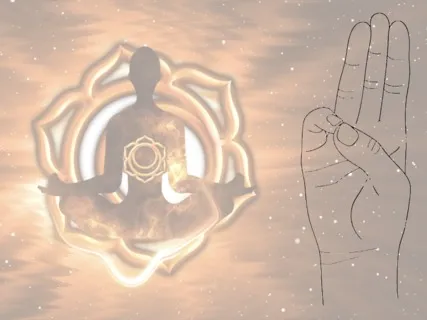
The mudra for the water element is Varun mudra or also called Jal mudra.
This formation is called the seal of mental clarity.
Varun is the Sanskrit word for rain referring to the water in the body and Varuna is the name of the god of water.
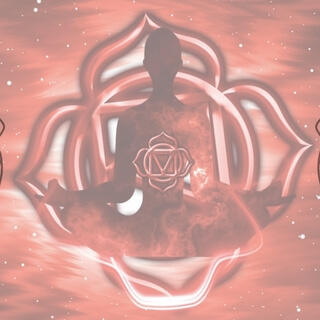
The water element is associated with the sacral chakra and housed in the pelvic and hip region.
Water is the element of emotions,
Passions and pleasure.
In Ayurveda it is associated with the hips,
Sacrum,
Reproductive organs,
Urinary and lymphatic systems.
Water is 70% of our makeup and represents itself in the body as literal hydration and cohesion bringing nourishment and fluid motion to the limbs.
Practice a Varun mudra on the tip of your thumb and the tip of your pinky finger together and extend the remaining fingers.
Place your mudra on your lap or at your sides with palms face up.
As much as possible do not move the fingers around.
This mudra increases the qualities of the water element within the body to support the flow within our bodies and minds.
Allow yourself to feel the qualities of water such as freedom,
Freedom,
Fluidity,
Healing,
Cleansing,
Joy,
Sensuality,
Creativity.
Find a rhythm with your breath that you can maintain.
Practice inhaling for two breaths and exhaling for four breaths both in and out through the nose.
Close your eyes and focus on the pattern of your breath giving yourself gratitude for this mudra and meditation practice following the ebb and flow of the waves of your breath.
Continue to breathe in this pattern making waves with your breathing.
When you feel the sensation of the water qualities that you most need to experience at this time,
Affirm to yourself that you can access this feeling anytime you need to simply by taking the time to connect to the water element with rhythmic breathing and the Varun Mudra.
Continued practice of the Varun Mudra should be performed in moderation under the guidance of an experienced yoga teacher.
Practice these mudras for 30 to 45 minutes.
This can be done in one sitting of 45 minutes or in a gap of three sittings 15 minutes per sitting.
Open your eyes slowly and release your mudra.
Write down any notes if anything stood out to you about this mudra.
Practice makes progress.
I look forward to focusing on the five elements and mudra practice with you next time.
Take a deep inhale,
Long exhale.
I bring my hands over my heart and invite you to do the same.
I ask that you may all be happy and all be healthy.
May we all experience what is good and let no one suffer.
Peace.