In this short practice,
I would like to introduce to you one of the base practices of rebirthing breathwork.
Which are the 20 conscious connected breaths.
There are different ways to do this 20 conscious breaths,
But in this very simple exercise,
Focus on just connecting the breath in itself.
Connected breathing,
So basically not leaving any pause between in-breath and out-breath and out-breath and in-breath,
Is a very natural form of breath that we can observe a lot by very young children,
By babies.
For example,
Who have not yet been subjected to too much conditioning,
To too many subconscious patterns.
That as we basically know in all different forms of working with the breath usually lead to subconsciously directed breath patterns.
Most ways of working with the breath and in the end also yoga tries to liberate it in order to liberate our patterns at the same time that limit our self-expression,
That limit maybe our aliveness.
And that limit our possibilities to act in a new way in the face of new situations or also of old situations.
So the breath is a very powerful instrument to work with and those 20 conscious connected breaths are very safe,
Very contained.
Practice we are not going to force the breath in any way.
The connected breathing exercises,
Also the longer rebirthing sessions that you can do in groups or ideally for the first times you do it in individual work they are not meant to lead to a new breath pattern.
But they are meant to be a conscious direction of the breath.
That will ultimately lead to us being able to release.
Our control.
So having said that let me give you an introduction to what we're actually going to do.
So the first important thing is we are going to actually focus on the physical location on the lungs.
We're not going to breathe into our belly.
We're going to relax our belly.
As much as possible so if the lungs expand downwards.
They may push it out a little bit,
But we're not focusing on the belly.
In the conscious connected breathing,
We are at least initially focusing on the in-breath.
So the in-breath is active.
Actually taking in the life.
And the out-breath is letting go.
So in breath out.
Active out-breath is letting go The third important thing is we do not change channels during the breath.
So we are either always breathing through the nose in and out.
This is preferable because it also creates a more held experience.
Or if the nose is blocked,
We may be breathing in and out through the mouth.
One more thing that is important in this practice is to keep your body as relaxed as possible.
Especially the belly,
But also the entire rest of the body.
So you are not really supporting the in-breath for example with any exterior movements.
Would you just breathe in?
Actively and then let go.
And the only thing that you will be focusing on is getting your breath into the circular motions,
Eliminating the pauses.
On the inhale and on the exhale.
Apart from this,
Conscious influence on the breath should be as light as possible.
If you really feel that you need more aliveness at the moment,
Then you're welcome to intensify the in-breath a little bit,
But I would advise you against forcing anything.
So intensifying or deepening the in-breath would be more in the sense of imagining yourself being out running,
For example.
And then the actual breath movement gets deeper and more ample in a very natural way.
And this is actually the sensation that we would like to create.
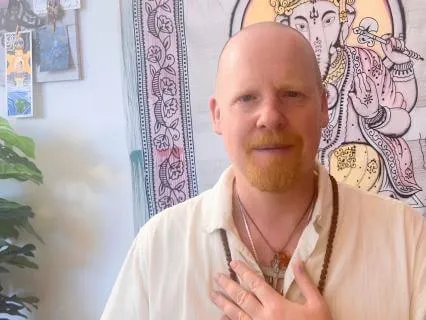
So now I will demonstrate the breathing movement of the conscious connected breath.
Basically I'm breathing always through the same channel,
Either nose or mouth.
So you noticed I was breathing without any break.
I was getting my breathing movement into a circular motion.
And I was just focusing on the inbreath.
Trying to release.
The out-breath.
Much as I could.
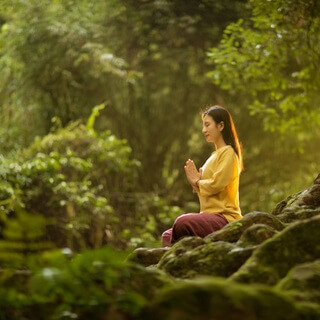
So now I'm going to guide you through this short practice of 20 connected breaths.
Now I invite you to close your eyes.
And observe your natural breath.
How does it flow?
Is there anything in your body that you can relax right now just a little bit more?
Especially the belly,
The shoulders,
The jaw.
Be aware of how the breath flows.
If you notice yourself influencing it in any way,
Stop.
Are there pauses?
It's either in-breath or out-breath,
Longer.
How does the rest of your body feel?
While the waves of the breath are moving it.
Fully present with the breath.
Notice how you are feeling right now what is alive within you How alive do you feel?
And if there is any kind of intention that you want to take into this practice,
Something to let go of maybe.
Question.
Or something you would like to manifest in your life.
Call it out.
In front of your inner eye right now.
And then let it go again.
And whenever you're ready,
You start connecting your breath.
Without doing a lot.
Just.
.
.
Activating the inhale a little bit more.
Breathing deeply.
Without forcing anything.
Your focus is on eliminating the pauses between breathing.
To allow the breath to become circular.
Count your breath.
And this way it's also a.
.
.
Meditation of focus.
Presence.
Breathe into the physical location,
Into the center of the lungs.
And the breastbone.
And when you're finished,
Your 20 connected breaths.
Allow your breath to be fully natural.
Stop all influence.
Be aware of the breath right now of the presence of your body.
How alive you feel right now.
Maybe you received some answer to your question.
Some inside.
Some impulse.
Some sensation of relief.
Memories or images.
And take a moment of gratitude.
Or your own aliveness.
That you have given yourself this practice.
Thank you.
For joining me on this little journey.
Journey of the breath.
Trusting your breath.
For your being.
Namaste.