Hello,
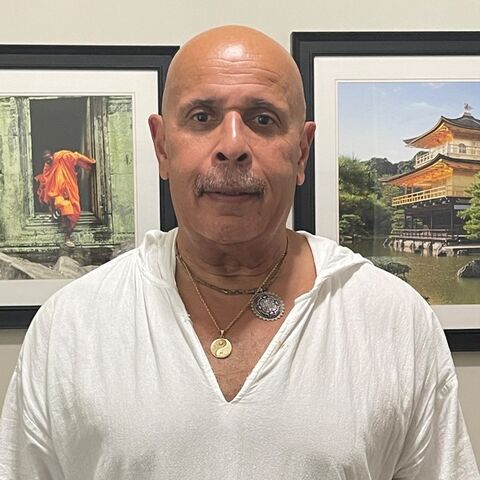
This is the Life Lama.
The goal of our meditative practice is Samatha.
In Buddhism,
This loosely means single-pointed concentration or clearing thoughts so that we can focus on an object.
Make no mistake,
That is the goal.
But in order to get there,
We must first analyze our thoughts so that we can see the repetitive nature of those thoughts.
I have found,
As talked about in the great book,
Thoughts Are Not the Enemy,
By Jason Sif,
That our thoughts,
When analyzed,
Can be better controlled.
And once subdued,
Then Samatha is possible.
As thoughts arise during this meditation,
Acknowledge them,
Then label them in categories such as anger,
Jealousy,
Attachment,
Love,
And so on.
After the thought has been acknowledged,
Let it go.
Return to the breath for as long as you can.
When another thought arises,
And it will,
Acknowledge that thought,
Categorize it,
Then let it go and return to the breath.
At the end of this meditation,
I will give further instructions.
Our first session will be a meditation used by Thich Nhat Hanh.
There will be four sections.
We will meditate on the body,
On our feelings,
On the mind,
And finally on the object of our minds.
Before beginning each section,
You will hear one bell.
We will then slowly breathe in and slowly breathe out three times to set our minds and our intentions.
And then I will guide you through each section,
Allowing you space for quiet analysis of thoughts and returning to the breath.
At the end,
I will ring the bell three times and allow space.
Finally,
You will hear a deep bell telling you the meditation has been completed.
We will then discuss ways to take what we have learned about ourselves and use that for the betterment of all sentient beings.
So please get relaxed in a comfortable position,
Keep your back as straight as possible,
And relax your body.
At the sound of the bell,
We will begin.
Breathe in deeply through your nose.
Breathe out through your mouth.
Again,
Breathe deeply through your nose.
And slowly release that breath through your mouth.
Breathe in.
Breathe out.
Now relax and set your intention.
Breathing in.
I know that I am breathing in.
Slowly breathing out.
I know that I am breathing out.
Breathing in a long breath.
I know that I am breathing in a long breath.
Breathing out.
I know that I am breathing out a long breath.
Breathing in.
I know that I am breathing in a short breath.
Breathing out.
I know that I am breathing out a short breath.
Breathing in.
I am aware of my whole body.
Breathing out.
I am aware of my whole body.
Breathing in.
I calm my whole body.
Breathing out.
I calm my whole body.
He or she practices like this.
Spend a few moments of quiet thinking about how your body feels.
How you will nourish it today.
How you honor your body.
Take some time.
Give that some thought.
Breathing in.
Breathing out.
Breathing in.
I feel joyful.
Breathing out.
I feel joyful.
He or she practices like this.
Breathing in.
I feel happy.
Breathing out.
I feel happy.
He or she practices like this.
Breathing in.
I am aware of mental formations.
Breathing out.
I am aware of mental formations.
Breathing in.
I calm my mental formations.
Breathing out.
I calm my mental formations.
He or she practices like this.
Take some time.
Slowly breathing.
Concentrating on your breathing.
And analyze your feelings.
What are you feeling today?
Anger?
Sadness?
Joy?
Whatever it is you're feeling.
Acknowledge those feelings and the source of those feelings.
And again,
Breathe.
Take some time to acknowledge feelings.
Breathing in.
I am aware of my mind.
Breathing out.
I am aware of my mind.
He or she practices like this.
Breathing in.
I make my mind happy.
Breathing out.
I make my mind happy.
He or she practices like this.
Breathing in.
I concentrate my mind.
Breathing out.
I concentrate my mind.
He or she practices like this.
Breathing in.
I liberate my mind.
Breathing out.
I liberate my mind.
He or she practices like this.
Please spend some time breathing and relaxing.
And acknowledge what's going on in the mind.
Breathing in.
I am aware of the impermanence of all dharmas.
Breathing out.
I am aware of the impermanence of all dharmas.
He or she practices like this.
Breathing in.
I disappear desire.
Breathing out.
I disappear desire.
He or she practices like this.
Breathing in.
I observe cessation.
Breathing out.
I observe cessation.
He or she practices like this.
Breathing in.
I observe letting go.
Breathing out.
I observe letting go.
He or she practices like this.
Take a few moments again to breathe and acknowledge your thoughts and categorize those thoughts and then let those thoughts go and come back to the breath.
Breathing in.
Breathe.
Slowly breathing out.
Breathing in.
Slowly breathing out.
The first thing we learn about our thoughts is how fleeting most of them are.
The vast majority of the thoughts you had during this session were inconsequential thoughts.
What's for dinner?
When do I pick up the laundry?
These types of thoughts come and go and already you've probably forgotten most of them.
But the ones you remember,
The ones you categorized in certain areas,
Attachment,
Love,
Fear,
So on,
Those thoughts are where the goal resides.
So remember them.
Please try to do this meditation at least once a day.
The whole idea is to see which thoughts are repetitive.
And my hope is that with the repetition of those thoughts,
You'll begin to analyze them,
And let them go so that you can get to a point of Samatha or an ability to focus on a single object.
Remember,
We're not trying to control thoughts as much as we're trying to make sure that our thoughts don't control us.
I wish you wellness,
Happiness,
And most of all,
Peace.
This is the Life Lama.
I hope to meditate with you again soon.