We learn Dhamma about the path of practice,
About meditation which we have received from the teachings of Venerable Ajahn Chah.
These are teachings that Ajahn Chah had gained by his effort and perseverance.
He had great effort and the highest perseverance in finding the Dhamma.
He walked Tudung,
Wandering in the forest,
Encountering difficulties and troubles to look for a Krubbajan,
An enlightened teacher,
Until he met,
Paid respects and listened to the Dhamma of Venerable Ajahn Mun,
The founder of the Thai forest tradition.
Ajahn Chah listened to that Dhamma and his doubts disappeared in regards to the whole of the path of practice.
Even though he didn't learn for a long time,
But he understood clearly the teachings Venerable Ajahn Mun had taught,
And he was an important disciple of Ajahn Mun.
And Ajahn Chah took this and founded Wat Nong Pa Pong Monastery in 1954,
And he led the monks,
Novices and all the laity in serious practice for the ending of Dukkha suffering.
He was strict in the practice of rules and vinaya,
The monastic discipline,
And the teachings of Venerable Ajahn Mun.
He strictly upheld the rules and vinaya of the Buddha,
Until he had got fame in his strictness in the vinaya and in his deep teachings,
And there were more and more Thai and Western people who came to practice in Wat Nong Pa Pong each year.
I was ordained in 1976,
And at that time,
Wat Nong Pa Pong had been built for 22 years.
Ajahn Chah started building the monastery when he was 37 years old,
And when I went there he was 59 years old.
In the Vassa,
The rains retreat,
There were about 60 monks and novices,
And about 60 Mechis as well,
Who practiced in separate zones.
And Ajahn Chah taught and instructed the path of practice to the monks about the right way of practice that isn't wrong.
In eating the meal,
To eat in moderation,
Not too much and not too little,
Sleeping not too much and not too little,
For four hours in the day and night for those with strength or five hours.
This is so as not to find pleasure in sleep,
Because one would get intoxicated,
Drowsy,
And drunk in sleep and in food.
For example,
There was one elderly monk who had drunk one big cup of coffee already,
And there was one more cup of coffee,
And he was thinking whether to drink it or not.
Ajahn Chah came out of the hall,
And I was following with Ajahn Chah at that time,
And Ajahn Chah said,
You're drunk on coffee already.
That monk was already drunk,
Or eating a lot and then going to sleep,
Sleeping at 12pm and waking up at 2pm,
They're drunk already.
He warned the monks about being drunk,
Drunk on food.
Then one couldn't see them walk meditation and sit in meditation.
Ajahn Chah visited some branch monasteries,
And some monasteries were so quiet,
They were too drunk on food.
So for food,
Have it just right,
Not too much until we get drunk,
Until we drowsy and sleepy.
That's not right.
And we train the mind,
Watch the mind,
To not be in liking or disliking,
Pleasure or displeasure.
It's normal when the eye sees forms,
The ear hears sounds,
The nose smells odours,
The tongue tastes flavours,
The body feels sensations,
The mind contacts mind objects.
Then liking and disliking arises.
It's so quick.
Liking and disliking is fast.
It's easy to be deluded in.
So we must follow watching the mind,
And teach the mind.
When the Aramanna,
The sense object,
Proliferates our mind,
We must know it.
We must teach the mind.
It's like we're still children,
And we can't swim yet.
You can see a child who can't swim yet,
So they use a floating ring first.
When they get older and can swim,
They don't need to use the floating ring anymore.
So we must teach the mind first.
Our mind is not yet intelligent.
It has no refuge.
When we have a sense object enter,
The mind attaches and clings to it,
And it's a cause for suffering to arise.
So we need to teach it.
When the mind is disliking,
It's displeased.
The mind is saddened and upset.
Then we need to teach the mind.
It's not sure.
It's not permanent.
Don't come to trick me.
It's proliferating the mood at the moment.
The mind is currently being proliferated by the sense object.
When the moods or mind objects proliferate,
We teach the mind.
It's not sure.
It's not permanent.
Don't attach to it.
Attaching to anything is suffering.
And as for liking,
Pleasure,
When we have liking,
We indulge in it.
We tend to not teach the mind then.
So we need to notice it.
When you have satisfaction and pleasure,
Then teach the mind again.
It's not sure.
It's not permanent.
This way we will see suffering arise as well.
Because pleasure brings us suffering as well.
So Ajahn Chah taught that suffering is like the head of a snake.
Happiness is like the tail of a snake.
If we hold the tail and don't let go,
Then we will have the snake come around to bite us all the same.
It is the happiness,
Pleasure,
Satisfaction in the attachment to these five khandhas,
The aggregates of body and mind.
Like this body these days,
If we don't get sick,
We feel pleased and are happy with the absence of sickness and pain and being strong.
So we don't contemplate it.
We are currently deluded in it.
Then when sickness does come up,
Then we see,
Oh,
It's not sure.
It's not permanent.
So see the drawbacks and danger in vata-samsara,
The never-ending cycle of birth and death.
That is,
This body,
Which changes constantly,
Constantly.
We can't trust it.
We chant that we have suffering awaiting us up ahead.
This body is a heap of suffering.
Or we contemplate that we will have suffering come to us whenever we attach and cling to anything.
Then we will meet with suffering there.
So we have to meditate,
Train the mind to be peaceful.
We chant,
Do group pujas,
Practice and we meditate.
Think of the Buddha.
Take up the virtues of the Buddha,
Dhamma,
Sangha as an object of the mind.
It all makes the mind peaceful.
And where do we enter into?
We enter to the nature of the Buddha,
Awakening.
In the beginning,
We need a refuge first.
There are the exterior Buddha objects and the Buddha,
Dhamma,
Sangha.
Like when we are still children and not yet grown up,
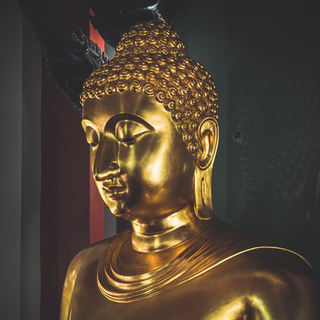
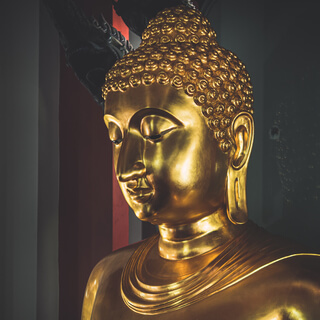
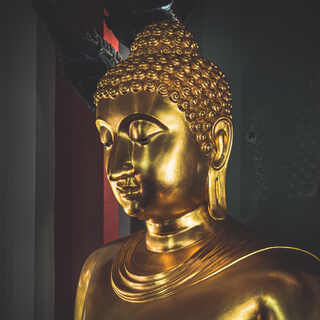
We may wear a Buddha statue amulet.
It's a refuge,
Something we attach and remember for us to think about doing goodness.
And then we follow the teaching of the Sammasambuddha,
The perfectly self-awakened one,
In the path of practice.
This is the foundation about entering the path of practice.
Or we wear an amulet,
A medallion,
With an image of an enlightened teacher.
And it's for us to recollect that we will practice following his teachings.
When we practice it often,
We recollect it often.
Then it's in the heart already.
When it's in the heart,
We can remember it instantly.
And we follow practicing those teachings he taught.
That whatever we attach to,
We will suffer in that thing.
This is what Venerable Ajahn Ginnari taught to Ajahn Chah.
Venerable Chah,
Whoever you miss,
That person will be a danger to you.
At that time,
Ajahn Chah was missing his mother.
And Venerable Ajahn Ginnari taught him a deep Dhamma.
Or sometimes Ajahn Chah would watch the black ants and red ants biting each other.
Ajahn Chah would cheer for them.
When the red ants bit them,
He would cheer on the red ants.
When the black ants bit them,
He would cheer on the black ants.
And Ajahn Ginnari,
The elderly monk,
Walked over.
Oh,
You're up in heaven.
Oh,
You've dropped to hell.
And Ajahn Chah contemplated about going up to heaven and dropping to hell.
So he clearly knew heaven and hell was in his mind.
Therefore,
We in this world,
If we have liking and feel pleased in whatever thing,
We go up to heaven.
We dislike and are displeased and we drop to hell.
All the time,
This is happening.
So we notice and be careful of our mind to not have liking or disliking.
The enlightened teacher teaches briefly like this.
But it's not that they got it easily.
They needed to go through difficulties to train and instruct their minds.
Think about it.
Staying in the cemetery every day for many days.
People carrying in the dead people to bury there.
In the day,
There would be a bird chirping to send the signal.
And in the evening,
There would be someone coming in who died,
Being buried every day.
It's not easy for a Dhamma practitioner who is training and instructing their minds.
It's not easy to live in the forest and have to face all the tigers and wild animals.
And fear arose.
But Ajahn Chah could overcome it until he got wisdom.
To get wisdom,
The mind needs samadhi,
Concentration as its foundation.
And wisdom arose.
When he was really scared,
He would take the alms bowl to be his friend.
Think about it.
Have we ever done it?
Taking the alms bowl as a friend.
And we feel warm in the heart.
Doing this because of being so afraid.
So Ajahn Chah asked,
What do I fear?
I fear death.
So wisdom answered,
Is there anywhere where you can't die?
There isn't anywhere.
When there was acceptance of this,
Then the brightness arose.
After that,
He never feared death again.
Here,
Fear came up strongly.
But wisdom was brave and could win over the fear.
Sometimes when we have fear,
We contemplate it and then the fear disappears.
Then fear arises anew.
Here we haven't cut off the root of fear.
We need to meditate onwards.
So we are afraid of death.
When we are scared of death like this,
We have suffering waiting up ahead.
If we are not afraid of death,
Then we die and we let it die.
We accept it.
It's normal.
Sankhara's bodily formations are suffering.
We put it down.
This is someone with wisdom.
Having wisdom,
One can put it down.
There is no fear.
Even when they are about to die,
They don't have fear.
No attachment,
No worries anymore.
This shows the mind is at ease.
So we need to contemplate that this body,
After death it's like a log.
Like a fallen down tree.
The tree falls down and becomes a log.
Left lying there and the log festers,
Rots,
Decays,
Breaks apart.
It's normal like that.
There was a western monk who went back home to visit his father.
And they went to take a walk in the forest.
And they saw a tree that had fallen down.
And the monk's son said,
Father,
Do you see that log?
Our lives,
After we die,
We throw away the body in the forest like this.
It decays,
Rots and breaks apart like this log.
And this is a deep Dhamma.
The father heard it and was deeply impressed.
He had never thought of it like this.
He had taken walks in the forest and seen trees fallen down and never thought anything about it.
He thought it was normal.
But he had never brought the contemplation in that when this body of ours dies and the mind leaves it,
We throw it away like this log.
It has no value,
No meaning.
When the body has no consciousness,
Then the body is like a fallen log,
A piece of timber.
The arm is like a piece of timber,
The body like a log.
The father was very impressed with this Dhamma.
It deeply entered his heart.
And after that he said he meditated on this every day.
Meditated on this every day,
Continually on this.
And ultimately you can see the Dhamma.
You get to accept it.
Every day,
Every day,
Meditating that our body is like a log.
When the breath ends and the mind has left it,
Then the body is like a log.
We have to throw it away like this,
Like this.
Every day,
Every day,
We meditate like this.
One day we know clearly that it's truly the way it is.
Just that much and oh,
We see people walking around and it's like a robot,
An AI walking.
It's not us anymore that are walking around these days.
It has consciousness residing in it.
But the body knows nothing at all.
It's like a log or a physical being.
Here it's seeing the Dhamma.
Contemplate like this until you see clearly,
Until you know clearly.
This is important.
At that time that we are contemplating it and see it,
The mind is not liking or disliking,
Right?
We have rapture and bliss arise.
This is the path that we'll see Nibbāna or see the Dhamma.
It's up to how much of the strength of samādhi and wisdom you have.
So may you keep growing and developing,
Developing your spiritual powers to be strong.
May you set your hearts on this.
May you attain and see the Dhamma.
May you grow in blessings.