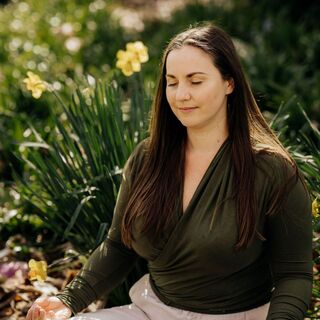
We cannot lead someone to a place where we have not been.
Truthfully,
We cannot do that.
Welcome,
I'm Adrienne Jarrett,
And today I'm sharing an interview that I did earlier in 2026 with the incredible Indu Arora,
Where we discussed the nuances and common misunderstandings of Yoga Nidra.
This episode was repurposed from my podcast,
All Matt's Taken,
Which typically creates content for yoga teachers specifically.
But this was such a good episode to understand Yoga Nidra,
Which is a practice that I share here and will be sharing more of in the future.
So if you're interested in learning more about what this practice really is and the benefits that you can see from practicing it,
Stick around for today's interview.
Rooted in empowering and inspiring students to awaken the inner guru,
And her core philosophy is yoga is a work in,
Not a work out.
So yoga nidra has very much found its fame in helping people get to sleep,
But it's not really what the practice is all about.
Could you,
Just to begin,
Explain to our listeners if yoga nidra is not about sleep,
What is it?
And maybe just a little bit about what yoga nidra is for anyone who's not familiar with the practice.
Thank you so much,
Adrienne,
First of all,
For having me.
And it's wonderful to be here.
Wonderful to be back.
So yes,
Yoga Nidra and sleep,
Why do they always get taken as synonyms or why it is being misunderstood as sleep?
Has sleep anything to do with Yoga Nidra?
The answer is yes and no.
The yes part of it is nidra.
The word nidra means sleep.
But what we are missing is the word yoga from it.
The word yoga,
When it comes prior to sleep,
Means a level of awareness.
So whilst the body and the brain is mimicking sleep,
There is a parallel layer of consciousness which maintains awareness,
A relaxed awareness.
So that is where I think a little bit of nuance is there.
A little bit of knowledge of the word itself can bring us closer to the concept,
Closer to the idea.
So there is something related to sleep and there is a very unique gift of sleep.
And the unique gift of sleep is that during sleep and specifically in non-rapid eye movement sleep or deep sleep or slow wave sleep,
The mind is absolutely in the deepest level of rest.
Which means that our energy is not going into thinking,
Memorizing,
Healing it is just deeply it's it's really close to the definition of yoga as per Patanjali yogaha chitta vritti nirodha so it is closest to nirodha closest to free from fluctuations free from modulations But the.
.
.
Catches!
In ordinary sleep it is almost impossible to stay aware or awake but in yoga nidra that's exactly what we are striving to do.
Why do you think that the yoga part has been kind of lost from it?
Is it just because we're all tired and anything that we think of helping us sleep has been like latched onto?
I think you've kind of nailed it down,
A part of it for sure,
That we are a sleep-deprived society.
Sleep has become.
By World Health Organization has declared sleep as an epidemic of our times,
That this is a real issue.
We are not able to fall asleep or not able to stay asleep.
Or even if we fall asleep,
It is not deep sleep.
It is not restful.
So our mind really needs that rest.
Anything that sounds like even the faintest promise of rest feels very attractive.
But there is another aspect of it too,
Why we are so much fixated on the nidra part of it and not so much on the yoga part of it.
Because whenever we think of a tool or a method,
We are always thinking of benefits.
Our mind is so super focused on what can it give me,
What can it bring to me.
So our practices are not really towards yoga,
The goal of yoga.
Is yoga.
It is not deep sleep.
It is not flexibility.
It is not strength.
It is not immunity.
It is not to heal lower back aches.
Now,
Does it end up helping us to some degree towards all these experiences?
Yes,
But that's not what yoga as a philosophy and as a practice was designed for.
Anything in yoga has only one purpose.
That is yoga.
And when we remove yoga from yoga nidra,
We have made it a tamasic practice.
We can derive benefit out of it,
No doubt about it,
But.
We cannot call it Yoga Nidra.
And if we do fall asleep during yoga nidra,
Does that mean we're just completely doing it wrong?
Are we missing out on all the benefits of it?
For anyone that does,
I fall asleep regularly in yoga nidra,
But I've also got a toddler,
So I'm incredibly sleep deprived.
But is there any way that we can practice to avoid falling asleep and stay in that,
The yoga and the conscious sleep side?
First of all,
There are no judgments in a person's yoga journey.
I think we have to always remind that.
To ourselves and always give ourselves and others grace.
Because what we see.
.
.
In a person's life or a part of person's life.
It's just a very,
Very,
Very tiny window.
We don't know how they practiced before and how their practice will evolve later.
So I think it's pretty immature to be judgmental about someone's practice.
That is point number one.
Point number two,
It's absolutely normal and natural to go through.
You just said that you have a toddler.
So you know that when a toddler as an infant moves towards growing into a toddler and a tiny human,
They go through different stages.
They don't just start walking.
They start crawling,
Becoming wobbly,
Falling,
And then taking those tiny wobbly steps,
And then maybe walking with complete control.
We are infants in yoga.
Of course we are going to crawl and wobble and fall.
That's absolutely okay.
What is important is what is the goal in mind when we are practicing yoga nidra.
If the goal is clear and during the practice we fall asleep,
That's absolutely okay.
Our efforts are sincere.
Our dedication,
Our honesty is up to the mark.
And during the process,
Whatever happens,
It happens.
And now you brought out a very,
Very important aspect of this in your question that is there something that can be done to avoid it?
And I think that's a very,
Very important question to be asked,
An important area to be explored.
What can what can I do which can make the effects of a practice better or more conducive or more close to the purpose of yoga itself?
That is prepare.
No journey begins without preparation.
The problem with Yoga Nidra is we begin the practice by lying down.
And we do not take into account that Our mind lives in the body,
Our consciousness is in this body,
And this body goes through a lot.
So those pains and aches and stiffness in the joints,
The dryness of the skin,
The fluctuating breath,
The gurgling sound in the stomach,
The stiffness in the lower back,
We have to take these things into account and each practitioner of Shavasana and Yoga Nidra has experienced it that the moment I lie down and start following the cues Within 10 minutes,
Either I drift off or I start feeling achy or stiff or groggy or irritable.
We know what our unique challenges are.
The problem is we are not learning from them.
So once you learn that the challenges are generally coming from your mind or your breath or your body and in your body from your digestive system or your musculoskeletal system,
Prepare.
Do practices in advance to prepare because == Notes Now that you know better,
Hopefully.
You do better.
Makes sense.
You talked about the journey of yoga nidra.
Would you like to share a little bit about your journey with the practice?
When did you start practicing and how has that evolved over time?
Generally,
I avoid talking about my personal practice and the reason for that is Every person's journey is very individualistic.
And sometimes,
Sometimes when we hear about a person's journey,
We start comparing.
That,
Oh,
My journey looks different,
Or my journey did not start at that age,
Or I did not have that kind of teacher,
Or I don't have access to this kind of book.
And the most important thing about a yoga journey is that it's really,
Really individualistic,
Which means that It changes based on a human being's,
A person's individual capacity.
Physical,
Mental,
Emotional,
And the resources around them at that time.
I will tell you that my sincere attempt of Yoga Nidra began somewhere in two thousand.
Early 2000.
And that is when I really,
Really started paying attention to the gift and the promise of Yoga Nidra and consciously started involving myself in the thought process,
Not just the practice of it.
And how has it changed?
It has opened up endless resources in my mind.
The gift that is talked about this practice in numerous texts,
Whether it is Hatha Yoga text,
Whether it is Tantrika text,
Whether it is in Upanishads,
The Vedic texts,
The Puranic texts,
And each text gives you a specific angle that allows one to come closer to the concept,
To the philosophy,
To the state of Yoga Nidra.
And it also beautifully,
Mystically,
And very clearly changes how you do the practice.
So for me,
What became clear is.
.
.
That yoga nidra as a practice which means the steps towards it is not equal to yoga nidra.
Those are just preparatory steps which may or may not lead to yoga nidra which is a state.
That makes sense.
I'm very fascinated with untangling what is said in the ancient practices versus what has become really modern.
And I've noticed so many things in yoga,
They are just modern mysticism masked as ancient practices.
So can you walk me through a little bit of the history of yoga nidra?
What is talked about in the text versus the practice we know today?
Is this the same?
Maps that we use in Yoganidra,
Are they ancient or were they developed in the 60s or was that just when they were written down from being passed down through lineages,
If that made sense.
Absolutely makes sense and I so appreciate your thoughtfulness and sincere curiosity from which you are asking.
I so so appreciate that Adrian and I sincerely hope that the listeners will benefit from it or at least become more curious or motivated to learn more.
So the steps that we see today.
Which makes yoga nidra a practice,
Also reduces it to a technique.
It's very new.
It's not even last 100 years.
It's not even been 100 years since Yoga Nidra has been codified as a practice and not just a practice but a list of things to do and a technique that promises certain benefits.
So those practices come from individual and certain lineages' explorations.
And there's nothing wrong.
They are really gifts to humanity that someone decoded a state and gave us certain guidelines that this particular state can be reached through these steps.
The problem is we have made it into a box.
That this is the way.
And we have forgotten the philosophy.
So we have stripped the philosophy out of Yoga Nidra and only kept Nidra and removed Yoga out of it.
I'm going to give you share some.
Ideas,
Some thoughts,
Some historical textual references that are coming to my mind.
The one of the ancient most epics is Mahabharata.
And Mahabharata,
This great text,
Talks about Yoga Nidra as the sleep of a God by the name Vishnu.
So Vishnu's sleep,
A divine being's sleep is referred to as Yoga Nidra.
And later on in a text called Devi Mahatmayam,
Which is a part of Markandeya Purana,
The same Yoga Nidra is talked about as the manifestation of a Goddess.
And those two are links.
So Yoga Nidra is the manifestation of a Goddess which presents itself as sleep of Vishnu.
But the sleep of Vishnu is no ordinary sleep.
The sleep of Vishnu is the dissolution of the entire manifested world and it is a state between two creations.
So we can call it really as a state of Samadhi.
Complete Dissolution but at the divine level,
At the level of Vishnu where this dissolution means the dissolution of everything possible that is manifested.
And the power that causes it is Yoga Nidra,
That is the Devi.
So that is one way to look at it.
Either the God-sleep or the manifestation of the Goddess as sleep.
But then Yoga Nidra is also talked about in Satha Yoga texts.
For example,
There is a Hatha Yoga text call.
Hatha Yoga Pradeepika or Hatha Pradeepika.
In that text,
Yoga Nidra is talked about as a mudra.
As Kecchiri Mudra.
That with the practice of Khechri Mudra,
One enters the state of Yoga Nidra.
And then there is another text of Raja Yoga which is called Amanasaka.
Which means beyond mind.
There the same Yoga Nidra is talked about as a different Mudra that is called Shambhavi Mudra.
The same Yoga Nidra in Tantrika texts is talked about as a state that is immutable peace.
A state of immutable peace.
That is the state of mind.
In Mandukya Upanishad.
It is talked about as sthurya,
Which is the fourth state.
Fourth means beyond the three.
What are the three?
Wakefulness,
Deep sleep,
And dream.
That these are our three ordinary states.
Everybody experiences wakefulness.
Everybody experiences dreaming,
Whether daydreaming or nightdreaming.
And everybody experiences deep sleep.
Whether this deep sleep is every night's deep sleep or absent-mindedness during the daytime or completely ignorant state of mind where we choose to stay ignorant or we are ignorant about something.
But these are ordinary state.
We all experience it.
But in Mandukya Upanishad,
Yoga Nidra is the fourth one,
Turiya,
That state which is the underlying undercurrent like the canvas behind the painting.
It is the underlying behind all the three states that all other ordinary states are fragmented reality and Yoga Nidra is that constant Immutable Non-perishable Consciousness.
So you see,
There are so many ways and I have not even listed all.
I've just given you some ideas that are coming to my mind in this moment.
But there are so many different ways to look at Yoganidra in every single text that you pick up.
Whether it's through the lens of Mahabharata through the eyes of Vishnu or through the eyes of Goddess that is Yoganidra or as the fourth state Mandukya Upanishad or an unbroken piece Every time or a kind of another thing that's coming to my mind is.
Yoga Vasishta where there is a dialogue between a Guru and the disciple where the Guru is guiding the disciple that is Rama that build your tapasya,
Your discipline,
So that you can experience the silence of deep sleep in wakefulness.
So there it is talked about as a kind of silence.
But you see peace,
Silence,
Then of course in Yoga Sutra it is talked about as a means to Samadhi.
As a tool to Samadhi.
So every single time you pick up a text which is related to Yoga Nidra and read about it and explore it,
Your practice is going to look different.
It won't look like the same 7 or 8 steps.
That is from a Tantrika perspective where we move our awareness through certain points which are the Marma points,
Which are the points of Pratyahara.
And that is one of the methods one of the methods.
To attain the state of Yoga Nidra,
Not the only method.
And I think that is so freeing.
At least the student in me feels so empowered and so free because one tool cannot work for everybody,
One method cannot work for everybody,
Especially for people who are not very visual.
Then to constantly visualize,
That can be very tiring for the mind.
So there is no one correct way to enter into yoga nidra.
What we need to do is we need to have solid understanding of the philosophy so that we can then choose the path that this is the philosophy that promises this particular experiential realization of this state.
That's interesting,
Because often you hear about,
You didn't mention them yet,
The koshas,
And that we follow the step through the koshas to reach Yoganedra.
How does that tie into yoga?
All of this is that one of the parts to.
.
.
Hopefully obtain the state of yoga nature.
It's a really interesting question and I'm so excited to share.
Understanding the body.
No,
Let me rephrase it.
Understanding the Self.
Self with a capital S.
The consciousness.
In order to understand the self,
Different texts give different pathways.
Not just one pathway.
Panchakoshas is one pathway that is talked about in Taittriya Upanishad,
Specifically the way the five koshas are lined up.
Mental sheath or emotional sheath,
Mano maya kosha,
Intellectual sheath,
Vijnana maya kosha,
Bliss sheath,
Ananda maya kosha.
This particular sequence of koshas is talked about in Taittriya Upanishad.
Where is it leading us?
To the self.
I'm going to say one thing here.
We still get stuck in kosha,
Because we mistake the fifth kosha as the self.
What is kosha?
The word kosha means a container or a bag.
Bag which contains something.
So these five bags,
One inside the another,
Are containing something.
When we mistake our soul as Anandamayakosha,
We are mistaking the bag for the contents.
That bag also has to be opened up so that nothingness unveils itself that nothingness almost think about it if you have something and it has five layers before you can reach the center as you keep peeling peeling layers and layers and layers even the last layer what is revealed or unveiled from inside is empty space But what's the difference now,
This empty space inside and the empty space outside,
There is no separation,
They have become one.
So even through the 5 kosha pathway we are getting stuck in the 5th kosha,
We are not going beyond it.
The Taittiriya Upanishad says that the soul is Pancha Kosha Vyati Raktaha,
Beyond the 5 koshas lies the soul.
Now we have also heard through yoga texts that the understanding of self comes through three bodies.
Physical body,
Sthool sharira.
Subtle body,
Sukshma sharira.
Causal body,
Karan sharira.
So you can approach Yoga Nidra through three-body pathway,
Not necessarily through five-kosha pathway.
And wait,
Then Ayurveda says that the prana is the precursor to the consciousness.
Prana enters the body and gives birth to 7 tissues.
The skin tissue,
The blood tissue,
The muscle tissue,
The bone tissue,
The adipose tissue,
The nervous system tissue and the hormonal tissue.
Now are you entering the yoga nidra through the 7 tissues or 5 pranas or 5 elements or 5 koshas or 3 bodies?
How are you entering?
Because look,
Right now as I'm talking to you,
I'm sitting in a room and there is a door and there is a window.
I can enter into this house through the door.
I can also jump through the window.
I can also use the power of my imagination and just imagine myself in this room.
Isn't it?
I can also break the wall and enter the room.
Are you getting what I'm trying to say?
You have to choose the pathway.
Because when the pathway is clear,
Then you know not to deter from it,
Not to get confused.
But also Have that awareness in the mind that there is more.
You can stick to one path,
But not with the ignorance that there is nothing else.
Stick to your path,
But with the knowledge that there are many other ways to enter,
To become one with the consciousness.
And when we know that,
We appreciate the diverse wisdom that is available in these texts.
And then we are able to share it in a way that becomes accessible to so many people.
For some,
It could be the lunar goddess state.
Bhakti Yoga.
For some,
It could be the intellectual state that Raja Yoga is talking about.
For some,
It could be through the path of self-enquiry that Vedas are talking about.
Koham,
Who am I?
Naham,
I am not that.
Soham,
I am that.
How are you going to enter into that state?
And bring light into the darkness.
The most dark place of our mind is when we go to sleep,
Right?
All the senses are turned off.
We have no awareness what's happening in the outside world.
The external world of sense objects has completely dissolved.
So that is why it is the state which is closest,
The darkest state for our mind.
How do I bring luminosity here?
That is yoga plus nidra,
Not just nidra.
Turning off the lamp in that darkest state.
How do people get stuck at that last stage?
How do they shift past that last kosher?
Is it just the understanding of that this is a state and there are many pathways to it and sitting in that will help you reveal it rather than getting stuck that there's a certain path that you need to follow?
Is no certain path.
The biggest gift of these texts is the philosophy,
The understanding,
Which means we have to chew upon it.
So one of the things that is coming to my mind is.
When you are in a position that feels right for Yoga Nidra,
Most commonly suggested is Shava Asana.
And most common picture in mind for people when they think of shavasana is lying down supine.
No,
It's not the only position.
So that is why I'm saying,
In a position that feels right for shavasana,
In that position.
When we enter when we are entering into that state of yoga and realizing that this state is filled with nothingness filled with nothingness So then we know there is nothing to hold on to.
As long as you're holding on to an image,
A sensation,
A thought,
A visual,
A texture,
Know that it is not there yet.
The same can unfold if you are thinking of doing your asana practice through the lens of panchakoshas.
Then when you are in the asana,
When you are in that center stage,
That is madhyastha,
The center of an asana,
In that moment after adjusting,
After evening out your breath,
Let there be that moment where the asana itself brings you to the meditative state.
The asana itself then don't worry about the muscles or the joints or the breath or this thought or this mantra.
When there is nothing to hold on to.
The only support is void is nothingness.
That is when you have arrived.
Or when you are able to experience indisputable,
Immutable silence,
Which means it's not something that's created.
It is something that is perennial.
Or peace.
Then you have arrived.
That irrespective of the pains and aches in your body and the chatter of the mind,
None of this is going to stop.
We are in this body.
There will be pains and aches.
We have the mind.
It's not going to be a state where the mind stops.
No,
You enter into deeper state of mind.
So the shallow layers do not bother you anymore.
They coexist.
So in this state of yoga nidra,
It's not that everything else disappears.
It is just that you have stopped.
Relating to it,
You have stopped interacting with it,
You have stopped reacting to it.
They coexist.
So in that state,
There is nothing else to hold on to and that is why There is an illusion when people talk about that I had this experience in Yoga Nidra.
The experiences that we have is either before yoga nidra or after yoga nidra.
The state of yoga nidra itself is devoid of any duality.
What is yoga?
Yoga is 1 plus 1 is equal to none.
Not 1 plus 1 is equal to 2 or 11 or infinity.
1 plus 1 is equal to none.
That is yoga.
There is no duality.
Neither the subject nor the object.
So as long as we are recounting,
Oh,
I had this experience,
We are only talking about when the mind is differentiated.
The mind has not completely merged with the soul.
So there is nothing to recount.
From Yoga Nidra.
It is a deep dive into a place where nothing remains.
So,
When there is nothing,
Then what are we recounting?
What are we narrating?
We are only narrating that which we can see,
Which we can hear,
Which we can smell,
Which we can taste,
Which we can feel,
Which means we are back to the realm of body and mind.
That makes sense.
You've said that yoga nidra is not just about reading a script,
It's about a transmission of your state.
As a guide,
How can we enter the state of transmission versus just reading a script?
And what's the difference in the person experiencing the session if we're just reading a script versus if we are able to enter a state of transmission?
Let me explain from the angle of brainwaves.
A human being commonly experiences these brainwaves,
Which is Beta,
Which is when the mind is engaged and active or worrying or thinking,
Like you and me right now,
Talking,
Engaging with the external world or engaging with your own mind.
But it's very active,
Active mind,
Better.
Then,
There is alpha,
Which is relaxed awareness.
As we are going into meditation or we are relaxed,
Our mind is relaxed.
We are slowly turning inwards.
Think about it as when we enter into shavasana.
Or when we enter into meditation,
Or we are doing some activity which is repetitive,
So the mind doesn't have to do a lot of thinking.
Then there is Theta,
Which is a drifty state,
Which happens when we are in dreaming state or when we are drifting.
A lot of time when people experience this drifting,
They think they are in Yoga Nidra,
But that is Theta.
Then there is delta,
Which is the slowest brain wave,
0.
5 to 4 beats per second,
Hertz per second.
This is the slowest brainwave which we experience when we are in.
.
.
Deep sleep or in Yoga Nidra.
Nidra with awareness.
When we are reading something.
We are in better.
And there is something called I'm thinking of the word,
It's kind of missing me right now.
Frequency following response.
Which is when I speak.
Depending upon the state of mind that I speak from.
It produces a certain frequency.
The frequency that is produced is not just based on the use of my vocal cords.
The frequencies produced based on the state of mind that I am in.
Irrespective of the content of what I'm speaking,
Your mind recognizes the frequency,
And in the form of neuroplasty,
It becomes easier for the mind to follow that frequency.
So let's say if someone is reading the script,
Relax your toes.
Now they're saying the same words,
Relax your toes.
But their own toes and fingertips are tensed.
So the frequency that is being carried in their voice versus what they are saying is not matching.
There is a definition of yoga which says that when what you say and what you think and what you speak or what you do are the same,
It is yoga.
So when the problem is not in reading something.
My limited awareness and I say limited because it is.
My limited exploration of this subject so far is We cannot lead someone to a place where we have not been.
Truthfully,
We cannot do that.
So how do you work towards that transmission?
You have to work on yourself.
You have to work on your practice.
There is just no other way.
No matter how many texts you read.
OK,
Indhu,
I have read 10 different historical contexts of Yoga Nidra.
That's not going to change your transmission.
That's going to change your intellectual understanding,
Appreciation and the knowledge of should I take the highway or should I not take the highway or how should I go from point A to point B.
It is your practice that is going to change the way you speak.
And the way you speak means the choice of your words.
The way you speak means the tone,
The space between the two words?
The appreciation of silence.
The time between one sentence and the other.
All of this is going to change.
Because there is a recognition through your own practice and understanding and experience that.
When I'm listening to something is not exactly the moment that I'm following it.
So it's the same happening for the other practitioners,
That when they listen to this cue,
Relax your toes,
It's not that,
Oh,
Immediately there is a switch and the toes are getting relaxed.
The person is hearing the sound,
The sound is becoming words,
The words is gaining meaning,
And the brain is then sending the signal.
Command to relax.
That is a time.
Between hearing and following.
And that appreciation comes with experience.
Beautiful.
You've mentioned preparing.
So for anyone that's listening that wants to work on their own practice,
First and foremost,
So that they can then guide people later,
What are some ways that people can prepare to then enter or guide the state of yoga nidra?
Absolutely.
I think the tool or the practice that one can use to enter into the state of Yoga Nidra effortlessly will depend upon when are they doing the practice.
Right upon waking up,
Middle of the day.
In the evening hours because then your energy levels and energy capacity and your goals will be different.
So.
.
.
In the morning hours,
What can really be beneficial is doing couple rounds of Surya Namaskar.
So warm up those muscles and joints and make the body limber so that you don't feel that stiffness in your lower back,
In your ankles,
In your neck.
And you don't feel like cracking and popping the joints.
And you don't feel that coldness in your body.
A lot of people feel cold hands and feet.
So you're already addressing it by generating a little bit of warmth and spreading the energy from the center to the periphery.
Knowing that in yoga nidra it's going to move back to the center and the extremities are going to feel cold or restless.
So just a few rounds of surya namaskar or simple practices like apana kriyas,
Joint rotation practices,
Those can be really beneficial.
Verses in the middle of the day,
Some breathing practices,
Longer exhalation,
Maybe just the chanting of OM,
Extending the humming,
Where you can take the inspiration from.
Mandukya Upanishad,
Om as the pathway to Yoga Nidra.
Where you prolong the humming and prolong the humming and do it for two to three minutes.
And that can really help you work on the prana,
Work on the nervous system.
And make the practice a little bit more effortless.
Versus if you're doing it in the evening when the body is tired,
Hands and feet are achy,
You know,
So much scrolling or sitting on the desk or standing and doing the job.
We know that all that energy and stress has gone into the hands and feet.
That is where a tool like MarmaStick,
Which is a wooden stick,
Rubbing it between the foot soles and palms and rubbing it till you feel warmth,
That can be really good to remove that achiness,
Stiffness and stress from the inner bendings.
Or even application of oil,
Sesame oil,
Warm oil on the body that can really help take away the daytime fatigue and make it easier.
So the point is tools are many.
You will have to check in.
You know,
We are kind of becoming very,
Very dependent in yoga.
Somebody tell us what to do.
Give me one magical cure.
Give me a script.
Give me one thing.
And the beauty of yoga is that yoga A state of realization,
Think about it as a point.
And just like around a point that are 360 degrees.
In the same way,
Around this point called yoga,
There are 360 pathways,
Just for the sake of this example.
And we are saying,
Someone just tell me one.
And as much as one might work for you,
But it will also always create dependency and hierarchy because you have not realized that path through your own inquiry.
And you never thought about applying another path and seeing that,
Does that work better for my capacity or my state or my situation?
And also it will keep the mind boxed.
So the point is we have to do the hard work.
There is just no other way in yoga.
I mean,
Whosoever told us or we thought or we assumed that the path of yoga is easy has mistaken it.
The path of yoga requires courage,
Dedication,
Hard work,
Consistency,
And trust.
It simply requires it.
Nobody else can provide solution.
They can provide only cues that may or may not work.
Don't look for that hierarchical relationship.
This is a path of self-discovery.
Exploration.
Realization.
The power is in your hands.
But you will have to work for it.
So you will have to check in with your body,
What is working,
What is not working.
Yeah,
So many people are always trying to find that one answer for themselves or get someone else to do it for them.
But we have to turn inward for the answers.
It's just the way it is.
What was missing from this conversation that you feel is important for the listener to know about yoga nidra,
Whether that's guiding it or practicing it?
Either way.
I think,
Adrienne,
You've brought in some really,
Really interesting,
Thoughtful,
Intriguing queries.
And that helped already bring out.
I hope a very holistic conversation for the listeners.
If there is one thing that I would say,
It's not lost from Yoga Nidra.
There is a lot that,
I mean,
It's a subject that I absolutely love and I'm passionate about.
And if you're curious,
Come and study.
If there is one thing that I would say,
And it is this,
Don't settle for anything less than yoga and yoga.
We are making a bad deal with yoga.
There is so much it can offer.
In fact,
What it can offer is everything and nothing all at once.
And we are simply settling with fractions.
With little tidbits.
We are simply settling for the shiny things when it is offering us absolute immutable luminosity.
So keep studying.
Don't let settle for anything less than yoga and yoga.
Beautiful.
I love that.
Everything and nothing all at once.
That's so true.
It's the perfect way of encapsulating it.
I could listen to you all day,
But time is only finite,
Unfortunately.
But thank you so much for taking the time to talk with me this morning.
And hopefully we can meet in person.
That would be magical.
And I hope you have a wonderful rest of your day and safe travels to Australia.
Thank you so much,
Adrienne.
It is always wonderful talking to you.
You always bring up such intelligent,
Thoughtful,
Curious questions.
I really,
Really hope that the listeners have benefited through this conversation.
My good wishes to you.
My good wishes to the listeners.
May we all continue walking this path of yoga.