Let's try some GMI.
By visualising the body part that's in pain,
We actually refresh our brain movement map and keep it nice and healthy,
Which has been shown to ease pain in time.
And just like in real life,
There's no need to start by doing everything at once.
So in this practice,
Start simple and then slowly challenge yourself.
I'm going to give you some ideas from easy to more advanced,
And if they cause no discomfort or very minor emotional or physical discomfort,
Then you can move on to the next step.
Otherwise stay at the step that's just a little challenging.
This practice is meant to be a progressive desensitisation.
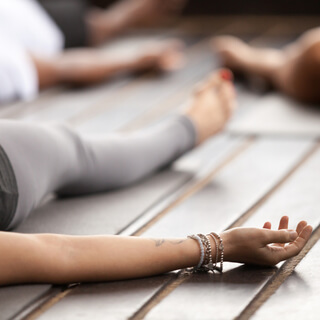
So taking a comfortable seat or lying down if you prefer,
And taking several nice deep belly breaths with a big sigh out to release any unnecessary tension.
Now close your eyes and see the whole of your body in your mind's eye.
Do this for a few seconds,
Breathe and relax.
Then open your eyes.
So do this a few more times.
Close your eyes,
See or sometimes for some people it's more sensing the whole of your body in your mind's eye.
Do this for a few seconds,
Breathing and relaxing.
Then open your eyes.
You might like to pause the recording at this point and do this a few more times.
Only move on to the next task when you really feel ready.
So now closing your eyes and see the difficult area of your body in your mind's eye.
If there's lots of difficult areas,
Just choose one.
To do this for a few seconds,
Breathe and relax.
How are you going?
If this is really easy,
Then just do this another few times.
Closing your eyes,
See or sense the difficult area of your body in your mind's eye.
Do this for a few seconds,
Breathe and relax.
So again,
You might pause the recording here and do this several more times.
Or you might move on with me to the next level.
And if this is enough,
You might even pause the recording and just pendulate between sensing the whole body and then the difficult part.
We're really wanting this sweet spot where you can stay for a while with a bit of a challenge,
But when it's not overwhelming.
And the idea is you can gradually increase how long you stay with the part or how often you do,
How many repetitions you do.
So if you're moving on to the next step,
Again,
Close your eyes.
Breathe and relax and see or sense the difficult body part at rest in various positions.
So the first one might be visualising the body part sitting in a chair.
Breathe and relax.
Do this for a few seconds.
And again,
You might like to pause the recording here and repeat this a few more times if it feels OK.
And now you can try some different positions.
So close your eyes,
Breathe and relax.
See your body part at rest lying on your back.
Pause here if you need to.
Pause the recording so you can try this on your own a few more times.
And then closing your eyes,
Breathe and relax.
See your difficult body part at rest lying on your side.
And again,
You might pause the recording.
Try this a few more times.
Closing your eyes,
Breathing and relaxing.
Seeing your body part at rest lying on your side.
And then moving on to closing your eyes,
Breathe and relax and see your difficult body part at rest in a standing position.
Again,
Pause the recording.
Try this a few more times.
Spending a few seconds there,
Breathing and relaxing and seeing your body part at rest standing.
And if this is all going quite well and it's easy and it's not causing pain,
Great,
Move on with me to the next level.
But if these are really quite challenging physically or emotionally,
Then just drop back to the step that was a challenge but not overwhelming.
It's not a good idea to overdo this.
It's a really,
You're really wanting to find that sweet spot to practice in and notice the changes as you practice this.
And I'm talking over days,
Weeks.
Yeah,
Not just hours.
So if you're moving on to the next level with me,
Close your eyes,
Breathe and relax and see your difficult body part moving now from a neutral resting position to another position.
So for you,
This could be moving from lying to sitting or sitting to standing.
And as you see your body part breathe and relax,
Hold the position for a few seconds and slowly return to the neutral position.
Do this a few more times,
Breathing and relaxing,
Seeing that difficult body part moving from a neutral resting position to another position,
Perhaps even enjoying the movement.
That can be really powerful.
So pause here if you need to,
To practice this,
Seeing how long you stay with it,
How many repetitions you do.
So if this was quite doable,
That's great.
Move on with me to this final level.
But if this moving one was,
Moving in your imagination was very challenging physically or emotionally,
Then again,
Dropping back to the step that was a challenge but not overwhelming.
Kookaburras are coming in on the meditation.
I think I'll leave them in because they're nice.
So next step,
Perhaps before you close your eyes,
You might identify some tasks that you would like to engage in,
That you'd like to have a goal eventually.
Be quite specific.
Perhaps it's a certain yoga stretch or going from sitting to standing or something that you do with the gardening or dance or other activity.
Maybe it's unloading the dishwasher or picking the bath mat up off the floor.
So once you've decided,
Close your eyes.
See the task.
See yourself performing the task.
Perhaps even enjoy doing the task.
See your difficult body part engaged in doing the task.
Relax and breathe.
And again,
You might like to pause.
You might like to do this a few more times for a few seconds.
Relaxing and breathing and opening your eyes.
So the concept here is actually quite straightforward.
Basically,
Your brain is worried about you.
Exposing it to healthy,
Enjoyable visions of the body and body movement,
Your brain becomes less worried.
The brain maps are refreshed.
The pain eases.
Movement improves.
And this can be wonderful preparation for actual physical movements of the body.
Now,
Obviously,
Everybody's different.
You might have to put a little bit of thought into this or you might ask your health practitioner to give you a little help in making it work personally for you.
Good luck with it.
Thank you.