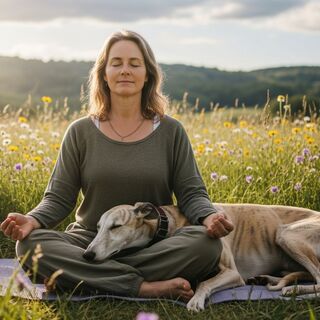
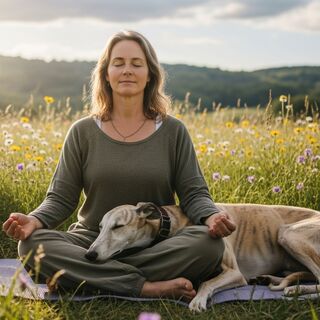
Welcome to Mindfulness and Dogs,
The podcast for dog audience walking the path of reactivity with heart,
Courage and compassion.
I'm Biggie,
Dog trainer,
Coach and lifelong student of mindfulness.
After many years with my own reactive dog,
I discovered that real change doesn't start with training the dog,
It starts with us.
Here,
We'll explore practical,
Force-free tools,
Grounding practices and compassionate strategies to help you and your dog find more calm,
Connection and confidence on your walks together.
Because calmer walks don't start with a quick fix,
They start with you and your calm is your dog's safe place.
Hi,
Welcome to the show.
This is Mindfulness and Dogs and my name is Biggie,
Coach,
Dog trainer and long-time student of mindfulness with a big heart for the messy sides of living with dogs.
Today I will talk about your new superpower.
Well,
Actually,
It's not new,
But it's a superpower nonetheless.
I'm talking about your breath.
But before we dive in,
Let's take a minute together and pause.
Please do not do this exercise while you are driving or operating machinery.
But if you're not,
Take a seat.
If you're not already sitting,
Put your hands in your lap or on your thighs and let your shoulders drop.
Let your gaze grow soft as if you're not focusing on anything in particular and just breathe.
In and out.
In and out.
If thoughts pop up,
Register them and then let them go like leaves on flowing water.
Stay there just a little while longer.
If you're listening to this podcast,
You are probably living with a dog who is very big on expressing their emotions by barking,
Lunging or growling at things they feel uncomfortable with.
When this happens,
Your breath disappears,
Right?
Well,
Mine does.
Quite literally,
I mean.
I hold my breath or I breathe very shallowly and then stress takes over.
I know these situations only too well.
Last time I told you about my many years with Charlie,
My dog was very clear in expressing his displeasure at a great many things we encountered on walks.
Charlie died last year.
Three months after his death,
Lucia entered my life.
She's a six-year-old German Shepherd girl and supposedly the easiest dog in the world,
Or so her foster mother told me.
Things turn out quite differently.
How this could have happened,
How the same dog could be seen so differently by different people,
Is an interesting question,
But one I will answer in another episode.
Lucia turned out to be very affectionate and cooperative with me while we are inside the house.
Outside is quite a different matter.
From the very first day,
She showed reactive behavior particularly toward other dogs,
But also toward other animals larger than herself,
And everything smaller she chases with great abandon.
She also seems to have trouble focusing on things in the middle distance which are not moving.
So,
If there is anything that could presumably be a dog,
Like a child or a baby buggy or a larger bag someone is carrying,
Lunging and barking at it is her first response.
I don't know much about her background.
She was found on a street somewhere in Eastern Europe,
Starved to the bone and in great pain.
Turns out her left hip was completely shot and the right one didn't look much better.
An animal welfare organization took charge of her,
Organized a crowdfunding campaign to enable her to receive a hip replacement,
And afterwards she was placed in two consecutive foster homes before she finally arrived at my doorstep.
It is safe to say that,
Like with a very large percentage of reactive dogs,
Pain plays a part in her behavior.
Of course,
She is on pain medication,
Both conventional and herbal,
And I do everything I can in terms of supporting her with the right kind of food,
With supplements,
Passive and active physiotherapy and acupuncture.
But pain has a memory,
As does Lucia herself,
And what other factors may have contributed to her reactivity in the past I can only speculate about.
Lucia has been with me for close to a year now,
And I have put a lot of things in place to help her with her sensitivity to certain triggers.
I will tell you about all of that another time.
What is important,
Though,
Is that change is a very slow process,
And she is still very much on edge when we're outside.
There was a particular situation just a couple of days ago I want to tell you about today.
We had been visiting my parents the day before.
They are quite elderly and frail and need a lot of support,
So I go there at least once a week,
And of course I take Lucia with me because it's too far away to leave her alone at home.
Changes in her daily routine always put her out of sorts,
As they do me,
By the way.
And I'm usually quite tense while I'm at my parents because I find it hard to reconcile the needs of everyone involved,
My parents,
Lucia's and my own.
So whenever we get back home,
My girl takes at least 24 hours to find back to a place of relative emotional stability.
On the day in question,
We were playing in the garden when a man with a golden retriever walked by.
The dog was unleashed and both were quite calm.
Lucia,
True to herself,
Shot forward like a fury and almost toppled me,
Which made me lose my emotional balance as well for a moment.
I held my breath,
Hunched my shoulders,
And everything inside me shouted,
No,
No,
No,
I hate this,
This is too much,
Stop it!
This hasn't happened for quite a while,
But I hadn't seen the other team coming and been on edge still after the visit of the previous day.
Then I remembered,
Or actually,
My buddy remembered.
She remembered to breathe and to ground herself.
So I just stood there for a few seconds,
Simply holding on to the leash,
Rebalancing myself.
Then I slowly gathered up the leash in my hands and moved toward my still raging girl.
I talked to her softly,
Told her that I would take hold of her harness – this is a conditioned cue we have been working on since the very beginning – and I also announced that I would put my other hand on her chest.
It took her a few minutes more to calm down,
At which point I offered her a tucked toy followed by an informal treat surge in the grass.
And then we went upstairs to the couch and relaxed together.
I'm telling you this in such detail for two reasons.
First,
To show you that a trusting and calm connection to your dog does not depend on ending the reactive behavior first.
And secondly,
To illustrate what can happen when you practice physical mindfulness exercises often enough – they kick in by themselves when needed.
So,
Let's play around with that a little bit.
You can do the exercise sitting,
Standing or even lying down.
Start with observing your breath a little bit.
Don't change it,
Just let it be as it is.
Where do you feel it most clearly?
At your nose?
In your chest?
Around your stomach or deeper in your belly?
Just observe it a little while.
Would you like to deepen your breathing somewhat?
It should still feel easy.
Don't force it.
Just extend the in-breath a little and let it go a bit deeper.
And then let it all go again.
Let the air leave your lungs by itself.
Don't push the air out.
Don't consciously contract any muscles.
Keep breathing a little deeper than usual.
It needs a bit of conscious effort.
And then let the breath leave your body all by itself.
When you have found your rhythm and you have the mental capacity,
Start counting in your head.
Count for as long as it takes you to breathe in.
Maybe that's a count of 2,
3 or 4.
And now,
When you breathe out,
Make the out-breath a little longer than the in-breath.
Maybe you inhaled to the count of 1,
2.
Then exhale to the count of 1,
2,
3.
Try that for a few rounds.
Make the exhalation roughly a third longer than the inhalation.
It is the out-breath that calms you,
Not the taking in of air.
And extending the out-breath is said to activate the calming part of the autonomous nervous system.
Maybe you can feel it already.
And if you can,
So can your dog.
Because your calm is your dog's safe place.
That's it for today.
I'm curious to learn how the exercise resonated with you.
Talk to you again soon.
Bye for now.