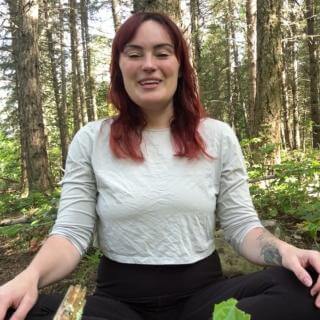
Hello,
My name is Zara and I'm dedicated to helping you regulate your nervous system and rewire your brain.
Today we're going to be doing a really amazing technique called eye yoga,
Which helps to stimulate your ventral vagus nerve and relax your nervous system.
We're going to start by just closing the eyes and taking three deep breaths.
So settling into this moment here and now.
Breathing down into your belly and long exhales.
Allowing the eyes to soften,
To close.
To relax.
Just noticing how you're feeling right now as we begin these exercises.
Maybe setting an intention for your practice.
To relax deeper.
To let go of something.
To settle into the moment.
Or whatever intention will work for you.
I'm now opening the eyes.
And we're going to start.
By tracing our fingers.
In a circle.
And following with your eyes.
Starting with a small circle,
You can go as slow as you need.
And following with your eyes.
We can think about matching the breath.
So maybe at the bottom of the circle,
You breathe out.
At the top,
Be breathing.
Noticing how this feels and seeing if you can Soften any effort.
If it hurts to move your arm in this way,
You can just move the eyes,
Making the circle a little bit bigger.
I'm trying not to stretch or put too much effort in.
With any of these nervous system exercises,
We want to be soft.
Let me just see if we can do a little bit less.
Let's go the other way.
Notice if there's any tension in your jaw or shoulders as you do this.
Try not to move the head or neck.
Could feel mine twitching there,
Trying to move.
And you don't need to do this perfectly.
It's a bit of an experiment.
It's a curiosity.
Just noticing what comes up when we get curious rather than trying to do something perfect.
And releasing that.
Closing the eyes,
Giving them a little bit of a break.
Another brush.
Long exhale.
Now bringing your thumbs out to the side.
And we're going to go left and right with the eyes.
This uses bilateral stimulation.
So it crosses the left and the right hemispheres of the brain.
Which reduces the activity in our amygdala.
So you're going to look left to your thumb.
You can put it as forward as you need to.
And right.
And left.
And right,
And find your own rhythm.
Stretching out the eye muscles helps to stimulate the ventral vagus nerve.
Which keeps us calm and relaxed.
Activating our parasympathetic nervous system.
Rewiring the brain.
Find your own steady rhythm,
Maybe matching the rhythm to your breathing.
Nice long exhales.
A few more.
And closing your eyes,
You can always pause at any time.
It starts to feel stressful.
Or too much,
Or if you feel dizzy.
Listen to your body.
Listen to what you need.
Doing this exercise right.
It just means listening to yourself.
Opening the eyes again,
And you can hold your thumb out in front of your face.
Looking at your thumb and becoming aware of the periphery,
So softening your gaze for a moment.
Deep breath.
Looking into your surroundings,
Noticing little details of the things around you while you pay attention to the thumb.
Sitting up nice and tall.
Relaxing and softening the belly.
And starting to slowly bring that thumb toward you.
All the way to your nose until it gets a little bit blurry.
And then bring it out again.
You can exhale on the way out.
You can inhale on the way in.
Nice long exhales.
Being playful and curious.
Nothing is that precious.
Nothing is that serious.
Just allowing whatever comes up.
Maybe a smile on your face.
That helps to bring more lightness.
And then release your hand down,
Close your eyes.
A deep breath here.
Settling and noticing how you feel after each exercise.
Opening the eyes one more time.
We're going to finish by rubbing our hands together.
Make them nice and warm.
And then hold them over your eyes.
I like to kind of knead my eyes left and right like a cat kneading bread.
Just gently,
Very softly pushing into the eyeballs,
Not too hard.
Taking deep breaths.
Long exhales.
One more like that.
And then releasing the hands down.
Thank you so much for joining me today.