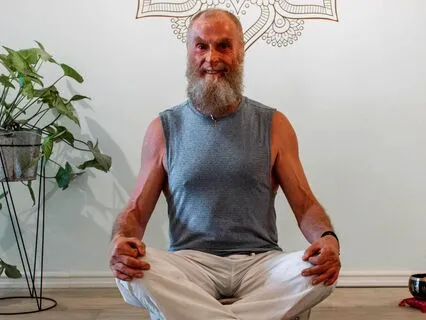
Hello and welcome to your yoga nidra practice for today.
Today the theme in our yoga nidra practice is going to be ahimsa.
The first of the yamas in Patanjali's eight limbs of yoga.
And fundamentally this means no harm.
So we are instructed not to harm ourselves and not to harm others.
But it also requires us to foster compassion,
Inner kindness and gentleness.
So throughout the practice today we want to focus on that and our ability to do that.
So find yourselves a comfortable position in shavasana either on a bed or on a mat.
Perhaps a bolster underneath the knees or maybe an eye pillow.
Making sure you're warm if it's a cold climate you're in.
And settling down for your yoga nidra practice.
Firstly I'd like you to examine your mind and the way you are right now.
Is there anything in your life that causes you distress and harm?
Is there anything that you say to people that might cause them distress and harm?
Is there some way that you can change that?
So as you know the beginning of a yoga nidra practice is the sankalpa.
And so this is about ahimsa.
So sankalpa could be something,
I'm gentle and kind towards myself.
I treat myself with tenderness.
I help others and make their lives more lovely.
Something along those lines.
Or as I say,
If you're working with a sankalpa and you want to stay with that,
That's fine.
But either way bring your sankalpa to mind.
Repeat three times and then simply let go.
Focus on the breath.
Just allowing yourselves to settle in to this moment.
Feel a deep sense of compassion for yourself.
Feel a deep sense of compassion for your family.
For the ones that you love.
And for humanity in general.
Feel compassionate towards the environment.
Towards the animals that inhabit the environment.
And settle down into that self-love and compassion.
Feel the body lying on the floor.
Feel all the contact points of the body on the floor.
The heels.
The back of the knees.
The buttocks.
The spine.
The shoulder blades.
The back of the hands.
The palm of the hands.
The arms.
The legs.
The torso.
The face.
The whole of the body.
Be aware of your body lying in yoga nidra.
Invoke a sense of kindness towards your physical form.
Recognize the work that it does for you.
And be kind and compassionate towards them.
A feeling of kindness.
A feeling of kindness.
Feel the breath now.
Feel the breath moving in and out of the body.
Feel the natural rhythm of the breath.
There is no force here.
No control.
Only gentle awareness.
Gentle awareness of the breath.
Allow each breath to be a gesture of kindness.
And each exhale a softening of internal tension.
Let the breath become your teacher.
The teacher of ahimsa.
Effortless,
Nourishing and unforced.
Feel the breath.
Feel the breath.
Allow yourself to get deeper now.
Deeper with the breath.
As you rest here,
Notice any emotions that arise.
Can you welcome even the difficult ones?
Welcome them.
Ahimsa means welcoming them.
Not turning away and not fighting.
Being gentle.
Imagine a place that was difficult.
A confrontation.
A confrontation.
Perhaps a feeling to be right.
In an argument.
And now a feeling of compassion.
Of understanding.
Of alignment.
Imagine the body feeling very cold.
Very cold.
And sit with that.
Sit with that understanding.
And now experience warmth.
Beautiful,
Kind,
Radiating warmth throughout the whole body.
Take your physical eyes and gently gaze at the third eye.
And in that space,
Visualize a place where everything is peaceful,
Soft and safe.
Here nothing is being demanded of you.
You are at peace.
Rest in that.
Imagine sitting there.
There's a lily pond.
The swans are swimming.
Notice how gentle they are with each other.
The sky is blue.
The clouds are white.
And you know you're not causing anyone,
Including yourself,
Any harm.
Wish peace for all men and women.
Reside in a place of peace.
Total peace.
Just be there.
In that space,
Reintroduce your sankapa.
Repeat three times and simply let go.
Just let go.
Allow this peaceful feeling to stay with you throughout the day.
Or the evening.
And tomorrow too.
Gently start to come back.
Moving the fingers,
The toes.
Taking some deeper breaths into the body.
And stirring yourself now.
Coming back now.
5,
4,
3,
2,
And 1.
Back here in this space.
The practice of yoga nidra is finished.
Sit tall.
Bring your hands into ajnali mudra.
Take a deep breath in.
May we have love in our hearts.
May we have truth in the speech.
May we have gratitude in the mind.
Namaste.