Hi,
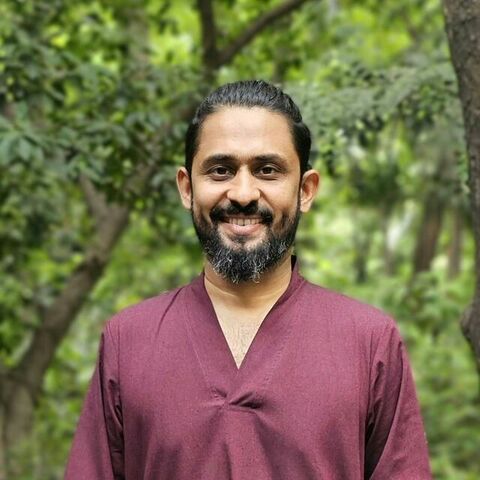
I'm Jerry.
I am a meditation and mindfulness teacher based in Fort Kochi,
India.
And I run Nish Rehasa,
A holistic wellness studio where I share meditation,
Mindfulness and sound-based practices.
Thank you for being here.
What is meditation actually doing to the brain?
Have you ever wondered?
From the outside.
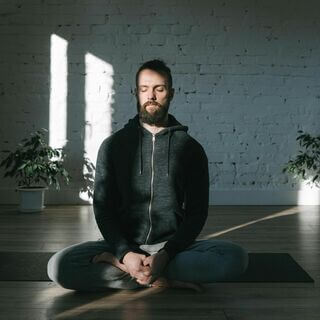
Meditation doesn't look particularly exciting.
You sit down,
You close your eyes and then your mind starts thinking about work or what you are going to have for dinner.
Sometimes you even start wondering whether you are meditating correctly.
So,
What's actually happening here?
Quite a lot actually.
But before we get into the neuroscience,
There is something interesting that happens when you first start meditating.
Your mind may actually seem busier.
And this can be confusing.
You might think,
I have been meditating for 5 minutes and my mind has never been this active.
But meditation didn't make your mind busier.
You simply became aware of how busy it already was.
Think about sitting in a room with a refrigerator running in the background.
When you are busy talking to someone,
You probably do not notice the sound.
But if the room suddenly becomes quiet,
You hear the hum.
The refrigerator didn't suddenly switch on.
You simply noticed it.
Meditation can be a little like that.
When we stop for a few minutes and become still,
We start noticing the activity that was already happening in the background.
Thoughts,
Memories,
Plans,
Images,
Emotions.
Meditation doesn't necessarily create all of this.
It gives us a chance to see it.
And that act of noticing is important.
Because every time you realize that your attention has wandered and bring it back to the breath,
The body or whatever you are using as an object of attention.
You are practicing something very specific.
You are practicing attention.
Your practicing awareness.
And your brain is remarkably adaptable.
One of the ideas researchers are interested in is neuroplasticity.
The brain's ability to change in response to experience and repeated practice.
Think about learning to play an instrument.
The first time you pick one up.
You have to consciously think about almost everything.
Where do my fingers go?
What's the next note?
How do I coordinate this movement?
With practice,
Some of that becomes easier and more automatic.
Meditation is obviously a very different kind of practice,
But the underlying idea is useful.
We are repeatedly practicing a particular mental skill.
We notice,
We return.
We notice,
We return.
And over time,
We may become better at recognizing when attention has wandered.
That can be surprisingly useful outside meditation.
You might catch yourself halfway through a worry spiral.
You might notice that you are no longer listening during a conversation.
The practice you do sitting quietly begins to show up in ordinary moments.
Another part of the brain that often comes up in conversations about meditation is something called as the Default Mode Network or DMN.
The name makes it sound more complicated than it really is.
The BMN.
Is a collection of brain regions that tend to become more active when our minds aren't focused on a particular task.
It is involved in things like remembering the past,
Imagining the future,
Thinking about ourselves and letting the mind wander.
And mind wandering isn't necessarily a bad thing.
We need it.
Some of our best ideas may come when we are not deliberately trying to solve a problem.
We need the ability to reflect on the past.
We need to imagine the future.
We need to think about ourselves and our relationships.
The problem isn't having a mind that wanders.
The problem is getting stuck there.
Especially when the mind keeps returning to the same worry,
The same regret,
The same conversation,
The same imagined future.
Meditation gives us an opportunity to notice that happening.
You may be following the breath and then suddenly realize you have been thinking about something that happened three days ago.
You notice and you come back.
Research has found that meditation can be associated with changes in activity and connectivity involving the default mode network and other brain networks involved in attention and cognitive control.
But I think the lived experience is more interesting than the brain scan because you can actually experience the process yourself.
You get lost in thought,
You notice,
You come back.
And that moment of noticing is something you can carry into the rest of your life.
There is also another reason meditation can feel calming.
When we sit quietly and pay attention to the breath,
We are not only working with the mind.
We are also giving the body a chance to slow down.
Our breathing may become more natural.
Our muscles may soften.
Or heart rate may settle.
And the nervous system is constantly receiving information from the body about what is happening.
When the body begins to settle,
That can influence how the brain interprets our experience as well.
This is one reason meditation can feel very different from simply telling yourself,
Relax.
You're not just thinking about relaxation.
You are giving yourself an experience of slowing down.
And then there is emotional regulation.
This is another area where meditation research gets interesting.
When you are meditating,
You don't necessarily prevent difficult thoughts or emotions from appearing.
Instead,
You practice noticing them without immediately reacting.
Anger appears and you notice it.
Anxiety appears and you notice it.
A difficult memory appears and you notice it.
And then you return to the breath.
That may sound simple.
But over time,
This repeated experience can change our relationship with difficult emotions.
Instead of I am angry.
There can be a little more awareness around.
Anger is here.
Instead of I am anxious and something is definitely wrong,
There can be anxieties here.
Let me notice what's happening.
That small shift in language reflects a bigger shift in experience.
The emotion is still there.
But perhaps we are not quite as entangled in it.
And this is where I think neuroscience and meditation become particularly interesting.
For thousands of years,
Contemplative traditions have been asking questions about the nature of attention,
Thought,
Emotion,
And awareness.
Modern neuroscience approaches many of these questions from a completely different direction.
One looks through the lens of practice and direct experience.
The other looks through brain imaging,
Behavioral studies,
Physiology and experiments.
The language is very different,
But there are some fascinating points of overlap.
And we are still learning.
Meditation research has grown enormously,
But there is also a lot we don't know.
We should be careful about turning every interesting brain finding into a promise that meditation will transform your brain in some dramatic way.
It doesn't quite work like that.
Meditation isn't a magic switch.
And your brain isn't going to become permanently calm because you meditated for 10 minutes this morning.
But something much more ordinary and perhaps more meaningful can happen.
You practice paying attention.
You practice noticing.
You practice returning.
And through that repetition,
You may begin to relate differently to your own mind.
And perhaps that's the part that interests me most.
But ultimately,
I don't think the most important question is what does my brain look like when I am meditating.
The more interesting question is,
What is changing in the way I live?
Am I noticing my thoughts sooner?
Can I pause when I'm angry?
Can I listen without planning my response?
Can I experience my ordinary moment without immediately needing to distract myself?
Those changes may never show up in a dramatic way or a brain scan.
But you can feel them in your life.
And perhaps that's the most interesting thing about meditation.
You sit quietly.
It looks like we are doing almost nothing.
But beneath that stillness,
We are practicing a very simple skill.
We are noticing.
We are learning to return.
And slowly perhaps we are learning that we don't have to be carried away by everything that happens in the mind.
The brain is changing.
The body is responding.
But most importantly,
We are learning to experience ourselves a little differently.
And that is something you don't need a brain scan to notice.
Thank you for listening.