Hi,
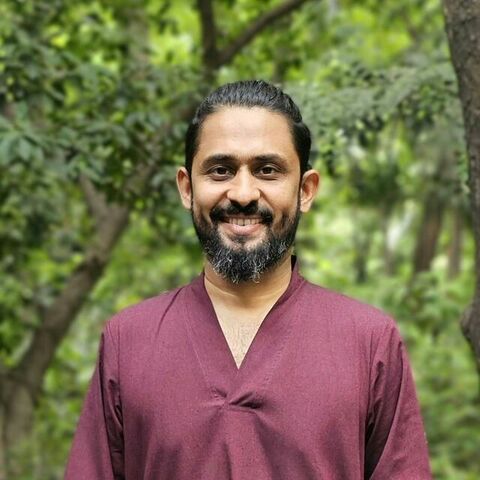
I'm Jerry.
I'm a meditation and mindfulness teacher based in Fort Kochi,
India,
And I run Nishrayasa,
A holistic wellness studio where I share meditation,
Mindfulness,
And sound-based practices.
Thank you for being here.
We talk about freedom all the time.
Financial freedom.
Freedom of speech,
Freedom of expression.
The freedom to choose where we live,
What work we do,
What we believe,
And how we want to live.
These freedoms matter.
But there's a kind of freedom we rarely talk about.
The freedom to be at ease within our own minds.
I think about this quite often when I sit with people in meditation.
Because many of us have a lot of freedom in our outer lives,
But surprisingly little freedom in our inner ones.
We may be free to go wherever we want,
But unable to stop worrying about what might happen when we get there.
We may be free to speak,
But spend hours replaying something someone said to us.
We may have plenty of choices in life.
But feel completely controlled by anxiety,
Anger,
Comparison,
Fear,
Or our own thoughts.
We don't usually describe this as a loss of freedom.
In fact,
We become so used to it,
We simply call it life.
And we've become very good at normalizing it.
We call constant stress a busy lifestyle.
Overthinking is being responsible.
We accept poor sleep because there's too much to do.
And we also carry yesterday's frustration into today's conversations and tomorrow's worries into today's moments.
And because so many people around us are doing the same thing,
We don't always stop to question it.
But something being common,
Doesn't necessarily make it healthy.
So what would mental freedom actually mean?
I don't think it means having a mind that never becomes anxious or angry or afraid.
After years of meditation,
I certainly don't believe such a mind exists.
Thoughts will come,
Emotions will come,
Difficult things will happen.
Mental freedom is something much simpler.
It is being able to experience what's happening within you without automatically being controlled by it.
There's a difference between having a thought and being carried away by that thought.
You might have the thought,
Or something is going to go wrong.
But having that thought doesn't make it true.
You might feel anger.
But you don't have to let that anger decide what you say next.
You might also feel anxious sometimes,
But anxiety doesn't have to make every decision for you.
You might feel sadness without deciding that you are a sad person.
The feeling is there,
The thought is there,
But you don't necessarily have to follow it.
And I think this is one of the things meditation slowly teaches us.
When you sit down to meditate.
You don't actually have much control over what appears in your mind.
A thought arises.
Then another one.
And then some memory comes up and maybe a sound catches your attention.
And you realize you've been thinking for the last two minutes.
And then you come back to the breath.
That's it.
You don't need to fight the thought.
You don't need to get annoyed with yourself.
You simply notice and return again and again.
And in that simple process,
We begin to see that a thought can be present without us following it.
An emotion can be present without us acting on it.
Something can be happening inside us without it determining what happens next.
With practice,
That starts slowly showing up in ordinary life as well.
You start noticing irritation coming up during a conversation.
And instead of reacting,
You take a pause.
You watch yourself worrying about something that hasn't happened.
You notice that you've been creating an entire story in your head.
Or perhaps you want to send an angry message.
And for once you wait.
Maybe only for a few seconds,
But those few seconds can matter.
Because inside that small pause is choice.
And I think that one of the most practical things mindfulness can offer us is choice.
The freedom from having to obey everything the mind says.
We don't need to win an argument with our thoughts or get rid of every uncomfortable emotion.
We simply need to become a little more aware of what's happening before we act.
And this kind of freedom doesn't come from outside of us.
Nobody can give it to us.
Not an employer or a partner or a family and certainly not money.
It begins with noticing.
Noticing where our attention goes.
Which thoughts repeatedly pull us into distress.
What tends to trigger our strongest reactions.
Noticing the stories we keep telling ourselves.
And noticing how often we are physically somewhere while our minds are somewhere completely different.
This isn't about constantly analyzing ourselves.
It's much simpler than that.
It is becoming familiar with our own experience.
When we start paying attention,
We sometimes discover that things we thought were simply who I am,
Are actually patterns that we have developed.
The way we react or worry or avoid or the way we hold on to resentment.
The way we immediately assume the worst.
These patterns may be deeply familiar,
But familiar doesn't mean permanent.
And once we can see a pattern,
We have a chance to relate to it differently.
Perhaps that's why the purpose of meditation can change as we practice.
In the beginning,
We may meditate because we want to feel better — less stress,
Better sleep,
More calm,
A quieter mind.
But eventually another question can arise.
Can I learn to be with my mind differently?
I think that's a much deeper question.
Because it doesn't require every experience to be pleasant.
You can feel fear and still have freedom.
Or feel anger and still have freedom.
You can have a difficult day and still have freedom.
Freedom doesn't mean that uncomfortable things stop happening.
It means that discomfort doesn't automatically take away your ability to choose how you meet it.
We spend a lot of time thinking about freedom in the world around us,
And rightly so.
But perhaps there is another question worth asking.
How free Am I within my own mind?
How much of my day is guided by conscious choice?
And how much is driven by habit,
Fear,
Distraction and automatic reaction.
How often am I actually experiencing the life that is right in front of me rather than living inside thoughts about what already happened or what might happen next.
The answer isn't to fight the mind.
The mind is not an enemy we need to defeat.
It is something we can learn to understand.
And that is where this kind of freedom begins,
When we realize we don't have to follow everything the mind says.
We can pause.
Notice.
Feel something without immediately reacting.
Have a thought without automatically believing it.
Experience an emotion without allowing it to define us.
And we can return again and again to the life that is actually happening now.
And we spend enough time asking how much freedom we have in the world around us.
Perhaps it's worth asking how much freedom do I have within myself.
And unlike many of the freedoms we spend our lives protecting,
This one begins without any noise.
It begins with noticing.
Thank you for listening.