Thank you for joining me on this rainy day for this beginner meditation.
This is a summary of many different meditations and a very grounding practice,
Especially if we're just beginning.
Enjoy!
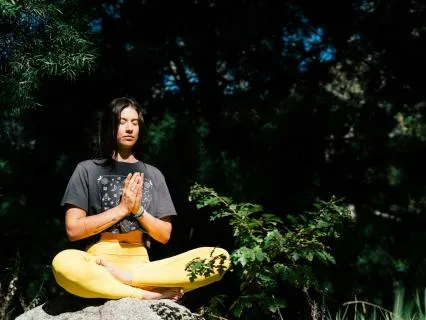
Finding a comfortable seat,
Either in a chair or cross-legged on the floor.
If you're sitting in a chair,
Just make sure your feet are flat on the floor,
Hands resting comfortably in your lap,
Either in a mudra or just resting.
And if you're cross-legged,
Just make sure that your hips are above your knees,
So propped up on a cushion,
So our low back can soften and relax.
Maybe our pelvis tilts forward so gently,
So we can have soft belly.
So,
Resting those hands,
Straight supported spine,
Relaxing your body.
If during the meditation you need to shift your position,
Feel free to do so,
Just mindfully.
And if you feel like you need to open your eyes,
Feel free to do so as well,
But close them again and return to the meditation.
Remember to let go of expectations and to be kind to yourself.
Let's first take some long,
Slow,
Deep breaths.
Inhale slowly through your nostrils,
Filling your abdominal area first,
Then your chest cavity,
And then the clavicle area.
Visualize expanding your body in 360 degrees as you inhale.
And your exhale is slowly through the nostrils,
Beginning with the clavicle area,
Then the chest cavity,
And then the abdominals.
Inhaling,
Filling the body,
Belly,
Ribcage,
Clavicle.
Exhale,
Letting the clavicle drop,
Ribcage contract,
And the abdominals contract towards your spine to clear your lungs completely.
Inhale,
Filling the belly,
And exhale.
We never want to force an inhale or an exhale,
And ideally,
Our inhale and exhale should match in length.
And you can let that go and let your breath be natural now.
Throughout this practice,
You'll breathe naturally,
Ideally through your nose.
With your eyes closed,
You might be coming into a deep breath.
As you become aware of the sounds in the environment,
Let's just welcome the sounds we hear.
There's no need to identify the source,
Just welcome the sounds near and far.
Sound is never a barrier to meditation.
Also,
With your eyes closed now,
You might notice that you're more aware of the sensations in your body.
I like to begin every meditation with a body relaxation practice.
So feel your body from the inside out,
Just noticing every sensation as I call attention to the areas of the body.
And as you focus on each body part,
Just do your best to relax any tension you find.
First,
Relax your scalp and your forehead.
Relax your eyes,
Your entire face.
Relax your ears.
Tune into the sensations and let go of any need for facial expressions.
Relax your mouth,
Your tongue.
Relax your chin and your jaw.
Tuck your chin in slightly,
Allowing the back of your neck to lengthen just a little.
Let your shoulders move down and away from your ears and let your arms hang comfortably.
Relaxing your hands and fingers.
Relax your hips and your pelvis.
Let them feel supported by gravity as you notice how you're being held by the chair or the cushion.
Now feel your spine reaching from the tailbone to the base of your skull,
Like a tree reaching for the sky.
Relax your upper back.
Relax your chest and your diaphragm.
Relax your belly.
Relax your right leg from hip to toes.
Relax your left leg from hip to toes.
Feel your whole body relaxed.
Feel the stillness of your body.
And now notice the movement of your body.
Notice the heartbeat,
Any pulsing,
Tingling or vibrations.
Just letting the body resettle.
Notice how your body moves with each inhale and exhale as it flows naturally throughout the body.
Bring your attention to the rise and fall of your chest.
Rest your attention on your breastbone.
Imagine looking inward toward your heart.
Let your attention rest there as you continue to naturally breathe.
If you like,
You can imagine your breath is moving into and out of your heart center,
As if it were a doorway.
To your heart,
Out of the center of your chest.
If you like,
You can place your hand over your heart,
Just to keep your attention focused here.
And rest your hands in your lap.
And we'll now practice self-inquiry,
A questioning meditation.
We're not looking for answers.
We'll just ask ourselves a question a few times and then return to the stillness.
The first question is,
Who am I?
Silently ask yourself a few times and then return to the stillness.
Just be comfortable with the silence and the unanswered question.
You can let that question go and now ask yourself,
What is my heart's desire?
You can let that question go and now ask yourself,
How can I best love myself?
Just ask a few times and then return to the stillness.
Let go of any questions and any answers you may have felt or heard and return to the silence for a moment.
Turn your attention now to the breath.
Notice the cool air as you inhale,
And the warmer air as you exhale.
Just remember to allow your breath to be natural.
There's nothing to figure out,
Nothing to control,
And nothing to change.
Letting your attention rest on the natural pause between the exhale and the inhale.
Allow your breath to be natural.
It might slow down,
Speed up,
It may get deeper or shallower,
Or even stop for a moment.
Just feel it and let it be as it is.
If your attention drifts away from your breath,
Simply refocus it.
It doesn't matter how many times you do it,
It doesn't matter how many times you do it.
It doesn't matter how many times you have to refocus.
This is a practice.
Let's introduce a silent mantra.
As you inhale,
Silently think the word hum.
And as you exhale,
Think of the word saw.
As you inhale,
You can gently draw your breath along the back of your throat and listen to the sound of hum.
As you exhale,
Listen for the sound of saw.
As your breath is amplified in the throat.
Just let go and allow your mind to become absorbed in the sound of the mantra in your internal chanting.
Hum saw There's nothing to figure out and no particular feeling that you should feel.
Whenever you notice your attention has drifted,
Maybe to a sound in the environment or a sensation in the body,
Or a thought,
Just gently refocus back to the mantra.
It doesn't matter how many times you have to refocus and remember to be kind to yourself.
Just keep returning your attention to the mantra.
This is training.
We'll meditate for a little while longer and I'll keep track of the time.
Keeping your eyes closed,
Stop repeating the mantra and simply sit in the stillness.
You can give yourself some deeper breaths.
Maybe wiggle your fingers and toes or stretch a little.
It's always important to come out of meditation slowly.
Take your time,
There's no rush.
When you're ready you can slowly open your eyes.
First with a downward gaze and when you feel ready you can open them completely.
Thank you for joining me in this simple easy everyday meditation.
I hope you continue your practice and thank you for joining me.