Hi there.
Thank you for taking time out of your day to listen.
My name is Candice Sunny and I'm a coach and well-being tutor.
Today I want to talk about something that sounds simple,
Yet so many of us struggle with learning to relax.
It's not collapsing on the sofa at the end of a long day.
It's not scrolling on our phones,
Not zoning out,
But genuinely relaxing.
The kind of relaxation that lets your shoulders drop,
Your breath deepen and your mind soften enough to feel human again.
Because in a world that constantly asks us to do more,
Be more,
Respond faster,
Stay switched on longer,
Relaxation isn't a luxury.
It's a skill and like any skill it can be learnt,
Practiced and strengthened.
Let's start with the uncomfortable truth.
Many of us don't know how to relax because our bodies have forgotten what safe feels like.
We live in a low-grade hum of tension.
Deadlines,
Responsibilities,
Notifications,
Worries,
The mental load of caring for others.
Our nervous systems get used to being constantly on.
So when we finally stop to relax,
It can feel strange.
We may even feel guilty.
We think I should be doing something or our mind starts replaying the to-do list.
Relaxation isn't the absence of activity,
It's the presence of ease and ease takes practice.
One of the most powerful things we can learn is that the body often relaxes before our mind does.
If you've ever tried to think yourself calm,
You'll know it doesn't work very well.
But if you change your breathing or your posture or your pace,
Your mind follows.
Let's look at a simple example.
Try breathing out slightly longer than you breathe in.
Just give that a go right now.
It signals to your nervous system we're safe.
You can stand down or try unclenching your jaw or perhaps dropping your shoulder,
Loosening your stomach.
These tiny physical shifts create space for mental calm to arrive.
Another important lesson is that relaxation looks different for everyone.
For some people,
Stillness works.
For others,
They need movement.
Some people relax by walking.
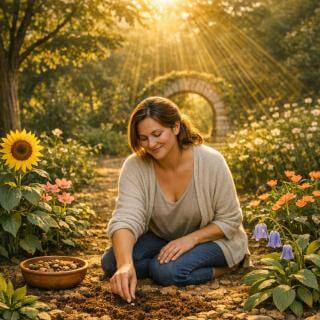
Others find relaxation in gardening or maybe doodling or perhaps listening to music.
The key is noticing what helps you shift from tension to ease.
Just take a few moments to ask yourself now,
What activities make my breath slow down?
What helps my mind feel spacious?
What leaves me feeling more like myself afterwards?
Relaxation is personal and it's allowed to be simple.
We often imagine relaxation as something we need a whole evening for or a spa day,
Perhaps a long bath or a weekend away.
But the most powerful relaxation skill is the micro-pause.
A micro-pause is a 10-second reset.
It's noticing your breath or softening your shoulders.
It's placing your feet on the ground and noticing the feeling of support.
It's giving yourself a moment of presence in the middle of the chaos.
These tiny resets,
Repeated throughout our day,
Teach our nervous systems that it doesn't have to stay on high alert.
They build a foundation of calm that you can return to again and again.
And finally,
Learning to relax means giving yourself permission.
Permission to rest without earning it.
Permission to slow down without apologising.
Permission to take up space as a human being,
Not a machine.
Relaxation isn't laziness,
It's maintenance.
It's how we restore our creativity,
Our patience,
Our clarity or our capacity to care for ourselves and for others.
So today I invite you to practice the art of relaxing.
Not perfectly,
Not dramatically,
Just gently.
Notice your breath.
Notice your body.
Notice the moments where you can soften instead of brace.
Relaxation is not an escape from life,
It's a way of returning to it with more presence,
More energy and more compassion.
Thank you for listening.
Take some time now to listen to one of the guided relaxations.
You might consider perhaps a grounding meditation or visualising your place of relaxation.
I look forward to spending time with you again in the future.