Greetings.
Some evenings invite quiet work,
The kind of work that doesn't need to be finished,
Only tended.
There's a hush that falls over the world just before twilight,
When the day exhales and shadows soften into a gentler hue.
In those hours,
Certain souls find comfort in small rituals,
The folding of a note,
The lighting of a lamp,
The release of something once held too tightly.
This is a story about one such soul,
A man who learned,
Quite by accident,
That there is peace and comfort in letting go.
His medium wasn't paint or clay,
But paper.
His gallery wasn't walls,
But water.
And his greatest masterpiece was made not from what he kept,
But from what he finally allowed to drift away.
If you've ever carried something too long,
A word unspoken,
A letter unsent,
A moment you couldn't rewrite,
Then perhaps you'll understand why he chose the river.
Allow your surroundings to grow still,
The quiet expanding around you like twilight mist.
And now we begin the Tale of the Paper Boats.
Once upon a time,
Long ago,
There was a village nestled in a gentle hollow alongside the winding edge of a river.
The village had quaint cottages,
Clustered like old friends,
Leaning in for warmth.
Narrow lanes wove between mossy stone walls and tangled gardens,
Where the scent of bread and early morning fires drifted through open shutters.
Life here moved at the pace of laughter exchanged across market stalls,
The ringing of distant church bells,
Or the shift of sunlight as it played over cobblestones worn smooth by generations of footsteps.
Ordinary in its geography,
The village held a quiet,
Enduring charm,
Found in the humble acts of tending,
Mending,
And greeting each day with a familiarity reserved for those who belonged to the river and to each other.
At the far edge of the village,
Just where the slow-moving river began to straighten its path,
Stood a cottage,
With windows always half-open,
As if to let the world come and go at its own pace.
The man who lived there was known to the villagers simply as the Paper Boatmaker.
His given name had once been Henry,
Though few remembered to use it anymore.
Titles like that—Cobbler,
Beekeeper,
Baker,
Boatmaker—tended to replace the rest of one's identity in small towns such as this,
Especially when one lived quietly and alone.
Henry's days unfolded with a deliberate rhythm—morning tea,
A walk to the market,
A stop to watch the swans glide through their reflections.
Then,
As the sun began its slow descent and the village sounds softened into murmurs,
He would return home to his work table by the window—the one that faced the river.
Stacks of paper filled the table—yellowed letters,
Pages from unfinished stories,
Even the curled corners of paintings that hadn't made it to their frames.
He never bought new paper—he preferred the kind that already had something to say.
With practiced hands,
Henry would smooth each page flat and begin folding.
There was a patient grace to the process—one fold for memory,
Another for release.
He never rushed it—every crease seemed to carry a small whisper of the past being set right.
When a boat was complete,
He would hold it up to the fading light,
Inspect its lines,
And smile in that quiet way people do when they know they've made something just fragile enough to matter.
Then,
Stepping out into the cool air,
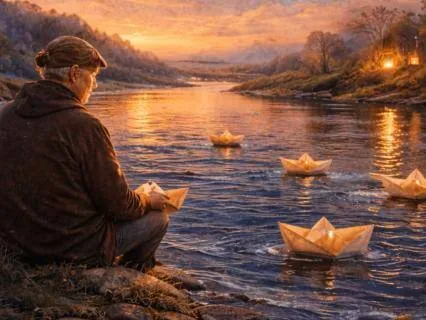
He'd walk down to the river's edge.
The ritual always ended the same.
Henry whispered something—sometimes a word,
Sometimes a whole thought—into the boat before setting it afloat.
Then he'd watch it drift,
Twirling once or twice as the current caught its corners.
Some boats sank quickly.
Some traveled farther than he could see—he didn't prefer one outcome over the other.
The first boats he made came from letters he'd written long ago and never sent.
Some were apologies.
Others were small thank-you notes that had lost their moment.
There were even a few love notes,
Never quite brave enough to be delivered.
He had once been married many years ago,
Though the house left little trace of that life now.
A portrait on the mantle.
A garden she'd loved that had grown wild again.
They'd parted with the soft ache of people who meant well but grew in different directions.
She'd gone inland to care for her sister.
Henry had stayed with the river,
Needing its company more than he could admit.
When he began folding the first letter—one written to her—his hands trembled.
By the time he released it,
He found his breathing had changed.
There was a kind of spaciousness in his chest,
As though the act of folding had loosened something old and heavy.
He paused,
The letter held between his palms,
And remembered the words he had written but never spoken.
The gentle apology.
The gratitude.
The hope that she had found peace wherever she had gone.
Each crease became an act of remembrance.
Each fold a way of acknowledging all that had been left unsaid.
The paper felt fragile,
Almost translucent,
Carrying not just ink but the weight of years.
He pressed his thumb along the edge,
Smoothing the final corner,
And for a moment he could hear her laughter echo from the garden long ago,
Soft,
Bright,
And fleeting.
Henry stepped outside,
The dusk settling around him like a gentle blanket.
The river caught the last light,
Shimmering with promise.
He knelt by the water's edge,
Lowering the boat onto the surface with the careful reverence reserved for farewells.
The current accepted his offering,
Tugging the boat from his fingertips and setting it adrift.
As he watched it spin and glide,
He whispered her name into the quiet air,
Not expecting an answer but grateful for the chance to let go.
The heaviness in his chest softened to a quiet ache,
Replaced by a sense of possibility as the boat drifted out of sight,
And he wondered,
For the first time in a long while,
Where the river might carry it and him.
It wasn't long before someone noticed.
A boy who liked to sit near the reeds,
Playing a small handmade flute,
Had seen Henry setting his boats afloat.
One evening,
The boy approached as Henry was at the river's edge,
Launching the second of two paper boats on their journeys.
He stood beside the paper boat maker and asked,
Do they go somewhere?
As he squinted toward the horizon,
Henry replied,
They go everywhere where the current decides.
Do they carry messages?
Sometimes,
Henry smiled,
But not always for someone else.
The boy nodded in the serious way of children who sense truth without needing to understand it fully.
The next night,
He appeared again,
This time with his own creation,
A small,
Uneven boat folded from a page torn from a school notebook.
When he set it afloat,
It tipped and half sank,
And Henry chuckled,
That one's learning,
He said.
The river likes to teach patience.
From then on,
The boy returned often,
His flute-weaving soft tunes as Henry folded boats alongside him.
Some evenings they spoke,
Others they sat together in friendly silence,
Each finding something meaningful in the motion of current and wind.
The following spring,
The river swelled beyond its banks.
The villagers were concerned,
But Henry watched with the calm of someone who understood the rhythm of things.
That return always follows release.
Still,
When the waters reached his doorstep,
He grew quiet.
His work table had to be moved to higher ground,
And for several weeks,
The river was too wild for his boats.
He used the time to sort his papers.
In the stack,
He found something he'd forgotten,
A folded sketch of his wife's face,
Drawn in the early years of their marriage.
The paper had worn soft from handling.
He traced her likeness with a fingertip,
Uncertain whether to keep it or send it away.
When the waters finally receded,
Henry spent a long while beside his work table,
Tracing the lines of his wife's face on the delicate,
Worn paper.
The memory of her laughter,
The gentle way she'd once sat beside him on quiet evenings,
Seemed to rise from the sketch itself,
Vivid and bittersweet.
He found himself recalling the warmth of her hand in his,
The way she'd encouraged him to send dreams downriver,
Even before the habit had become a ritual.
The boat he folded was smaller than most,
Its edges soft and imperfect,
As if it already held the tenderness of years within its creases.
That morning,
The river ran calm beneath a sky washed with early light.
Henry stood at the water's edge,
Holding the fragile boat in his palms,
As if cradling a memory.
He whispered words only the river would hear,
A quiet farewell,
Gratitude for every shared dawn,
Every lingering echo of love.
Setting the boat afloat was not just an act of letting go.
It was the closing of a circle,
Honoring the time they'd shared and the space now left behind.
The current took the little vessel swiftly,
Spinning it once before carrying it beyond sight.
Henry watched until it disappeared around the bend,
Feeling a sting in the letting go of it,
Sharp and sudden as the chill of river air.
Yet,
Beneath that ache,
A warmth began to bloom,
A gentle release,
The kind that comes when love is finally freed from needing to stay.
No longer bound by longing,
But carried onward by memory and water.
As the sun climbed higher,
Henry lingered at the shore,
Knowing that some goodbyes were not endings,
But part of the river's endless carrying.
As summer arrived,
Henry's quiet ritual drew a small circle of regulars.
A widow from the next village over,
Who brought letters her late husband had written.
A traveling poet who left behind scraps of verse.
Even the baker's apprentice,
Who shyly asked if she might write wishes.
Instead of farewells.
Henry welcomed them all.
The river,
He said,
Could hold everything.
Joy,
Grief,
Gratitude,
Longing.
Its only request was that you let the water do the carrying.
Some evenings,
As the little fleet of boats floated away together,
They looked like lanterns drifting on twilight's breath.
Each vessel wobbled and turned,
Some colliding,
Some continuing alone,
Yet all part of the same quiet procession downstream.
The boy with the flute began to play as they watched,
Soft,
Steady notes that mingled with the hush of water.
I think they're happy,
He once said,
As if speaking to the boats themselves.
Henry smiled.
I think they're free.
By autumn,
The air grew thin and clear.
The leaves along the river turned the color of faded gold,
Not unlike the paper Henry used most often.
One morning,
As he walked the bank,
He noticed a bit of soggy paper caught in the reeds.
It was one of his boats,
Returned after what must have been many miles.
The writing was blurred,
But he recognized his own hand.
This was the first time a paper boat had returned to him.
He could have taken it as a sign,
Perhaps that all stories circle back.
Or that not all goodbyes are permanent.
But instead,
He smiled,
Gently lifting the fragile thing from the water and refolded it anew.
This time,
He whispered a simple thank you and sent it off once more.
After that morning,
Henry found himself visiting the river not just for rituals,
But to listen.
There was a hush in the world that season,
The kind of silence that felt rich with unseen life,
As if the trees and water were keeping gentle secrets.
Occasionally,
A herring would startle from the reeds,
Its wings beating slow shadows over the water,
Reminding him that even what departs often returns in another form.
With each passing week,
Henry's walks became moments of quiet gratitude.
He started noticing how the gold of the leaves seemed to linger longer on the surface of the river,
How the mist curled like breath above the current in the early hours.
He understood now that the letting go was not a single act,
But a rhythm,
A way of being in the world,
One small,
Steady release at a time.
Sometimes,
When the wind shifted,
He thought he heard laughter or music drifting from downstream,
Echoes of those who had gathered with him in seasons past.
He would pause,
Smile,
And remember that every story,
Once set afloat,
Found its own way,
Carried beyond his reach,
But never truly lost.
The year turned again.
Snow dusted the fields and glazed the riverbanks.
The boy with the flute had grown taller.
The widow had stopped coming,
Saying she no longer needed to.
The river had become quieter,
As though it,
Too,
Had entered a kind of reflection.
One evening,
Henry sat at his table with the last of his paper,
An old sheet of parchment he'd been saving.
He didn't know why he felt it would be his final boat,
Only that it should be.
He folded it slowly,
The lines practiced but reverent.
His whisper that night was almost too soft to hear.
Then he watched as the current caught it and carried it away,
Glowing faintly under the moonlight's silver touch.
He stayed there long after it vanished,
Until the chill found his hands,
And then,
For the first time in years,
He turned toward home with no paper waiting to be folded.
Inside,
The cottage seemed both emptier and fuller at once,
Quiet but content.
The End Some stories don't need endings.
They only need release.
The river,
If it could speak,
Might tell us that nothing we give to it is ever truly lost.
It all becomes part of a larger motion,
The endless ebb and return that shapes the world in silence.
Perhaps we,
Too,
Are small vessels,
Folded from memory,
Set adrift in the current of time.
What we think of as letting go is often just a different way of continuing on.
So if you ever find yourself by water and something in you feels ready,
A hope,
A sorrow,
A wish,
A story,
You might try Henry's ritual.
You don't even need to write it down.
Just share your thoughts at the river's edge and let the water have them.
Not everything needs to be kept to be loved.
Some things,
Perhaps the truest ones,
Are meant to travel.
Let the gentle currents of tonight's story carry you into sleep,
Just as Henry trusted the river with his final folded boat.
May you feel safe to release your thoughts and worries into the peaceful dark,
Knowing they will find their place in the greater flow of life.
You are held,
You are whole,
And nothing you let go is ever truly lost.
Remember,
You are a small vessel of memory and hope,
Drifting gently onward.
May your dreams be soft and your heart unburdened.
May you awaken with the morning light,
A little lighter and a little more at peace.
Good night.