Tonight's story is called The Star Keeper.
It takes place in a quiet mountain village,
Where nights are velvet and clear,
And the stars seem close enough to touch.
This is a story about wonder,
The kind that hides in ordinary moments,
And about remembering that the light we look for in the sky also lives quietly within us.
Nestled high among the slopes of the Northern Range lay a village so small that it never appeared on most maps.
It was the kind of place that looked as though it had grown directly from the earth.
Roofs made of slate,
Walls of stone,
Chimneys whispering soft plumes of smoke into the crisp mountain air.
The people who lived there measured time,
Not by clocks,
But by the slow rhythm of the mountains themselves.
Sunrise and snowfall,
The call of owls,
The shifting colors of dusk.
And above it all,
Every night without fail,
The stars stretched endlessly across the sky.
They were the village's truest companions,
Bright,
Constant,
And close enough to believe in.
Among the villagers was a woman named Nika.
She was quiet and kind,
Known for keeping a small observatory at the far edge of town.
A round,
Glass-domed building,
Perched on a ledge of rock overlooking the valley.
By day,
She worked in the village library,
Cataloging stories and histories.
By night,
She climbed the winding path to her observatory,
Where she sat for hours among notebooks,
Telescopes,
And the warm hum of quiet lamps.
People often called her the Star Keeper.
They said it affectionately,
Half in jest,
Half in truth.
Some swore she could predict where a star would fall,
Or when the northern lights would sweep across the sky.
Children whispered that she caught pieces of starlight in jars.
Nika never corrected them.
She simply smiled and said,
Maybe.
The truth was gentler.
She didn't know where to keep stars.
She kept their stories.
Every night,
As the village settled into sleep,
Nika would open the dome and watch the sky unfold.
She carried an old leather journal,
Filled with sketches and words.
Notes on constellations,
Yes,
But also,
A book.
Nika would read them on the moments she imagined those lights had witnessed.
A fisherman's wish,
A mother's prayer,
The silent wonder of someone looking up in the dark.
It was her way of honoring connection,
Of tracing invisible threads between hearts and heavens.
One late autumn evening,
When the air tested faintly of snow,
Nika climbed to the observatory as usual.
The night was clear,
But something felt different.
The sky pulsed with unusual brightness,
Like a breath being held.
She set her telescope toward the western horizon,
And there she saw it.
A single star,
Lower than the rest,
Flickering faintly.
She watched it for a long while.
It seemed to waver,
Its light growing softer,
Dimmer,
As though struggling to stay.
Don't go yet,
She whispered without thinking.
But by midnight,
It had vanished.
The next day,
The village buzzed with the first hints of winter.
Markets bustling,
Wood smoke curling through the air,
But Nika couldn't shake the feeling of that fading star.
She felt its absence like a missing note in a familiar song.
That night,
She returned to the observatory and scanned the same patch of sky.
Nothing.
Only the quiet brilliance of the other stars.
She sighed,
Resting her hands on the wooden ledge.
Where did you go?
As she spoke,
The faintest shimmer appeared on the floor.
A flicker like a reflection.
Nika knelt,
Heart quickening.
There,
Nestled in the dust near her chair,
Was something small and glowing.
Not hot,
Not cold,
Just softly radiant.
It pulsed gently,
As if breathing.
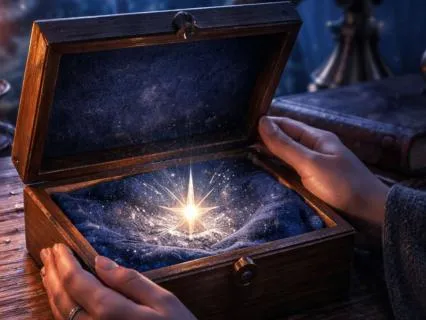
A fallen star.
It was no larger than a pebble,
Pale silver with a faint golden core.
When she touched it,
She felt warmth.
Not from heat,
But from recognition,
Like holding the hand of an old friend.
Oh,
She whispered,
So that's where you went.
She lifted it carefully and placed it on her desk.
The light dimmed and brightened,
Pulsed and stilled,
Almost as if it were trying to speak.
Nika stayed awake until dawn,
Watching it,
Listening.
She didn't know what to do,
Except what she always did.
She began to write.
She wrote about its fall,
About the stars that remained,
About the strange sadness she felt that this tiny piece of the sky had landed here alone.
And as she wrote,
Something inside her softened.
In the days that followed,
Nika kept the fallen star safe,
In a small glass bowl lined with soft fabric.
At night,
It glowed faintly beside her window,
Casting gentle patterns on the walls.
Visitors to the observatory noticed the light and asked where it came from.
Nika would smile and say only,
It's a little piece of the night that needed rest.
And perhaps that was true,
Because slowly,
Over the weeks,
The star's glow began to change.
It became steadier,
Stronger,
And as it did,
Nika noticed something else.
She herself began to change too.
Her thoughts,
Which had felt cluttered with questions and worry,
Grew quieter.
Her breath deepened.
She found herself lingering longer in the silence between moments,
Finding beauty through pine branches,
The sound of her own heartbeat.
One evening,
She heard as the first real snow blanketed the village,
She carried the little star outside.
The air was cold enough to sting her cheeks,
But the light in her hands felt alive.
She walked to the edge of the cliff,
Where the observatory stood,
And looked up at the vast,
Brilliant sky.
It was full of stars,
Countless,
Timeless,
Patient.
The fallen star pulsed once,
Faintly.
I think,
Nika whispered,
You're ready to go home.
For a moment,
She hesitated.
It had been her quiet companion,
Its light filling her lonely nights,
But she knew what it meant to hold on too long to something meant to move.
She opened her hands.
The star rose slowly,
Hovering before her,
As if in gratitude,
Then drifted upward,
Higher and higher,
As if it was once again among its kin.
Nika stood there,
Breath misting in the cold air,
Watching until she could no longer tell which light was hers.
Something in her chest ached,
Not from loss,
But from fullness,
And for the first time in a long time,
She laughed softly into the night.
Winter deepened,
And the village settled into its rhythm.
Fires glowed in hearths,
Footsteps crunched on frosted streets.
The air smelled of pine and bread,
And the air smelled of snow.
Nika returned to her observatory each evening,
But her journal entries began to change.
She still noted the constellations,
Still mapped the sky,
But she also wrote about the world below,
The kindnesses she noticed,
The laughter of neighbors,
The warmth of the air.
The glow of lanterns through windows,
The light she once looked for only in the heavens,
She now saw all around her.
Sometimes,
On especially clear nights,
She would glimpse at that same faint star near the western edge of the sky.
It would flicker once,
As if it was greeting,
And each time,
She'd smile,
Because she understood now,
The stars didn't need to be kept.
They only needed to be seen.
One late night in early spring,
As the snow began to melt from the peaks,
Nika sat outside the observatory instead of within it.
The air was soft,
Cool,
Alive with the scent of thawing earth.
Above her,
The sky unfolded endlessly,
Deeper than she could ever name,
Older than she could ever imagine.
She thought about how much of her life had been spent trying to hold on to moments,
To people,
To the light itself,
And how gently the world had taught her that everything shines more brightly when given the opportunity to shine and be free.
She closed her eyes and breathed in the mountain air.
Somewhere far above,
A star shimmered,
And though no words were spoken,
Nika felt the message settle within her heart.
You have been keeping the stars all along.
She smiled.
The mountains held their breath.
The sky seemed to lean closer,
Listening.
And in that stillness,
Nika felt a peace so deep,
It hummed through her bones.
The quiet understanding that wonder is never lost,
It only changes form.
The wind stirred,
Gentle and steady,
Carrying the scent of pine and night.
And as she drifted towards sleep,
Her last thought was not of the sky,
But of the village below.
All those small lights shining in windows,
Steady and kind,
Echoing the stars above.
The end.
The Star Keeper gently reminds us that true peace and wonder are found not in clinging tightly to what we love,
But in allowing things,
And ourselves,
The freedom to shine in their own way.
Nika's journey highlights the beauty of letting go,
And trusting that the light within us,
And around us,
Endures even as it changes.
In the quiet of the mountains,
And the warmth of the village below,
We are invited to recognize that our own inner light,
However small,
Is always enough.
The night sky is vast,
But its wonder begins close to home,
In every breath,
Every heartbeat,
Every small kindness that shines in the dark.
May your dreams be bright with that same starlight,
And may you wake to a softer morning.
Good night.